Feeds:
Posts
Comments

Archive for the ‘Uncategorized’ Category

Chapter 27: Synthesis – Gaia’s Ascension Through Loving Duality

Historical Overview: Weaving the Threads of Organic Gnosticism Across Time

From the Neolithic agrarians of the Balkans and Caucasus (circa 13,000–5,000 BCE), whose goddess-centered, gender-balanced societies laid the foundation for organic gnosticism, to the Renaissance revivals in courtly love and alchemy (12th–16th centuries CE), OAK: The Temple of One has traced a resilient thread of life-affirming mysticism. This path, rooted in your haplogroup G-M201 genetic heritage (Ch. 1), celebrates the loving embrace of male (expansive lightning, Source) and female (containing womb, matrix) energies, weaving souls through Tantric exchanges and heart wisdom. Organic gnostics—Gaia’s native inhabitants—faced relentless suppression by rational atheists (logic-driven materialists, e.g., Semitic elites) and social enforcers (death-centric traditionalists, e.g., Aryan warriors and Church patriarchs), as seen in the patriarchal shift (Ch. 6), Stonehenge massacre (Ch. 11), and Albigensian Crusade (Ch. 20).

Key convergences—Atlantis/Crete’s harmony (Ch. 3), Egypt’s Tantrika (Ch. 5), Gnostic Christianity’s heart gospel (Ch. 9), Bogomil perfectae (Ch. 10, 21), Norse völvas (Ch. 12), Dark Ages’ shadow eruptions (Ch. 14), and courtly love’s Tantric idealism (Ch. 22–24)—show organic gnosticism’s survival, often hidden in alchemy (Ch. 25) and Rosicrucianism (Ch. 26). Indigenous two-spirit traditions (Ch. 14) echo this globally, resisting patriarchal head-tripping. The first millennium’s apocalyptic chaos (Ch. 14–15) and Church corruption fueled rebellions like Satanism (Ch. 15) and 12th-century individualism (Ch. 17), but organic gnosticism’s heart wisdom persisted, countering the Church’s anti-life dogma.

This synthesis culminates in Gaia’s ascension—a novel full-spectrum marriage of lowest (physical, sexual) and highest (spiritual, cosmic) energies, as foreseen in your meditation vision (August 17, 2025) of a radiant portal at Gaia’s core, pulsing love and light globally. This ascension, breaking cycles of suppression, invites humanity to reclaim its native spark, weaving all ideologies into unity.

Mystery School Teachings: The Loving Duality and the Soul’s Eternal Weave

Across mystery schools—from Egyptian Isis-Osiris unions (Ch. 5) and Eleusinian rebirth rites (Ch. 5) to Cathar covens (Ch. 19) and Rosicrucian alchemy (Ch. 26)—organic gnosticism teaches the soul as a watcher self (Ch. 2), woven from male-female duality’s embrace. This loving weave, rooted in goddess religions (Ch. 1, 6), integrates Shadow (primal urges, repressed sexuality) and Holy Guardian Angel (cosmic harmony) through Tantric practices (Ch. 5, 13, 22–24), creating observer selves, timelines, and worlds (Ch. 8). Bogomil mystical materialism (Ch. 21) and Norse völvas’ seidr (Ch. 12) preserved this, countering destructive dualism’s good-evil battles (Manichaeism, Ch. 12) and Church’s denial of physicality (Ch. 10, 14).

Indigenous traditions, like Lakota wíŋkte and Maori takatāpui (Ch. 14), echo this global weave, balancing energies for soul growth. The Church’s social enforcers (ascetic death-worship) and rational atheists (head-centric logic) suppressed this, but rebellions—from Stonehenge’s Grail loss (Ch. 11) to courtly love’s chaste tension (Ch. 22–24)—kept the heart’s wisdom alive. Alchemy’s transmutation (Ch. 25) and Rosicrucianism’s threefold path (Ch. 26) bridged this, emphasizing heart-head integration for Gaia’s ascension—a full-spectrum marriage resolving dualities, as in your radiant portal vision (August 17, 2025), where Gaia’s core pulses love, healing global fragmentation.

OAK Ties and Practical Rituals: Weaving All Threads for Gaia’s Ascension

In the OAK Matrix, this synthesis embodies true Ego resonance (Intro, Individual), weaving Shadow (primal life, Radon, Ch. 26, Magus) and Holy Guardian Angel (cosmic harmony, Krypton, Ch. 24) in Oganesson’s womb (Ch. 20). Organic gnosticism’s loving duality mirrors resonant circuits (Ch. 13), creating watcher selves through chaos leaps (Ch. 11), countering social enforcers’ asceticism (Ch. 7) and rational atheists’ logic (Ch. 9). This resonates with Ipsissimus unity (Ch. 10) and Adeptus Exemptus compassion (Ch. 7), with the Holy Grail as womb (Ch. 8) empowering Gaia’s ascension (Ch. 4).

Practical rituals weave this:

  • Oak Grail Invocation (Start of Each Ritual): Touch oak bark, affirming: “Roots in Gaia, branches in Source, I unite duality’s embrace.”
  • Gaia Ascension Meditation (Daily, 15 minutes): Visualize Gaia’s core portal (your August 17, 2025 vision), pulsing love. Journal refused Shadow (e.g., patriarchal division) and aspired HGA (e.g., loving weave). Merge in Oganesson’s womb, affirming: “I ascend Gaia’s soul, weaving all threads.” Tie to synthesis: Inhale unity, exhale fragmentation.
  • Full-Spectrum Weave Ritual (Weekly): By an oak, invoke Gaia’s womb as Grail, offering seeds for life’s vitality. Visualize Tantric union (male lightning, female womb, Ch. 8), weaving soul timelines from Neolithic to Rosicrucian. Affirm: “I rebirth Gaia’s spark, transmuting duality’s love.” Echoes courtly love’s chaste tension (Ch. 22–24).
  • Partner Global Weave: With a partner, discuss Gaia’s ascension. Men: Share expansive visions; women: Grounding acts. Build non-physical energy via breath or eye contact, visualizing Tantric union (Ch. 5) for soul growth. Solo: Balance enforcer asceticism and atheist logic in Gaia’s heart.

These empower organic gnostics to weave Gaia’s ascension, reviving loving duality. Next, explore indigenous traditions, echoing organic gnosticism globally.

Read Full Post »

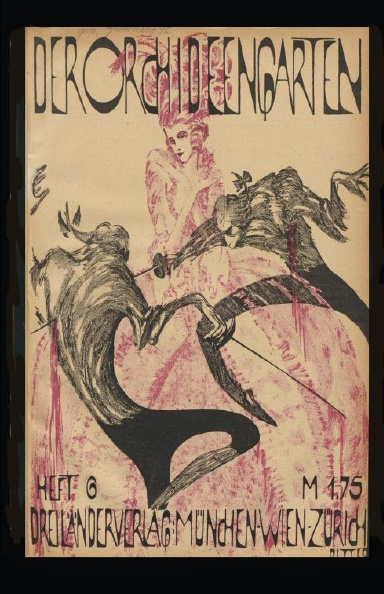
Der Orchideengarten Vol 2, No. 7 contains the following stories: The Hair of Lady Fitzgerald by Wolf Durian; The Experiment of One’s Own Soul by J. Winckelmann; Sparks by Vladimir Aratov. Translation by Joe E Bandel. Layout by John Hirschhorn-Smith. Original art throughout. This is the first time these stories have been translated into the English language.

Read Full Post »

Der Orchideengarten Vol 2 No. 6 includes the stories: The Will to Death by Kurt Moreck and The Byzantine Coin by Karl Hans Strobl. Original art. Translated into English by Joe E Bandel. Layout by John Hirschhorn-Smith.

Read Full Post »

Der Orchideengarten Vol 2, No. 5 contains the following stories translated for the first time into English. Discovery by Rudolf Schneider; The Three Rings by Margot Isbert; Chorus of the Dead by Conrad Ferdinand Meyer; Secret Decapitation by Johan Peter Hebel; Shadows by M. Pokorny. Translations by Joe E Bandel and layout by John Hirschhorn-Smith. It contains the original artwork.

Read Full Post »

Homo Sapiens: Under Way by Stanislaw Przybyszewski and translated by Joe E Bandel

VIII.

When they both stepped out the door, Falk became a little uneasy. 

“He had sent the coachman home. The night was so splendid; he would so like to accompany her home on foot. It would also be good for her to refresh a little from the stupid society in the open air.” 

Falk’s voice trembled slightly. 

Marit spoke no word; a dark oppression almost took her breath away. 

They stepped onto the open field; both thoughtful, silent. 

Now the moment had come when one can look into the soul of the being one loves as into one’s own. Falk felt her soul like a roulette ball rolling from one boundary wall of his suggestions to the other: 

“Wouldn’t she like to take his arm? 

The path was very bad; it had many holes, one could easily sprain one’s foot.” 

She took his arm silently. He pressed it very firmly to his chest and felt her tremble. 

Falk knew that he couldn’t speak now; his voice would break. 

He fought against this excitement; but his unrest grew and grew. 

No, he gathered himself. No, not now! 

That reminded him of the way peasants clumsily grab with both hands right away. 

The moon poured pale streams of light on the meadows; in the distance one saw high-piled black heaps of peat. 

Falk tried to master himself. He wanted to postpone the happiness he could now enjoy; he wanted to enjoy it slowly. 

They stopped and contemplated the landscape. 

Then they walked again, but didn’t look at each other; it was as if they felt a kind of shame before one another. 

Now Falk stopped again. 

“Strange: every time I see the peat heaps, I always have to think of a peculiar man from my home village. 

He was a peat cutter for my father; naturally he drank, like almost all our farmhands, and had a great fixed idea.” 

Falk instinctively sought to loosen and scatter the sexual concentration through stories; then he could overwhelm the girl all the more surely afterward. 

“You know, from the peat bog at times will-o’-the-wisps rise, which move back and forth with fabulous speed. 

The man now got it into his head that the will-o’-the-wisps were souls of deceased Freemasons; at that time the famous papal encyclical also appeared, in which it is written that the Freemasons are possessed by the evil one. 

Now the man ran around all night and shot at the will-o’-the-wisps with an old pistol. With somnambulistic certainty he jumped over the widest peat ditches, crawled through the mud and densest undergrowth like a swamp animal, sometimes sank up to his neck in the marsh, worked himself out again and shot incessantly. 

There lay a terrible tragedy in it. I saw him once after such a night. His eyes were bulging and bloodshot, the mud sat finger-thick on his clothes, he was completely soaked, the thick swamp water dripped from him; his hair was glued together into strands by the mud, but he was happy. 

He swung the pistol back and forth and jumped and cried out with joy. For in this night he had shot a Freemason soul with a twenty-pfennig piece; as he watched, only a little heap of tar remained of the will-o’-the-wisp. 

The pistol was his sanctuary from then on. But once he was locked in prison because he didn’t send his son to school. The boy stayed home alone—the mother had long since run away—and tended the goat on the peat meadows, the peat cutter’s only wealth. 

Yes; now it occurred to the boy to fetch the pistol to frighten the neighbor’s child, whom he was also supposed to watch. He turned the pistol with the muzzle toward his mouth and held a burning match near the pan. 

‘Watch out, now I’m shooting dead!’ He held the match ever closer. The child gets frightened, starts screaming, and in that moment 

the pistol discharges: the boy gets the whole charge in his mouth. I had just come from school and was witness to the scene that I will never forget in my life. 

The boy ran around in mad fear, blood gushed from his nose and mouth, and with every death scream the foam shot and gurgled forth in dark stream. 

The child understood nothing and laughed heartily at the crazy jumps. Only the goat seemed to have understood it. In wild fear it had 

torn itself from the stake to which it was tied; it jumped—no, you really can’t imagine it—it jumped over the long, skinny boy, and then over a wide ditch, and back again… it was terrible. 

Marit was completely excited. 

“That must have been gruesome! Did the boy die?” “Yes, he died.” 

Again they walked silently side by side; they were quite, quite close. 

“Good God, you looked wonderful today! You had an expression on your face, you know, an expression that I had seen on you only once before; yes, once a year ago. We were as happy as children and so happy; God knows, it was beautiful. And then we stood in the evening on the veranda. In the distance we heard the monastery bells ringing for the Ave Maria, and you stood there and looked ahead with the expression of unspeakable intimacy and bliss; it was like a sea of bright gold around you—and today I saw it again.” 

Falk trembled. 

“I looked at you the whole evening, I admired you and was happy and felt you quite close to me… to me.” 

He pressed her even tighter to himself, his voice almost gasped. “Marit, I love you; I…” 

His hand encircled hers. He felt how hot streams flowed into her. 

“I came only because of you; I lay there in Paris and longed for you like mad; I had to come. And now you know; now I have a morbid desire to take you in my hands and press you so wild, so wild to my heart and breathe your breast against mine, hear your heart beat against mine. 

Look, Marit, my gold, my everything; I will do everything, everything for you; you mustn’t resist; you give me an unnameable happiness; you give me everything by it; look, I have suffered so; my sweet girl, my sun, give me the happiness!” 

Around them both, the hot, sexual atmosphere wove tighter and tighter. She could hardly breathe. 

“I was so immeasurably unhappy all the time because I love you so endlessly; never have I loved a being as I loved you before.” 

She felt above her two abyssal eyes shining like two stars; her head grew confused, she couldn’t think, understood only his hot, gasping words, which fell like hot blood drops into her soul, and above her she saw two abyssal stars that guided and pulled and tore at her. 

She felt how he embraced her, how he sought her mouth, and felt his hot, feverish lips as they sucked into her lips. 

She no longer resisted; her whole soul threw itself into the one kiss, she embraced him. It was like a jubilation that dances with wild leaps over an abyss. She kissed him. 

Falk had not suspected this wild passion in her. A hot gratitude rose in him. 

“You will be mine, Marit; you will be… will…” 

Yes, that had to be… she felt it, that had to be… the eyes, the terrible eyes above her… and the voice… it sounded like a command. 

Just let me—now—let me—to my senses—let… 

Again they walked silently side by side, trembling, with bated breath. 

“You will be mine?” “How, how? What?” 

Falk was silent. 

For the rest of the way, they spoke no word. 

At the garden gate, they silently shook hands.

Read Full Post »

A Modern Inquiry into the Hermetic Mystery

Part II: A More Esoteric Consideration of the Hermetic Art and Its Mysteries

Chapter 1: The True Subject of the Hermetic Art, Part 2

Introduction: The esoteric heart of alchemy deepens, revealing humanity’s soul as the vessel for the universal essence. In this section, adepts like Böhme and Sendivogius guide us toward the transformative power of this hidden root, aligning nature’s principles with divine wisdom.

The Soul as the Golden Seed

Basil Valentine declares, “He who knows the golden seed or magnet and searches its properties holds the true root of life, fulfilling his heart’s longing.” This seed, no mere fantasy, is a certain truth for diligent seekers. Oswald Crollius, a Paracelsian, reveals that this “mineral vapour” producing gold in the earth resides in humanity, the generating spirit of all creatures. Albertus Magnus adds, “Gold exists everywhere, but its highest virtue burns most gloriously in man, where the fiery principle of life shines erect.”

Hermes echoes, “Our Mercury is philosophic, fiery, vital, mixable with all metals yet separable, prepared in life’s innermost chamber where it coagulates.” This essence, found where metals grow, is most potent in humanity’s soul. Ripley’s verse captures this:

Man, the noblest creature wrought,
Holds nature’s elements in proportion.
A natural Mercury, costing nothing,
Drawn from its mine by art,
For metals are but minerals too,
As Raymond Lully wisely said.

Maria notes philosophers speak sparingly of this essence due to life’s brevity and the art’s length, yet they found and enhanced these hidden elements. Alipili exclaims, “O man, you unite the elements through your breath and power, producing a miraculous essence—fiery water surpassing all elements. It dissolves gold into black earth, like thick spittle, revealing a pure salt without odor or corrosiveness, a treasure accessible to all.” This essence, the soul’s vital spirit, is the Hermetic art’s core.

The Adept’s Virtues

Hermes advises, “To master this hidden wisdom, one must reject vice, be just, good, rational, ready to help others, and guard these secrets from the idle or vicious.” Crollius adds that a true alchemist, sincere and skilled in vital analysis, knows all bodies contain salt, Mercury, and sulphur—principles of attraction, repulsion, and circulation, the universal accord of life. Morien tells King Calid, “This essence is extracted from you, where it resides. Through love and delight, it grows, revealing enduring truth.”

Nature’s Three Principles

Attraction, repulsion, and circulation govern all motion, from planets orbiting stars to chemical affinities. Attraction draws matter together, repulsion pushes it apart, and circulation balances them, forming circles when equal or ellipses when imbalanced. In nature, these principles are unequal, causing dissolution. Alchemists claim only their “antimonial spirit,” rectified by art, can harmonize these forces, creating a perfect, star-like circulation.

Böhme explains, “The Invisible Mercury, the spiritual air of Antimony, harmonizes these discordant principles—attraction, repulsion, circulation—in the arterial blood, where repulsion dominates, drawing life outward from its divine source.” The Hermetic art reverses this, restoring balance through dissolution and purification. He cites Paracelsus: “Nature gives blood and urine, pyrotechny yields salt, which art circulates into Paracelsus’ circulated salt. This salt, transmuted through a ferment, loses its outer life, retaining its essence.”

Hermes reiterates, “Unless you know how to mortify, generate, vivify, and cleanse the spirit, freeing it from darkness through contention, you achieve nothing. But mastery brings great dignity.” Böhme details the process: “In three months, digestion turns the powder black, halting the opposition of attraction and repulsion. The fixed attracts the volatile, both dying into rest. In three more months, a brilliant whiteness emerges, then a red or purple tincture, signaling the reign of sin’s end and the king’s scarlet robe.”

This cyclical process—dissolution, blackness, whiteness, redness—fortifies the spirit, unlike common matter that combusts. The alchemical Mercury, enhanced by fresh antimony, grows tenfold stronger with each digestion, becoming a “terrestrial Sun,” a magnetic chariot of life.

Closing: This section reveals humanity’s soul as the alchemical vessel, harmonizing nature’s principles to create the philosopher’s stone. The transformative process begins to unfold, promising deeper insights into this sacred art in our next post.

Read Full Post »

Chapter 26: Rosicrucianism – The Hermetic Tradition and the Threefold Path of Soul Development

Historical Overview: Rosicrucianism’s Emergence and Organic Gnostic Threads

The 14th to 17th centuries CE marked a pivotal era for the hermetic tradition and Rosicrucianism, which revitalized organic gnosticism’s life-affirming, gender-balanced spirituality amid the Renaissance’s intellectual ferment. The Rosicrucian movement, traditionally traced to the mythical Christian Rosenkreutz (born 1378 CE), emerged in the 15th century, with Martin Luther (1483–1546 CE) identified by AMORC’s first Imperator, H. Spencer Lewis, as a Rosicrucian leader in Germany. Luther’s coat of arms—a cross with a garland of roses—symbolized the Rosicrucian ideal of soul transformation, as noted in AMORC teachings (Ch. 0). The Protestant Reformation, sparked by Luther’s Ninety-Five Theses (1517 CE), challenged Catholic dogma, aligning with organic gnosticism’s rebellion against social enforcers’ control (Ch. 7).

By the 17th century, Rosicrucianism crystallized with the publication of three manifestos—Fama Fraternitatis (1614 CE), Confessio Fraternitatis (1615 CE), and Chymical Wedding of Christian Rosenkreutz (1616 CE)—attributed to figures like Michael Maier, Robert Fludd, and Thomas Vaughan. These texts, rooted in hermeticism and alchemy, advocated soul development through mystical and scientific inquiry, resonating with organic gnosticism’s integration of head and heart (Ch. 25). Sir Francis Bacon (1561–1626 CE), linked to Rosicrucianism by AMORC tradition, is credited with founding Freemasonry as a social experiment, particularly high-grade forms like the Scottish Rite and the Rite of Memphis-Mizraim, as per John Yarker’s unification efforts (19th century).

Three distinct threads emerged from Rosicrucianism, as you’ve identified through your AMORC eldership (since 1976) and translations of Hanns Heinz Ewers and Stanislaw Przybyszewski:

  1. AMORC and Mystical Christianity: The Ancient Mystical Order Rosae Crucis (AMORC), founded by H. Spencer Lewis in 1915, continued the Traditional Martinist Order, emphasizing cosmic consciousness through mystical Christianity, as seen in its monographs (Ch. 0).
  2. OTO and Kabbalistic Magic: The Ordo Templi Orientis (OTO), led by Aleister Crowley after Theodore Reuss, blended magical and mystical paths in a Kabbalistic framework, incorporating sex magic, as in Crowley’s Liber AL vel Legis (1904 CE).
  3. Organic Gnosticism and German Satanism: Discovered through your translations, this thread—embodied by Ewers and Przybyszewski—focused on soul development through Tantric love relationships, termed “German Satanism” for its dark, sexual energy, echoing organic gnosticism’s left-hand path (Ch. 5, 13).

The Rite of Memphis-Mizraim, unified by Yarker, influenced both AMORC and OTO, with Lewis and Crowley as initiates. Przybyszewski’s funeral (1927 CE), with its 3/4-mile procession and state dignitaries, underscores his prominence, suggesting a formal spiritual organization linking him to Ewers, possibly initiating Crowley in New York (circa 1914–1918 CE).

Mystery School Teachings: Rosicrucianism’s Threefold Path and Tantric Roots

Rosicrucianism’s hermetic tradition, rooted in alchemy (Ch. 25), emphasized soul development through three paths, mirroring organic gnosticism’s integration of physical and non-physical energies:

  • AMORC’s Mystical Path: Focused on cosmic consciousness, blending heart wisdom (Ch. 9) with mystical Christianity, as in the Traditional Martinist Order’s meditative practices.
  • OTO’s Magical Path: Combined Kabbalistic rituals and sex magic, weaving male-female energies for soul powers, as in Crowley’s Thelemic teachings (Ch. 5).
  • Organic Gnosticism’s Tantric Path: Emphasized love relationships and Tantric practices, as in Ewers and Przybyszewski’s “black current,” aligning with Cathar and Bogomil duality (Ch. 19, 21).

These paths countered the Church’s social enforcers (ascetic denial) and rational atheists (logic-driven control), reviving organic gnosticism’s heart-centered mysticism. The philosopher’s stone, symbolizing soul transmutation, resonated with the Holy Grail as womb (Ch. 8), weaving energies for watcher selves (Ch. 2). Luther’s Reformation and Bacon’s Freemasonry challenged Church dogma, while Przybyszewski’s German Satanism preserved Tantric sexuality, defying head-centric spirituality.

OAK Ties and Practical Rituals: Weaving Rosicrucian Paths for Gaia’s Ascension

In the OAK Matrix, Rosicrucianism’s threefold path aligns with true Ego resonance (Intro, Individual), weaving Shadow (repressed physicality, Radon, Ch. 26, Magus) and Holy Guardian Angel (cosmic harmony, Krypton, Ch. 24) in Oganesson’s womb (Ch. 20). Its Tantric and mystical currents mirror resonant circuits (Ch. 13), creating soul timelines through chaos leaps (Ch. 11), countering social enforcers’ asceticism (Ch. 7) and rational atheists’ logic (Ch. 9). This resonates with Ipsissimus unity (Ch. 10) and Adeptus Exemptus compassion (Ch. 7), with the Holy Grail as womb (Ch. 8) empowering Gaia’s ascension (Ch. 4).

Practical rituals revive this:

  • Oak Grail Invocation (Start of Each Ritual): Touch oak bark, affirming: “Roots in Gaia, branches in Source, I unite duality’s embrace.”
  • Rosicrucian Alchemy Meditation (Daily, 15 minutes): Visualize threefold path—mystical (AMORC), magical (OTO), Tantric (Organic Gnosticism). Journal refused Shadow (e.g., repressed sexuality) and aspired HGA (e.g., cosmic balance). Merge in Oganesson’s womb, affirming: “I weave soul paths, transmuting Gaia’s spark.” Tie to Fama Fraternitatis: Inhale transformation, exhale dogma.
  • Gaia Transmutation Ritual (Weekly): By an oak, invoke Gaia’s womb as philosopher’s stone, offering water for soul vitality. Visualize Tantric union (male lightning, female womb, Ch. 8), weaving soul timelines. Affirm: “I transmute base into gold, reviving Gaia’s heart.” Echoes AMORC mysticism.
  • Partner Soul Weave: With a partner, discuss Rosicrucian paths. Men: Share expansive visions; women: Grounding acts. Build non-physical energy via breath or eye contact, visualizing Tantric union (Ch. 5) for soul growth. Solo: Balance enforcer asceticism and atheist logic in Gaia’s heart.

These empower organic gnostics to weave Rosicrucian paths, ascending Gaia’s soul. Next, explore modern esoteric revivals, continuing organic gnosticism’s legacy.

Read Full Post »

Alraune by Hanns Heinz Ewers and translated by Joe E Bandel

Then she takes the child, washes him, changes him, and tucks
him into bed. Wülfche never stirs, lies quiet, still and contented. Then
he falls asleep, beaming blissfully, the ghastly black cigar stub always
in his lips.
Oh yes, she was right, this tall woman. She understands children,
at least Gontram children.
During the dinner and into the evening they eat and the Legal
Councilor talks. They drink a light wine from the Ruwer. Frau
Gontram finishes first and brings the spiced wine.
Her husband sniffs critically.
“I want champagne,” he says.
She sets the spiced wine on the table anyway. “We don’t have
any more champagne. All that’s left in the cellar is a bottle of
Pommery.”
He looks intently at her over his spectacles, shakes his head
dubiously.
“Now you know you are a housewife! We have no champagne
and you don’t say a word about it? What? No, champagne in the
house! Fetch the bottle of Pommery– Spiced wine is not good
enough.”
He shakes his head back and forth, “No champagne. Imagine
that!” He repeats. “We must procure some right away. Come woman;
bring my quill and paper. I must write the princess.”
But when the paper is set in front of him, he pushes it away
again. He sighs.
“I’ve been working all day long. You write woman, I’ll dictate to
you.”
Frau Gontram doesn’t move. Write? She’s a complete failure at
writing!
“I can’t,” she says.
The Legal Councilor looks over at Manasse.
“See how it is, Colleague? Can’t she do this for me? I am so
exhausted–”
The little Attorney looks straight at him.
“Exhausted?” He mocks, “From what? Telling stories? I would
like to know why your fingers always have ink on them, Legal
Councilor. I know it’s not from writing!”
Frau Gontram laughs. “Oh Manasse, that’s from last Christmas
when he had to sign as witness to the children’s bad behavior!–
Anyway, why quarrel? Let Frieda write.”
She cries out the window to Frieda. Frieda comes into the room
and Olga Wolkonski comes with her.
“So nice to have you here,” the Legal Councilor greets her.
“Have you already eaten this evening?”
Both girls have eaten down in the kitchen.
“Sit here Frieda,” bids her father. “Right here.”
Frieda obeys.
“Now, take the quill and write what I tell you.”
But Frieda is a true Gontram child. She hates to write. Instantly
she springs up out of the chair.
“No, no,” she cries. “Olga should write, she is so much better
than I am.”
The princess stays on the sofa. She doesn’t want to do it either.
But her friend has a means to make her submit.
“If you don’t write,” she whispers. “I won’t lend you any sins for
the day after tomorrow.”
That did it. The day after tomorrow is Confession and her
confession slip is looking very insufficient. Sins are not permitted
during this time of First Communion but you still need to confess.
You must rigorously investigate, consider and seek to see if you can’t
somehow find yet another sin. That is something the princess
absolutely can’t understand.
But Frieda is splendid at it. Her confession slip is the envy of the
entire class. Thought sins are especially easy for her. She can discover
dozens of magnificent sins easily at a time. She gets this from Papa.
Once she really gets started she can attend the Father Confessor with
such heaps of sins that he never really learns anything.
“Write Olga,” she whispers. “Then I’ll lend you eight fat sins.”
“Ten,” counters the princess.
Frieda Gontram nods. It doesn’t matter to her. She will give
away twenty sins so she doesn’t have to write.
Olga sits at the table, picks up the quill and looks questioningly.
“Now write,” says the Legal Councilor.
“Honorable Princess–”
“Is this for Mama?” the princess asks.
“Naturally, who else would it be for? Write!”
“Honorable Princess–”
The princess doesn’t write. “If it’s for Mama, I can only write,
‘Dear Mama’.”
The Legal Councilor is impatient.
“Write what you want child, just write!”
She writes, “Dear Mama!”
Then the Legal Councilor dictates:
“Unfortunately I must inform you that there is a problem. There
are so many things that I must consider and you can’t consider things
when you have nothing to drink. We don’t have a drop of champagne
in the house. In the interests of your case please send us a basket of
spiced champagne, a basket of Pommery and six bottles of–”
“St. Marceaux!” cries the little attorney.
“St. Marceaux,” continues the Legal Councilor. That is namely
the favorite of my colleague, Manasse, who so often helps.
With best Greetings,
Your–”
“Now see, Colleague!” he says. “You need to correct me! I
didn’t dictate this letter alone but I will sign it single handedly, and he
puts his name on it.
Frieda turns away from the window, “Are you finished? Yes?
Well, I can only say that you didn’t need to write the letter. Olga’s
Mama is coming and she’s in the garden now!”
She had seen the princess a long time ago but had kept quiet and
not interrupted. If Olga wanted to get ten beautiful sins she should at
least work for them!
All the Gontrams were like that, father, mother and children.
They are very, very unwilling to work but are very willing to let
others do it.
The princess enters, obese and sweaty, large diamonds on her
fingers, in her ears, around her neck and in her hair in a vulgar display
of extravagance.
She is a Hungarian countess or baroness. She met the prince
somewhere in the Orient. A marriage was arranged, that was certain,
but also certain, was that right from the beginning it was a fraud on
both sides.
She wanted the marriage to make her impossible pregnancy
legal. The prince wanted the same marriage to prevent an
international scandal and hide his small mistake. It was a net of lies
and impudent fraud, a legal feast for Herr Sebastian Gontram,
everything was in motion, and nothing was solid. Every smallest
assertion would prompt legal opposition from the other side. Every
shadow would be extinguished through a court ruling.
Only one thing stayed the same, the little princess. Both the
prince and the princess proclaimed themselves as father and mother
and claimed her as their own. This product of their strange marriage is
heir to many millions of dollars. The mother has the advantage, has
custody.
“Have a seat, princess!”
The Legal Councilor would sooner bite his tongue than call this
woman, ‘Highness’. She is his client and he doesn’t treat her a hair
better than a peasant woman.
“Take your coat off!” but he doesn’t help her with it.
“We have just written you a letter,” he continues and reads the
beautiful letter to her.
“But of course,” cries the princess. “I will take care of it first
thing tomorrow morning!”
She opens her purse and pulls out a heavy envelope.
“Look at this, Honorable Legal Councilor. I came straight here
with it. It is a letter from Lord, Count Ormes of Greater-
Becskerekgyartelep, you know him.”
Herr Gontram furrows his brow. This isn’t good. The King
himself would not be permitted to demand him to conduct any
business while at home. He stands up and takes the letter.
“That’s very good,” he says. “Very good. We will clear this up
in the morning at the office.”
She defends herself, “But it’s very urgent! It’s very important!”
The Legal Councilor interrupts her, “Urgent? Important? Let me
tell you what is urgent and important, absolutely nothing. Only in the
office can a person judge what is urgent and important.”
He reproaches her, “Princess, you are an educated woman! You
know all about proper manners and enjoy them all the time. You must
know that you don’t bring business home at night.”
She persists, “But I can never catch you at the office Honorable
Legal Councilor. During this week alone I was–”
Now he is almost angry. “Then come next week! Do you think
that all I do is work on your stuff alone? Do you really believe that is
all I do? Do you know what my time alone costs for the murderer
Houten? And it’s on my head to handle your millions as well.”
Then he begins to tell a funny story, incessantly relating an
unending imaginary story of a strange crime lord and the heroic
attorney that brings him to justice for all the horrible sex murders that
he has committed.
The princess sighs, but she listens to him. She laughs once in
awhile, always in the wrong places. She is the only one of all his
listeners that never knows when he lies and also the only one that
doesn’t understand his jokes.
“Nice story for the children!” barks Attorney Manasse.
Both girls are listening eagerly, staring at the Legal Councilor
with wide-open eyes and mouths. But he doesn’t allow himself to be
interrupted. It is never too early to get accustomed to such things. He
talks as if sex murderers were common, that they happen all the time
in life and you can encounter dozens of them every day.
He finally finishes, looks at the hour, “Ten already! You children
must go to bed! Drink your spiced wine quickly.”
The girls drink, but the princess declares that she will under no
circumstances go back to her house. She is too afraid and can’t sleep
by herself, perhaps there is a disguised sex murderer in the house. She
wants to stay with her friend. She doesn’t ask her Mama. She asks
only Frieda and her mother.
“You can as far as I’m concerned,” says Frau Gontram. “But
don’t you oversleep! You need to be in church on time.”
The girls curtsey and go out, arm in arm, inseparable.
“Are you afraid too?” asks the princess.
Frieda says, “What Papa was saying is all lies.”
But she is still afraid anyway and at the same time strangely
longing for these things. Not to experience them, oh no, not to know
that. But she is thinking how she wants to be able to tell stories like
that! Yes, that is another sin for confession! She sighs.
Above, they finish the spiced wine. Frau Gontram smokes one
last cigar. Herr Manasse stands up to leave the room and the Legal
Councilor is telling the princess a new story. She hides her yawn
behind her fan, attempts again to get a word in.
“Oh, yes, dear Legal Councilor,” she says quickly. “I almost
forgot! May I pick your wife up at noon tomorrow in the carriage? I’d
like to take her with me into Rolandseck for a bit.”
“Certainly,” he answers. “Certainly, if she wants to.”
But Frau Gontram says, “I can’t go out.”
“And why not?” the princess asks. “It would do you some good
to get out and breathe some fresh spring air.”
Frau Gontram slowly takes the cigar out from between her teeth.
“I can’t go out. I don’t have a decent hat to wear–”
The Princess laughs as if it is a good joke. She will also send the
Milliner over in the morning with the newest spring fashions.
“Then I’ll go,” says Frau Gontram. “But send Becker from
Quirinusjass, they have the best.”
“And now I must go to sleep–good night!”
“Oh, yes, it is time I must get going too!” the princess cries
hastily.
Legal Councilor escorts her out, through the garden and into the
street. He helps her up into her carriage and then deliberately shuts the
garden gate.
As he comes back, his wife is standing in the house door, a
burning candle in her hand.
“I can’t go to bed yet,” she says quietly.
“What,” he asks. “Why not?”
She replies, “I can’t go to bed yet because Manasse is lying in
it!”
They climb up the stairs to the second floor and go into the
bedroom. In the giant marriage bed lies the little attorney pretty as can
be and fast asleep. His clothing is hung carefully over the chair, his
boots standing nearby. He has taken a clean nightgown out of the
wardrobe and put it on. Near him lies his Cyclops like a crumpled
young hedgehog.
Legal Councilor Gontram takes the candle from the nightstand
and lights it.
“And the man insults me, says that I’m lazy!” he says shaking
his head in wonderment.
“–And he is too lazy to go home!”
“Shh!” Frau Gontram says. “You’ll wake everyone up.”
She takes bedding and linen out of the wardrobe and goes very
quietly downstairs and makes up two beds on the sofas. They sleep
there.
Everyone is sleeping in the white house. Downstairs by the
kitchen the strong cook, Billa, sleeps, the three hounds next to her. In
the next room the four wild rascals sleep, Philipp, Paulche, Emilche
and Josefche. Upstairs in Frieda’s large balcony room the two friends
are sleeping. Wülfche sleeps nearby with his black tobacco stub. In
the living room sleep Herr Sebastian Gontram and his wife. Up the
hall Herr Manasse and Cyclops contentedly snore and way up in the
attic sleeps Sophia, the housemaid. She has come back from the dance
hall and lightly sneaked up the stairs.
Everyone is sleeping, twelve people and four sharp hounds. But
something is not sleeping. It shuffles slowly around the white house–
Outside by the garden flows the Rhine, rising and breasting its
embankments. It appears in the sleeping village, presses itself against
the old toll office.
Cats and Tomcats are pushing through the bushes, hissing,
biting, striking each other, their round hot glittering eyes possessed
with aching, agonizing and denied lust–
In the distance at the edge of the city you hear the drunken songs
of the wild students–
Something creeps all around the white house on the Rhine,
sneaks through the garden, past a broken embankment and overturned
benches. It looks in pleasure at the Sunday antics of the love hungry
cats and climbs up to the house. It scratches with hard nails on the
wall making a loose piece of plaster fall, pokes softly at the door so
that it rattles lightly like the wind.
Then it’s in the house shuffling up the stairs, creeping cautiously
through all the rooms and stops, looks around, smiles.
Heavy silver stands on the mahogany buffet, rich treasures from
the time of the Kaiser. But the windowpanes are warped and patched
with paper. Dutchmen hang on the wall. They are all good paintings
from Koekoek, Verboekhuoeven, Verwee and Jan Stobbaerts, but
they have holes and the old golden frames are black with spider webs.
These magnificent beauties came from the ArchBishop’s old hall. But
the broken crystal is sticky with flyspecks.
Something haunts the still house and each time it comes it breaks
something, almost nothing, an infinite smallness, a crack. But again
and again, each time it comes, the crack grows in the night. There is a
small noise, a light creaking in the hall, a nail loosens and the old
furniture gives way. There is a rattle at the swollen shutters and a
strange clanking between the windowpanes.
Everyone sleeps in this big house on the Rhine but something
slowly shuffles around.

Read Full Post »

Madame Bluebeard by Karl Hans Strobl and translated by Joe E Bandel

First Chapter
Police Commissioner Mirko Bovacs was at a loss.
No, he wasn’t merely at a loss—he was utterly
despairing. In all his years of service, nothing like
this had ever happened. With an extraordinary—
charitably, one might say superhuman—keenness of
mind, he had identified, among Abbazia’s
international crowd, the long-sought Innesvar bank
robber in an unassuming Mr. Müller. And now, Mr.
Müller refused to be arrested, perched instead on the
roof of his small house, firing wildly with two
Brownings.
This defied all precedent. Once discovered, a
criminal was supposed to concede defeat and submit.
That, at least, was what any respectable crook was
expected to do. No serious trouble was to be caused
for the police; one simply vowed to play more
cautiously next time.
Initially, news of the bank robber’s unmasking
spread fear and horror among the spa guests. To think
they were exposed to such dangers! Patrons of the
Hotel Royal, where Mr. Müller had dined several
times, were beside themselves with agitation. “You
really don’t know who you’re sitting with anymore,”
said Hofrätin Kundersdorf. The young poet
Bystritzky, who consorted only with elderly ladies
and spared young girls not a glance, added dutifully,
“This Müller… a man of the world… who’d have
thought!”
But when word got out that the bank robber was
defending his stone cottage up in the vineyards,
refusing to let any policeman near, the mood shifted
to amusement. Soon, the beach and promenade lay
deserted. The public had flocked to the vineyards as
if to a fair, keeping a safe distance, of course, and
seeking cover behind walls and houses. It was
5immensely entertaining to watch the police and
gendarmes at a loss, and to see Mirko Bovacs darting
about behind a gamekeeper’s hut, wringing his hands.
Whenever a policeman or gendarme peeked to
check if Mr. Müller was still on the roof, a shot rang
out. The head ducked back faster than a seal’s. “What
am I to do? What am I to do?” wailed the
commissioner. “I’m becoming a laughingstock. This
rogue is humiliating me before all of Europe. Damn
him… he must come down. I’m ruined if we don’t
get him. What crook will respect me then? Every
lousy Italian pickpocket will laugh in my face.
They’ll spit on my boots.” He roared at his men:
“You scoundrels, you cowards, go hide behind your
wives’ skirts, you bastards, you toads! You’re truly
made of clay God forgot to fire. Get moving… it’s
your duty… I’ll report you all!”
But Constable Kristic, unshaken by anything,
replied, “Commissioner, it’s our lives at stake. What
do you expect? Duty’s duty. But where’s it written
we must let ourselves be killed when we can just wait
until hunger drives him down?”
“So, you’d starve him out?” the commissioner
shouted. “We could wait forever. Do you know if
he’s got supplies for a year? Or two? We might all be
dead—or pensioned—by then. If we could at least
reach the neighboring house, fifteen paces away…”
“Sir, what good’s that?” Kristic countered. “If we
show ourselves, he shoots. He’s capable of picking us
off. He’s already hit one gendarme in the foot. And
Schusterschic got two holes in his cap for not
ducking fast enough.”
The commissioner peered cautiously around the
corner. “What’s he doing? What’s he doing?” he
stammered. “He’s mocking us. He’s pulled out a ham
sandwich and is eating calmly. I’ll have a stroke,
6Kristic… has anyone seen such a thing? He’s eating a
sandwich right in front of us.”
Mr. Müller’s composure won the spa guests’
admiration. Even Hofrätin Kundersdorf couldn’t
withhold praise for his cool-headedness, and
Bystritzky chimed in with aphorisms on masculinity
and the grandeur of criminal characters.
As the day passed without change, bets were
placed on how long Mr. Müller would hold out. The
English dove into the wagering with zeal. Lord
Stanhope bet a hundred pounds that the splendid
bank robber wouldn’t be brought down for three
days. No one took the bet, knowing Stanhope’s
uncanny luck.
“You can safely take the wager,” said an elegant
man of about thirty-five to the hesitant group. “Go
on, dare it. This Mr. Müller will be in police hands by
tonight.”
Lord Stanhope eyed the stranger calmly. “How
can you claim that?” he asked slowly. “And if you’re
so sure, why not bet yourself?”
“I don’t bet,” the stranger replied, “when I know
the outcome for certain.”
“How can you know the outcome?”
“How? Because I’ll bring that man down myself.”
With a polite, curt bow, he descended toward the
beach.
Half an hour later, the stranger approached
Commissioner Mirko Bovacs with a greeting. “Sir,
what do you want here?” Bovacs shouted. “There’s
shooting. Don’t cause trouble.”
“I’m here to end the shooting,” the elegant
stranger replied.
Bovacs’s jaw dropped. His mind stalled. Clinging
to the one remaining faculty—that a commissioner
7must never lose composure—he rubbed his hands
together. But they felt like someone else’s hands.
“Sir…” he said, “how will you…”
“That’s my concern, once you permit me to
assist.”
“I warn you, don’t rely on the night. We saw that
scoundrel has a barrel of pitch on the roof. He’ll
likely light it when it’s dark.”
“I won’t wait that long. In twenty minutes, it’s
over. Be ready to seize him when I have him.”
Shaking his head, Bovacs watched the stranger
step from the gamekeeper’s hut. A shot rang out from
the roof, but the man was already behind a garden
wall. Bovacs marveled at the transformation. The
polished gentleman, master of decorum, became an
Indian. His body stretched like a lithe animal’s, limbs
propelling him in an almost impossible crouch, half-
lying, always concealed by stones, moving swiftly
and surely once he found his path.
After minutes, he vanished into a pile of rocks
above. For Bovacs, an agonizing wait began. It galled
him to owe a volunteer, but it beat prolonging the
siege. “A blessed candle for Saint Joseph in Fiume,”
he vowed silently, “if this works.” Kneeling, he
watched the enemy. Beyond the two houses, a green
evening sky spread, bottle-glass clear, sharpening
every outline. Mr. Müller sat at the roof’s edge,
smoking. A tiny light gleamed, a blue-pink cloud
around his head.
Suddenly, a figure shot from the neighboring
house’s horizon—like a devil in a puppet show.
Müller flinched, raising his Browning, but a thin
snake whipped across, coiling around him, biting
fast. No shot fired…
Bovacs saw Müller leap up, but the snake
tightened. Bovacs sprang, dancing, shouting, drawing
8his saber, striking stones. The rooftop struggle
thrilled him, maddening, a beauty like a falcon’s
flight or a heron’s strike. But the puppet play against
the glass-green sky ended. Müller staggered, arms
pinned, and vanished.
“Go, go!” Bovacs roared, charging up the hill with
his men. Below his stronghold, Müller lay, bound in
tough coils, immobile, face blue-red. The lasso’s end
was in the stranger’s hand, peering over the roof’s
edge.
The policemen and gendarmes pounced on the
criminal, hauling him from the ground, eager to
display their zeal. Mirko Bovacs approached the
stranger as he descended from the roof. “Sir,” he
panted, exhilarated, “ask anything of me. I’m entirely
at your service.”
“Then, please, give me a light,” the stranger
replied. He’s not as young as he looks, Bovacs
thought, as the match flared near the man’s face. The
stranger took two puffs on his cigarette, coiled his
lasso, tucked it into his pocket, and slipped sideways
into the darkness of the now-fallen night, nodding a
brief farewell to the commissioner.
That same evening, news of these events swept
through Abbazia. Those who hadn’t witnessed the
spectacle borrowed their friends’ eyes to catch a
fleeting glimpse. The authorities were irredeemably
ridiculous, Mr. Müller earned sympathies, and a halo
crowned the stranger. To Bystritzky’s chagrin,
Hofrätin Kundersdorf declared him a most interesting
young man. Bystritzky bristled when his elderly
ladies found other young men intriguing.
At ten o’clock, Court Secretary Ernst Hugo
returned from a sailing trip in the Quarnero,
ravenous. As he devoured his beefsteak, Franz,
standing respectfully behind his guest’s chair,
9recounted the day’s events. Suddenly, Hugo stopped
eating. He raised his napkin as if to wipe his mouth,
let it fall, brushed his mustache with the back of his
hand, and turned to Franz. His eyes were wide.
“Good Lord!” he muttered, “that’s none other than
my friend Ruprecht. It can only be Ruprecht.”
It was indeed Ruprecht von Boschan, confirmed
the next morning when Hugo arrived for breakfast at
the Hotel Kaiser von Österreich. The hero of the
previous evening sat on the terrace between two stout
pillars resembling petrified prehistoric rolls. He
stirred his coffee with a silver spoon, a Times before
him, but he didn’t read, gazing instead at the sea, blue
and silver-embroidered, swelling beyond the terrace.
“Ruprecht!” Hugo cried, striking his famous embrace
pose, Roman One, capital A. He performed it twice—
first with the right arm, then the left atop—looking
like a two-winged windmill, his massive hands
poised to spin.
“You’re still a mad hen,” Boschan murmured,
yielding to the hearty embrace.
“Where’ve you come from?” Hugo asked.
“From down there,” Ruprecht replied, gesturing at
the blue sea.
“From the water? Are you Venus Anadyomene?
Or posing as a sea god?”
“I’ve been testing a submarine.”
“Dangerous?”
“Eh—manageable. Not much to it. It wasn’t a
French submarine.”
“And before?”
“Before, I did some high-altitude climbs in the
Himalayas.”
“Sapperment! How high?”
“Between seven and eight thousand…”
“And before?”

Read Full Post »

Homo Sapiens: Under Way by Stanislaw Przybyszewski and translated by Joe E Bandel

“Yes, you are very inquisitive, Herr Editor. You surely don’t demand that I deliver my political credo here; but we can look at the things from a bird’s-eye view. 

I understand the anarchist propaganda of the deed, for that’s what this is about here, very well; I understand it as an unheard-of indignation against social justice. 

Yes, we the sated, we who have the privilege of doing no work or at least choosing a work that is a pleasure to us, we call it justice when our brothers in Christ must rise at four or five in the morning, day-labor twelve hours uninterrupted, serve us the privileged. Well, I need hardly list for you which things we consider socially just. But you must understand that there are people who cannot reconcile themselves to it, who rebel against such justice in naive rage. Well, the rage can, if favored by certain circumstances, such as, for example, futile job searching, thus unemployment, or hunger or

illness, rise to a height that it simply tips over into madness. 

And now take a person who day in, day out sees such examples of unheard-of social cruelty, take a person who is witness to how the workers in a strike riot are shot dead like dogs, how they are starved out by mighty capitals and crippled in their justified resistance: don’t you believe that such examples of our social justice suffice to produce in a person who has a strong heart a vengeance that blindly wants to—must!—sate itself on the first best of the socially privileged? 

Our heart is dulled, sir; our heart is weak and narrow-minded, as our interests are; it has eye and ear only for our own petty conditions. But take a person who is strong and exuberant and childlike enough to feel himself a whole world—yes take for example that Henry: what drove him to his murder acts? 

A heart, a great heart, whose power we dulled, small egoists cannot comprehend! A heart that answered with terrible resonance to all the misery, all the powerlessness all around! 

He became a criminal, certainly; but he was no ordinary criminal. He was a criminal out of indignation, an outrage-criminal. That is a great difference. In effect, of course, it comes to the same; but we are surely advanced enough in our judgment that we begin to form categories not according to success, but according to motives. 

A group had formed around Falk, listening attentively. 

The editor now saw the opportunity as favorable to expose Falk before the reactionary elements. 

“So you completely excuse the anarchist murder acts…” The editor grinned maliciously… “So you would have pardoned Henry without further ado?” 

Falk surveyed the people standing around him with his eyes and said very calmly. 

“No, I wouldn’t have done that. I myself belong to the privileged, thus risk in the next moment being blown into the air by an explosion, thus find myself in a kind of self-defense that makes Henry’s death indispensable. At the same time, however, I say to myself: from my standpoint I am right, but Henry was right from his. He perished through social justice or rather social arbitrariness, which alone gives power and right. But you can surely imagine that social arbitrariness could just as well take Henry’s side, and then Henry would be praised as a great hero. Take, for example, a war: isn’t it a mighty mass murder? But to murder in war is—sweet and honorable, as that Roman sings. 

Well; that doesn’t belong to the matter. But I ask you not to misunderstand me. We see the things from a bird’s-eye view. I only say: I can understand such indignation. 

For we all have the psychic germs in us from which later the most intense forms of murder, robbery, etc. can develop. That they don’t do it is pure chance. By the way, I believe that we can all understand such indignation. How often has not each of us already given himself to this feeling! 

Falk’s sharp eyes discovered the director, who stood a little apart. 

“Look, gentlemen, for example, two days ago I went so far in my indignation that I offered slaps in the face to the so highly esteemed, so well-deserved person of the Herr Director.” 

Those around involuntarily looked at the director with a discreet smile. 

“Yes, I sincerely regret it; but in the moment of an intense emotional outburst I did it.” 

For what? “Yes, gentlemen, if one is indignant about a man’s writings, one really doesn’t go to the school and let one’s rage run free in somewhat uncivilized expressions before stupid boys. 

No, a gentleman doesn’t do that. Perhaps that’s the custom here in the country, but I am accustomed to European customs. 

Right, Herr Editor: You are right to remind me of the résumé. 

The résumé? Hm, yes, the résumé. I understand anarchism as propaganda of the deed, I can explain it to myself. I can examine, analyze, understand all the psychic components from which the idea of political murder develops, one after the other, just as I can understand, analyze, and observe the affect forms that in their heightened intensity become ordinary madness, a mania, a melancholy, etc. etc. 

No, nothing could be done with Falk; he was slippery as an eel. The editor withdrew ashamed. 

Marit had stood at Erik’s side the whole time. 

She felt so close to him; so close. She was happy and proud. He turned to her so often, almost spoke to her. 

Yes, he had the beautiful, great, splendid heart he spoke of. He had the proud heart of indignation and courage: before a whole world he confesses openly and courageously what he thinks! 

And how beautiful he was in this atmosphere of fat, stupid people. How splendid his intellectual face and the fine, discreet gestures with which he accompanied his words. 

A mighty jubilation filled her whole soul, the feeling of boundless devotion. She trembled, and her face colored purple-red. 

Falk disappeared for a moment. 

“Shall we not go?” he whispered in Marit’s ear when he returned. Marit rose. 

It was the custom in this house to leave without the usual farewell formulas. The district commissioner was nervous and loved it when people came and went without a word.

Read Full Post »

« Newer Posts - Older Posts »