The Rebirth of Melchior Dronte by Paul Busson and translated by Joe E Bandel
This was all the easier for me because many of our
classmates thought that Sennon, for all his affection, was a
little disturbed. But nevertheless, they all liked him, and I know
of no instance of anyone teasing him, arguing with him, or
holding his peculiarities against him, as children are wont to do.
Even the crudest of us knew that he deserved love and
consideration, for he was the kindest and most helpful person
even in his youth. Every occasion to do good to others was
welcome to him. Even if it was only the small sorrow about a
bad grade that he had received – Sennon would not rest until he
had made the afflicted person cheerful again with his loving
consolation. I myself was very attached to him, and when he
rebuked me in his gentle way, it had more effect on me than if
it had come from my own good father.
Yes, now in this spring midnight, when the wind passes
over my roof and invisible feet seem to walk along the street,
ever onward, toward an unreachable goal, everything that was
lost in the whirlpool of the young years and in the lost, terrible,
unfruitful time of this insane war sinks to the bottom of the
soul. I remembered the summer day when, to my amazement, I
saw the songbirds in the meadow on the head and shoulders of
the resting Sennon and a little weasel was sniffing at his hands.
A weasel! The shyest of all animals! And how everything
disappeared when I stepped up to him. I also remember how
Sennon helped a sick drunkard, the Pomeranian-Marie, who,
seized by severe nausea, fell to the floor with a blue face. He
picked her up, and stroked her forehead softly with his hand,
whereupon she smiled at him and continued on her way,
completely recovered. Like I was there, when blood was
spurting out of a sickle cut and it stopped when he stepped up
to it, and how the flames on the roof of the carpenter’s roof
shrank, twitched and went out, as Sennon appeared and
reached out his hand. I saw it with my own eyes. How could I
have held all this in such low regard that I forgot it? How sorry,
how unspeakably sorry I am for the years I spent so dully
beside him. I would give all my exact science to do it over.
No, I cannot approach the matter with emotional regret.
I was foolish – like all young people. When I came home
for vacations, I found that contact with the worker in Deier and
Frisch’s optical workshop was not appropriate. I preferred to go
with Herr Baron Anclever from the District Headquarters and
the dragoon lieutenant Herr Leritsch.
I cannot change it. It was like that.
But then I came to my senses. Herr Professor Schedler’s
lectures about psychic phenomena were the ones that pulled me
out of the silly life I had fallen into. I began to look into the
depths, into the twilight abyss, diving into which held a greater
incentive than chasing after little dancers, drinking sparkling
wine and conferring with morons about neck ties, pants cuts,
and race reports. I threw them out of my inner life, as one
removes useless junk from a room in which one wants to settle
into. But I also forgot about Sennon.
Oh, what have I lost! I put my cheek on the last leaf of
writing on which his hand rested in farewell. I call his name
and look at the black window panes in the nonsensical hope
that his dear, serious and yet so joyful face may appear behind
the glass instead of the darkness outside. Everything that I now
long for so unspeakably, was close to me, so close! I only had
to reach out my hand, just to ask. Nobody gives me an answer
now, and all my knowledge fails me. Or shall I console myself
with the vague excuse that Sennon Vorauf had a so-called “split
consciousness” and that the Ewli of Melchior Dronte could be
nothing else than an allegorical revival of the sub
consciousness, that became the second ego of Vorauf?
No, I can’t reassure myself with the manual language of
science. For I am mistaken about all of it —
When I came to Albania, occupied by us, in the course of
the war and went from Lesch to Tirana, in order to establish a
home in that cool city, with its ice-cold, shooting mountain
waters at the foot of the immense mountain wall of the Berat,
for my poor malaria convalescents, I saw Sennon Vorauf for
the last time. It was exactly that day that a searchlight crew had
just returned from Durazzo via the Shjak bazar. Among the
crew members that were searching for their quarters I
recognized Sennon.
I immediately approached him and spoke to him. His
smile passed over me like sunshine from the land of youth. He
was tanned and erect, but otherwise looked completely
unchanged. I did not notice a single wrinkle in his masculine,
even face. This smoothness seemed very strange and unusual to
me. For in the faces of all the others who had to wage war in
this horrible country, showed misery, hunger, struggles and
horrors of all kinds, and everyone looked tired and aged.
We greeted each other warmly and talked of old days.
But time was short. I had meetings and many worries about the
barracks, for the construction of which everything that was
necessary was missing. Our ships were torpedoed; nothing
could be brought in by land. Everything had to be brought in
from Lovcen, floated across Lake Scutari, and then from
Scutari brought overland in indescribable ways. Every little
thing. And boards were no small matter. I negotiated with
people whose brains were made up of regulations and fee
schedules. It was bleak; I felt like I was covered in paste and
old pulp dust. All this disturbed me. I promised Sennon I would
see him soon. He smiled and shook my hand. Oh, he knew so
surely—-!
In the afternoon a man from his department, Herr
Leopold Riemeis, came to me and had himself examined. He
had survived the Papatatschi fever but was still very weak. I
involuntarily asked him about his comrade Herr Sennon Vorauf.
His face was radiant. Yes, Herr Sennon Vorauf! He had saved
his life. A colleague, I thought and smiled. He had naturally of
course also, as I did at the time, taken a fever dream for truth.
But I was curious, gave Riemeis a cigarette and let him tell the
story.
Riemeis was a Styrian, a farmer’s son. Sluggish in
expression, but one understood him quite well. It had happened
like this: In a small town, in Kakaritschi, he, Riemeis, had been
struck down by fever. But it was already hellish. He was
burned alive, his skin was full of ulcers, and on other days he
would have liked to crawl into the campfire because of chills.
And there was no medicine left. The senior physician they had
with them shook his head. In eight days Riemeis was a skinned
skeleton, and not even quinine was left, it had long since been
eaten up.
“Go, people!” The senior physician addressed the platoon.
“If any of you has quinine with you, he should give it to
Riemeis, maybe the fever will go down, or we’ll have to bury
him in a few days.”
They would have gladly given it away, but if there is
none left, there is none left. My God, and there were already
crosses on all the roads of the cursed land, under which our
poor soldiers lay – in the foreign, poisoned earth.
“There you go, Riemeis -” said the doctor and patted him
on the shoulder. “There’s nothing that can be done.” And left.
Riemeis had a burning head that day, but he understood the
doctor quite well, “There’s just nothing that can be done.”
Sennon was sitting next to Riemeis’ bed. It was at night.
“Sennon, a water, I beg you!” moaned the sick man.
But Sennon gave no answer. He sat with his eyes wide
open and did not hear. Riemeis looked at him fearfully. And
then it happened. Something glittering fell from the forehead of
Sennon and hit the clay floor. And then Sennon moved, looked
around, smiled at his comrade, bent down and picked up a
round bottle, in which were small, white tablets. Quinine
tablets. A lot of them. From the depot in Cattaro.
Our peasants are strange. They didn’t say anything to the
doctor, but they put their heads together and whispered.
“My grandfather told -“.
They did not question Sennon about it. They were shy.
But they surrounded him with love and reverence, took
everything from him, did all the work for him, and listened to
his every word. And they understood well that it was precisely
on his heart that all the suffering of the poor lay, who were
driven into this killing, without even being considered worthy
of questioning. This is not an accusation. Our country was in
danger. Even those in power over there did not ask anyone.
How else could they have waged war? How could they take
revenge on us because we were more efficient and industrious?
But why do I speak of these things! It will take a long time
until mankind will be able to judge justly again. So Sennon
Vorauf.
He bore the woe of the earth, all the misery of countless
people, and his heart wept day and night. Even though he
smiled. They understood well, his comrades, and it would not
have been advisable for anyone to approach Vorauf. Not even a
general. The people had gone wild through their terrible
handiwork. But there was no opportunity. Never has there been
a more well-behaved, more dutiful man than Vorauf, but they
all thought that shooting at people – no, no one could have
made him do that. Riemeis said.
Oh, I had to go and mark out the ground for the barracks.
I asked Riemeis to give Sennon my best regards. I would come
tomorrow. Yes, tomorrow! Already that evening I had to leave
for Elbassan.
Then came the letter from Riemeis to me and a copy of
the desertion notice.
But fourteen days passed before I could leave for Tirana.
A full fourteen days. I hoped that Vorauf would have been
found after all.
First I visited the commander of Vorauf’s department,
who had filed the complaint, Herr Lieutenant Wenceslas
Switschko. I found a fat, limited, complacent man with
commissarial views, for whom the case was clear. Vorauf, a so-
called “intelligent idiot”, had deserted, and the Tekkeh he had
disappeared into certainly had a second exit. One already
knows the hoax. But, woe betide if he were brought in! Well, I
gave up and went to the people. Riemeis received me with tears
in his eyes. Corporal Maierl, too, a good-natured giant, a
blacksmith by trade, had to swallow a few times before he
could speak. They recounted essentially what was written in
Riemei’s letter to me. We went to the Tekkeh of the Halveti
dervishes. Slate-blue doves cooed in the ancient cypresses. A
rustling stream of narrow water rushed past the wooden house
and the snow covered crests of the Berat Mountains shone
snow-white high above the pink blossoming almond trees and
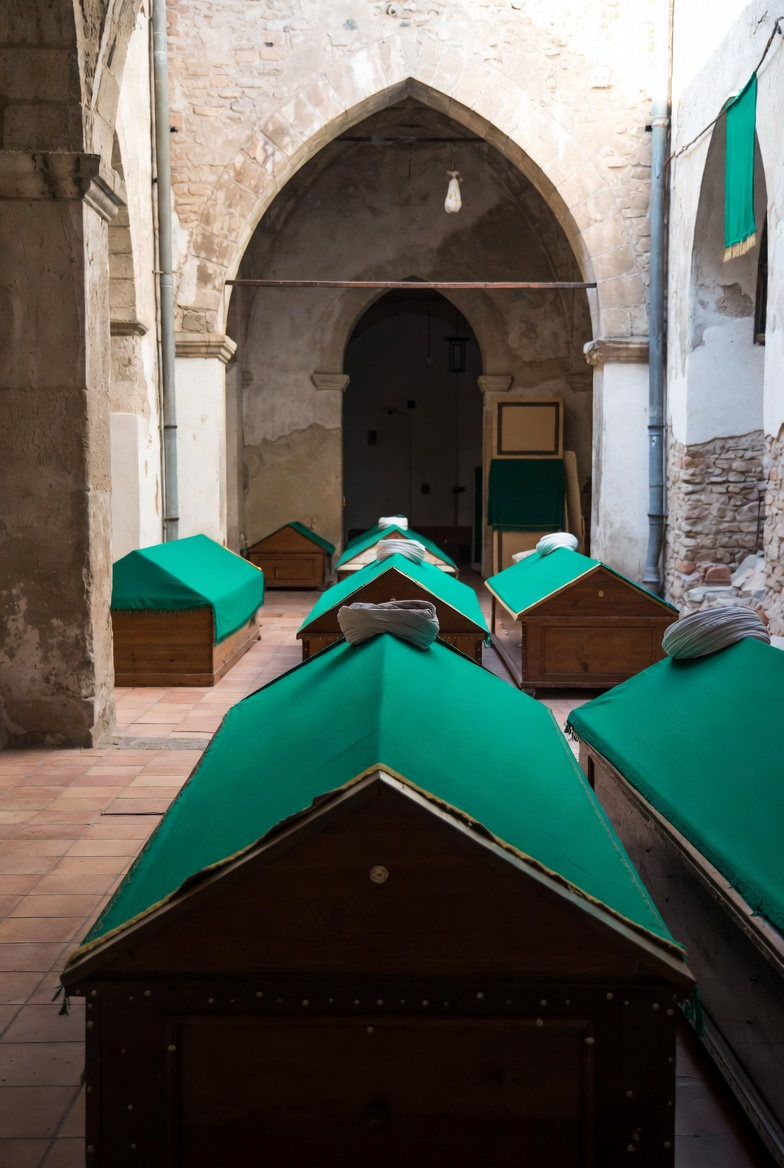
soft green cork oaks. In the open vestibule of the Tekkeh stood
large coffins with gabled roofs, covered with emerald green
cloths. On each of them lay the turban of the person who had
been laid to rest.


 Anarchistbanjo's World
Leave a comment