The Rebirth of Melchior Dronte by Paul Busson and translated by Joe E Bandel
It took a very long time until I recovered from the intense
pain that hit me at the renewed new loss and to regain my
equilibrium.
Soon after this incident, my father fell ill and died,
occupied to his last breath with the care for my and my
mother’s further life. A few weeks later, my mother caught a
severe cold, which turned into a severe pneumonia. I held her
hand in mine until her last breath and had the consolation of
hearing from her mouth shortly before her death, a saying that
was well known to me:
“Thank God, we will meet again!”
Nevertheless, I cried bitter tears because she had left me.
I had long since been offered a well-paid position in the
institution and my modest needs were amply provided for.
In my free time, after careful consideration, I wrote the
long story of my life as Melchior Dronte and this brief
description of the hitherto peaceful existence that I led under
the name of Sennon Vorauf, and provided the whole with a
preface. I now pack and seal the described sheets and will mark
them with the name of Kaspar Hedrich who in the meantime
has completed his studies and, like his late father, has become a
doctor.
He lives in a nearby town, and when the right time has
come, this completed manuscript will perhaps give him an
explanation of my being, and it may be that it will put death in
a different and less gloomy light for him and others than it may
have appeared to them so far.
Some thoughts, which are difficult to put into words, of
whose comforting truth I have convinced myself, cannot be
shared with anyone. Everyone must find them in his own way,
to the beginning of which I believe I have led everyone who
seriously and devotedly strives to explore the truth.
It was about time that I did it. For great misfortune is in
store for those who are now living —.
To the Imperial and Royal Palace – Command Center
in Tirana.
The charge of desertion is filed against the infantryman
Sennon Vorauf, assigned to Searchlight Division No. 128/ B for
unauthorized absence from his post.
Herr Wenzel Switschko, First Lieutenant.
Herrn Wolgeborn regimental physician Dr. Kaspar
Hedrich
Field post 1128
Dear Herr Regimental Doctor! I regret to inform you that
a report has been made to the Royal Headquarters that our
friend Sennon Vorauf has deserted. Dear Herr Regimental
Doctor it is not true that he deserted, but it was like this. I and
Vorauf and Corporal Maierl went for a walk in the Albanian
town of Tiranna, and Vorauf had been acting very funny
already the entire day and all of a sudden I was scared when he
said:
“Thank God we will meet again.”
He was very kind to us and he gave his silver watch to
Maierl and gave me a ring with a red stone.
“Keep this for a souvenir,” he said, and so I said,
“Sennon, what are you doing?”
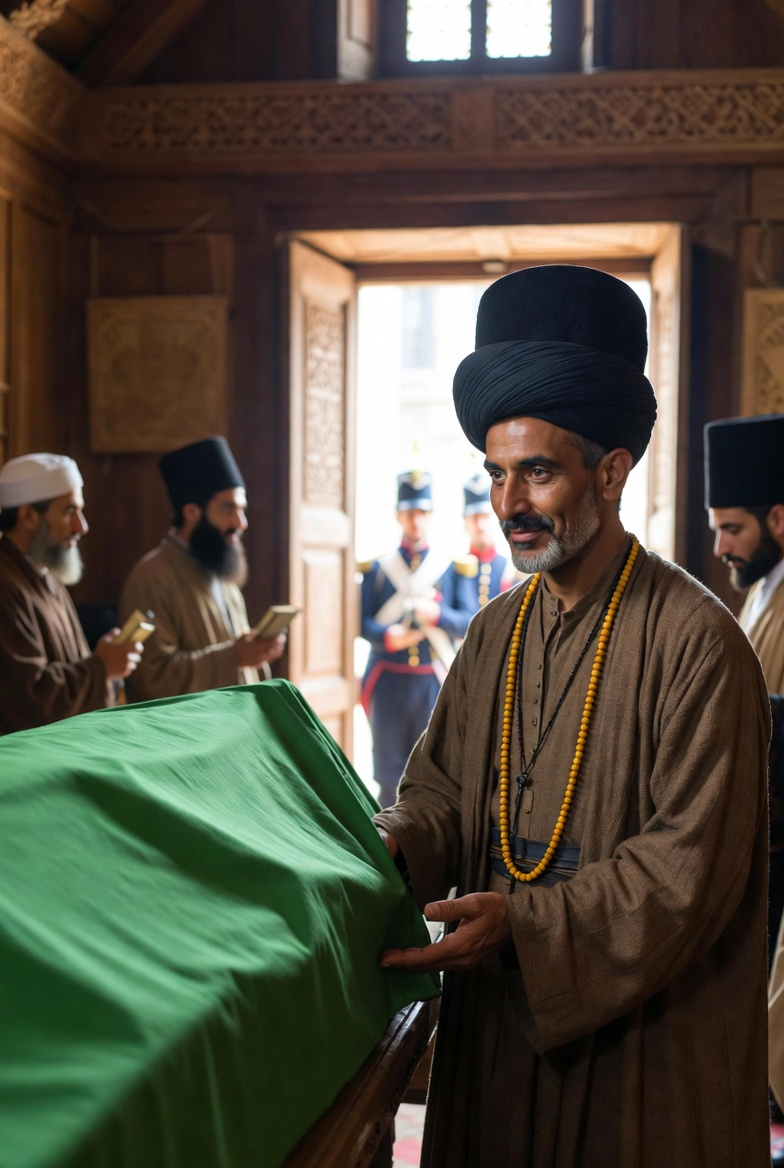
Meanwhile we went to a Tekkeh of the Halveti dervishes,
this one was a wooden house where there were coffins of holy
Muhamedan Dervishes with green cloth on them by the door
and Vorauf said: “I am called,” and went inside.
Then the corporal said, “Vorauf, how dare you! It is
strictly forbidden for soldiers to enter the sacred places of the
Muhamedans, but he went in, so we waited for him and after a
while a dervish came out with a black turban and a small beard,
a handsome man and he had a brown robe and a rosary with a
yellow beads around his neck and this dervish gave us a
friendly greeting, it was strange and we saluted him and again
we waited for a long time, but no one came. So I went to the
house where the dervishes live and in the meantime Herr
Corporal Maierl stayed at the Tekkeh to watch, so one of the
dervishes with a grey beard went along with me to the Tekkeh
and searched for Sennon. Then he returned and said there was
no one inside, so we looked at each other, went home and the
corporal reported to the commander Herr Lieutenant
Shwitschko and then he cried with me about Sennon and today
it’s been five days and there is no Sennon to be found, so only
our Lord knows where he is, and the regimental doctor knows
that he was a dear friend, and you might not know Maierl says
he was a holy man, he did so much good for all of us and gave
away his things. I wanted to report this, and if the Herr
regimental doctor wanted to come it is a whole riddle with
Sennon and I greet you obediently,
Herr Leopold Riemeis. Infantryman, searchlight
128/B.
It is around midnight.
Below my windows the country road runs out into the
flat countryside, endless, gray. The wind rustles in the poplars.
It picks at my windowpanes. Ghost fingers, huh? No, it’s just
the old leaves, which held out so splendidly in the freezing
winter storms and which now the damp wind picks off, one by
one. Down with them! Should one think it possible that I, Dr.
Kaspar Hedrich, a man of exact science, the author of the book
“The so-called occult phenomena. A Completion”, yet here I sit,
a beaten man.
Must I now recant, or what should I begin? Did I see as a
boy of fourteen sharper and better than I do now?
I must go back. I have to get rid of the thick sheets of
paper that my boyhood friend, Sennon Vorauf, left with his
strange, squiggly handwriting, with a pale blue ink, as if the
whole thing were a bundle of letters or diary pages from the
eighteenth century. Did he do this on purpose? It does not
correspond at all with his straight and sincere nature. If ever a
man was honest with himself and others, if anyone was
passionate about the truth, it was Sennon Vorauf. For that I will
put my hand in the fire.
After the horrible war, after all the misfortunes, the
stupidity and hatred that have been brought to my country, I
have returned home. And the first thing I find is this thick, now
unsealed and read pack of closely written pages, which was left
with me while I was with malaria patients in Alessio or Lesch,
as the Shiptars call it, a poisonous and sad summer and was
summoned to Tirana by a soldier’s letter to look for Sennon.
But I have to go back; I have to look at things from the
beginning. Maybe Sennon is looking over my shoulder or is
looking, even invisibly, in at the window. Who can know?
We were together a lot in childhood. In his writings, he
mentions the mysterious incident that took place on the river
journey and in which he saved my life. Also my father, who
had lived in the Orient for a long time, also believed it. He told
me so himself. Only I, I told myself later that a rapid onset of a
cold fever after I had rescued myself from the water-hole had
fooled myself into believing that he had saved me.
And what happened later? I once went very early in the
morning to pick up Sennon according to my habit. He was still
in bed, his mother told me to go in and wake him up. I entered.
Sennon was lying on his back in bed with his eyes open and
staring. His chest did not rise and fall. I saw, already at that
time with the observation of a doctor and practiced it
unconsciously, that his breathing had stopped. I became restless
and put my hand on my friend’s chest. His heart stood still.
Fear gripped me. Was I supposed to go to Frau Vorauf in
despair with the terrible news that her son, to whom she had
been attached with an uncommonly tender love, was lying dead
in bed? Thick tears dripped from my eyes, and I could not take
my eyes off the calm and stylish face of my dearest playmate.
Then it was as if I looked into the fine red mark that Sennon
wore like an Indian caste badge between the curved brows, a
luminous mist seemed to come out of the air and only became
denser as it neared him. But this lasted only a very short time,
and while I was still stunned with amazement at the bedside,
life came back into the rapt look of my friend, his eyes moved,
his usual sweet smile (never have I seen a person smile so
enchantingly as him), played around his lips and as if
awakened he said, “Is it you, Kaspar?”
In the manner of a boy, I immediately informed him of
my just made perceptions and added that I had been on the
point of either calling his mother in or to call him back to life
by shaking him and pouring cold water on him. Then he looked
at me seriously and asked me that if I should ever find him in
such a state again, not to call him to life by force and to prevent
the attempts of others in this regard.
“It is worse than what is called dying, when the thin cord
between soul and body is torn. It is a pain which nothing can
compare to,” he said sternly, and nodded to himself.
I was used to incomprehensible speeches from him. He
often muttered names to himself, the meaning of which was
quite incomprehensible to me, named people with whom he
could not possibly have come into contact with. But I was a
boy, didn’t think much about such things, and thought to myself:
“Today he’s crazy again, that Sennon!”


 Anarchistbanjo's World
Leave a comment