The Rebirth of Melchior Dronte by Paul Busson and translated by Joe E Bandel
“At the risk of disturbing your meditations, I would like
to ask you, with your kind permission, a few more serious
questions, the answers to which I am very anxious to hear.”
With a quiet unwillingness I tried to recognize the facial
features of the interrupter. But I could only determine that he
was no longer young and that his white and very narrow hands
were folded around his knee.
“I am glad to be at your service,” I said quietly, so as not
to disturb the deepening silence.
The unknown man moved with his stool close to me and
whispered, as it seemed to me, in some agitation:
“All of us, who are here, so far as human calculation is
correct, will be sentenced to death in a few days. In the
certainty that our life, which would lead anyway to annihilation
will now be completed more quickly than nature demands,
there is nothing frightening for me. Another question worries
me, my lord. What happens, when the path of life, which leads
from the brain to the most distant and smallest parts of the body,
is cut by the axe?”
“Any doctor can tell you,” I answered.
“What happens is what we call death.”
“What we call it!” hissed the stranger close to me. “But
have you never heard that the severed heads are still alive? Do
you know that they move the eyes, the hairs stand up straight
against the walls of the basket? That they look in the direction
of the caller, when their name is called, and form clearly
recognizable words with their lips when they are asked? How?
Come to me, esteemed one, but not with Doctor Galvani’s frog.
Here we are talking about the ability to think, to be conscious–
“
“The problem is idle in a higher sense,” I said, “even if
we assume that the cut-off head still thinks and tries to act, this
lasts only a few seconds as a result of the lack of blood supply.
Then the standstill is there.”
The man slid his stool even closer.
“Good, good,” he said excitedly. “Let’s not bother with
that. It is indeed of little importance. What however, is death?
Is it the death of the body and the freedom of the soul, or are
the body and the soul so much together that one dies with the
other? Can you give me a comforting answer?”
The last words sounded like a plea. It had become
completely quiet in our dungeon, and nothing could be heard
but the stomping of the guards in front of the windows and a
soft whistling, the breath of the sleepers.
“Since you seem to be interested in the opinion of a
stranger, I will answer you. Now then, my dear Herr, I believe
that after death, the soul is separated from the body and enters
the eternal life from which it comes,” I said in a muffled voice.
He shook his head vigorously.
“The priests of all creeds say such things. But no one can
imagine what they are really saying. What do you mean:
Return to eternity? Without the artful apparatus of the brain,
the soul is incapable of expressing itself. What becomes of it?
A vortex of air, a cloud of smoke, transparent ether? Where
does it go?”
“It goes into a new vessel.”
I felt as if someone else was speaking out of me. I had
never thought this thought, and yet now it was there as if I had
always carried it within me.
The other laughed unwillingly.
“Into a new vessel, that is, a new body! Here is already
the absurdity. The number of departed are so great that not
even a thousand of them can find a new home.”
I listened to the inner voice.
“Whoever can preserve the consciousness of his earthly
existence beyond death will be reborn in a human body. That is
my belief.”
“And if it succeeds – how often would such a return have
to take place?”
“As often as needed until the soul is purified,” I replied,
moved.
“And then?”
“Then the soul rests consciously in God.”
The man struck his knees with his fist.
“Always the same old stories! Purified! Pure! And the
hatred? The burning greed for revenge, the rage beyond the end,
the hope to retaliate a thousand fold?”
“These are all impurities that must fall off,” I repeated
what my inner voice said. “In the purification of purgatory -“
“Purgatory?” he cried out. “You talk like a Catholic priest.
Where is it supposed to be, this fabulous purgatory?”
“Here, it is life. Life in human form or -“
“Or?”
“Or in the body of an animal,” I said, and saw in my
mind’s eye how tears were streaming from the parrot’s ugly
spherical eyes.
“But these are theories. I want certainty -“, my late
companion insistently demanded.
“There is only one certainty: that of feeling.”
“Faith, then, my lord.”
It was I who spoke thus.
“Fairy tales, my lord, fairy tales. I will tell you what is
after death: nothing is. And that’s the terrible thing, this
extinction of being. To have never been! It is horrible. And I
don’t need to believe in it. I know it.”
“I’m sorry I couldn’t bring you more comfort,” I said, and
was seized with intense pity.
“It is my fault,” he defended me politely. “A few days
ago I spoke to ‘Abbe Gautier before he was executed. An old
man with white hair, a worthy priest. He was struggling to find
a hunchbacked quack- who had been convicted of common
crimes, and pointed him to the infinite, eternal goodness of
God. But the Italian with the hump would have nothing of it
and kept shouting:
“Niente! – Finito -nulla. Nix immortalita – o Dio, Dio!”
“Then why did God call upon him?” I asked.
“Out of habit, I guess. That good Abbe Gautier said about
the same thing as you. I envy him and you. Sleep well!”
He slipped into a dark corner with his stool. I heard him
sigh deeply.
A bunch of keys jingled. The iron door creaked open.
The sleepers groaned unwillingly, turned around, and muttered
unintelligible words.
A turnkey, carrying a large, dimly burning lantern,
entered, and followed by a commissar with a tricolor sash.
Carefully he examined the paper that the official had handed to
him, and then called out half aloud:
“Citizen Dronte!”
I stood up and saw the commissar make a violent
movement of surprise or of joy. He took the lantern from the
overseer’s hand, motioned for him to stop at the door, and came
quickly towards me.
“I am Commissar Cordeau!,” he said hastily and quietly.
It was Magister Hemmetschnur whom I had taken from
Krottenriede.
“I can only stay for a minute,” he repeated in a
monotonous, indifferent voice, while the lantern in his hand
clinked and trembled.
“I went to all the prisons when I found your name on the
list. This is the last one. I know everything. As many of the
cursed Aristocrats I have sent to the Orkus. I would go back to
being the poor miserable Hemmetschnur on Krottenriede if I
could save your noble life, which is so dear to me. Do not
move, do not speak. There are spies in every dungeon, even
here. I’ve spoken to the chairman of your tribunal. The charge
is false. It was not your intention to free Lamballe, but rather as
a loyal supporter of the Republic, you wanted to prevent the
ignorant people from a rash act through which the discovery
and exploration of the dangerous plans in which the princess
was involved are now forever impossible to determine. They
will believe you. You were providing an important function
that will protect you forever. Do not move your head. You must
accept. Otherwise, you will be lost. If you have not understood
me, clasp your hands together as if pleading. You don’t? So you
have understood everything. Now a necessary comedy begins.
Do not be frightened of me, who would like to kiss your hand.”
And with a loud voice he continued, “So you refuse? You want
to know the whereabouts of the escaped traitor? Good. You will
stand in front of your judges tomorrow. Don’t forget that the
lictors’ bundle also contains a hatchet.”
Seemingly angrily, he stomped up and waved at the
turnkey.
“Citizen Gaspard! You’re liable to me for this dangerous
person!”
The turnkey shone his light in my face and grinned:
“This head is loose! I’m getting the hang of this thing,
Citizen Commissar!”
Laughing, the magister slapped him on the shoulder, and
they both left the dungeon. The door slammed shut with a thud,
the key rattled.
“Francois!” scolded one in his sleep. “See, which of the
cursed peasants drives over the inner yard.”
Then there was silence. The darkness dripped down like
pitch.
Before me in the darkness I saw the face of Isa Bektshi.
The kind gaze was directed at me. The narrow scar between the
eyebrows shone like the dawn.
“I will not lie,” I said to myself.
I saw nothing but the black night and I stretched out on
the thin straw of the floor to rest a little. After breakfast, which
the turnkey brought in on his board, a commissar appeared
with several soldiers and brought three of us, including me, to
the court session.
A young, pretty woman, who had mostly been sitting on
a cot, crying, and had received little notice by the ladies in my
prison, was brought in with me and a tall, very haughty looking
man in a dark blue, gold-embroidered jacket and white
stockings was led away. The name of my fated companion I
had not understood when I was introduced yesterday. The only
thing that struck me was the deference with which the
aristocratic prisoners had treated him, and his careless,
condescending manner with which he had spoken a few words
to this one, then to that one, while he hardly noticed me. I was
walking behind these two, the woman and the haughty man; I
was walking alone between two soldiers who had been
specially commanded to guard me. We were led through a
narrow, terribly dirty alley, in which all kinds of garbage rotted,
to an old building, over the archway of which fluttered the
three-color flag. Then we reached a corridor into a low, very
large room, and had to pass behind a freshly painted cabinet,
smelling of fresh oil paint and then stopped.
The inner elevation, in which I had spent yesterday
evening, was gone from me. The thought that this day was to
be one of my last lay heavy as lead on me and filled me with a
dull ache. Even the inanimate objects around me took on a
strange and unfamiliar ghostly form, and even the early
morning light that shone through the dirty windows had a
mysterious reddish glow.
When a soldier motioned for us to sit down, I was given
the seat between the young woman, who from time to time
sobbed violently, and the gentleman in the blue jacket, who
looked before him with a stern and unapproachable face,
without paying any attention to anyone. Now and then he
would pull out of his pocket a gold can in the shape of a pear
and sniffed it with an extremely affected movement. In front of
us stood a heavy table with carved legs, on which everything
necessary for writing was piled up. On the walls lolled pale,
long-haired soldiers, some of them wearing wooden shoes on
their bare feet, and blowing foul-smelling tobacco smoke from
their lime pipes. They only changed their comfortable position,
when a rumbling drum roll outside the door announced the
entrance of the revolution tribunal.
We were compelled to stand and wait until the judges
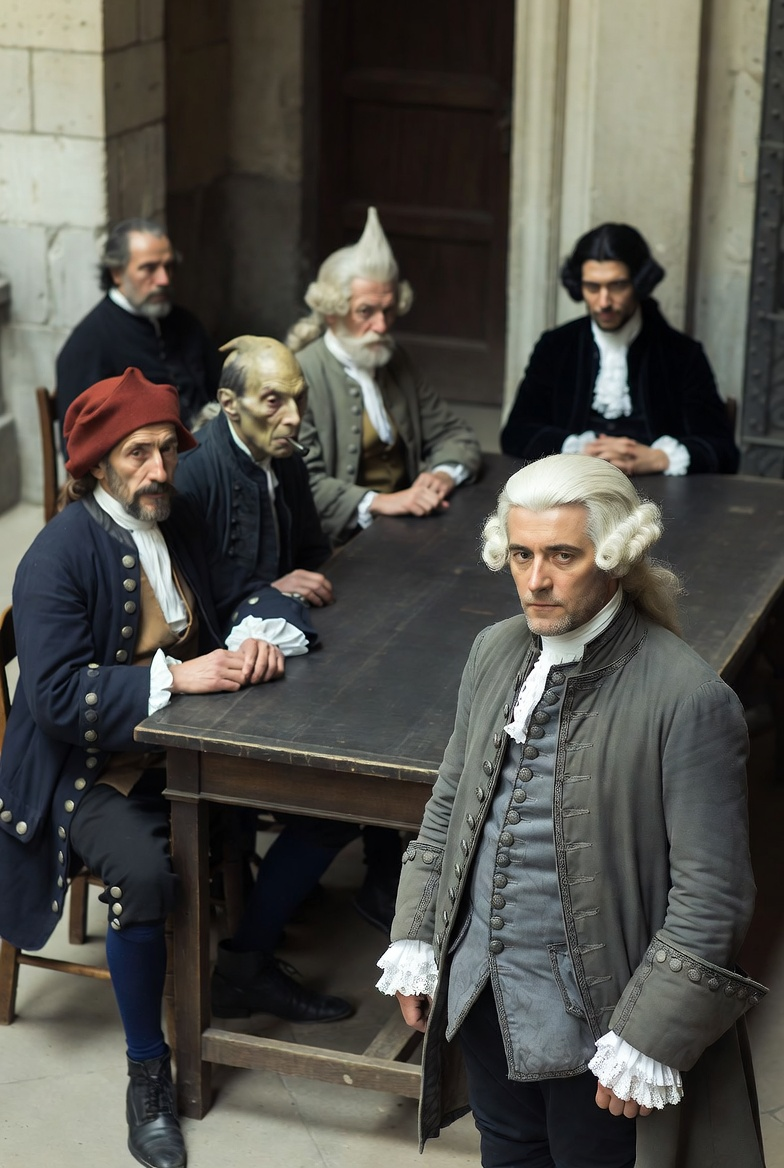
were seated at the large table. I looked at the men who
presumed to decide on the duration of the lives of others. The
first at the table on the left was a craftsman with badly cleaned,
hands, whose imprint was visible on the rim of his red cap. In
the middle between him and a constantly coughing, obviously
sickly person with pointed, gray-yellow face, was enthroned a
black-haired young man of peculiarly impudent, but not
unhandsome appearance. His restless, dark eyes sparkled under
strong brows, and his long, carefully stranded hair under the
two-cornered hat hung down to his shoulders. He stretched his
legs, clad in white pants and boots with cuffs, far under the
table, waved to an acquaintance in the densely packed area in
the back of the room, and then rummaged with a pile of files
that lay in front of him. Then he spoke a few half-loud words to
the sitters and to the skinny clerk at the narrow end of the table,
propped his elbows on the tabletop, rested his chin on his
clasped hands and looked at us in turn with a look that seemed
to command the highest respect.


 Anarchistbanjo's World
Leave a comment