The Rebirth of Melchior Dronte by Paul Busson and translated by Joe E Bandel
They had known how to prevent it, if one took them as
symbols of a caste, prevented people from reaching the heights
of a decent life. Again and again shoved the unfortunates into
their doghouses and holes, pressed them into the fronts, and in
shallow dalliance mocked the muffled cry from the depths. At
last, when even the excessively rich resources that had been
withdrawn from the others, ran out, they heaped up the grain of
the fields into locked barns, in order to sell sparingly and with
usurious profits to the starving, during the coming famine.
They had forced a painful bridle between the teeth of the
desperate and tightened the reins, while their whip tore bloody
weals. Thus the masses had now finally burst their bonds in
insane rage and torment, and the dull masses had acquired a
flaming will: the will to destroy, to slaughter, to tear to pieces
the wanton, the tormentors and to wipe them off this earth
forever. Who but knew how to read the people’s faces, in those
faces, in their ignorant and still astonished expressions, he
knew in retrospect that the power that had been shattered, if it
had been used with a little kindness, with wise prudence
humanity, would have endured for a long time and could have
achieved a bloodless, peaceful transition to a more just
distribution of goods. But so it was, as if these kings, dukes,
counts and rulers of all kinds had undertaken the ludicrous
attempt to see how long and to what extent they could torture
patient people, until they would finally rise up against the
burden of tortures. And yet I also felt sorry for them.
I was soon awakened from my thoughts by the senseless
and agitated pushing after me of those who also wanted to be
part of the sad procession.
I was startled when, with a jerk, everything stopped and
the people flowed apart. We had arrived at a not too large
square surrounded by old, steeply gabled houses with
blackened walls; my feet almost sank in a sticky, dark mud that
covered the ground, and I had to find a somewhat elevated spot
on the pavement to escape the vile swamp, whose foul-sweet
haze enlightened me about its nature. Around me was a wild
roar and murmur of voices. All the windows were crowded,
and from there cloths were waving to acquaintances on the
street.
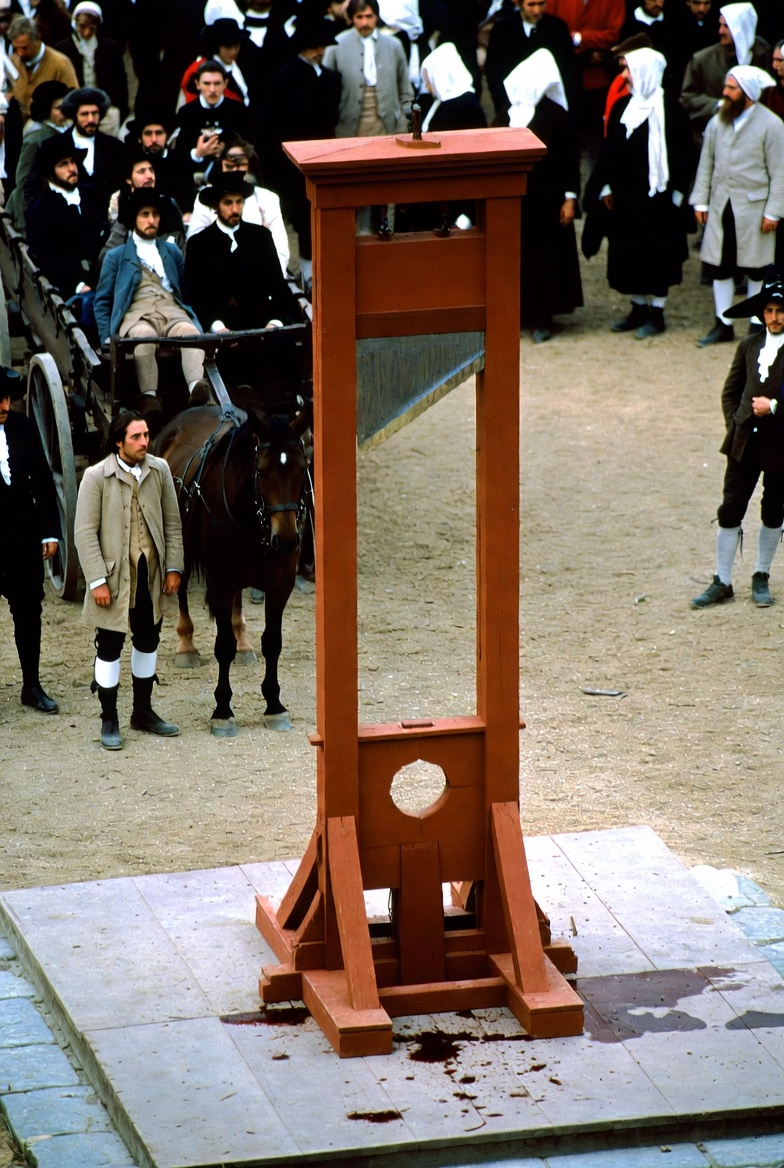
Just in front of me, in the middle of an irregular square,
towering over all the heads, hoods and hats, stood a slim,
reddish-brown, two-footed gallows, on which at the top under
the crossbeam, the drop knife hung slanting and flashing. The
posts, between which it ran, shone dark and greasy in the
daylight, so much was the wood smeared with blood and
human grease. The condemned men rose stiffly and with great
effort from the seat boards of the cart. A horse neighed,
scenting the haze of the square. The poor condemned who had
arrived at their final destination now helped each other politely
and courteously to dismount, the old clergyman made an effort
to help the crippled Doctor Postremo, who was making terrible
faces and chattering with his teeth. I saw the white-powdered
hair of the other and the hunchback’s fuzzy head walking the
narrow alley between the soldiers. The doomed men quietly
and slowly climbed the small staircase up to the blood scaffold.
Abusive words flew at them, fists were shaken, ugly, fat market
women, who stood in the front row, sitting on benches knitting,
were even telling dirty jokes.
I saw exactly every single face and except for Postremo,
who grimaced, they all looked with a stony attitude in face and
gesture towards what was coming. The ring of people around
Guillotine’s machine found itself in grinding motion, and I was
gradually pushed very close, so that the victims stood with
their faces turned toward me. I wished myself far away, to get
rid of the terrible pressure under my heart, with which the sight
of such sad preparations tormented me. But I could not move,
as I was wedged so tightly, I could not even turn my head away
from the tangled hair of an unclean woman who smelled of
garlic, and I had to be sneezed on from behind by a man who
had caught the sniffles. But these small adversities quickly
faded before a nameless horror.
Now a giant swung onto the scaffolding, whose sight
surpassed in meanness everything I had ever seen in my varied
life. On tremendously broad shoulders, over a naked, red-
haired chest and muscular arms rose the face of a devilish
monkey with bared teeth, maliciously glowing eyes and a fiery
comb of red-yellow bristles. Samson, whose portrait I had seen
in a bookstore, it was not. I knew that he was indisposed and
that his first assistant was standing in for him. Horror seized
me at the sight of this guy.
This man-beast, who was followed by two crude-looking
figures grinned, licked his blue lips and then pointed with a flat
thumb at Postremo. The two guys behind him pounced on the
hunchback in an instant, who kicked with his feet, hissed
incomprehensible words and pulled his misshapen head even
deeper into his shoulders. They tied him with lightning speed to
a vertical board, and tipped him over, so that the helpless man
was lying with his chin on a double board, cut out in the shape
of a semicircle, the upper half of which was now pulled down
between the posts and pressed down. A shiver ran through me,
as the red-haired, blood-black hand of the executioner pushed a
protruding knob in the post. The guillotine whistled down.
Something jumped into a basket, the hunched body twisted,
writhing, and flapping its feet, just as poor Bavarian Haymon
did under the murderous ring, and from a huge dark- red
wound, from which a flashing semicircle seemed to hang,
blood gushed out in thick streams, which then gurgled and ran
heavily down the side wall. The executioner’s hand reached
into the basket, lifted the head up high by the stained, white
hair. The axe had not reached the neck, and so the lower jaw
was severed and hung separated with the semicircle of the teeth
on the body, so that I once more saw the mutilated grimace of
the doctor. And this hideous head slowly drew the eyelid over
the right eye, as if he wanted to wink at me.
“It’s not pretty, citizen – but how could he have dressed
up the hunchback angel maker any other way?” said a
craftsman next to me, pulling out a flask from the upper,
opened part of his burn-stained apron smock. “Here, drink once
this will keep the food down if it wants to rise from the
stomach!”
I took a sip of the pungent and burning juniper brandy,
and the trickling warmth inside gave me strength. Once again I
looked around me to see if I could not escape from what was
coming, but it was impossible to squeeze through this wall of
human bodies. A wall was around me that no one could have
penetrated.
So I had to witness the execution of all six condemned,
and each time the leathery clap of the falling knife sounded, I
trembled from my head to my feet. The cold sweat broke out
and my legs trembled violently. The last of the crowd, after the
old lady, who died quietly and without any movement, came
the officer of the Flanders Regiment, who had remained loyal
to the king the longest. He placed himself at the board. While
the executioners nimbly fastened the blood-soaked straps
around his body, he looked at the blood man’s face with eyes
flashing with anger and said loud and clear:
“Do not dare to hold up my head with your paws, red-
bristled pig!”
But the executioner just pursed his bulging lips, waited
for the overturning of the board and the clasping of the neck in
the hole formed by the two semicircles of the double boards,
dropped the axe that the two blood fountains sprang from the
stump of the neck, and reached into the basket.
But immediately, with a grunt of pain, he pulled his hand
out of the basket and flung his index finger rapidly back and
forth in the air, as if he had touched red-hot iron. In a senseless
rage, he kicked the basket several times with his foot, so that
the severed head bounced and jumped in it. Then he hid the
finger of his right hand in his clenched left hand and uttered a
blasphemous curse.
“The aristocrat bit his finger!” The man with the apron
smock shouted. “They are not so easily killed, these haughty
ones!”
Then, as if a bright light shone on me from heaven, I
thought of Isa Bektschi and the parable of the beheaded
evildoer, who used the last of his last strong will with a similar
thought of revenge.
Meanwhile, one of the servants, a jaunty black man,
jumped up to the basket, looked inside, at which the bystanders
had to laugh, and, grasping his hair with two fingers, lifted his
head out. The eyes of the dead man looked half-closed,
contemptuously staring at the gawking crowd, and a thin red
stripe ran down his chin.
Cursing, the redhead climbed down from the scaffold.
In the depths of my soul, I understood the effort of the
priest, perhaps not entirely comprehensible to himself,
although he eagerly displayed it, with which he exhorted the
dying to focus all their thoughts only on eternal bliss,
repentance of sins, and the continuation of life in God, and to
do away with all thoughts of revenge and earthly desires. What
immeasurable wisdom lay hidden in this need, what promise
and what consolation! An indescribably joyful knowledge
glowed through me when I thought of such things and I almost
regretted that my own path had not ended here.
Now that there was nothing more to see, the crowd
loosened and flowed away, getting lost in the side streets. The
windows closed, and the two helpers appeared with water and a
cart on which they loaded the dead remains of the executed in a
crude manner.
I still stood spellbound in my thoughts of Isa Bektschi’s
words, which he spoke to me, when I lay ill in the haunted
room at Krottenriede, when I felt that someone was looking at
me.
When I turned quickly, my eyes met those of a still
young man with a brownish face of regular cut and dark eyes,
from which an extraordinary willpower flashed at me. A great
power emanated from this gaze, with the strange, austere
beauty of the face and the harsh mouth that harmonized.


 Anarchistbanjo's World
Leave a comment