The Rebirth of Melchior Dronte by Paul Busson and translated by Joe E Bandel
Among the otherwise light-hearted and good-natured
people were mingled at that time riffraff and tavern scavengers,
who were only interested to fill their coffers, to drink, to
fornicate, to whore, to splurge and to murder. Also even among
the leaders, many of whom meant well, they were swamped by
those who would use any means and who stirred up the
common instincts of the crowd in order to make himself
popular with the plebs. A gentleman of my standing would be
better in the safety of home, instead of traveling in a country
where there is neither discipline nor justice nor security. I
would soon see that a limited measure of freedom is like a
fortifying drink of good wine, but a mad exuberance like the
exuberance, however, as it reigns here, is like senseless
intoxication and insanity.
This kind of expression in a mail coach driver surprised
me; however, his expression and posture told me that he
belonged to the educated classes. And so I addressed the
question to him, how it comes that a man of such politesse
could not find any other position than that of a stagecoach
driver.
The coach driver smiled and said:
“Don’t bother addressing me as a gentleman! During this
time I am quite modest and observe as a philosopher that which
I cannot prevent. Who in such times holds his head too high
can easily lose it, and since I only have this one, I am worried
about it and on my guard. – Forgive me, mein Herr, but the road
is getting so bad that I must turn my attention to it.”
With these words he turned and seemed to pay attention
only to his reins and the trotting of the horses. But already the
nonchalant posture of the reins, indicating great practice and
the noble certainty of his movements told me, from which
social class my coach driver came from.
In front of a town, which we were approaching, we were
stopped by a strong group of armed peasants, who, they
claimed, had been assigned to guard the road. One of them
grabbed the reins of the horses, which were walking at a walk,
while two of them, with their muskets extended, stepped up to
the coach.
But the coach driver, about whose fine and educated
nature, I had just voiced my thoughts to, spat in a vulgar
manner into his hands and shouted in the lowest dialect of the
area:
“You dung-scratchers and filthy beetles, you lice-pack
want to dare to stop a citizen commissar? Death over my life, if
I don’t bring you under Doctor Guillotine’s machine, you
thieves and skunks! Away, by the fiery claws of the devil, or I
shall ask the citizen commissar in the coach to write your
names in his pocket-book!”
Immediately they drew back, pulled off their greasy hats
and shouted:
“Long live freedom!”
Our coach rolled on. The driver laughed to himself.
“What did you say about the machine of Doctor
Guillotine?” I asked him.
“Ah – have you heard nothing of it? Imagine that they put
you on a board between two beams. High above hangs a knife
with a slanting edge, which falls and separates the head so
neatly from the trunk as if it were only a head of cabbage on a
thin stalk. It travels around the country, the machine of Father
Guillotine.”
In my mouth was suddenly a tepid, sweetish taste, which
almost made me sick. It was the air in this country that I had in
my mouth. It tasted like blood. And with a second-long freeze I
thought of the words of Demoiselle Köckering, her shrill cry–
“A knife hangs – falls -‘”
In the city, whose gate lay before us, a bell began to ring
low and menacingly: Death-Death-Death-Death.
My fear vanished as quickly as it had come.
“Non omnis moriar,” I said to myself.
“I will not die completely!”
I was standing under the archway of the Paris house
where I lived and looked down the street.
Muffled sounds came closer. Whistles, shrill laughter.
A bunch of soldiers in various uniforms, red and white
striped, dirty trousers on their legs, crushed hats with the new
cockades on the long hair, came down the street with
shouldered rifles. Two barefoot ragamuffin boys ran forward as
drummers. On one of the two drums I recognized the scratched,
colorful coat of arms of the Esterhäzy regiment.
Behind the soldiers ran a large crowd of people, girls,
men, women and children. Among the people one saw ragged
prostitutes, fellows with murderous clubs, tramps, and lowly
rabble. In the middle of this throng swayed and bumped a high-
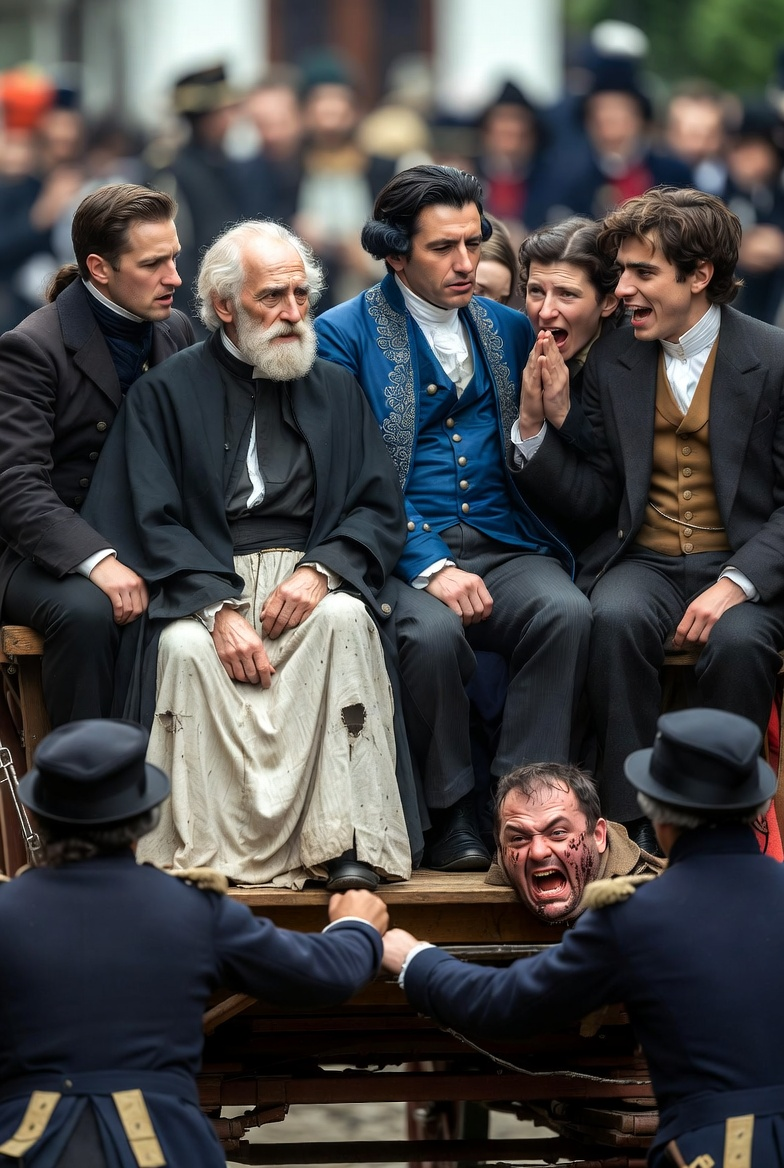
wheeled cart on which six people were sitting. The first one my
eyes fell on–
Merciful God!
The cart stopped because the procession was stalled, and
I looked closely.
The first one I caught sight of was Doctor Postremo.
A shiver of fever shook me.
He was sitting in front, with his hands tied behind his
back. His now snow-white ugly ape-head with coal-black thick
brows and whiskers sat deep in his shoulders.
His eyes were filled with mortal fear, and his broad
mouth stood wide open.
Doctor Postremo!
“Samson won’t be able to cope with that hunchback!”
The crowd shrieked with laughter.
“They will have to pull out the pumpkin for that one!”
answered a second. “Hey, old man? Don’t you think so, turtle?”
Postremo made a ghastly face, closed his mouth,
gratingly moved his jaws, and then spat in the face of the man
who had addressed him.
A burst of laughter flew up.
“Bravo! Good aim, hump!”
Two soldiers pushed back the angry man, who, with his
disgusting face covered in spit, wanted to get on the cart. Next
to the Italian sat an old, venerable cleric in a torn cassock,
behind him was a stern-looking man in a blue silk jacket
embroidered with dull silver, and a gaunt lady who moved her
lips in prayer. The last seat on the cart was taken by a former
officer from the Flanders regiment and a young man, smiling
indifferently and contemptuously in a morning suit. The officer
bit his lips angrily and said something to his neighbor, who
answered with a shrug of the shoulders.
Immediately the cart started to move, rumbling and
skidding into motion, and the crowd sang a wild song unknown
to me, that roared down the alley. The soldiers put their short
pipe stubs on their big hats and sang along enthusiastically.
Without will, driven forward by an irresistible force, I
stepped into the middle of the crowd behind the executioner’s
cart on which sat the wretch who had robbed me of the
happiness of my poor miserable life with his satanic arts.
Nevertheless, I felt no resentment against him, as much as his
look reminded me of the greatest pain that I had ever suffered.
But now I felt as if he had only been the tool of an inscrutable
power which had directed everything as it had come. It also
seemed to me that the terrible end to which he was now rolling
toward on the shaking seat of the cart was not in the light of a
punishment that had been executed on him, but as a redemption
for this poor, wicked spirit, bound in a misshapen body.
Between these more foreboding than clear thoughts, was the
inexplicable feeling that moved all the people here, the terrible
and unfathomable desire to witness a terrible operation on
others, which in this time of great death and uncertainty of all
fate, excited great interest because without a doubt many of
those who today walked along freely and safely might in the
very near future experience the same.
In these minutes, the revolution, which I had longed to
see close up, was seen as something unspeakably horrible and
terrible. It was as if one had unleashed vicious animals against
sentient human beings, creatures of the lowest kind, which
cannot get enough pleasure in the suffering of their fellow
beings, as if demons from the depths had united, to eradicate
their former tamers and rulers and with them to exterminate
every order. What I saw in the reddened, eye-twinkling,
distorted faces around me was not humanity. Then I saw the
young nobleman and the officer on the rearmost seat, but also
from these victims a cold wave flowed toward me. They were
evil in their hearts to the last. It was obvious that to them the
people in the street were the same as the cobblestones, the dirt
that stuck to the high wheels of the cart, or the half-starved dog
that yelped and jumped around the harnessed mares.
In my desolate misery and in the burning pity that almost
burst my heart; I nevertheless knew clearly that in the last
feelings of these two on the cart lay all their guilt. They had
despised all people, God’s creatures as well as they, all their
lives and still despised them in their own bitter hour of death,
because they were unclean, uneducated, sweaty and lousy.
These nobles did not consider that their own insensitivity had
made of them what they were: a horde of half-animals, who
had to defend themselves against the cruel scourge of poverty
and being outcasts.


 Anarchistbanjo's World
Leave a comment