The Rebirth of Melchior Dronte by Paul Busson and translated by Joe E Bandel
“A knife hangs – falls -. -Ah!”
A shriek came from her mouth. She squirmed in her chair,
half opened her eyes, so that one could see the whiteness,
jumped up briefly in the chair and fell back heavily.
Everybody had jumped up.
“A hysteric,” someone said loudly.
“For today the demonstration is finished,” sounded the
voice of the man standing next to her. “I hope that the
gentleman has not been left unsatisfied, namely the gentleman
who has had his rooster stolen.”
Someone gave a forced laugh.
Everyone was pushing towards the exit, pursued by the
sneering looks of the pale man.
I looked around once again. The girl was awake, looking
around confused and astonished.
A shiver ran down my spine, as if death were standing
behind me. We hastily descended the stairs.
“It’s a pity I didn’t ask to know the day of my death,”
crowed Magister Fleck. “Could have made my dispositions in
good time.”
“You did well to omit that question.”
It was Doctor Schlurich who spoke these words.
No one made any reply.
In the thick, gray river fog that rolled through the streets,
we parted.
Silently I walked next to Doctor Schlurich.
“I suspected that she was deceiving me. But it hurts when
you know for sure,” he said softly.
He shook my hand and disappeared around the next
street corner.
Far and near sounded the calls of the patrols and
watchmen.
“A knife hangs – then falls -“, The Pythia had shouted.
Icy cold crept under my coat and shook me. The handle
of the bell pull at the inn was a small, brassy hand, a small,
cold hand of death.
When my extra mail coach had crossed the French border,
and the horses had to be fed and watered in a respectable spot, I
went to the inn and had an egg dish prepared for me.
The tables around me were full of people. Carters,
peasants, merchants, burghers and craftsmen were discussing
with all the liveliness of their nature the latest incidents, the
increasing frequency of executions. Recently, very close to this
place the castle of a very haughty and extremely hard-hearted
Viscount against lowly people, was stormed by the peasants
and after a thorough plundering was set on fire. Some of those
who drank the thick red wine openly boasted of the deeds they
had committed.
When I heard how beastly the people had been in the
priceless library and in the picture gallery of the castle, how
they had used the porcelain as chamber pots before smashing it
as night crockery, I had to think of the words of Doctor
Schlurich, who warned me against observing revolutions at
close range. Then, when a very ugly, badly scarred fellow
started to boast, bawling, how he had speared “Bijou”, the
favorite dog of the lady of the castle, on a pike and carried it
around squirming alive for an hour whimpering, until it finally
died in pain and fear, I was seized by a furious anger against
this two-legged beast.
But immediately, like a black cloud, the memory of a dog
fell on me, whose faithful love I had destroyed in a senseless fit
of rage with a deadly stone throw. No, I had no right to be a
judge, even though I had only acted in a violent fit of temper,
but this man, however had acted in diabolic malice.
Tormentingly the thought rose in me that there were people
who were evil by nature -. What should happen to them?
“Melchior Dronte!” fluted a repulsive voice. “Melchior!
Beautiful Melchior!”
I was so frightened that I almost knocked my wine glass
off the table.
I looked to where the voice had come from, and saw an
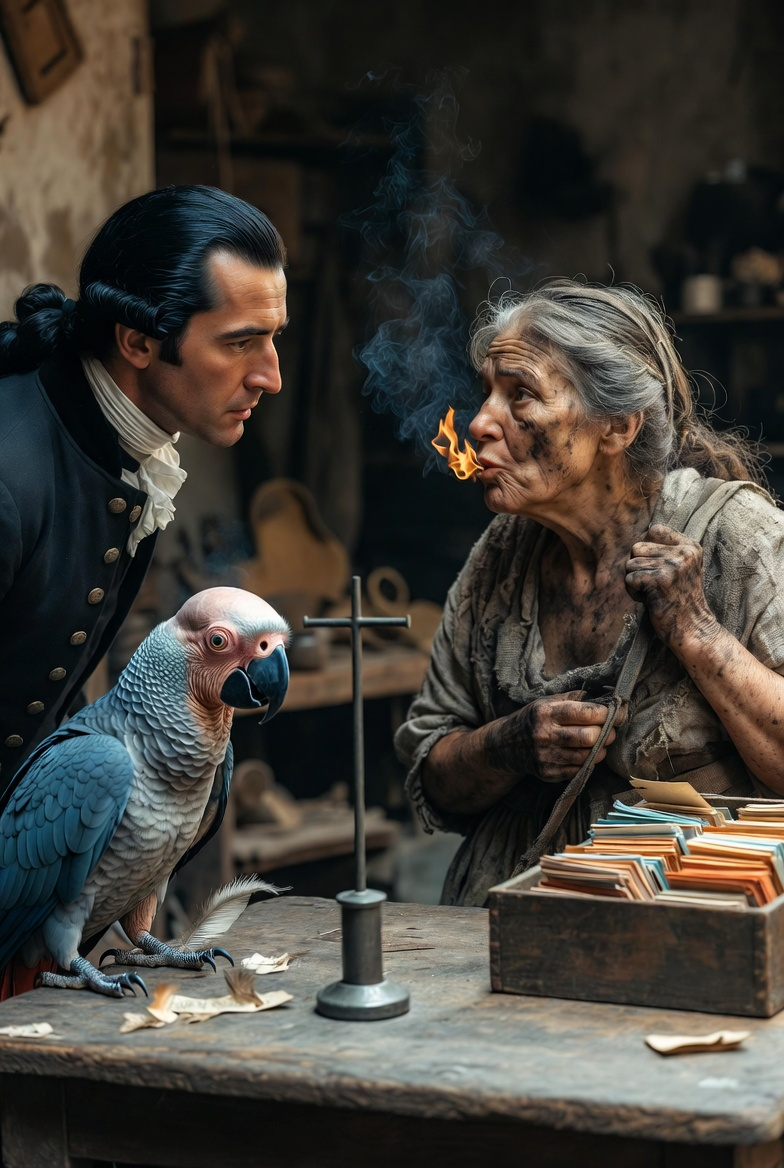
old woman, covered with dirt and rags, sitting at a table. She
had a box of multicolored slips of paper sitting next to her,
from which a short pole with a crossbar was sticking up. But
on the wood sat a parrot, in whose blue-gray, wrinkled skin
only a few quills were still stuck, while the large head with the
rolling eyes was wrinkled and completely bald. The woman,
noticing my gaze, hurriedly stood up, approached my place and
after she had slung the strap over her shoulder, blew her
burning breath into my face:
“Beautiful, young Herr, Apollonius will tell you
prophesy!”
Despite her pitiful appearance, the dripping drunkard’s
nose and the inflamed eyes I recognized in her the beautiful
Laurette and in the parrot, the monster of the Spanish Envoy. A
sharp pain went through my heart when I compared the image
of Sattler’s Lorle against this gruesome, lemur-like apparition.
Although the infernal parrot had called me by my name, there
was not a spark of memory in her poor, devastated face. Instead
I recognized in the squinting look of the bird such a rage that I
could not free myself from a feeling of fear. The dull, old
woman, who had once been young, rosy and innocent in my
arms, looked at me out of half-blinded eyes and repeated the
slurred phrase from before. I slipped a coin into her gouty
fingers, which she put in her mouth in a disgusting way for
safekeeping, and I saw with satisfaction that for the time being
no one was paying any attention to us.
“Sicut cadaver -,” chuckled the bird. “Kiss her like a
corpse, fair Melchior!”
I approached him and said, as if speaking to a human
being:
“May you soon be redeemed, poor soul!”
Was it really I who suddenly found these words?
The parrot looked at me with a fixed gaze. All malice
disappeared from his eyes, and two large tears rolled down his
beak, as I had seen before. It was eerie and poignant beyond
measure.
“Misericordia,” he groaned. “Mercy!”
And then he hurriedly climbed down the short pole,
rummaged back and forth with his beak in the colorful papers
and grabbed a fiery red one, which he held out to me.
I took the paper from his beak and gave the poor Laurette
a gold piece and nodded to her.
Not a ray of remembrance flickered in her features.
With her box, on the crossbar of which the parrot
lowered its head on her bare breast, she shuffled to the nearest
table.
“O mon Dieu!,” cried the parrot, and the hopeless tone of
this lament went through my marrow and legs.
“Keep your basilisk quiet, you old bone box,” cried a
carter in a blue smock at the neighboring table. “No one
understands its own words. There are no loud aristocrats here,
who take pleasure in such silliness!”
“Why don’t you turn the collar on that stinking grain-
eater, Blaise?” shouted a miller’s boy covered in white dust.
“And if you get your hands on an aristocrat, by the way –
I’ll be happy to help you!” he said, half aloud, with a wry look
at me.
Startled, the old woman limped away from the table and
huddled in her corner again.
I observed the people, who were mainly given to boastful
speeches and certainly not all of them were malicious, and
drank my wine slowly. Besides, I had to wait for the new mail
coach driver before I could continue my journey.
I put the red square slip of paper from the box of the
beautiful Laurette down on the tabletop, and although I told
myself that such things could have no meaning at all, I had to
remember that Apollonius had selected this note for me and I
wanted to pay serious attention to it. In bad print under a series
of astrological signs was written:
“There is a great danger threatening you, which is not in
your power to ward off. A tremendous change will happen to
you, but fear nothing: for you it will be nothing more than the
precursor to a new life.”
I could not see anything else in this writing other than the
ambiguous and naturally quite indeterminate nature of such
fortunes which are given for a piece of copper, and selected
from the heap of similar ambiguous sayings by an animal
which is usually trained for this purpose, nevertheless this
small piece of paper moved me in a significant way. And even
though I was distressed at Laurette’s fate, the fate of so many
careless and frivolous girls and women, I was almost more
moved by pity for the soul, which in a miserable, slowly dying
bird body had to atone for a terrible sin unknown to me. I was
heartily pleased when the new mail coach driver, a young
Frenchman adorned with the tricolor cockade, came in and then
politely asked me to get ready for the onward journey.
As I left the room, it was as if I heard scornful laughter
and swearing aimed at me. I made an effort to remain
completely calm and to excuse the groundless bitterness of
people because of the injustice that had been inflicted on them
for many generations.
I was quite happy when I drove away in the coach.
Admittedly, I was accompanied by all kinds of heavy thoughts.
The sight of my former playmate, whom I had left in splendor
and glory in Vienna and found her here as a pitiable, and
trampled person deprived of reason, and even more the eerie
encounter with the ghostly bird Apollonius, in which a damned
soul was atoning, and lastly, the painful observation that
undiscriminating hatred and blind vindictiveness rose up like
an ugly layer of mold in this image of a great national
revolution – all this saddened me very much and almost made
me regret having undertaken this dangerous and exhausting
journey. But at the same time, I felt the compelling necessity of
a fateful decision, which drove me on and perhaps even more
than that: the desire that came from the depths for the
fulfillment and completion of what I had been destined to do.
Also the conversation with the new coach driver, which
he began with me, half turned back, did not help to cheer me
up. He saw; that I was a gentleman of distinction, and in spite
of the drivel about freedom and equality, this was a source of
refreshment to him. Every day he had to deal with the lowest
classes of society, who made big words and boasted of their
bad manners. Nevertheless, the farther we got into the country,
the more he wanted to advise me all the more urgently to howl
with the wolves and in particular not to meet in public places,
as I had just done, to stay away from the mob. Nothing irritates
the rabble more than silent disrespect, for which the otherwise
thick-skinned fellows have an exceptionally sensitive feeling.
There was nothing else to do than to leave pride aside and be
fresh with every brother and pig. For the time being, only the
most hated and well-known oppressors of the common man,
who succeeded in getting away with their bare lives, should
still be happy. But as the signs were, it would soon go against
all the nobles, but then also against those who were
intellectually superior to the lower people, since they were
considered protectors and friends of the old order. Whether the
individual lived righteously and honestly, whether he perhaps
had even been a faithful helper of the poor and oppressed, or
even suffered hardship for their sake, blood-drunk mobs did
not think about that.


 Anarchistbanjo's World
Leave a comment