The Rebirth of Melchior Dronte by Paul Busson and translated by Joe E Bandel
Tiredly I groped behind the others, who had the bunch of
keys from the innkeeper’s belt and now climbed into the cellar.
In the hallway lay, big as a calf, the dog shot by Garnitter.
Behind empty wine barrels and other junk we found an iron
door, discovered the key on the key ring and opened it – rusty
dust flew into our eyes – but, good heavens! What was this?
All four of us jumped back in horror.
There were probably twenty corpses, brown, dried up,
withered, eaten by rats, stripped of all their clothes. And on
their shoulders they carried wide-squeezed disks with mouth
gaps, hair tangles, jumbled white teeth. One could see an ear, a
lower jaw, which was pressed up to the empty eye sockets, a
worm-like black tongue that stretched sideways, clenched
hands, blood crusts, splintered bones —
We rumbled up the stairs, ran out of the house and sat
down on the mossy stone balls, breathing deeply, and the rain
trickled down on us.
In the east it shone drearily. When it became quite light,
we fed the fat horse of the innkeeper with oats and hay, and
then harnessed him.
Before that, Hoibusch had looked in on the girl. She hung
with twisted eyes as if fainted in the ropes. – Then they climbed
up into the innkeepers’ bedroom, rummaged in cupboards and
chests and found a whole hoard of gold and silver coins,
jewelry, precious garments, fine linen and weapons of all kinds.
In the meantime, I crept into the chamber of horror. The
girl was awake, and her face was shining with tears. Silently I
went there and cut the ropes with the landlady’s knife, which I
had picked up, cut the ropes in such a way that she herself
could untie herself.
“Wait until you hear us leave,” I said, “and then see to it
that you save yourself -.”A glow of hope passed over her
decayed face, in which, despite all the depravity, showed the
harmless child of old.
“Gracious Herr-” she stammered.
“Be silent and do not stir until we are gone. Perhaps that
you may become honest again, girl. I dare on it!”
“Every day I will pray to God for thee, Lord,” she
whispered, “that he may have mercy on you as you have had on
Bärbel -“.
Quickly I went out.
I asked the three boys, as they came out of the house to
leave me out of the game, since I had important things to do at
Krottenrieder castle and the court could ruin all my plans.
It was all right with them, and since the way to the town
would certainly pass by the castle, we traveled with each other
through the dull morning toward the army road, the shivers of
the night in all our limbs.
“With all my heart I pity the young blood on the
column,” said Garnitter after a while. “She is not at all guilty of
any serious crime, and even if she came to listen, because she
had to, and one or the other prey fell into her lap.
“What are you babbling about?” Hoibusch said and he
struck at the lame gray horse. “One can see that you are a
windy philosopher and know nothing of legal matters. I know
the Roman law as well as the famous Carpzov enough to
already know today the judgment that she will and must be
given. And besides, I know myself to be of one mind with
Baron Dronte and the Sollengau -“.
“There is also a jus divinum, and of that you are
obviously ignorant. Of course, it has nothing to do with
scholarship, and has no paragraphs and subtleties and is better
to be found in simple-minded people than in those who, like
peacocks, have a green-gold wheel to beat, but have a nasty,
inhuman voice,” Garnitter replied.
“Are you trying to cheat me?” asked Hoibusch and pulled
back on the reins.
“No fighting, gentlemen,” I admonished. “Let us rather
be grateful to Providence, which has saved us from death.”
“This is also my opinion!” agreed the squire.
Thus peace was restored, and the Philosopher shook
hands with the jurist.
But no matter how often we tried to turn the conversation
to more pleasant things, again and again the terrible night came
to our minds and the danger from which we had escaped, but
from which the unfortunates in the cellar and our companion,
Haymon, the last Baron of Treidlsperg, had fallen victim to.
Around noon we met on a heath, which lost itself into the
forest, an old shepherd with his herd and asked for the way that
led to Krottenriede castle.
“The gentlemen have to drive far around there,” said the
old man and stroked his wolfhound. “Or else get down from
the wagon and take the narrow forest path on the right hand. It
goes straight to the castle, whose sheep I herd.”
Then I quickly climbed down from the wagon, took my
coat bag and shook hands with the good fellows who had
brought me this far, wishing them all the best in their lives.
Garnitter, however, I looked especially into the eyes; at first I
liked Hoibusch the best when I entered the Ball Mill, but now
because of the kindness of his heart, I was sorry that I had not
talked to him a few more times.
Once again, I asked them to let me, who had neither had
to make use of a gun nor had I been harmed, keep silent to the
courts, that I was involved in other matters that were extremely
important to me.
They promised me cordially and then drove on and went
to fetch the courtiers, to clean out the robber’s nest and to
arrange for Christian burials for the lamentable corpses in the
cellar, and also to redeem Haymon from the death stone and
bury him as well.
As I turned to go, Hoibusch stood up in the carriage and
shouted:
“Baron Dronte, I have sensed that you are on the side of
the philosopher, and that out of love for you, I want to turn it so
that Bärbel gets away from the tower and keeps her life!”
I waved back at him and slowly went my way.
But then I had to sit down under the trees and cry. I cried
for the Bavarian Haymon and about our young years–.
The path I had taken on the advice of the shepherd was
an old, dilapidated horse path, which led quite steeply uphill. In
places, falling water and landslides had torn away many meters,
and I had to, badly hindered by the coat bag, climb over the
steep clay slopes. But the higher I got, the better the climb
became, because all kinds of bushes and alluvial forest
strengthened and thus protected the path from destruction. The
hike lasted long enough, and it was getting late when I reached
the uppermost part of the moderately high castle. After a bend
in the path I stood unexpectedly before castle Krottenriede,
where I longingly hoped, I would finally be granted an
audience with Ewli.
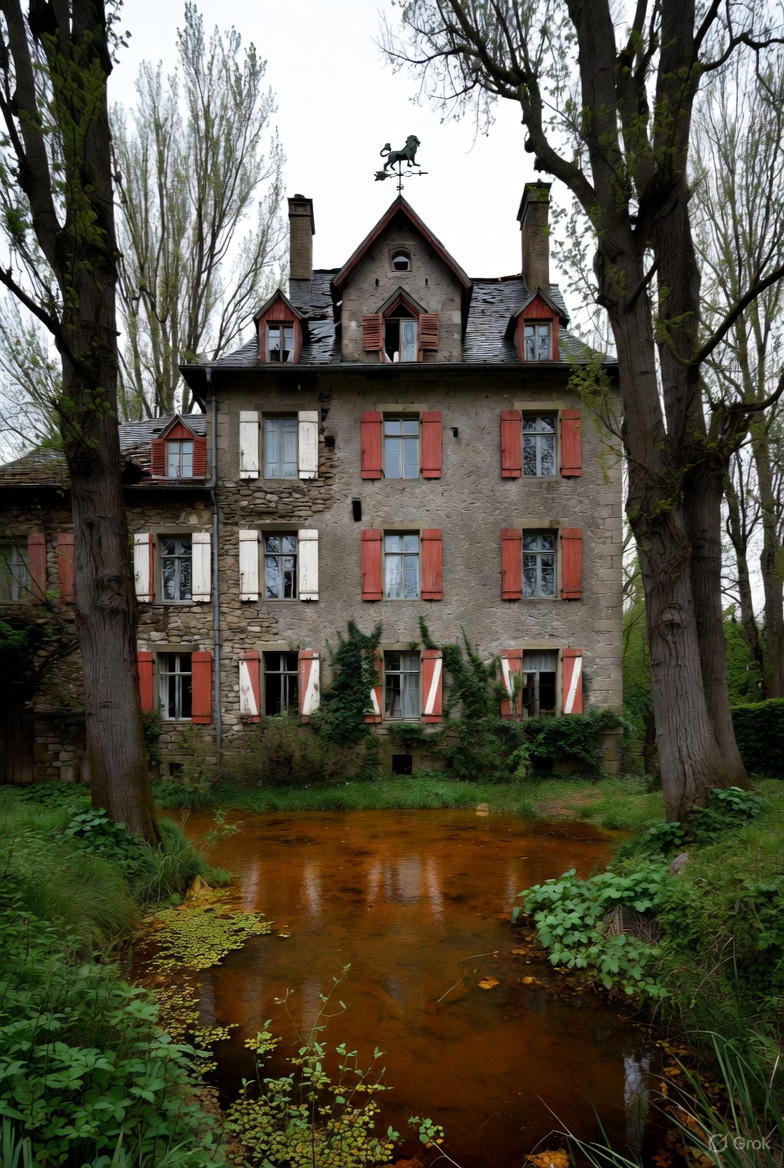
But if there was something even sadder, neglected and
gloomier than the Ball Mill, it was this castle. A monstrous,
gray stone box with formerly red-white-red shutters, now faded,
peeled off and crooked on their hinges, it stood between
disheveled, thorny, mighty poplars and two ponds with brown,
putrid water, which was overgrown by poison-green lentils. On
the steep, damaged roof was a weather vane bent by the storms
and eaten by verdigris- representing an upright lion. Part of the
window panes were gray with dust, other parts had only jagged
shards in the rotten frames. A large pile of garbage, in which
broken bottles, scraps of clothing, rags, bones and ashes were
mixed together, piled up not far from the main entrance, a
pointed arched gate, over which a Moor’s head was carved as a
coat of arms, in one eye of which was an arrow. Since no one
was to be seen, I entered the castle courtyard and was
immediately attacked by a pack of spotted hounds. But before
the wild males could quite snap at me a silent young man with
a sullen wrinkled face appeared and whipped them into their
stone kennel, whose torn down iron grille had been replaced
and strengthened with a couple of heavy stones leaning against
it. I saw that both of his ears had been smoothly cut from his
head.
I was about to turn to him, but out of a gate a huge, fat,
white-haired man with a red face and a glowing nose
approached me and gruffly asked for my name and desire.
I named myself, and his face became immediately
cheerful. He held out his hand to me and shouted loudly while
he shook my right hand:
“What?”How? A Dronte? Melchior Dronte, perhaps even
the son of my old crony and Willow comrade?”
When he then learned the name and last place of
residence of my dead father, he embraced me, blew his warm,
wine-scented breath into my face and shook me by the
shoulders.
“My lord Baron, I rejoice to the depths of my eighty-
year-old hunter’s soul to get to know you. Your godly father
was a hunter comme il faut, and there will not be many more
like him in these shitty times. Ei, how the time goes by, and
now I get to know Melchior, whose birth we celebrated with
champagne from the big ducal silver cup, called the
“Sauglocke”, and look, this child, whom I saw with wet panties
already has gray hair at the temples. But what is the reason?
Has the skinny hunter already put the bullet in the barrel, in
order to lay an old deer on my blanket? So let’s be happy my
Lord Baron, and commemorate the knightly days of which
your name reminds me so fiercely.”
I thanked him, strangely and not pleasantly moved by the
fact that he had been my father’s friend. Even the morose man
who was missing his ears and who was now ordered to find a
place for me to stay somewhere in the castle, did not make me
feel very cheerful.
“But now I want to introduce myself formally,” said the
old gentleman and stood up straight in his green coat. “I am the
Master of the Hound of the erstwhile Duke of Stoll-
Wessenburg, Eustach von Trolle und Heist, and I have been
sitting here for twenty years among crows and owls, with a
small salary on Krottenriede. We hadn’t a thought at the time
squire, not a single thought, your Herr Father and I, as we held
Serenissimo’s head when the wine was about to run out for
those at the top.”


 Anarchistbanjo's World
Leave a comment