The Rebirth of Melchior Dronte by Paul Busson and translated by Joe E Bandel
Our entrance attracted noisy attention. Immediately they
dragged Görg to the table and quickly brewed a mixture in a
mug of beer, wine, spit and pipe juice, which he had to empty
immediately as a toast to the well-being of the four senses. But
me they mockingly addressed as “Your Honor” and asked if I
did not know that one has to make three bows and a scrape of
the foot when entering, such an illustrious group or if the fine
gentleman felt like a few passes with the rapier. This I could
have in a moment.
“Are you still acting so wild, Bavarian Haymon?” I asked
and had to smile wistfully, when I recognized my old Order
brother.
He sat there with his mouth open, as if he had been
struck by a blow.
“I know you well,” I said, stepping close to him. “Even if
time has run away!”
“Pinch me, Hoibusch, pinch me!” he sputtered and
nudged the student next to him. “A ghost stands before me-“
“Ei, what, a ghost!” said I. “its Mahomet and no other!”
Something like a pathetic joy was in me, that I saw him
again, although degenerated and aged before his time. And on
the lapels of his skimpy coat he still wore the letters of our
secret slogan, artfully entwined from silver wire:
“Vivat circulus fratrum amicitiae!”
Long live the brotherly circle of the Order of Friendship.
I pointed with my finger and said smilingly:
“Vivat, crescat, floreat!”
Then he jumped up on both feet and shouted:
“Murderous hail of bombs! Stinking foxes, kneel down!
An old Amiciste stands before you, Mahomet, who has wiped
more blood from his thrusting blade than runs in your sour
veins. O brother of heart! What a race has taken our place!
Drinking from little cups, crying for their mothers when they
run out of veal…and run into the lecture hall with their pens
and notebooks. -O the old times! O Amicitial!”
He threw his long arms around me, kissed me
resoundingly on both cheeks, and the tears trickled from his
inflamed eyes.
“And now here, by my green side, Herr Brother, and that
none open their mouth till Mahomet has told us about the best
of his famous life experiences – Hey, Ball Mill Innkeeper, hey,
Bärbel, jump and swing and bring as much wine as the table
can bear. And the farmer shall join in the drinking!”
But he had gone out and was no longer to be seen.
The innkeeper now approached the table very politely
and asked what we wanted. I looked at him with a certain
horror. In his one eye was a false squint, the other lay as a
white, blind glass ball between slitted eyelids. A fiery red cut
scar, shaped like an ‘S’, ran across the bald skull, eye and the
cheek, to the fat double chin. I knew that murderers marked
traitors with such a cruel mark.
Soon there were large bowls of venison on the table
along with flagons of wine on the table, and a wild carousing
began, in which I participated with caution. My heart was
loaded with feelings that had nothing to do with those of the
people at the table, and I had enough to answer Haymon’s
questions. The three others were listening quite modestly and
the girl looked at us like a cow at a new gate.
When the candles had burned down and Haymon’s
tongue grew heavier and heavier, I first learned how his life
had turned out, how, when all his parents’ property was gone,
he had to be glad to be able to crawl under somewhere as a
town clerk. And that was also the end since his hand was so
shaky from the continued drunkenness that his squiggles were
no longer legible. Now he had set out to find one of his former
tenants who had become rich, from whom he thought he could
still claim something, however little it was, and while
wandering he had met the three students today and continued
together on the path with them. After a long wandering back
and forth in the wild forest they had found the lonely Ball Mill
about two hours before I arrived with Görg, and were glad to
find a roof for the night, even more so, as a whizzing west
wind brought up ever wilder clouds and the earth smelled of
rain.
Now, however, the many wines had won Bavarian
Haymon’s heart completely and utterly, and with many gulps,
belches and weeping he could not do enough to remember
those wild times full of youthful foolishness and exuberance in
the magical false light of memory, keeping the good and the
pleasant, but completely forgetting the excess of adversity and
bitter worries. And after each sentence he spoke, he let a new
cup trickle down his skinny, knitted neck, while the three
young students only dared to talk quietly in a whisper so as not
to interrupt the dialogue of their mossy superior. I was hurting
enough. Friendship and youth were gone.
“Strike and heavy death, Herr Brother!” He cried out one
more time, “What kind of guys we were! Do you still
remember the same night, how tall Heilsbronner gave up the
ghost in the road dirt? How the brave Montanus emptied the
glass boot into his gullet for the last time? O brother, Finch has
also perished, drowned in the Murg, and the Portugieser has
rotted alive in the Spittel in Erlangen, so badly did the Dancing
Lily, with whom he had lived, make such a mess of him. And
Wechler, I don’t know if you would still know him, has become
a cathedral lord and no longer acknowledges me. O vanitas,
vanitatum vanitas! Gone are all the oaths and brotherly love!
Hey, Bärbel! Where is that bitch in heat? Give me some light!
Are we to remain in this hellish darkness? The three vixens
have enough money to pay for several candles!”
Then the innkeeper came out from behind the tiled stove,
where he had been lurking without our knowledge and said
rudely and hoarsely that it was bedtime, and new candles had
to be fetched from afar. Only a stump remained, and that was
just enough to find the sleeping room.
One of the young boys wanted to say something but
another one next to him, a quiet, nice boy who, as I had
observed the whole time, had drunk almost nothing and was
quite sober quickly nudged him and said softly, but in such a
way that I could hear it:
“Quiet, Hans! We may yet need your candles!”
The lout of a landlord without further ado took the last
candle, which was barely enough for a quarter of an hour, from
the table and mumbled, “Now whoever wants to sleep, let him
follow me. Who does not like it can squat in the dark room.
Nothing more will be poured out!”
Haymon wanted to stay, but I quickly took him under the
arm, and so we went behind the innkeeper and his big dog to
find our resting place.
We walked through a long corridor with several thick,
dusty or boarded-up windows. Haymon’s intoxication came out
as we walked, and I heard him say something about a
goddamned town piper, who he wanted to wipe out.
Meanwhile I remembered that the farmer was not with us.
“Where is my driver?” I asked the innkeeper, whose giant
shadow slid along the wall.
“Rehwang?” he grumbled, half looking around. “He’s
long since gone home with his harness.”
“Why didn’t you say anything?” I was annoyed. “What
shall I do tomorrow?”
The hulking fellow stopped in front of a door and
shrugged his shoulders.
“If the gentleman had drunk less and had paid attention
to Rehwang, he could easily have kept him here. It’s not my job
to care about such things.”
He threw a sidelong glance with his one-eye at me.
“And who knows if tomorrow will be so urgent.”
I kept silent, and he pushed open a wooden door with his
foot, holding his hand in front of the stump in the tin
candelabra.
We entered and found ourselves in a large, completely
empty hall, which had probably once been the pouring floor. In
the middle of the room stood, oddly enough, a thick, round
column, which supported the main beam of the ceiling on a
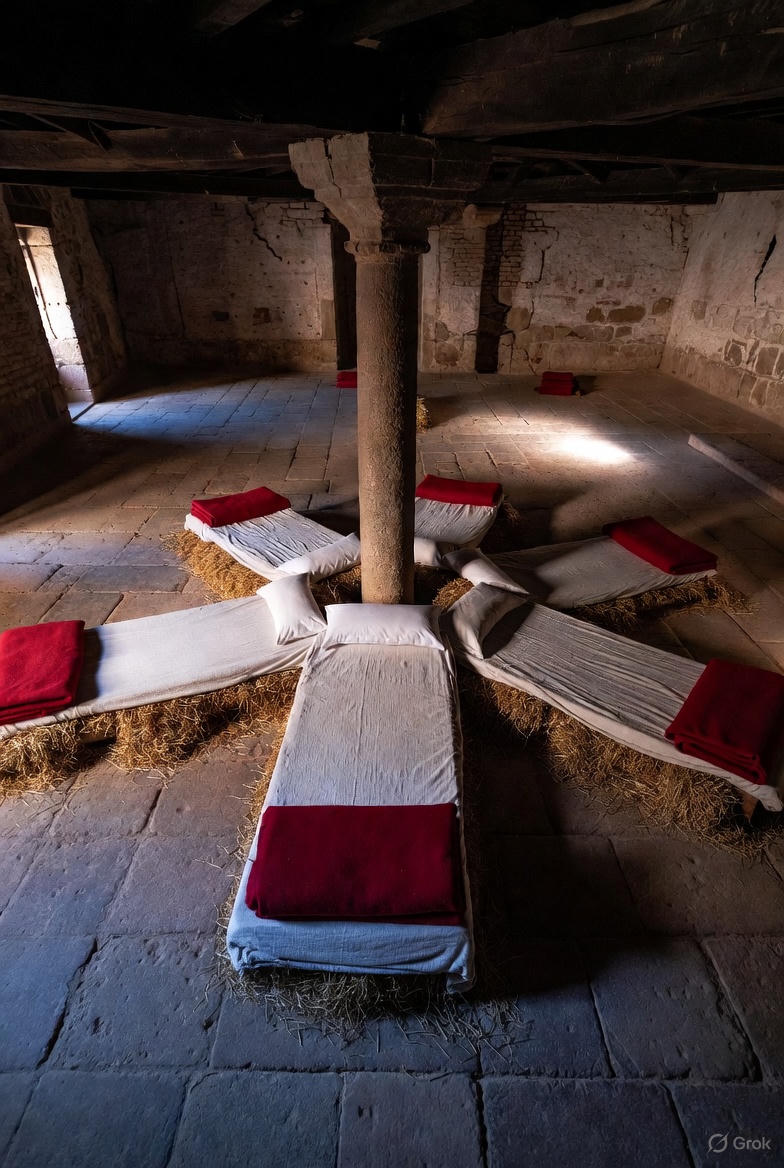
wide annulus. Star-shaped around this column were five berths,
better than we had thought. On clean, fresh straw were coarse,
but white sheets laid down, hard against the pillar there was a
head cushion for everyone, and five thick red-woolen blankets
were spread out for covering.
“We don’t have any better than this in the Ball Mill,” said
the innkeeper, as if embarrassed.
“The gentlemen must make do.”
We testified that we were satisfied, and so he, smiling
and bending down, put the burning light on a stool, showed us
the little luggage that was ours, and under the evil growl of his
mutt, wished us a good night. We heard him shuffle away
through the hallway and then throw the heavy front door shut,
sliding the bar and locking it with the turning of a key.
The two who had led Haymon so far now let him slide
gently onto one of the beds, and it was not two minutes before
he began to snore and mumble meaningless words, which the
wine had given him. A frightening restlessness was in me, and
some dark foreboding lay warningly and heavy in the pit of my
stomach. I took the light and looked around. Sooty cobwebs
hung like banners of mourning from the old beams of the
ceiling; the three small windows with their blinded, lead-lined
bull’s-eye panes could not be opened. A choking musty cellar
odor brooded in the wide room with the column. The wide ring
it wore at the top had recently been whitewashed, so that it
stood out glaringly against the lurid ceiling.
When I turned around, I saw that my feelings were
shared by the three students. None of them made any
preparations to visit the tempting beds or to put their swords
away.
“It smells like old blood in here,” said the bright-eyed
Hoibusch, who had already impressed me with his sobriety and
calmness at the table.
Also Hans Garnitter, who was lighting the candles said,
“This is where the devil is supposed to spend the night!” and
the third, a young gentleman of Sollengau, who gradually
became free of the wine spirits, nodded apprehensively.


 Anarchistbanjo's World
Leave a comment