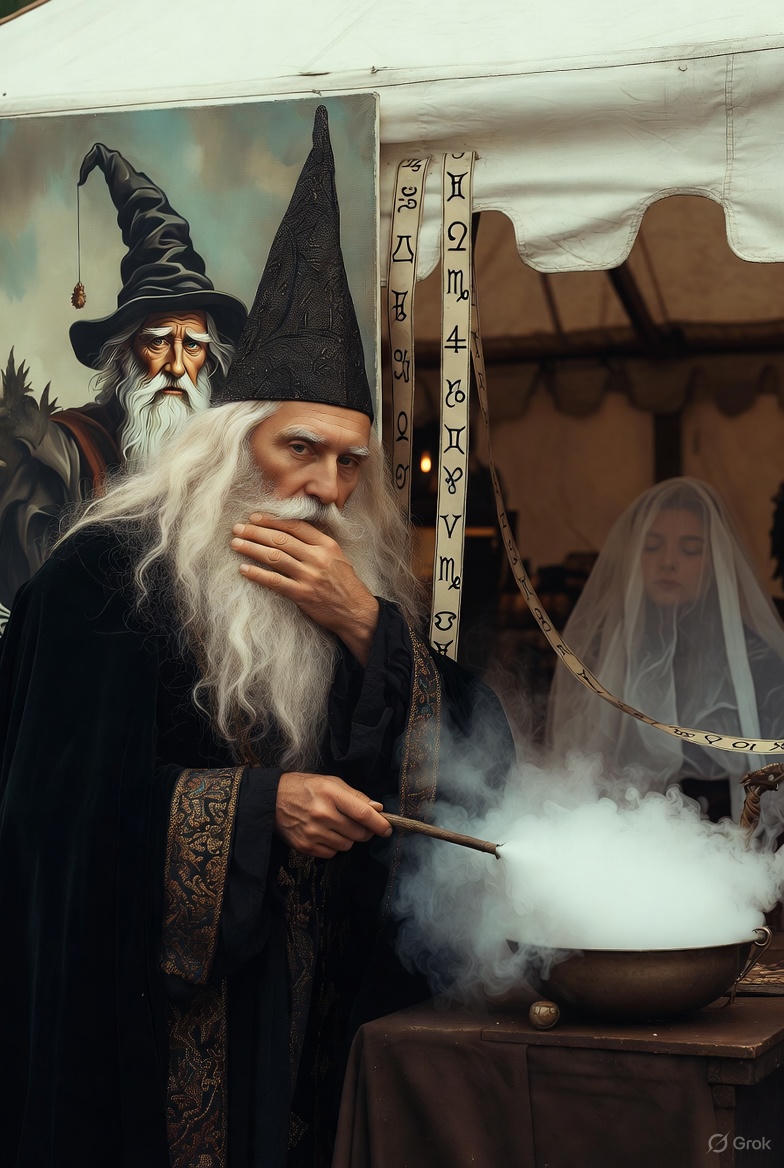
The Rebirth of Melchior Dronte by Paul Busson and translated by Joe E Bandel
“Enter and make the sacrifice, of concealing your own
pain, so that the dying may fall asleep without a soul martyr.”
I felt a burning pain that took my breath, clenched my
teeth and went slowly into the next room. Through the veil of
tears that, despite all my intentions, inexorably ran from my
eyes, I saw a small table, with a bloodstained sheet that
covered, something lying there, the mere outlines of which sent
horror through my nerves. Then I stepped up to the bed and
knelt down.
Zephyrine opened her eyes with great effort. Her face
was white as snow; her lips were torn by her own teeth. I
grasped her hand, light and cool as a rose petal, and pressed it
to my heart. Then she smiled. Whispering, her lips moved.
“It -is- a – little – son – as I – asked for it – from heaven –
and for me a little vixen -a little Aglaja- Later may I see the
children – ?”
The doctor, who was standing on the other side of the
bed beckoned to me, “Yes.”
“Certainly, dearest -as soon as you are asleep,” I said,
thinking that my heart must burst. But suddenly fear entered
her gaze. She tried to straighten up, but fell back powerlessly.
“Or – must- I- die?”
“Zephyrine!” I cried and covered her hand with kisses.
“Don’t talk like that -you sin. Everything is fine. Only you must
sleep, rest and gain new strength after what you have suffered.”
“I – have suffered it – gladly – for you-and for me,” she
smiled. “I am so -joyful- that I -may- stay -with- you.”
Her hand pulled -me- closer- with a strange strength.
“But I want- your face – to stay – close – to – me.”
I drew as close to her as I could. Her tired eyes suddenly
widened, fastened on me with an expression of thirsty desire,
held me tightly – her gaze remained staring deep into my eyes.
I sat like that for a long time.
Then someone stepped behind me and touched my arm.
It was the doctor.
“You have held your own, poor Herr Baron. She crossed
over easily and blissfully.”
And only then I saw that on Zephyrine’s angelic face was
the holy radiance of eternity.
I could not cry, could not think.
Aglaja lay before me. White and beautiful, as I carried
her image in my heart.
Was the bell still ringing? Or was it the raging blood that
hummed in my ears?
“Do you feel strong enough to look at the cause of
death?” the doctor pulled me out of my brooding.
It was all so indifferent now that she was dead.
But the sight that now came to me was so terrible that it
forced a sobbing cry from me. I drew back and barely felt it
when my head hit the door jamb. A small well-formed torso lay
there. And this small body carried on the shoulders two necks,
and on the necks sat two heads.
One of them had fine, dark hair, the other one golden red
curls.
“Moreover, this strange monster was a true
hermaphrodite, man and woman at the same time -“
I fought back, ran past the crying midwife into the other
room, threw myself over the table, and a dry sob choked my
throat.
The doctor sat down silently next to me and waited.
When I had regained my composure I told him about the
drops that that wretch had talked us into and which I had left
undestroyed in recklessness.
Doctor Hosp thought for a long time and then said:
“I remember having heard once, that an Italian doctor
had succeeded by certain poisons to produce monstrous
deformities of the fruit in pregnant women. But it seems to me
not very credible, that such interventions in the most secret
workshop of nature -“
A terrible thought rose in me.
Without caring any more about the doctor, without
listening to his anxious questions about what I was going to do
next. I tore open the door of the weapons cabinet, took out a
double barreled pistol, tore my hat and coat from the hook and
rushed out into the snowfall.
Just as I stepped out of the garden, a carriage drove
slowly by.
I shouted to the driver to take me to the Fassl house as
fast as the horses could run. He looked at me stupidly. I took
several gold pieces, pressed them into his hand. He pulled his
hat, the blow worked. The whip whistled, the horses leaped out.
When I came to, I was standing in the half-dark hallway
of the house. Someone was rubbing me over the face with a
wet sponge that smelled of lavender vinegar.
Only one word droned in my head, “- Gone -“
“Yes, Herr, you must believe me,” said a stolid woman.
“Thank God that the crook is gone. Already two months ago he
left in the night and fog, and his things have been taken away
by the court.”
I heard something else about a young girl who had died
after a forbidden operation that Postremo had performed.
Gone!
I let out a maniacal laugh.
I was taken to the waiting carriage, and I left.
The snow swirled, the wind whistled through the open
windows. The houses moved with night-blind windows. She
was dead, she was dead!
Never again —.
I was only an empty shell, clothes draped on a soulless
body. I ate now and then, fell asleep on chairs, and found
myself dressed in bed. My eyes were inflamed, my clothes,
which I never changed, unclean and damaged. I did not know
the time of neither day, felt neither heat nor cold and let my
people do as they pleased. Sometimes burning longing ate at
me, and I ran restlessly through the rooms and the garden
sobbing, calling Zephyrine’s name, calling her Aglaja, too, to
lure her back. For days I sat at her grave, until the gravediggers
kindly reminded me that the gates were closed. And to my
consolation they showed me the corner where the
unconsecrated ground was, a little under which lay my wife’s
favorite dog, Amando.
Amando, who had come to her last resting place, would
not leave, had refused food and drink and had died of grief and
hunger.
When I began to feel the healing effect of time, I sent for
a notary public and gave the house and garden, along with a
sufficient sum to a foundation for crippled children, who from
birth had to carry miserable and deformed bodies from birth. I
myself moved into the large inn “Golden Lamb” and made my
departure from the city, where everything pained me; since I
was reminded by everything and everyone, that just a short
while ago Zephyrine’s eyes had rested on it.
From her I had kept only a little tuft of her hair and the
silver ring with the fire opal, which first Aglaja and then she
had worn. Her fingers had been as slender and fine as those of
my cousin. The little curl of Zephyrine’s, however, mixed so
much with Aglaja’s in Muhme’s pale blue box, that one could
no longer distinguish and separate them.
I wanted to go to a foreign country. Just far away from
here. When I walked haphazardly through the streets I often
noticed that I bumped into people and they looked at me
strangely. Ordinary people in their unconcerned way probably
pointed at their own foreheads and laughed. All this did not
touch me in any way.
So, wandering aimlessly outside the city, I came to a
place called Lustwäldchen. There it was taken care of that the
attention of the people remained active. Nobody cared about
my behavior, which, even unconscious to myself, was certainly
conspicuous enough by nervous twitches in the face and other
consequences of my mental suffering. Here there were various
booths and huts, dancing bears, cake bakers, fortune tellers,
canvas theaters, plus vendors and all kinds of market criers.
Boys and girls frolicked together in a circle on blue and white
or yellow and red painted wooden horses to the sound of music.
I passed tents from which came the false cries of
trumpets and the sound of drums. A sword swallower in tinsel
trousers stood with his neck bent back in a circle of gawkers,
and next to him dirty hands were fishing pickles out of a barrel.
And in the midst of the swarm I saw – like an unreal
apparition – Laurette on the arm of a tall, lean man with a
brown face. She wanted to pour out with laughter at the crude
and mean jokes of a buffoon, who pulled off his pants on a
podium and showed a hairy devil’s butt. Two southern servants
in dark livery stood behind the couple. Laurette did not see me.
I walked on, ignoring the fatigue of my feet, and then
stopped in front of a large booth on which a painting on canvas
captivated me. In front of a smoking fire stood an old wizard
with pointed cap, and a ribbon with the signs of the zodiac
slung around his shoulder and hips. His left hand was buried in
his white beard; the right held a small staff toward the smoke,
in which a figure wrapped in a white veil, with closed eyes
appeared dimly. Under this not completely artless image, but
nevertheless in screaming colors, the following was written to
read:
“The famous necromancer, magician and magister of the
seven liberal arts Arkadius Chrysopompus from Ödenburg,
called the Hungarian Doctor Faust.”
A colorful harlequin, who just a moment ago was playing
the tinkling sounds of a Savoyard lyre was now sounding a
brass horn, inviting the audience with all kinds of joking,
contorted gestures and loud shouting to visit the performance
that was about to begin. Two grenadiers in white coats, who
had colorfully dressed, busty girls on their arms, were the first
to enter. Then went a few citizens with their wives and some
young people of both sexes went up the three steps, paid a
pittance and pushed their way through the red curtain, which
the crier lifted. For some reason I followed and soon sat in the
midst of the people on a bench in front of the small, dimly lit
stage.


 Anarchistbanjo's World
Leave a comment