The Rebirth of Melchior Dronte by Paul Busson and translated by Joe E Bandel
I looked around the distinguished room in which I was kept
waiting, and looked closely at the only picture, a man with
olive-brown, finely chiseled features, dark, sad eyes, of rather
unattractive facial formation, wearing a canary yellow uniform
with red lapels and under the coat, which was open, a black
breastplate. Then the maid reappeared, lifted the curtain and
asked me to enter with a curtsy.
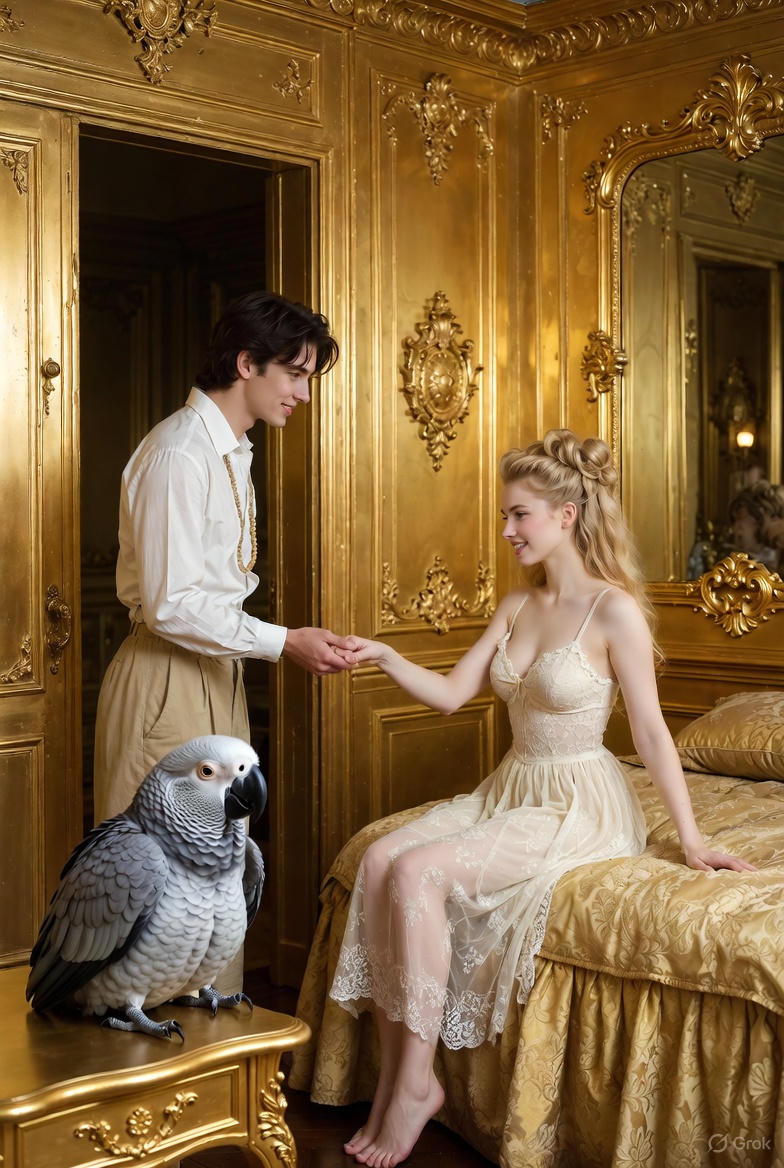
I entered a boudoir entirely in gleaming gold with
precious furniture and a brocade-covered resting bed, on which
Laurette half sat, half lay. She smilingly held her hand out to
me from a cloud of lace and thin silk, smiling, and I was again
struck anew by the unusual charm that her pretty, rosy face
radiated under the artful coiffure. But while I stared at her, not
at all to her displeasure, enraptured, that disgusting, shrill
laughter sounded close to us, and only then I noticed a chubby,
bald-headed parrot of gray color, from whose crooked beak
came the laughter.
If my whole mind had not been filled with the image of
that sweet child’s face and the reddish-gold hair, I would hardly
have felt at ease in the presence of this blossomed woman, who
had stirred my first emotions of love. I felt that I could not have
restrained myself for long, and all the more so because Laurette,
with consummate art, soon showed me a part of her perfectly
beautiful breast, soon the noble shape of a leg or the curve of
her classic arm. Nevertheless, I could not resist the desire to
remind the distinguished lady of those days, when she was still
called Lorle and had kissed me in the honeysuckle arbor behind
her father’s house. But she slipped away from me in a playful
mastery of the conversation, and thus forced me to respect the
boundaries she wished to keep. Yes, when I, fired by my
blissful memories, dared to touch her bare arm with my hand,
she struck me on my fingers and pointed with peculiar, even
serious, significance at the parrot, who was entertaining
himself by wiping his beak on the silver perch.
“Take care, my all too friendly cavalier, beware of this
bird,” she said softly, as if she were afraid that the ruffled beast
might be listening. “Apollonius does not like it when one
caresses me in his presence. Besides, my little finger tells me,
dear Baron, that you have not come to court me, but that you
have called on my willingness to serve you in some other way.”
“I cannot deny it,” I replied, somewhat affected, although
it seems unclear to me from where you, my dear Laurette, have
received such wisdom.”
“Ei!” she laughed, “Don’t I have my soothsayer and at
the same time protector and guardian next to me?” and less
loudly she added:
“It can be called a true good fortune, that the good
Apollonius is becoming somewhat hard of hearing and is no
longer able to overhear all that is spoken.”
The fact that she lowered her voice seemed indeed to
disgust the bird. He rolled his ball-eyes, stepped from one foot
to the other, and struck the cage bar with his beak, so that it
rang.
“Louder!” he cried.
“You see?” said Laurette, glancing shyly at him. “He’s in
a bad mood today.”
“He looks like an old Hebrew, your Apollonius,” I said
aloud. “It is believed that animals of his species live to be over
a hundred years old.”
“Hihihi! Hehehe! I’m an animal?” cried the bird. “A
hundred years! Imbecile!”
“What do you mean, he speaks French?” I turned to the
beautiful one.
“He speaks all languages,” whispered Laurette.
“Take care! He guards me, tells everything to the Spanish
envoy – whose mistress I am,” she added hesitantly, her cheeks
flushing slightly. “But Apollonius also bears witness to events
and is able to see into the future.”
Now I knew who the pimp was to whom she owed her
well-being, and so naturally a faint feeling of jealousy would
have arisen at this discovery. Not being of a jealous nature, I
felt nothing of the kind. Nevertheless, I felt sadness and
remorse that this once pure and benign child through my fault
had been taken from the peaceful and safe shelter of her
parents’ home to the glittering and uncertain splendor of a life
based only on lust.
At the same time, however, I clearly recognized that her
restraint towards me was not due to gratitude towards a present
friend and lover, but rather the fear of the treacherous gossip of
the feathered fowl to which she obviously attributed intellect
and human-like malice.
That through such thoughts the extremely ugly, bald-
headed animal became even more repugnant and hated by me
than already at the first sight, is understandable. I was tempted
to interact with the chattering bird. Or at least to check in every
way, to what extent Laurette’s description about his intelligence
was justified. How could this small, round bird’s head, behind
these rigid, rolling eyes be anything different from that of other
animals?
The repeating and coincidentally making sense of learned
words and randomly putting together learned words might be
suitable to cause strange, astonishing effects. But I could not
and did not believe in a human-like thinking ability. The only
thing I understood was Laurette’s caution to speak softly, so
that the hard-of-hearing bird would not parrot them back at
inopportune times. I myself had heard a story, in which a
starling, also a talking animal, had betrayed his mistress by
singing in front of her husband in the most melting tones the
first name of a young gentleman, who had been suspected for a
long time of being the favored lover of the housewife. Without
waiting for Laurette’s warm gesture, I turned to the parrot,
looked at him and said:
“Well, Apollonius, if you are really so clever as you are,
tell me who won the most money the day before yesterday at
the Pharaoh’s?”
The bird ruffled its feathers, twisted its eyeballs in a
ghastly way, chuckled a few times, and then cackled:
“Defunctus” – the dead one. I looked at him, unable to
speak a word.
“I beg you, Melchior, let him go,” said Laurette quickly
and quietly, and in her gaze there was fear. Then she said loudly,
“Baron, don’t tease Apollonius, or he’ll tell me the nastiest
things that deprive me of sleep at night.
“It was I who won, infernal beast!” I cried, and pulled
myself together.
The gray one laughed and said with his head bent
forward, eyeing me maliciously:
“Donum grati defunctil”-a gift from the grateful dead.
“Why don’t you turn the collar on such vicious vermin?”
I angrily prodded. “Give him some peach pits and get some
peace with it.”
She shook her head.
“He eats no poison, fair Herr! Little killer! Little
murderer!” chuckled Apollonius and flapped his wings.
“Perhaps you have murdered yourself, chewy, disgraceful
beast!” I screamed and shook my fist at him. “Perhaps you are
a soul damned by God and must now repent in the form of an
animal!”
There came a heavy, almost human sigh from the bar, a
groan from a tortured chest. The parrot looked at me with a
fearful and horribly desolate look, and hung its head. Slowly he
pulled the nictitating skin over his eyes, and with an inner
tremor I looked – by God in heaven! -, I saw two tears dripped
from the eyes of the animal. But this lasted only a moment,
because immediately after that he stared at me with such
appalling insolence that I became hot and cold and my rising of
pity quickly disappeared. But when I saw the troubled face of
the beautiful Laurette, I thought how naughty and disturbing
for her peace my behavior must have seemed to her, and to
rectify my mistake, I decided to turn the matter into a joke. I
bowed therefore with ironic politeness before the animal and
said in a cheerful tone:
“Do not be angry with me, venerable Apollonius, I did
not mean to offend your wisdom. I am now converted and no
longer doubt in your wonderful gift to see the past and the
future. Would it not be possible to make friends with you, king
of all parrots?”
The feathered one shook with laughter, clucked his beak
and whistled. Then he moved his head quite distinctly, after
human style, violently denying, back and forth.
“So we can’t be friends?” I continued and winked at
Laurette. “I would have liked to ask a question – about a
hunchback I’m looking for -.”
My question was for Laurette, of course, and I was about
to explain myself further, when it came buzzing from the bar:
“Dottore Postremo.”
“What do you want with him?” said Laurette, in
astonishment.
“Do you know him?” I asked, unable to conceal my
excitement. A deep blush passed over her face.
“As it happens –” she replied sheepishly.
“What is it about him?”
“He’s an Italian doctor — a lot of women go to see him
who wish to remove the unpleasant consequences of a few
pleasant hours. He has a reputation, and the courts have often
dealt with him. But nothing could ever be proved. – But you
must not think, Baron, that I might -“
I laughed politely, “How could I, beautiful Laurette?”
“He is said, by the way, to have a very beautiful foster-
daughter or niece,” she went on, looking at me lurkingly. “A
girl who has hardly blossomed. He lives in the house called
Zum Fassel.”
She lowered her eyes and looked at me from under her
lids.
“Be careful! The man is capable of anything!”
“You are mistaken, Laurette,” I lied. “It’s not a question
of adventures.”


 Anarchistbanjo's World
Leave a comment