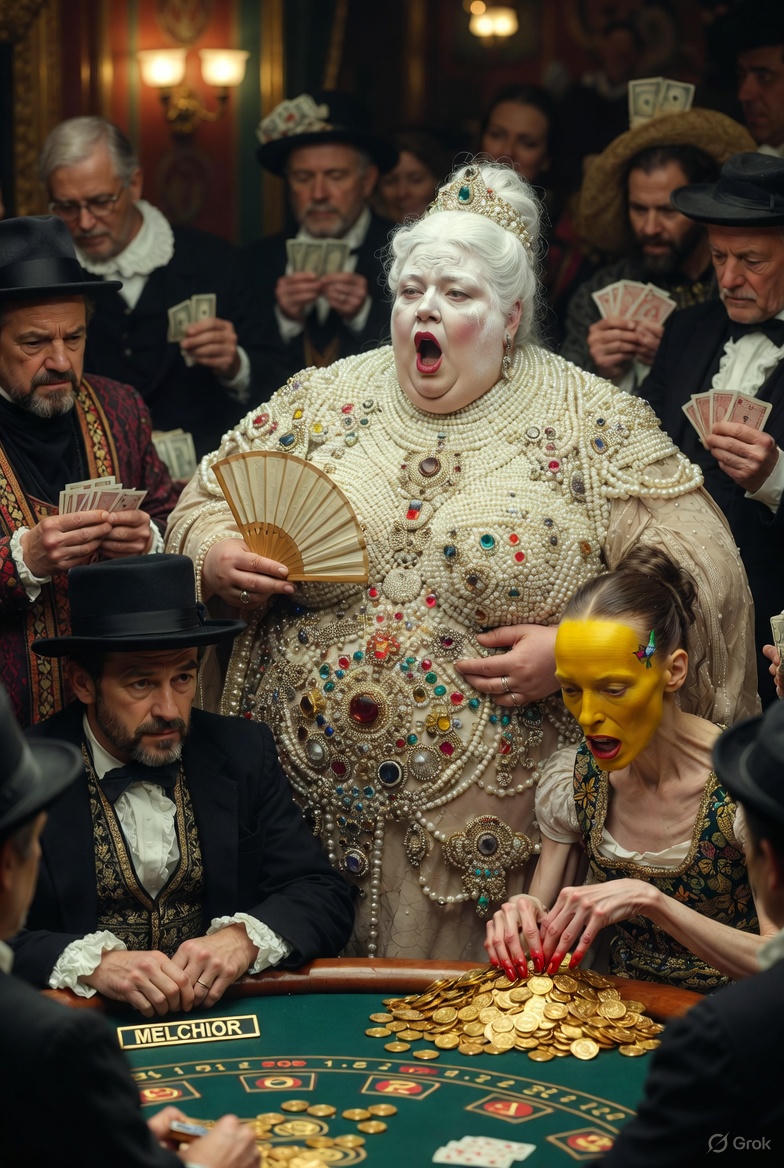
The Rebirth of Melchior Dronte by Paul Busson and translated by Joe E Bandel
There was a loud calling and it came closer. Two
gravediggers, an old man and a sturdy young fellow, came
running with bludgeons and confronted me. What had
happened here and why had I shot? I talked to them and
described to them the guy with the satchel, who once before
had been suspiciously at an unburied corpse in the past, and
also at the execution of the blacksmith Fessl in a tree and with
his new corpse-desecrating behavior, had now put me in such a
rage that I fired my pistol at him, but apparently did him no
harm, after he had laughed, escaped and flitted away.
They listened to me calmly and seriously, and the old
man nodded his head as if to indicate that the man was well
known to him, and that he, like me hated him to his very soul.
Then he asked me my name, and when I told him, he said:
“The Baron may now do as he pleases. We have the
vested right to punish offenses against the sanctity of the place
on the spot, or to punish the offence if the penalties are not paid
to the court. For shooting on consecrated ground, a man shall
pay only one silver thaler.”
I threw the man two thalers. But he gave one of them
back to me and said:
“I am not allowed to take excess money. It is only a pity
that your shot will never been able to harm him. -“
“What do you mean? Is he frozen?” I asked.
The boy laughed, and the old man shrugged:
“If the gentleman has not buried a cross in his bullet
mold, as it should never be lacking and thus imprints itself on
the leaden birdie, then he has not even hurt him, however
powerful the weapon may otherwise be.”
“I do not carry a cross on the bullets.”
“So it’s a pity about the shot and about the penalty for it.”
The old man cradled the hairless head back and forth.
“But the fact that the Lord can see him is significant.”
“Why?”
“Not everyone can see him, only the blessed.” the
younger man interjected. “Like, for example, father here, who
has often shooed him from fresh graves, and I would give
anything if I could ever catch sight of him. But I am days and
nights in vain and have not seen him. And yet he has been
there.”
“Who is that fellow?” asked I fiercely.
“Fangerle,” said the old man, making a cross.
“Is it a man or is it-?”
But they gave me no more answer and looked toward the
entrance in the quietly falling rain. From there, with singing
and many-voiced prayer came a funeral procession.
“I always thought that he would show himself at the
graves of the miserly,” the old man muttered and climbed into
the pit. They did not pay any further attention to me, and when
I asked again, the boy said gruffly, “It is better for the Lord to
pray!”
Confused and saddened in my soul, I walked away along
the side paths to reach the exit, while the coffin of the miser
was swaying towards the open pit.
Before the post coach left, I noticed the faded and sealed
box that the notary had given me as an inheritance from my
Muhme, Aglaja’s mother. I tore off the lacquer seal and lifted
the lid. On the white, yellowed silk rested a red-gold curl of my
unforgettable, beloved cousin and her silver finger ring, which
I had often seen on her small child’s hand. It was formed with
the finest art from two slants which wound around a round-cut
fire opal. I pressed countless kisses on the mysteriously shining
and iridescent stone, on the silvery, scaly adder’s liver, which
had once held a finger of the sweetest hand, and called out the
name that had been cut into my heart and painfully scarred
there.
But on the evening of the day I arrived in the great city of
Vienna and marveled at the life in the streets, the many
carriages, the many carts, and sedan chairs, adventures of such
a peculiar kind happened to me that I thought of the influence
on my life of dark and sinister powers.
The first thing I encountered was of course of noble
origin and graceful species. When I walked across the square
on which St. Stephen’s Cathedral stretches its stone carving
into the sky, I was caught in a crowd of carriages and sedan
chairs, and was so close to a very distinguished, finely painted
sedan chair with two dark red liveried porters, that I had to
stand close to the lowered side window eye to eye with the
occupant. But who can describe the astonishment I felt when I
recognized in the highly toupeed, nobly dressed lady, Sattler
Höllbrich’s Lorle? She too knew me again immediately, for she
uttered a slight cry and called my name.
With my hat drawn, I remained, enraptured by her
unimaginable, fully blossomed beauty, enhanced by small arts,
and asked in quiet, urgent pleading words for an early reunion.
She pointed with a short, openly fearful movement towards the
dark red carriers and then said very loudly, “Well, Doctor, you
can bring the new ointment for my complexion to my house.
Just ask for Madame Laurette Triquet in Schönlatern Street.”
With that she nodded at me pathetically, in fact
condescendingly, and gave the porters a sign to go on.
After an exquisite dinner, I left my room in the evening
and went to Himmelpfort Street quarter again and thought to
mingle a little with the evening walkers who were glad of the
pleasant breeze after the hot day. Already for some time I
thought I had noticed an extremely graceful and neatly dressed
young lad following after me at every turn. And really, it did
not take long, and then he was beside me and said half aloud:
“If you desire exceptionally good and amusing company
and would like to play a game, I would be prepared to take the
gentleman to a house where you can find such things of the
best quality.”
Gladly willing to spend my evening hours in a pleasant
way, and hoping to increase my money supply I agreed to
follow the man. He modestly went ahead as a guide, only
looking back from time to time to see if I was behind him.
After a long back and forth through dark, poorly lit and bumpy
streets, we finally reached a crooked and very narrow alley. In
front of a large gate, the young man stopped and made four
quick knocks with the knocker, followed by two stronger ones.
We had to wait a while and I noticed how a dark eye looked at
us through a crack in the most precise way. Then, however, in
the large gate, which was covered with heavy iron plates, a
small door was opened, in which an older, cunning looking
woman appeared and looked at us with a burning candle for
quite a long time. Only when my guide quietly whispered
something that seemed to me to be a word of recognition or a
password, the woman stepped back so that we could pass her.
We walked over a large, damp, ivy-covered courtyard, in which
water poured from a triton’s mouth, and then climbed a steep,
barely lit spiral staircase.
On the second floor, my apparently disinterested guide
asked to be let in the same way as downstairs, and when the
servant opened the double doors to let me enter, I stood for a
moment as if dazzled in the brightness, the hundreds of
fragrant wax candles spread. A gold dressed lackey took our
swords, hats and cloaks from us and told us to go on.
I saw at once that the ugly, dilapidated outer appearance
of the isolated house, the unpleasant darkness on the stairs and
in the courtyard were only intended to keep away the curious,
and the lavish furnishings and the abundance of light into
concealment. For here the walls sparkled with gold,
magnificent tapestries partially concealed the scarlet silk
wallpapers, the floor was bare and smooth as glass, hundreds of
candles burned in Venetian prismatic chandeliers and silver
chandeliers. On tables with priceless plates of Malachite, lapis
lazuli and ruin marble stood the most exquisite delicacies and
drinks.
“The Baron of Dronte might like to go to the playroom,”
said my pale guide with a smile.
“How do you know me?” I asked not very friendly.
The young man smiled superiorly.
“We take an interest in all strangers of distinction who
arrive, and are informed by the Stagecoach drivers in good
time. Thus I know that the Baron has taken lodgment with the
widow Schwebs- küchlein, and I made it my business to
introduce the Baron to a certainly agreeable circle, in which
equally chivalrous amusement, as well as something from
Fortuna’s horn of plenty.”
During this speech we stepped into brightly lit,
magnificent adjoining rooms, in which Pharaoh and
Landsknecht were being played at several tables. The players
hardly turned their heads toward me, when my name was
shouted loudly, because at the largest of the tables, where I was
standing at, all eyes were fixed on the Bankholder, who was
putting on his apron. Muffled exclamations rang out from
everywhere like “Va tout!” or “Va banque!” and the soft
clinking and rolling of the louisdors on the green cloth that was
stretched over the stone slabs of the tables.
I reached for the money cat, which I was wearing under
my vest as a precaution against thieves, and approached the
large table. Immediately the young man, who had brought me
here, offered me a comfortable armchair and then disappeared,
when I sat down with a light greeting. Before I began to play, I
looked at the people with whom I was dealing, and found that I
had stumbled into a gathering of distorted images. The
bankholder had a colorless, pinched face, which had been
devastated by a restless and wild life. He wore over the right
sunken eye a black cloth patch, a square piece of cloth on a
ribbon, which crossed the forehead and ran further behind the
right ear. Next to him sat a tremendously obese, heavy-
breathing woman with a white powdered pumpkin head,
fanning her pressed-up bosom. She was tastelessly covered
with pearls and jewels of all kinds and seemed to me to be a
Spanish Jewess, judging by her facial features. Enthroned
beside her, upright and haughty under half-closed lids, a very
skinny woman of standing, whose yellow monkey face had
been plastered with beautiful patches in the form of palms,
butterflies and little birds. Her bloodless fingers rummaged
greedily in a whole pile of gold pieces that lay in front of her.


 Anarchistbanjo's World
Leave a comment