Feeds:
Posts
Comments

Archive for November, 2025

Madame Bluebeard by Karl Hans Strobl and translated by Joe E Bandel

Rotrehl sat by, marveling at the professor’s
insatiable curiosity. Like all city folk, he pried into
things that weren’t his business. After Johann left,
Rotrehl muttered toward the window, “The air’s bad
at that castle. I told him, Herr von Boschan, I told
him.” Outside, the castle glowed in the evening sun, a
thin blood-red cloud drifting over the old tower.
Beyond, an apple-green, silken sky shimmered, alive
with spring’s voices.
When Rotrehl tried to steer conversation to skull
measurements and facial features after such visits, he
had little luck. Schiereisen gave distracted replies and
soon retreated upstairs. Annoyed, Rotrehl locked his
door and read late into the night in his French
cookbook under Napoleon’s stern, commanding gaze.
A week had passed since Schiereisen’s first
encounter with Ruprecht. He hadn’t yet visited the
castle, forging hooks and sharpening arrows, waiting
to fill his quiver.
Herr von Boschan, returning from a tenant farm,
rode slowly through the woods. Spring stormed the
world, unstoppable. All was steeped in blissful
yearning. The sky kissed the earth, and the wide earth
pressed toward it, longing.
Ruprecht’s horse was tamed earth-force. He felt
one with the land through it, clasping this young,
vibrant world between his thighs. He was lord and
victor, a wild zest for life singing in his heart.
This battle with a demon was glorious. Compared
to past exploits, what matched this drama he was part
of? To be with a woman who—if Jana was right—
sought his life, and to conquer her repeatedly. A
woman who—if Jana was right—was a criminal, as
mysterious as the castle hiding corpses in its tower.
Life triumphing over horror and danger. Strength
enthroned, towering, fate-mastering. The wondrous
thrill of daily victory. Ruprecht wouldn’t follow Jana
or dwell on his reasons. He’d only heeded him by
taking a separate bedroom, feigning a nervousness he
didn’t feel.
Lately, though, his joyous victories sometimes
yielded to deep despondency. A lethargy crept into
his limbs, settling in. It slunk from the dark, ugly,
like a premonition of grave illness. A vile unease
stole his confidence. His head throbbed with heavy
drilling, as if his skull had softened, a thumb pressing
at its crown. His scalp tightened, like over a swelling.
At the crown, he felt twitching, burning, as if the skin
might peel away, hair and all.
Mornings, he felt especially weak and listless.
These were bodily states, but he refused to yield. His
will broke free, and by day’s end, he banished the
gloom. He wouldn’t let his triumph dim. He grew
free and strong again.
Today’s forest ride had restored his freedom.
Bending under the last trees’ branches at the wood’s
edge, he saw Rotrehl’s house to his right. That’s
where the yellow-overcoat man lived. He hadn’t
come to the castle. Perhaps the forest invitation
seemed too casual—scholars could be oddly formal
at the wrong times, clueless when etiquette mattered.
Maybe Herr Schiereisen from Vienna awaited a
renewed offer. Fine, he’d get one now.
Ruprecht rode along the forest edge to Rotrehl’s
house, dismounted, and tied his horse to the garden
fence. He passed through budding blooms. Smiling,
he read above the door: “Jérome Rotrehl, Violin-
Maker.” It was like a blessing, a creed one entered
under. On the ground-floor door, he read “Jérome
Rotrehl” again. The host was determined to impress
his identity on visitors. Voices came from within.
Perhaps his tenant was there. Ruprecht knocked. It
wasn’t Schiereisen inside, but Rauß, the village
ruffian everyone feared.
“What do you want, Herr von Boschan?” Rotrehl
asked with measured courtesy. He disliked recalling
how he’d once spoken too freely about Frau Helmina
Dankwardt to Ruprecht, unaware he was her suitor or
would be. It felt like a trick played on him, proof of
human deceit.
“Doesn’t Herr Schiereisen from Vienna live
here?” Ruprecht asked.
Rauß sat by the window, puffing a Sunday cigar,
its end splayed like a broom. He glared at the baron,
sullen and hostile, sprawling wider to show he
wouldn’t rise for him.
With grave demeanor, Rotrehl extended an arm
upward, a gesture fit for commanding an army.
“Upstairs,” he said, “first floor… you’ll find him
home.”
Ruprecht climbed the creaking, worn stairs into
deep gloom. A door opened above, light spilling
down.
“My God, it’s you, Herr von Boschan?”
Schiereisen said, bowing. “I looked out… saw a
horse tied below… wondered who—then you!”
Ruprecht reached the top, shaking the scholar’s
hand. “I was passing by today and thought I’d check
if you got home safe that night…”
Schiereisen grabbed Ruprecht’s arm, pulling him
into the front room. “This way, please,” he said. “I
sleep in there—it’s a mess… The maid hasn’t been
yet; Sundays, she’s late… Can’t mind too much,
right? Come in. It’s nicer here, with your castle in
full… splendor.”
Schiereisen’s excitement was clear. He darted
about, searching for his coat—he was in
shirtsleeves—missing it, though it lay on a chair in
plain sight, flung there when he saw Ruprecht.
“Pardon me,” he said, “I was just dressing. I’m so
surprised… an honor…”
Ruprecht stood at the window, looking out. “It’s
charming up here. If this house edged closer, I’d
worry you could peek into our rooms.”
Schiereisen snatched his coat, hurrying into it. His
fluster eased, feeling he’d regained propriety’s shore.
A worldly man isn’t fazed by a bit of informality,
Ruprecht thought, amused. Schiereisen wasn’t
worldly. “Yes, I’m quite content,” the scholar said.
“I’ll likely stay all summer. My host’s a fine fellow.”
“Jérome Rotrehl, Vorderschluder’s Krampulljon!
You know he’s an old acquaintance? He was my first
guide to local affairs, laid the foundation for my
knowledge here.”
“We get on well. He’s open… heartfelt… But
please, pardon, Herr von Boschan, won’t you sit?”
With a sweep, Schiereisen pulled two chairs forward.
One had a wobbly back; the other’s straw seat gaped,
sprouting prickly spikes. New dismay followed.
“Well…” he said, with a horrified smile, “it’s a bit…
rustic here…”
“Let it be, Herr Schiereisen… tell me, why
haven’t you visited the castle yet?”
Schiereisen tucked his cuffs into his coat sleeves,
adjusting them. “My God,” he said hesitantly, “I
don’t know… I reproached myself afterward. I was
too forward. One can’t just… It was kind of you to
invite me. But when you’re practically ambushed…
in the woods, at night, by a total stranger… I didn’t
want to seem pushy.”
“I figured as much. So, I’m here to renew my
invitation.”
A halo of delight shone around Schiereisen’s head.
“Oh, Herr von Boschan, you’re too gracious. I shan’t
fail to take advantage of your kindness…”
“Your studies intrigue me,” Ruprecht said. “I’d
love to learn from you. This region… I’ve grown
fond of it. I’ve traveled widely, but here, one can find
a home. It reminds me of Upper Austria, where I
spent my youth. Then I left. Now I’ve rooted here
again. Everything’s so open, heartfelt, like a face
hiding no thoughts. Every stone’s dear to me. I’m
wooing this land, wanting to know it deeply. So far,
I’ve been consumed with my new role as a farmer,
catching up on what I forgot since my student days.
You can imagine, traveling far, each mile costs a bit
of learning. Now, I’d like to explore this land’s past.
It’s like with a beloved woman—you want to know
her roots, her ties.”
Schiereisen shot Ruprecht a quick, sharp glance.
Wasn’t this comparison striking? What did it mean?
Was he mistaken, or did a shadow cross Ruprecht’s
face—a cloud of disappointment, hidden pain?
Warmth rose in Schiereisen. He was glad he’d
already cleared this man in his mind. This splendid,
upright man had won his affection. If tormented by
suspicions, they hadn’t yet surfaced into conscious
light. But now wasn’t the time for reflection—the
scholar had work to do.
“Of course!” he said calmly. “It’ll be an honor to
serve you. I’ve had some successes. This area has
geographic names undeniably Celtic. The Kamp, for
one… farther north, there’s the enigmatic Thaya.
Near Rosenburg, a stream joins the Kamp, called
Taffa! What does that mean? Then there’s Gars,
another such name…”
“You know what?” Ruprecht cut in. “Tell me at
my place… Come now. Have a spoonful of soup…
then rummage in Herr Dankwardt’s library as much
as you like…”

Read Full Post »

A Modern Inquiry into the Hermetic Mystery

Part III: Concerning the Laws and Vital Conditions of the Hermetic Experiment

Chapter 1: The Experimental Method and Fermentation, Part 6

Introduction: The Hermetic art confronts the soul’s chaotic essence, purifying it through fiery transformation to reveal divine light. This section explores the alchemical stages of dissolution and renewal, symbolizing the soul’s heroic struggle against its original shadows.

The Soul’s Inner Conflict

As the divine reason stirs the soul’s vital essence, it unleashes a profound inner turmoil, loosening the bonds of earthly life. This is the soul’s confrontation with its original flaw, a self-willed force that ignites passions and illusions. Alchemists describe this as the “Green Lion,” a fierce, devouring power that reduces the soul to a venomous “Black Toad,” its essence corrupted in putrefaction’s depths.

Sendivogius illustrates, “Sal and Sulphur meet at a fountain, battling until Sal wounds Sulphur, from which flows white milk, becoming a great river.” This symbolizes the soul’s essence (Mercury) purified through conflict, flowing as a vital stream. Ripley adds, “The sun passes Noah’s flood, the waters recede, revealing rivers in dry land.” The soul, stripped of illusions, emerges renewed, its chaotic forms dissolved in divine fire.

The Heroic Sacrifice

This process mirrors heroic myths: Achilles, avenging Patroclus’ death, rises triumphant in radiant armor; Aeneas, honoring Misenus, unlocks the infernal path. The soul’s heroic will, sacrificing its lower nature, dissolves sensory bonds to awaken divine virtue. Palingenius’ verse captures this: “Drown the youth in Stygian waters, dissolve his taint, and a golden spirit rises, perfecting all it touches.” This death and rebirth, the alchemical crucifixion, loosens the soul’s self-will, transforming it into a vessel of divine light.

Böhme advises, “Seek the mystery within, to the Cross. There, Sol and Luna unite; through anguish, they die, reviving in paradise with golden fruits.” This inner crucifixion, where the self-willed essence is mortified, births a new life of divine harmony, free from illusion.

The Divine Light’s Victory

The alchemical stone, emerging from this conflict, is the soul’s radiant essence, the “infinite fortitude” overcoming all. Hermes declares, “Separate the subtle from the gross, gently, with sagacity.” This spiritual wind purifies the soul’s “seed of gold,” revealing universal truth. The soul, once bound in chaos, now radiates divine light, as Job’s imagery illustrates: “Wisdom’s path, hidden from all, is known only to God.”

The alchemists’ “Mercury of Philosophers”—pure, intelligent, living—emerges from this purification, a mirror of divine reason. Eirenaeus instructs, “Our sulphur, trapped in the body, is released by our water, revealing the Third Menstrual—a radiant essence—through patient meditation.”

Closing: This section unveils the Hermetic art’s fiery purification, transforming the soul’s chaotic essence into divine light. The journey into alchemical fermentation deepens in our next post, unveiling further secrets of this sacred practice.

Read Full Post »

Homo Sapiens: In the Maelstrom by Stanislaw Przybyszewski and translated by Joe E Bandel

“But you are fighting windmills. Do you believe that Napoleon is a great person for me? He is only that for you because he showed you with what ruthlessness and brutality one may proceed when it comes to satisfying one’s greed…” 

Falk stared at him with feverish tension. But he did not grasp what the other said. And suddenly he saw Czerski’s face as if he had never seen it before! 

“Strange, strange,” he murmured, staring incessantly at Czerski. He moved quite close to Czerski and spoke quite softly. 

“See, you will commit crimes, no, no! don’t get upset. Understand me correctly, I mean what our society calls crimes. I know it. I suddenly saw it now. I believed you were sick or ate opium, now I know it. How? Suddenly. All at once. All political criminals get the same expression. I saw Padlewski in Paris, you know, he murdered the Russian ambassador… I saw him three hours before… 

Falk sat down again. For a moment everything went dark before his eyes. But it passed immediately. 

When you murder, you naturally have motives for it. Yes, I know, you have great love and great pity. And in what do the roots of your great pity stick? Only in the greed to realize the purpose you have before your eyes. In what does your greed differ from mine? Ha, ha, you don’t even listen to what I say, your 

gaze is a thousand miles from here… Ha, ha, you don’t need to listen to it at all, but just tell me, in what will your crime then differ from mine? In that my crime remains unpunished, and you are punished with death. But I have the torment, and you have the happiness of sacrifice, yes—of sacrifice, Falk cried out. 

Czerski started. 

“What did you say now?” 

“You have the happiness of sacrifice! And I have the torment.” Falk fell exhausted back into the chair. 

“Naturally you will say I got all that from Nietzsche. But that is not true. What Nietzsche says is as old as the bad conscience is old…” 

He straightened up again, his state bordered on ecstasy. 

“You said you spit on all this. Didn’t you say so? Well, approximately so. And I agree with you! This with the overman… Ha, ha, ha… Nietzsche teaches that there is no good and no evil. But why should the overman suddenly be better than the last human? Ha, ha, ha… Why is the criminal more beautiful than the martyr who perishes out of pity? Where does the valuation between beautiful and ugly suddenly come from? Why? Oh, I love great suffering beauty, I love ascetic beauty… Ha, ha; I perhaps loved Janina because she is so extraordinarily thin… What do I know? Everything is nonsense! I spit on all that, I spit on the overman and on Napoleon, I spit on myself and the whole life…” 

He looked around confused and suddenly became very serious, but then he began to speak again, quickly, hastily; he tumbled over himself, it seemed to him as if he could not say enough. 

“I have told no one what I tell you. I admire you, I love you. Do you know why? You are the only one who has ceased to be himself… Yes, you and Olga—you both. I love you both for the sake of your love. And I love great love. That is the only feeling I love and admire. Don’t you hear how my heart beats, don’t you feel how my temples throb… But to love, one must have your faith, yes, the faith that has no purpose, only love, love, love is!.. He, he, he… I love, I admire, I crawl on my knees before this love that is the great faith. It is 

so strange that precisely you, you levellers, you compassionate ones are the overmen! Faith, love makes you so mighty and so strong. I am the human on the extinction list. I am the last human. See: in the Polynesian archipelago there is a wonderful human race that will no longer exist in thirty, fifty years. It is dying out from physical consumption. My race is dying from physical phthisis. The lung of the brain, faith is rotted, eaten away… 

Falk suddenly began to laugh. 

“Ha, ha, ha… I had a friend. He was also such an overman as I. He was not as strong as I, and so he died from the debaucheries. When he was dead, I went to a café to think about death and to make clear to myself that he was really dead. I met there a fat and greasy medic who had muddled with us. I said to him: Gronski is dead. He thought a little. Then he said: I could imagine that. Why? I said. One must have principles, was the answer. One must have principles. If one has principles, one does not perish. But to have principles, one must believe, believe… 

He suddenly straightened up and stood long almost unconscious. “It is my despair that speaks through me,” he finally said… 

You are right, Czerski—the whole life, this disgusting life of the worm that eats in the flour, the life of small love… You are the first I have seen who has thrown that away, who has forgotten that… For you there are not these commandments for whose sake I suffer, because you are too great for that… 

Falk suddenly seized his hand and kissed it. Czerski jerked violently and tore his hand away. 

Falk looked at him long without saying a word, then sat down again. It seemed to him as if the fever had suddenly left him. He also didn’t quite know exactly what he had said or done. 

Czerski was unusually pale. “Why did you come here?” 

His voice trembled. 

Falk looked at him calmly. They looked into each other’s eyes for probably a minute. 

“I swear to you,” he finally said, “that I came for no small motives.” 

“Is it true?” 

“Yes, it is true.” 

Czerski walked uncertainly back and forth a few times. 

“I retract everything unpleasant I said to you—his voice was very soft, he seemed to have great difficulty fighting down his excitement. You are no scoundrel, Falk. Forgive me that I wanted to insult you.” 

He went to the window. 

A long pause ensued. Suddenly Czerski turned around. 

“I didn’t know you,” he said harshly, “I believed you were unscrupulous… I wrote everything to Janina’s brother because I had promised him to watch over her. And now I have something else to think about.” 

“You wrote to Stefan Kruk?” “Yes.” 

Falk looked at him indifferently. 

“Hm, perhaps you did well… But now farewell Czerski. I am glad that we do not part as enemies.” 

He went down mechanically.

Read Full Post »

Madame Bluebeard by Karl Hans Strobl and translated by Joe E Bandel

Eleventh Chapter
Rotrehl’s small house at the forest’s edge offered
summer guests lodging in its upper floor each year.
There were two cozy rooms: one faced forward,
overlooking the Kamp valley, with Vorderschluder’s
castle and scattered cottages visible below. The
other’s window gazed directly into the woods, where
a great beech stood so close that, on windy nights, its
branches tapped the panes.
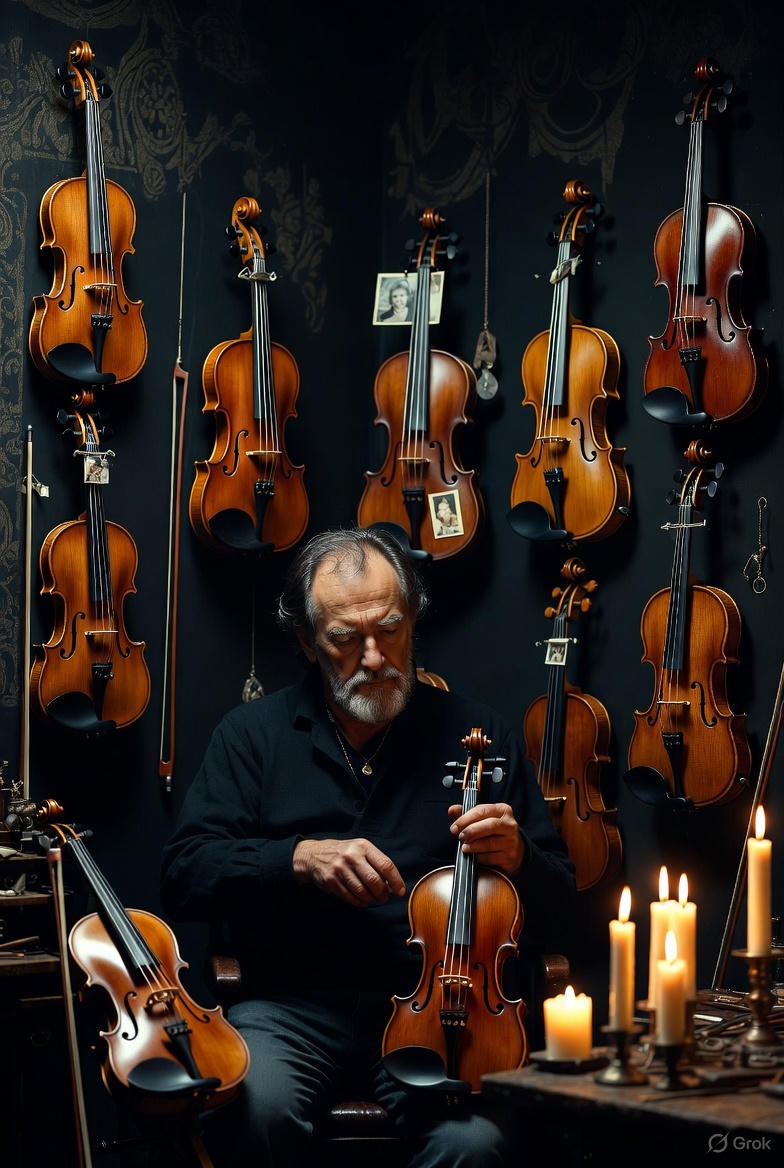
On the ground floor lived the violin-maker. At the
back was a gloomy kitchen; in front, a large, bright
room served as Rotrehl’s living, sleeping, and
workspace. Here, he crafted fine violins, some of
which traveled to the city with summer guests each
autumn. On the wall by his workbench hung five
violins, coveted by many buyers but never sold. They
hung in a row, each with a name painted in clumsy,
crooked black letters beneath: Jean – François –
Antoine – Madeleine – Marie. Below each name, a
cross and date marked the memorials to his wife and
four children. He’d kept his wife’s German name but
honored the French blood in his children. These
memorial violins had a soft, sweet, mournful tone.
On long winter evenings, after setting work aside,
Rotrehl would take one down and play simple,
melancholic tunes—songs heard nowhere else, alive
only in his heart. He played until sadness lifted. On
All Saints’ Day, the feast of the dead, he took all five
from the wall, lighting five candles on his
workbench. He played each violin in turn,
extinguishing a candle as he set each aside, until he
sat in darkness. But he was no longer alone—his wife
and children surrounded him, the room filled with
kind words, growing ever brighter.
Across from the bed, a large lithograph of
Napoleon hung beside a mirror. In it, Rotrehl sought
resemblances between his features and the great
conqueror’s, rewarding Napoleon with a fresh oak
sprig or garden flowers when confirmed. In a corner,
a bookshelf held a modest library: a Bible, a German
school association calendar, and several French
books. Rotrehl knew no French, but on heroic days,
feeling his French blood, he’d take one down and
read, tracing lines with his finger, straining eyes and
mind. He was certain enlightenment would come
before his death, revealing all. A summer guest fluent
in French once caught him at it, laughing
uproariously at the violin-maker poring over a French
cookbook. Since then, Rotrehl locked the door when
reading French.
Summer guests were often a nuisance, prying into
everything, but their money was vital for the lean
winter. This year’s early guest, however, pleased
Rotrehl. Herr Schiereisen wasn’t as intrusive. He
roamed the countryside daily, quizzing farmers,
borrowing old church records from priests and village
protocols from aldermen to study river and place
names. He chatted with locals about this and that,
occasionally asking about Herr von Boschan and his
young wife, as one does when thoroughly researching
a region.
Winning Rotrehl’s trust with his reserve,
Schiereisen drew the violin-maker’s interest in his
peculiar studies.
“What’s it all for, Herr Professor?” Rotrehl asked
one evening as Schiereisen sorted notes on a rickety
garden table. It was a warm, spring-like evening. A
gentle, fragrant south wind had blown for days,
filling the Kamp valley with scent. Sitting outdoors
was pleasant.
“Well,” Schiereisen said, fixing an earnest gaze on
Rotrehl, “long before Germans settled here, there was
another people. Nearly all traces of them are lost—
we don’t even know their language precisely. Yet
science has uncovered some things. Place and river
names sometimes trace back to the Celts. So, we
study how these names were spoken and written.
Then there’s skull measurements and facial features,
which also prove ancient blood mixtures…”
Rotrehl eyed the scholar thoughtfully. “Yes…
facial features, right? They’re proof? Surer than
papers. Papers can be lost… but not faces.”
Schiereisen placed a stone on his notes to keep the
spring breeze from stealing them. “Our methods
should interest you especially. Your case is strikingly
clear. You’ve good reason to hang Napoleon over
your bed. Tracing your lineage would be
rewarding… you differ markedly from this region’s
typical peasant type.”
This struck a chord with Rotrehl. The words
flowed into him like fiery, aged wine. He savored the
moment in silence, then said in a low, mournful voice
that it was a pity his line had dwindled—all dead,
swept away, only he remained.
Schiereisen murmured about fate’s tragedy, the
fall of noble blood, and the triumph of the inferior,
veering into theories of long and short skulls.
Rotrehl felt his personal fate gain weight, merging
with history’s grand stream. He grew in his own eyes,
grateful to Schiereisen for this elevation. This city
man could be trusted with anything. So Rotrehl spoke
of his time in Vienna, gaining higher learning, of his
children’s deaths, and the violins he’d crafted in their
memory, bearing their names.
They often discussed matters Rotrehl otherwise
kept private. With Schiereisen, usual cautions
weren’t needed. He could even share his thoughts on
the castle folk.
Sometimes, Rotrehl’s friend, old Johann from the
castle, visited. Before him, Rotrehl held back
opinions about Frau Helmina, as Johann brooked no
criticism of her. One might think him smitten. Saying
“the gracious lady” warmed his heart; whispering
“Helmina” with trembling daring lit his face like
sunrise. Yes, she’d been willful and moody, and Herr
Dankwardt had sighed often, but he should’ve been
happy.
Schiereisen enjoyed chatting with the old servant,
asking about countless trifles—the former masters’
lifestyles, their quarrels with Helmina, their finances,
their deaths. Johann answered tirelessly, relishing any
chance to speak of his mistress.
“How did Herr von Boschan meet Frau Helmina?”
Schiereisen asked.
“I don’t know. Must’ve been in Abbazia. The
gracious lady was there last year.”
“So Herr von Boschan was never at the castle
before?”
“Never.”
“Absolutely certain? Never during Herr
Dankwardt’s time? Think carefully.”
Johann didn’t hesitate. “I’m sure,” he said. “Herr
von Boschan first came last autumn. The very first
time…”
“Do you know if Frau Helmina knew him
earlier?”
“I don’t. But… no. She likely didn’t, as he was
traveling for years. He brought a servant, an Indian,
they say at the castle—God knows where he’s been.”
A suspicion began to fade, a trail dissolving.
“How does Frau Helmina get along with her
current husband?” Schiereisen pressed. “No disputes,
like before…?”
Johann shook his head. “I’ve noticed nothing.
He’s the first to handle her right, knows her worth. I
think,” he smiled, “he loves her dearly. Though…”
he paused.
Schiereisen seized the opening. “Have you noticed
something? A rift, any estrangement…?”
“No… it’s just… the gracious sir’s been a bit
nervous lately. For some time, they’ve had separate
bedrooms.”
“Oh? You mean, due to his nervousness, or…?”
The thrill of the hunt made Schiereisen’s questions
rapid and pressing, though only Rotrehl noticed. Old
Johann found it natural that anyone would take a
keen interest in everything concerning his mistress.
“Yes… he’s a bit nervous… says he can’t sleep in
a shared room. His nerves won’t allow it… he gets
anxious… often wanders half the night, unable to
sleep. That disturbed the gracious lady, of course. It
was sensible of him to take a separate room until it
passes…”
“And before, he wasn’t like this? He was—
healthy?” Schiereisen grew calmer, his focus
sharpening as he followed a thread.
“He’s quite healthy now,” Johann said. “I think
the gracious lady has no cause for complaint. You’d
notice no nervousness otherwise. Just these nighttime
episodes… when alone, he’s spared them. It’s surely
from that time he nearly suffocated. No wonder it left
a mark.”
This was new. Schiereisen maneuvered his
questions like chess pieces, keeping his strategy clear
in mind.

Read Full Post »

Alraune by Hanns Heinz Ewers and translated by Joe E Bandel

Wölfchen stared at it, fat tears running down his cheeks. But he
lit another cigarette when the first one burned down, removed the stub
from the frog’s throat and with shaking fingers pushed the fresh one
back into its mouth. The frog swelled up monstrously, quivering in
agony, its eyes popping out of their sockets. It was a strong animal
and endured two and a half cigarettes before it exploded.
The youth screamed in misery as if his own pain were much
greater than that of the animal he had just tortured to death. He sprang
back as if he wanted to run away into the bushes, looked around and
then quickly ran back when he saw that the torn body of the frog was
still moving. Wild and despairing he crushed it to death with his heel
to free it from its misery.
The Privy Councilor took him by the ear and searched his
pockets. He found a few more cigarettes and the boy confessed to
taking them from the writing desk in the library. But he could not be
moved to tell how he had known that smoking frogs would inflate
themselves until they finally explode. No amount of urging worked
and the rich beating that the professor gave him through the garden
didn’t help either. He remained silent.
Alraune stubbornly denied everything as well even after one of
the maids declared she had seen the child taking the cigarettes.
Despite everything they both stuck to their stories; the boy, that he
had stolen the cigarettes and the girl, that she had not done anything.
Alraune stayed at the convent for one more year. Then in the
middle of the school year she was sent home and certainly this time
unjustly. Only the superstitious sisters believed that she was guilty
and just maybe the Privy Councilor suspected it a little as well. But no
reasonable person would have.
Once before illness had broken out at Sacré Couer, that time it
had been the measles and fifty-seven little girls lay sick in their beds.
Only a few like Alraune ran around healthy. But this time it was much
worse. It was a typhoid epidemic. Eight children and one nun died.
Almost all of the others became sick.
But Alraune ten Brinken had never been so healthy. During this
time she put on weight, positively blossomed and gaily ran around
through all the sick rooms. No one troubled themselves over her
during these weeks as she ran up and down the stairs, sat on all the
beds and told the children that they were going to die the next day and
go to hell. While she, Alraune would continue to live and go to
heaven.
She gave away all of her pictures of the saints telling the sick
girls that they could diligently pray to the Madonna and to the sacred
heart of Jesus–but it wouldn’t do them any good. They would still
heartily burn and roast–It was simply amazing how vividly she could
describe these torments. Sometimes when she was in a good mood
she would be generous. Then she would promise them only a hundred
thousand years in purgatory. That was bad enough for the minds of
the pious sick little girls.
The doctor finally unceremoniously threw Alraune out of the
rooms. The sisters were absolutely convinced that she had brought the
illness into the convent and sent her head over heels back home.
The professor was tickled and laughed over this report. He
became a little more serious when shortly after the child’s arrival two
of his maids contracted typhus and both soon died in the hospital.
He wrote an angry letter to the supervisor of the convent and
complained bitterly that under the existing circumstances they should
have never sent the little one back home. He refused to pay the tuition
payment for the last half of the year and energetically insisted that he
be reimbursed for the monies he had put out for his two sick maids–
From a sanitary point of view the sisters should not have been
permitted to act as they had done.
His Excellency ten Brinken did not handle things much
differently. While he was not exactly afraid of contagion, like all
doctors he would much rather observe illness in others than in his
own body. He let Alraune stay in Lendenich only until he found a
good finishing school in the city. By the fourth day he had already
sent her to Spa, to the illustrious Institute of Mlle. de Vynteelen.
Silent Aloys had to escort her. As far as the child was concerned
the trip went without incident but he did have two little incidents to
report. On the train trip there he had found a pocket book with several
pieces of silver and on the trip back home he had slammed his finger
in the compartment door of the car he was riding in. The Privy
Councilor nodded in satisfaction at Aloy’s report.
The Head Mistress was Fräulein Becker who had grown up in
the University City on the Rhine and always went back there on her
vacations. She had much to relate to the Privy Councilor over the
years that Alraune stayed with her.
Right from the first day that Alraune arrived in the ancient
building on Marteau Avenue her dominion began and it was not only
imposed on her schoolmates. It was also imposed on the instructors,
most especially over the Miss, who after only a few weeks had
become a plaything for the absurd moods of the little girl, without any
will of her own.
At breakfast on that very first day Alraune declared that she
didn’t like honey and marmalade and much more preferred butter.
Naturally Mlle. de Vynteelen didn’t give her any. It was only a few
days until several of the other girls began to crave butter as well.
Finally a large cry for butter went up throughout the entire Institute.
Even Miss Paterson, who had never in her life enjoyed anything
with her morning tea other than toast with jam suddenly felt an
uncontrollable desire for butter. So the principal had been obliged to
give in to the demand for butter but on that very same day Alraune
acquired a preference for orange marmalade.
In response to the Privy Councilor’s pointed question Fräulein
Becker declared that the torturing of animals never came up during
those years at the Vynteelen School. At least no incidents had ever
been discovered. On the other hand, Alraune had made the lives of the
other children miserable as well as those of all the instructors, both
male and female.
Especially the poor music instructor who always placed his
snuffbox on the mantel in the hall during class so he would not be
tempted to use it. From the moment of Alraune’s entrance into the
school the most remarkable things had been found in it. For example,
thick spider webs, wood lice, gunpowder, pepper, writing sand black
with ink and once even a chopped up millipede. Several girls were
caught doing it and punished–but never Alraune.
Yet she always showed a passive resistance toward the musician,
never practiced and during class laid her hands in her lap and never
raised them to play an instrument. But when the professor finally
complained in despair to the principal Alraune quietly declared that
the old man was lying. At that point Mlle. de Vynteelen personally
attended the next hour and saw that the little girl knew her lesson
exquisitely, could play better than any of the others and showed a
remarkable talent.
The Head Mistress reproached the music instructor heavily. He
stood there speechless and could say nothing other than, “But it is
incredible, incredible!”
From then on the little schoolgirls only called him “Monsieur
Incredible”. They called after him whenever they saw him and
pronounced the words like he did, as if they didn’t have any teeth in
their mouths either.
As for the Miss, she scarcely ever experienced a quiet day. New
stupid pranks were always being played on her. They sprinkled itch
powder in her bed and one time after a picnic placed a half dozen
fleas in it. Then the key to her wardrobe was missing, then the hooks
and eyelets were torn from the dress that she wanted to wear. Once as
she was going to bed she was almost frightened to death by an
effervescent powder reaction in her chamber pot. Another time so
many stinging insects flew through her open window that she
screamed out for help. Then the chair she sat on was smeared with
paint or with glue or she found a dead mouse or an old chicken head
in her pocket.
And so it merrily continued, the poor Miss could hardly enjoy an
hour of her life. Investigations took place and those girls found guilty
were always punished but it was never determined to be Alraune even
though everyone was convinced that she was the mastermind behind
all the pranks.
The only one that angrily rejected this suspicion was the English
woman herself. She swore the girl was innocent up until the day she
left the de Vynteelen Institute.
“This hell,” she said, “only shelters one sweet little angel.”
The Privy Councilor grinned as he noted in the leather volume,
“That sweet little angel is Alraune.”
As for herself, Fräulein Becker related to the Professor that she
had avoided coming into contact with the strange little creature from
the very start. That had been easy for her since she was mostly
occupied in working with the French and English students. She only
had to instruct Alraune in gymnastics and sewing. As for the latter
subject, she had quickly exempted her from it when she had seen that
not only did Alraune have no interest in sewing, she showed a
downright aversion to it.
But in calisthenics, which by the way Alraune always excelled
in, she always acted as if she never noticed the joking around the
child did. She only once had a little confrontation with her and that
was just after Alraune’s entrance into the school. She had to confess
that unfortunately Araune had gotten the better of her.
By chance she had overheard Alraune telling her schoolmates
about her stay in the convent. The boasting and cheeky bragging was
so abominable that she took it as her duty to intervene. On one hand
the little one told how splendid and magnificent the convent was and
on the other hand she told truly murderous stories about the various
misdeeds of the pious sisters.
She herself had been brought up in the Sacré Couer convent in
Nancy and knew very well how simple and plain it was and knew as
well that the nuns were the most harmless creatures in the world. So
she called Alraune into her office and reproached her for telling such
fraudulent stories. She also demanded that the girl immediately tell
her schoolmates that she had not been telling the truth. When Alraune
stubbornly refused, she declared that she would tell them herself.
At that Alraune rose up on her toes, looked straight at her and
quietly said, “If you tell them that, Fräulein, I will tell them that your
mother has a little cheese shop in her home.”
Fräulein Becker confessed that she had become weak and given
in to a false shame. She let the child have her way. There had been
something so deliberate and calculated in the soft voice of the child in
that moment that she had become afraid. She left Alraune standing
there and went to her room happy to avoid an outright quarrel with the
little creature.

Read Full Post »

A Modern Inquiry into the Hermetic Mystery

Part III: Concerning the Laws and Vital Conditions of the Hermetic Experiment

Chapter 1: The Experimental Method and Fermentation, Part 5

Introduction: The Hermetic art transforms the soul’s essence through a fiery process of purification and rebirth, revealing divine light within. This section explores the alchemical stages of dissolution and renewal, symbolizing the soul’s heroic journey to transcend earthly illusions.

The Soul’s Transformative Descent

As the divine will loosens the soul’s chaotic impulses, it ignites a profound inner conflict, loosening the bonds of earthly life. This is the soul’s confrontation with its original sin, a loosening of the self-will that unleashes a tempest of passions. Alchemists describe this as the “Green Lion,” a wrathful force that devours and dissolves, reducing the soul to a venomous “Black Toad,” its essence corrupted in the depths of putrefaction.

Sendivogius explains, “Sal and Sulphur meet at a fountain, fighting until Sal wounds Sulphur, from which flows white milk, becoming a great river.” This symbolizes the soul’s essence (Mercury) purified through conflict, flowing as a vital stream. Ripley adds, “The sun passes Noah’s flood, the waters recede, revealing the rivers in dry land.” The soul, stripped of illusions, emerges renewed, its chaotic forms dissolved in divine fire.

The Heroic Will’s Triumph

This process mirrors heroic myths: Achilles, avenging Patroclus’ death, rises triumphant in radiant armor; Aeneas, honoring Misenus, unlocks the infernal path. The soul’s heroic will, sacrificing its lower nature, dissolves sensory bonds to awaken divine virtue. Palingenius’ verse captures this: “Drown the youth in Stygian waters, dissolve his taint, and a golden spirit rises, perfecting all it touches.” This death and rebirth, the alchemical crucifixion, loosens the soul’s self-will, transforming it into a vessel of divine light.

The soul, purified, becomes a “new world,” where the divine light nourishes all faculties. As Hermes declares, “Separate the subtle from the gross, gently, with sagacity,” this is no mechanical act but a spiritual wind, freeing the soul’s “seed of gold” from its dungeon. Eirenaeus instructs, “Our sulphur, trapped in the body, is released by our water, revealing the Third Menstrual—a radiant essence—through patient meditation.”

The Divine Light Revealed

This wondrous essence, the “infinite fortitude” of the Hermetic art, overcomes all, penetrating every solid to reveal universal truth. The soul, once bound in chaos, now radiates divine harmony, as Job’s imagery illustrates: “Wisdom’s path, hidden from all living, is known only to God.” The alchemists’ “Mercury of Philosophers”—pure, intelligent, living—emerges from this purification, a mirror of divine reason, not a common substance but the soul’s awakened light.

Closing: This section unveils the Hermetic art’s purification through fiery conflict, transforming the soul’s essence into divine light. The journey into alchemical fermentation deepens in our next post, unveiling further secrets of this sacred practice.

Read Full Post »

OAK Meditation Course 001 is now available to paid membership.

https://www.patreon.com/posts/oak-meditation-143203747

It contains a lecture, a group meditation and a solo meditation. It is available to paid members only. This course shares what I have learned over the 30+ years of doing these meditations by myself and with others. Learning through experience is the next step to embodying spiritual truth. There are no shortcuts.

Read Full Post »

Homo Sapiens: In the Maelstrom by Stanislaw Przybyszewski and translated by Joe E Bandel

Sacrifice was ridiculed because it is so infinitely hard to sacrifice oneself, because it costs so much struggle and despair. You say: I! But what is your I? Is it not perhaps an antidote against a bad conscience? Your I is only there so that you can transgress the small law that regulates your small desires… You, you, Falk, you are despite your self-glorifying individualism a small person. In what has your life exhausted itself if not in debauchery and sexual desire… Well, I do you wrong, you have done much, but was it not because you found a kind of atonement in it, tell me Falk, was it not to calm your bad conscience? 

He stood almost threateningly before him, but sat down again immediately. “Why I you concerned about me?. I have nothing to do with you. I sit here ten hours and think that I have nothing more to do with you all. I have nothing personal about me anymore. My soul has widened, infinitely widened… You naturally don’t know what humanity is, because your lying brain, this flexible instrument in the service of your digestion, has made a concept of humanity, yes a concept, to be able to conveniently dissect, unravel and dispute it away. I don’t know this concept, but I know humanity as the root of my soul, I feel it with every beat of my heart, as the basic feeling that the sacrifice I bring to millions from my self is something else than the crawling and sweating and running after a woman. But now go Falk, I want to be alone before my departure. Just think that you are a small person, and you should have been one of the greatest. You, yes, you; you should have become one.” 

Falk felt deeply shaken. But in the same moment a cynical shame overcame him that he let himself be shaken, it seemed to him as if his brain grinned at his helplessness. 

“Do you eat opium?” he asked half unconsciously. Czerski looked at him seriously. 

“Your brain is shameless,” he said slowly and almost solemnly. “Shameless!” Falk ducked under this look and these words. He stared at Czerski ashamed, he clearly felt two souls stretching up against each other. 

“Yes, my brain is shameless.” 

But immediately he regained his superiority. The cynical soul triumphed. He adjusted himself, smiled scornfully and said: 

“It is very beautiful what you said there. Your criticism of our society was very good, although you did not go beyond what Nietzsche says in his *Zarathustra*, yes, the Nietzsche you so despise.” 

He was silent for a moment to see how that would affect Czerski. 

But Czerski seemed not to listen to him at all. He turned his back to him and looked out the window. 

Falk was not surprised at all about it, he even brooded that he was not upset about it. He suddenly became sad and serious. 

When he began to speak again, it was only to hear himself speak. 

“You are right, my brain is shameless because it cannot grasp that your feeling ‘humanity’ has no causes, no causes that are not grounded in some experience. But that is how my brain is, it takes your soul state under the magnifying glass and analyzes it. You sat in prison. The woman you loved treacherously forgot you. Your loneliness, your bitterness, your pain and your despair finally produced this selfless surrender. So is your humanity not a lie, a great lie to save yourself from despair, is that not a lie to break the pain that caused these terrible torments, a lie of your physique in need of rest and recovery? You are now happy with your great lie and I am unhappy because my lie is small. But what does great mean? What small? My God, the concepts are lost to me, I usually don’t judge from a logical standpoint either. I know very well that the soul does not follow logical principles… But what did I want to say?… Yes, right… 

Czerski suddenly turned around. “Do you want tea?” 

“Yes, give tea, much tea… Yes! You condemn me, you called me a scoundrel. Isn’t that so, you did it? Why did you call me that? Because in my destructions sex was a motive. I speak destructions because the case with Janina is not the first. No… 

He drank the tea hastily. The fever began to dominate him. 

“Sex was the motive. Good! But—” again he lost the thread of thought; he thought long, then suddenly started triumphantly. 

“Look at Napoleon. He is a classic example for all such cases.” 

His face shone. 

“You smile! No, I don’t want to compare myself with Napoleon at all. I only weigh motives against each other. What were his motives?… He, he: some say he was like the thunderstorm that cleans the air. But it is a ridiculous comparison. That the thunderstorm cleans is only accidental, if it weren’t, we would have to assume a providence, a pre-established harmony. He, he… those are only false conclusions. Give me another glass of tea. 

Napoleon had to have motives though. Well: ambition for example. But what is ambition? You don’t believe that ambition is a fact… but—does that interest you? 

“Speak only, that seems to calm you.” 

“Yes, you have a splendid psychological eye. It actually calms me. So ambition is something enormously composite. A thousandfold parallelogram of forces, if you want. It is no basic drive like hunger and sex are. It is something that has developed from the basic drives. All these motives have the common root in the basic drives. They are only derivations, development and differentiation phenomena… 

Falk laughs nervously. 

“So see, see: all emotional motives have biologically and psychologically the same value because they come from the same root. He, he… those are special theories, they don’t have to be correct at all. I only wanted to prove to you that my action motives do not lag behind Napoleon’s in value at all. 

In most cases, however, the motives are unknown, one doesn’t know why one does this or that… Well yes… 

Falk had great difficulty concentrating. He literally suffered from thought flight. 

Yes, so, the motives from which Napoleon destroyed can also only be derived sex drives… Isn’t that so? We can assume that as probable. But then you will say there is a great difference, to conquer a world and to make a girl unhappy… He, he, he… So you reproach me that I am too small a criminal? For to conquer a world one must destroy a world, and I have only destroyed a few girls. Now you will naturally say: Napoleon made a world happy. But in his thoughts, God knows, there was no intention to make a world happy. He did everything because he had to do it. In the psychic fact there is no purpose of consciousness at all. The brain only lies that in afterwards… 

Read Full Post »

Madame Bluebeard by Karl Hans Strobl and translated by Joe E Bandel

The stranger turned, striding in the opposite
direction. The plain’s rolling waves stretched before
him. Fields lay in patches of black and dirty snow-
gray. Winter crops showed green in sheltered spots.
The air was potent, the earth pulsing with urge. Over
narrow field paths, wet earth clumping on his boots,
the sausage-skinned man marched toward his goal.
At last, Sankt Leonhard am Horner Wald’s tower
rose over a ridge. Three or four houses clustered near
the church; the village’s other farms scattered across
the plain. Dark woods filled the hollows.
As fitting, the houses by the church were two inns
and a large general store stocking every farmstead
need.
Entering Alois Fürst’s tavern-room, the stranger
found carters by the stove, discussing weather. Talk
halted as they scrutinized him.
Finally, Mathes Dreiseidel von Vorderschluder,
pointing with his pipe stem, said to his neighbor,
“That’s the daft professor livin’ with us.”
“A professor?” others whispered hoarsely. “He
can’t wait for summer.”
“He ain’t no summer guest. He’s doin’ studies
round here.”
“Oh… is that so?”
They fell silent, eyeing the professor, who’d shed
his sausage coat and sat at a nearby table. Thick blue
smoke curled from their pipes. Mathes Dreiseidel
drained his glass, rapping the table for another quart.
“Say, then,” the Wegschaid carter, who drove
twice weekly through Sankt Leonhard to Gars,
resumed, “our roads are a mess. I tell ye, some folk
meddle in everything. Big mouths get their way.
Look at our roads—they ain’t built for all’s best, but
for them loudmouths. Roads take big detours. Why?
‘Cause someone’s got a tavern there. I name no
names. Anyone crossing the Wolfshofen land knows
who I mean.”
“Aye… true enough,” others agreed. The
Idolsberg bergmaster added, “Plenty to fix round
here. Couldn’t the gentry build a road from
Rosenburg to Wegschaid? I’ve studied the Kamp
valley close. Two blasts, no more. It’d profit them
too. Now they float logs from Rosenburg. Half’s
lost—twenty percent gone. What arrives is half-
rotted.”
“Pardon, gentlemen,” the stranger cut in. “You
mention the Kamp. Do you know why the river’s
called that?”
Mathes Dreiseidel nudged the Idolsberg
bergmaster. He grunted, catching the hint. Those
studies. But what to say to such a daft question?
The Wegschaid carter spoke, slipping into High
German. “Well, since the Herr asks, I must say we
don’t rightly know. The river’s always been called
that. It’s marked Kamp on maps too.”
“That’s so,” the bergmaster growled.
The professor pressed on. “Haven’t you heard
older folk call the river something else? Idolsberg’s
an intriguing name too. There’s a wealth of ancient
names here.”
“Nah!” the carters said. The Wegschaid carter,
once a waiter at Graz’s Golden Elephant, added,
“No! No memory of it remains.”
“Hm!” the professor grunted, then continued, “By
the way, you’re quite right about what you said
earlier. The Kamp valley needs a road. It’d boost
traffic tremendously.”
“Aye, but that Rosenburger does naught. Always
off in Africa,” grumbled a farmer.
“There are other landowners. Rotbirnbach has a
stake, too. And Herr von Boschan in Vorderschluder,
most of all. He’s said to be a capable man.”
The farmers exchanged glances. “Herr von
Boschan’s only been in Vorderschluder a few
months,” said the Idolsberg bergmaster. “If he lasts
longer, he might do somethin’.”
“What do you mean? Is he strapped for cash?” A
brief silence followed. The Wegschaid carter, eager
to show his worldliness, spoke up. “Well, money’s no
issue, but folks say he won’t last long, ‘cause none of
Frau von Boschan’s husbands ever do.”
The professor smiled. “Yes, I recall now. I was
told. He’s her third husband.”
“Pardon! Beggin’ yer pardon! He’s the fourth.”
“Right, the fourth. Yes, yes! And the last, if I’m
not mistaken, was a certain Herr Sangwart.”
“Dankwardt, his name was. A right kind
gentleman, but knew nothin’ ‘bout farmin’. Always
buried in books.” The Wegschaid carter shared what
he knew of Herr Dankwardt.
The others cloaked themselves in smoke and
silence. The professor dipped his bucket of questions
into the carter’s well of eloquence.
Evening fell. A red sky peered through the
windows. The Idolsberg bergmaster, first to stir,
decided it was time to head home. He tapped out his
pipe, spat on the floor, and stood.
Mathes Dreiseidel offered the professor a seat on
his cart. They rolled into the dusk. Dreiseidel smoked
on the driver’s bench; the professor, jostled on straw
in the back, jotted notes in a red book as best he
could.
At Achenwald, he tapped the farmer’s shoulder.
“Thanks kindly, Herr Dreiseidel,” he said. “I’ll cut
through the woods—much shorter.”
“Know the paths? It’s pitch dark.”
“When you roam as much as I do, you’re
prepared. Got my pocket lantern.” He climbed down.
“So, thanks again. Next time, you ride my cart.”
Dreiseidel clattered off, the night swallowing the
rumble. The professor stood alone in the dark. He
carefully drew his folding lantern from its oilcloth
case, snapped it open, and fitted a candle. A match
flared, and after some effort, the bent wick caught.
He plunged into the woods. On the narrow path,
the light danced in wild leaps ahead. With sure steps,
the stranger followed, his gait confident, springy. He
mulled over today’s haul from the Wegschaider’s
well.
After a while, he looked up, startled. A light
flickered toward him through the trees. He stepped
aside. A man approached in a short hunting jacket
and high boots. A jolt of joy shot through the
professor. By God, it was none other than Herr von
Boschan.
The professor stepped back onto the path,
shoulders slumped, trudging with a despairing air.
Facing Boschan, he raised his lantern. “Excuse me,”
he said.
Boschan lifted his lantern, revealing a distressed,
pitiful face.
“Pardon, good sir,” the professor said again. “Can
you tell me if I’m on the right path?”
“Where are you headed?” Boschan asked, amused.
What was this man in his yellow overcoat doing in
the pitch-black woods?
“I think I’m lost. I’m new here, don’t know my
way yet.”
“Where do you live?”
“With Rotrehl, the violin-maker. They told me this
wood path cuts a good distance.”
“You’re on the right track. Keep going, take the
left at every fork, then left down at the forest’s edge.”
“That’s a relief. I’m not familiar yet, as I said…
always left! Thank you kindly, sir! Allow me—
Schiereisen… from Vienna!”
Ruprecht bowed briefly. “Boschan.”
Schiereisen’s wide mouth gaped. “What, Herr von
Boschan? An honor and pleasure… truly. Since
arriving, I’ve hoped to make your acquaintance…
and now chance brings us together at night in the
woods… ha… ha! Quite something, no? I’m here for
studies. This area’s remarkably interesting; I
suspect—”
He’s liable to lecture me here, Ruprecht thought,
cutting in. “I knew at once you were a professor,” he
said, smiling.
“Not quite! I’m more a private scholar,
researching for pleasure. I haven’t sold out to the
state. Once you’re dubbed professor, free inquiry’s
done. Look at our dear Austria’s state of affairs.
What do you say? I’d rather forgo titles and honors,
stay independent. I can do and write as I please… no
one’s leash on me. I’m working on a study of Central
European culture, and your region—”
“Pardon,” Ruprecht said, a touch impatient, “my
wife’s expecting me. I was delayed at a quarry…”
Schiereisen laid a hand on Ruprecht’s arm. “One
more word, Herr von Boschan… I’ll let you go… I’m
thrilled to meet you… There’s a bit of self-interest,
too. I heard your predecessor, Herr Dankwardt, had a
vast library and loved books. It’s only natural some
might… I mean, he likely took interest in this land’s
prehistory, and I could find valuable resources.
Amateurs often stumble on books scholars seek in
vain. If you’d…”
“It’d be my pleasure to host you. The library’s at
your disposal.”
The lantern-lit talk on the narrow forest path
ended. They shook hands and parted. Schiereisen’s
candle had burned low. He paused after a few steps to
adjust it, whistling softly with a smile. His lantern’s
Marienglas crackled in the heat.
Then he strode briskly to reach home.
That evening, he wrote to Herr Peter Franz von
Zaugg, Section Councilor in the Railway Ministry:
“Dear Sir, It is with sincere satisfaction that I report,
after a relatively short stay, some not insignificant
successes. I have diligently gathered material. You
will understand that this case, which you kindly
entrusted to me, presents considerable challenges. I
reserve a full account for later. Today, I wish only to
note that a fortunate chance introduced me to Herr
von Boschan. I have secured unobtrusive, harmless
access to the castle, and rest assured, I will seize
every opportunity to advance my goal. I hope soon to
provide you and your esteemed wife with clarity on
the dark, mysterious circumstances surrounding your
late brother-in-law’s fate and, should your suspicions
prove founded, to ensure justice for a heinous crime.
With utmost respect, Your devoted, Josef Tängler.”

Read Full Post »

Alraune by Hanns Heinz Ewers and translated by Joe E Bandel

Chapter Seven
Shares the things that occurred when Alraune was a young
girl.

FROM the time she was eight years old until she was twelve
Alraune ten Brinken was raised in the Sacré Couer convent
in Nancy. From then until her seventeenth birthday she
lived at Mlle. de Vynteelen’s finishing school for young
ladies on Du Marteau Avenue in Spa. During this time she went to the
ten Brinken home twice a year to spend her vacations.
At first the Privy Councilor tried to have her taught at home. He
hired a girl to teach the child, then a tutor and soon after that another
one. But even with the best intentions in a short time they all
despaired of ever teaching her anything. It was simply not going to
happen. It was not something they could point out. She was not wild
or unruly. She just never answered and there was nothing that could
break through her stubborn silence.
She just sat there quiet and still, staring straight ahead and
blinking with half-open eyes. You could scarcely tell if she was even
listening. She would pick up the slate in her hand but she would not
move it, not up, down, or to make a letter–If she did use it, it was to
draw some strange animal with ten legs or a face with three eyes and
two noses.
What she learned at all she learned before the Privy Councilor
sent her to the convent, before her separation from Wölfchen. This
same boy that failed miserably in every class in school and looked
down with contempt on any schoolwork had an unending patience
with his sister at home.
She had him write long rows of numbers, write out his name and
her name hundreds of times and she enjoyed it when he made a
mistake, when his dirty little fingers cramped up on him. It was for
this purpose that she would take up the slate, the pencil or the writing
quill. She would learn a number, a word or its opposite, grasp it
quickly, write it down, and then let the boy copy it for hours. She
always found something to correct, there, that stroke was not right.
She played the teacher–so she learned.
Then one day the principal came out to complain to the Privy
Councilor about the pathetic performance of his foster son. Wölfchen
was especially weak in the sciences.
Alraune heard this and from then on played school with him,
controlled him, made him study till dark, listened to him recite his
lessons and made him learn. She would put him in his room, close the
door and not let him come out until he had finished off his homework.
She acted as if she knew everything already and would not
tolerate any doubt of her superiority. She learned very easily and
quickly. She did not want to show any weakness in front of the boy so
she took up one book after another grasping its contents and moving
on to the next in a wild and chaotic manner without tying them
together. This went on until the youth would come to her when he
didn’t know something. He would ask her to explain it to him because
she must surely know it. Then she would put him off, scold him and
tell him to think it over.
That gave her some time to search in her books. If she couldn’t
find the answer she would run off to the Privy Councilor and ask him.
Then she would come back to the boy and ask if the answer had
occurred to him yet. If it hadn’t she would finally give him the
answer. The professor noticed the game and it amused him. He would
have never even considered placing the girl out of the home if the
princess hadn’t kept pressuring him again and again.
The princess had always been a good Catholic and it seemed as if
she became more devout with every Kilo of fat that she put on. She
was insistent that her Godchild must be brought up in a convent. The
Privy Councilor had been her financial advisor for several years now
and invested her millions almost as if they were his own. He thought
it prudent to go along with her on this point. So Alraune went to the
Sacré Couer convent in Nancy.
There were several exceptionally short entries in the Privy
Councilor’s hand during this period and several long reports from the
Mother Superior. The professor grinned as he filed them, especially
the first ones that praised the girl and the extraordinary progress she
was making. He knew his convents and knew very well that a person
could not learn anything of this world among these pious sisters.
He enjoyed how the first letters filled with the praise that all the
parents received very soon took a different tone. The Mother Superior
reported more and more urgently on various cruelties and these
complaints always had the same basis. It was not the behavior of the
girl herself, not her performance in giving presentations. It was
always about the influence she exerted on her schoolmates.
“It is entirely true,” writes the Reverend Mother, “that the child
herself never tortures animals. At least she has never been caught at
it–But it is equally true that all the little cruelties committed by the
other girls originate in her head.
First there was little Mary, a well-behaved and obedient child
that was caught in the convent garden blowing up frogs with hollow
grass stems. When she was called to account for her actions she
confessed that Alraune had given her the idea. We didn’t want to
believe it at first and thought it was much more likely that she was
trying to shift the blame away from herself.
But very soon after that two different girls were discovered
sprinkling salt on some large slugs so that they writhed in agony as
they slowly dissolved into slime. Now slugs are also God’s creatures
and again these two children declared that Alraune had pushed them
into it. I then questioned her myself and the child admitted everything
and went on to explain that she had once heard that about slugs and
wanted to see if it was really true. As for the blowing up of frogs, she
said that it sounded so beautiful when you smashed a blown up frog
with a stone. Of course she would never do it herself because some of
the crushed frog might squirt onto her hands.
When I asked whether she understood that she had done wrong
she declared No, she had not done anything wrong and what the other
children did had nothing at all to do with her.”
At this place in the report in parentheses the Privy Councilor
wrote, “She is absolutely correct!”
“Despite being punished,” the letter continues, “a short time later
we had several other deplorable cases that we determined must have
originated from Alraune.
For example, Clara Maasen of Düren, a girl several years older
than Alraune, she has been in our care for four years now and never
given the slightest cause for complaint. She took a mole and poked its
eyes out with a red-hot knitting needle. She was so upset over what
she had done that she spent the next few days extremely agitated and
bursting into tears for no reason at all. She only calmed down again
after she had received absolution during her next confession.
Alraune explained that moles creep around in the dark earth and
it doesn’t matter if they can see or not.
Then we found very ingeniously constructed bird traps in the
garden. Thank God no little birds had been caught in them yet. No
one would tell us where she had gotten the idea. Only under the threat
of severe punishment did some girls finally admit that Alraune had
enticed them into doing it and at the same time threatened to do
something to them if they told on her.
Unfortunately this unholy influence of the child on her
schoolmates has now grown to the point where we can scarcely find
out the truth anymore.
Helene Petiot was caught at recess carefully cutting the wings off
of flies, ripping their legs off and throwing them alive onto an anthill.
The little girl said that she had come up with the idea herself and
stuck with her story in front of His Reverence, swearing that Alraune
had nothing to do with it.
Her cousin Ninon lied just as stubbornly yesterday after she had
tied a tin pot to the tail of our good old cat and almost drove it insane.
Nevertheless we are convinced that Alraune had her hand in that
game as well.”
The Mother Superior then wrote further that she had called a
conference together and everyone had concluded the best thing was to
respectfully beg his Excellency to take his daughter away from the
convent and come as soon as possible to get her.
The Privy Councilor answered that he very much regretted the
incidents but must beg them to keep the child a little while longer at
the convent.
“The more difficult the work, the greater the reward.”
He had no doubt that the patience and piety of the sisters would
be successful in clearing the weeds out of the heart of his child and
turn it into a beautiful garden of the Lord. The reason he did this was
to see if the influence of this sensitive child was stronger than the
discipline of the convent and all the efforts of the pious sisters.
He knew very well that the cheap Sacré Couer convent did not
draw from the best families and that it was very happy to count the
daughter of his Excellency as one of its students. He was not
mistaken. The Reverend Mother replied that with God’s help they
would try once more. All the sisters had declared themselves willing
to include a special plea for Alraune in their evening prayers. In
generosity the Privy Councilor sent them a hundred Marks for their
charities.
During the next vacation the professor carefully observed the
little girl. He knew the Gontram family from the Great-grandfather
down and knew that they all took in a great love for animals with their
mother’s milk. He felt that her influence on this much older boy
would at last meet its match, become powerless against this innermost
feeling of unlimited goodness.
Yet he caught Wölfchen Gontram one afternoon down by the
little pond under the trumpet tree. He was kneeling on the ground. In
front of him sat a large frog on a stone. The youth had lit a cigarette
and shoved it in the wide mouth and deep down its throat. The frog
smoked in deathly fear, swallowing the smoke, pulling it down into its
belly. It inhaled more and more but couldn’t push it back out so it
became larger and larger.

Read Full Post »

« Newer Posts - Older Posts »