Feeds:
Posts
Comments

Archive for November, 2025

Homo Sapiens: In the Maelstrom by Stanislaw Przybyszewski and translated by Joe E Bandel

Falk breathed heavily. 

“Then I heard him cry loudly: Murderer! And in this second I understood that I had committed a hideous crime… In the same moment he stepped toward me, I see his hand stretch out, in time I caught it, and pushed him back with my fist so violently that he staggered and fell. — — Since that time it has come…” 

Falk spoke almost inaudibly. 

Olga was seized by an uncanny feeling. Almost unconsciously she grabbed his both hands, held them tight, pressed and shook them and looked at him with growing fear. 

“Why, why must you be so unhappy?!” 

Falk was suddenly overcome by a feeling that he must throw himself at this woman’s feet, something forced him down with all power, he collected himself with great effort. 

“You, you…” he stammered. 

But suddenly he pulled his hands away and laughed with a short hoarse whistle. 

“Don’t look at me like that. Don’t do it! That touches me so uncannily.” He was seized by a whirl. He spoke quickly and laughed

constantly. 

“There are namely here in the city quite strange places where one can suddenly get temporary attacks of madness… Yes, there, at such a place, I believe it was in the African Cellar, I sat with a friend whom I love to madness… Ha, ha, also an overman! He abducted a painter’s wife here and ran away with her. Since then he has disappeared. I hate him, I hate him, he suddenly cried out. I must not even be with him, he hates me too, yes, now… We sat quite still then and drank. But suddenly our eyes met. Quite by chance. Yes, by chance—and they stuck to each other. I wanted to tear them loose, but it was impossible, our eyes had grown into each other. And then he suddenly begins to scream, in such an animal fear feeling that cold sweat ran over my whole body… There is something in the soul that must not be touched, otherwise the person falls apart… He, he, he… You see, the old man tore it open in my soul and since then it bleeds incessantly… The cursed old man, may the devil take him… He, he: that is something that lies beyond the brain—quite, quite beyond… The greatest, the holiest criminal on earth, Napoleon, yes Napoleon, this great holy criminal got cramps when he had the Duke of Enghien killed… I have illustrious models… I explained that very long and broad to Czerski… Have you ever heard that the Romans carried around such a holy Bacchus heart at the Saturnalia? Whoever got to see it had to die… Ha, ha, ha… the ancients knew it, they knew it very well, and they knew much more than is in your communist manifesto.” 

Suddenly he saw Olga staring at him with unspeakable fear. He became calm instantly. Then he smiled embarrassedly. 

“Yes, you probably have a little fear of me?” He sat down. “Do you perhaps have something to eat? I have eaten nothing today.” 

She got him bread and butter, but he did not touch it. He seemed to sink completely into deep brooding. 

A nameless pity seized Olga with the man she loved so boundlessly with her strong soul. His fever communicated itself to her, a wild whirl began to spin in her soul. It was as if something had sprung open in her, and the hot glow welled out unstoppably. She felt her whole body rear up and jerk in hot shiver. 

She lost her senses, a raging fury seized her, a desire tore at her for this man, she felt that she must now cry out: Here, take me then—take! 

But in the same moment she saw Falk’s eyes staring at her with a strange expression. 

“Olga, I torment you, I will go.” 

She jerked violently: the man seemed to read every thought in her soul. She became so confused that she only stared at him speechlessly. 

But Falk seemed to forget her again already. He fell into his former brooding. 

Suddenly he laughed with a strange laugh. 

“I namely also drove a friend to death; he was my wife’s fiancé, but his death does not touch me in the least. He is as indifferent to me as the Medici Venus to a cow. That probably comes from his death being necessary and having a purpose. By the way, I could kill him a second time now if he came to life again…” 

Hm… Olga, you don’t believe how morbidly brittle my psychic constitution is. Isa held me together for a long time. I namely had a feeling of love for her, so unheard-of strong that my whole soul was filled with it. But then this wonderful synthesis suddenly got a crack, a deep crack through quite strange and disgusting sensations… Well yes… He, he… Don’t you perhaps also have such little worms in your heart?… I read somewhere how a fellow says, when he appears before the almighty judge, then he will be quite astonished at the extent of the sufferings that his noble heart harbors… Ha, ha, ha… Splendidly said, splendidly… 

He was silent. 

Olga supported her head in both hands and looked at him mutely. “Do you perhaps have tea?” 

Then he saw great tears in her eyes, he saw them run silently and unstoppably over her cheeks. 

It looked terrible. The face was as if frozen in pain. Not a muscle twitched. It was for him a feeling of fright and horrible torment. He could not look at it. 

He stood up and went on tiptoe inaudibly out the door. 

A never known feeling of shame choked him. He had never felt it before. 

Only not home, only not home. He repeated it incessantly. 

He ran along the street, then around the corner and suddenly stopped: A huge glass sign in which gas burned inside: “To the Green Nightingale” he read. 

He came into a state of delighted bliss. 

Here he was with Isa on the day he met her… Just sit down for a moment and live through everything once more. 

The town hall clock began to strike. 

It was two o’clock. Then he had time enough to get home. 

He entered.

Read Full Post »

Madame Bluebeard by Karl Hans Strobl and translated by Joe E Bandel

Twelfth Chapter
Herr Schiereisen held a delicate web in his hands.
He saw Frau Helmina already ensnared. A thread led
to Vienna. It was necessary to follow it and tie it to
the right end. The matter was gaining weight,
growing beyond the single case. Schiereisen’s keen
instincts sensed something vast.
On his second day in Vienna, he visited Section
Councilor von Zaugg at the Railway Ministry. The
refined, pale, slightly stooped gentleman received
him with unusual animation. “What can you report?”
he asked eagerly. “Have you found something?”
Schiereisen disliked giving accounts before his
material was complete. He asked the councilor to
forgo details and trust that all was progressing well.
“You have faith in me, don’t you?” he smiled.
Zaugg leaned forward in his club chair, inspecting
his fingertips. “I consider you Vienna’s finest
detective,” he said warmly. “If anyone can shed light
on this dark affair, it’s you. I defer to you entirely.”
“I didn’t shave my fine beard and oil my rusty
prehistory knowledge for nothing. Rest assured, your
commission is a matter of honor, and I’ll do
everything to see it through.”
“Thank you! You know, it’s not so much my
brother-in-law’s estate, though I deeply regret the
total loss of my father-in-law’s bequests to my wife.
Above all, I want to know if a crime was committed.
My wife insists on it. She never quite took to this
Frau Helmina with her strange past. I want to give
her certainty to calm her nerves. But I urge you again
to proceed with utmost caution. We don’t want to
tarnish the woman who once bore the name
Dankwardt with a scandal if our suspicions are
unfounded. An exhumation of my brother-in-law’s
body could be arranged, but that’s a last resort, only
if the chain of evidence is otherwise complete…”
Schiereisen accepted a ceremonial Havana of
unusual shape and was dismissed. He set to work at
once, his full acumen engaged. Never had he pursued
a case with such zeal. A personal stake had
emerged—a splendid man was in danger. The work
of avenging justice was also one of rescue.
During this time, Schiereisen did something his
Vorderschluder acquaintances wouldn’t have
expected. He suddenly craved marriage and
approached a renowned matchmaking agency. He
visited the head of “Fortuna,” Herr Anton Sykora,
outlining his wishes: a modest household, a sensible,
not-too-young woman capable of managing it, a few
thousand crowns’ dowry welcome but not essential.
More important was a compatible personality for
emotional harmony. Schiereisen enrolled as Johann
Nähammer, retired bank clerk. Negotiations lasted
over a week, with near-daily visits to Fortuna. When
Sykora was absent, he dealt with the secretary,
showing keen interest in the operation. No match was
found, and after a fortnight, Nähammer left Vienna.
The Kamp valley burst with spring’s jubilation
and sunlit joy when he returned. All was green, the
river roaring between rocky banks. Young birches
leaned dreamily against Gars’s ancient walls like
maidens. Forest beeches stood like bands of youthful
athletes, bright-eyed, sap coursing through their
veins.
Rotrehl greeted his tenant with genuine joy, then
grew grave. “Heard the news? A tragedy at the castle.
The Indian killed himself.”
Schiereisen recoiled. “Killed? The Malay? How
did it happen?”
“Fell somewhere… from the tower or such… old
Johann’s all muddled… can’t make sense of his
story.”
“When—when did it happen?”
“Day before yesterday. The commission’s already
been up.”
“Dead instantly?”
“Stone dead. Nothing to be done…”
The guardian was gone. Schiereisen knew at once
this was no accident. The Malay had stood watchfully
before Ruprecht; he had to be removed.
An hour later, Schiereisen was at the castle,
finding Ruprecht in his study. Herr von Boschan sat
at his desk, arms propped, face buried in his hands.
He didn’t look up as Schiereisen entered. The visitor
approached slowly, stopping behind him. He noticed
a reddened patch on Ruprecht’s bowed head, sparsely
haired, as if disease had caused hair loss.
Ruprecht seemed unaware of anyone’s presence.
A loud throat-clearing startled him; he spun, hand
jerking as if to yank open a half-ajar desk drawer.
“Oh, it’s you… Herr… Schiereisen,” he said, as if
groping for the name.
Schiereisen stood shaken. He saw a weary, slack
face with dull eyes and sagging cheeks. The brow
was furrowed, mouth muscles softened, sunken,
making the nose jut sharply. “My God,” he said,
grasping Ruprecht’s hand, “you look awful. It’s hit
you hard. It’s dreadful…”
Ruprecht nodded slowly, stiffly, as if his neck
tendons resisted his will. “You’ve heard, then!” His
speech, too, had changed—words formed heavily,
emerging haltingly.
“I was told,” Schiereisen said, “but I don’t know
how it happened… He was so devoted to you, poor
man… I’m quite shaken myself… How did you find
him?”
Head drooping, Ruprecht scanned the desk’s
surface. “Yes… found? We found him in the garden,
between the old tower and the… side… the side
wing. Head smashed, limbs broken…”
“Horrible… how could it happen?” Schiereisen
saw Ruprecht’s struggle to answer but couldn’t spare
him now.
“He… fell… plunged down…”
“From where… the tower?”
“Well, from the gallery… There’s a wooden
gallery from the castle to the tower.”
“Oh, I recall seeing it. Your servant fell from
there? But it’s covered. How’s that possible?” No
caution was needed. He could ask bluntly without
Ruprecht noticing. Today, his thoughts were
muddled, clouded by grief, blinding him to his
surroundings. He stood shrouded in a fog of pain,
answering questions from outside with effort.
Perhaps, in this state, a vague fear stirred, a hint of
something terrible.
Ruprecht gathered himself. “How it… was poss…
possible? Simple… Jana broke through… through the
gallery floor… it must’ve been rotten. Hundreds of
years, right?”
“Yes, yes—of course!”
“Maybe he went without… light—without a lamp.
Didn’t see the floor was rotten… and broke
through… easy to understand. The comm…
commission ruled it so.”
“The commission ruled it so? Well, no one’s to
blame, then. But, Herr Baron, could I see the accident
site?”
Ruprecht’s head had sunk to his chest. He lifted it,
meeting Schiereisen’s gaze with dull eyes. “Why see
it? What’s the point?”
Schiereisen let unease flicker in his look. “Well…
such things are awful… but intriguing,” he hedged.
“A man doesn’t shy from a bit of blood.”
“Fine—if you want… let’s go!” Rising, Ruprecht
wavered, pausing as if recalibrating his body’s
balance. He moved clumsily, feet shuffling. “Come,”
he said. “I have the key.”
What had happened to this man? How to explain
this state? It wasn’t just the accident’s effect. A
physical change was evident, a clear weakening.
Schiereisen shuddered. Had they already gotten to
Ruprecht?
It was high time to act. No regard for his client
could hold him back from striking, even if the chain
of evidence wasn’t yet seamless.
“You know,” Schiereisen said, following
Ruprecht, “these are atavistic instincts. Each of us is
a thwarted savage. Interest in accidents stems from
ancient urges. These drives fuel the success of lurid
tabloids, feeding the public images of the latest
murders and atrocities. People savor them with a
pleasant shudder. It’s part of life’s comfort for most.”
That this spiel clashed with the bustling, slightly
awkward culture scholar didn’t faze Schiereisen. He
needed to talk, to numb Ruprecht, to keep him from
thinking.
They climbed to the upper floor, heading to the
side wing. No one crossed their path on corridors or
stairs, as if all life in the castle shunned the accident
site. Through an open window came the river’s
spring song and a wind-borne snippet of a tune from
nearby hills. The castle’s silence grew only darker,
more menacing.
Ruprecht unlocked an iron door, struggling to turn
the key. They entered the gallery. Sunlight pierced
two small, dust-clouded windows on the left; from
the rear, clear light poured through a large hole in the
floor.
“Watch out,” Ruprecht warned. “You must be
careful!”
Schiereisen knelt, crawling closer to the hole. The
gallery’s support beams were worm-eaten but seemed
sturdy enough. The plank floor, despite some
damaged spots, appeared generally sound.
Schiereisen noted decayed, eaten fibers here and
there, but nowhere enough to overcome the healthy
wood’s resistance. The seventh and eighth planks
from the floor were gone, with only splinters clinging
to the beams. They were unmistakably rotten, dusted
with worm meal. Those planks had indeed been
perilously weak.
Suddenly, Ruprecht saw Schiereisen lean far out,
probing a spot on a beam. Schiereisen drew back,
inspecting his fingertip. What clung there was fine
yellowish dust—sawdust, from work on sound wood.
The difference between this dust and the powdery
worm meal of wood ground by beetles was
unmistakable. Schiereisen drew out a paper, carefully
sweeping the sawdust into it, folding it like a small
letter, and slipping it into his notebook.
Ruprecht watched silently.
Schiereisen didn’t leave yet. He examined every
inch of the gallery’s woodwork. In the sunlight, it
gleamed a warm, golden brown beneath its dust.
Schiereisen ran his hand over it, feeling a velvety
softness. Dust flocked under his fingers, leaving
traces of his probing. Then he felt smooth, dust-free
wood. Looking closer, he saw the golden brown
shine brighter, fresher, with a faint gloss. A large
patch was cleared—wiped or washed.

Read Full Post »

Alraune by Hanns Heinz Ewers and translated by Joe E Bandel

This man of the world knew a lot, scarcely less than little Manasse,
but he never acted upon that knowledge or did anything with it.
He had gathered his information just like as a boy he had
collected stamps, because his schoolmates were doing it. Now his
stamp collection lay in a desk drawer someplace. Only when someone
wanted to see a rare stamp did he take it out and flip through it.
“There, Saxony, red!”
Something had attracted him to Wolf Gontram. Perhaps it was
the big black eyes that he had once loved when they belonged to
Wolf’s mother. He loved them as well as he could considering how he
loved five hundred other beautiful eyes as well. Yet the farther back
his relationship with a woman, the greater it now appeared. Today he
felt as if he had once had the most intimate trust of this woman whose
son now worked with him even though he had not once even kissed
her hand.
And so it came about that young Gontram took in all his little
love stories and believed them. Not for one second did he doubt the
doctor’s heroic deeds and solidly held him up as the great seducer that
he so terribly wanted to be himself.
Dr. Mohnen selected his wardrobe, showed him how to tie a
bowtie and made him elegant–as much as he understood elegant–
He gave him books, took him with to the theater and to concerts
in order to always have a grateful audience for his stories. He held
himself to be a man of the world and wanted to make Wolf Gontram
into one as well. And it was no lie that the Gontram youth had him
alone to thank for everything that he became. Dr. Mohnen was the
teacher that was needed, that demanded nothing and always gave day
after day. Minute by minute without even knowing it he fashioned a
new life for Wolf Gontram.
Wolf Gontram was beautiful, everyone in the city could see that
except Karl Mohnen who thought beauty was only possible in tight
association with skirts and to whom everything was beautiful that
wore long hair and nothing else.
But the others saw it. Even when he was going to school old
Gentlemen turned as he went by and squinted after him, officers
glanced at him and turned pale whenever he was around. Many a
well-groomed head with jaded tastes sighed–and quickly suppressed
the hot desire and longing that screamed inside them. But now the
glances came from under veils or grand hats. The beautiful eyes of
women now followed the young man.
“That must be nice!” growled little Manasse as he sat in the park
with the Legal Councilor and his son listening to a concert. “If she
doesn’t turn back around soon her neck will really hurt!”
“Who are you taking about?” asked the Legal Councilor.
“Who? Her Royal Highness!” cried the attorney. “Look over
there Herr Colleague. She’s been staring at your rascal for the last half
hour, craning her neck around to look at him.”
“God, just let her be,” answered the Legal Councilor good-
naturedly.
But little Manasse wouldn’t give up.
“Sit over here Wolf!” he commanded and the young man obeyed
sitting beside him and turning his back to the princess.
Yes, this beauty frightened the little attorney. He felt that it was a
mask and he could hear death laughing behind it just as he believed it
had done for the boy’s mother. And that pained him, tortured him
until he almost hated the young man, even as he had once loved his
mother. This hatred was strange enough, it was a nightmare, a burning
desire that young Gontram’s fate would soon be fulfilled, that it
would happen suddenly–much better today than tomorrow.
Still it was the attorney that tried to liberate the boy from his fate
if he could and did everything possible to help, to smooth his life out
as much as possible. When his Excellency ten Brinken stole his foster
son’s fortune he was beside himself.
“You are a fool! An Idiot!”
He barked at the Legal Councilor. He dearly wanted to nip at his
heels like his poor dead hound, Cyclops, had done and he set down to
the father in smallest detail every way his son had been swindled, one
after the other.
The Privy Councilor had taken over the vineyards and fields that
Wolf had inherited from his aunt and scarcely paid fair market price
for them. Then he had discovered no less than three mineral springs
on those same grounds that he now bottled and profited from.
“We would have never thought of that,” responded the Legal
Councilor quietly.
The little attorney spit in anger. “That doesn’t matter! The
properties are worth six times as much today and the old swindler
didn’t even pay that. He deducted over half of the price for the boy’s
upkeep. It is an obscenity–”
But it made no impression at all on the Legal Councilor. He was
a good man, so full of goodness that he only saw the goodness in
others as well. He was ready to find a bit of it in the lowest criminals
no matter what their crimes. So he thought highly of the Privy
Councilor for hiring the boy to work in his offices. Then he threw in
his trump card. The Privy Councilor himself had told him that he
wanted to remember his son sufficiently in his will.
“Him? Him?” The attorney became bright red with restrained
anger and plucked at the gray stubble of his beard.
“He won’t leave the boy one copper!”
But the Legal Councilor closed the debate, “Besides, a Gontram
has never gone bad as long as the Rhine has flowed.” And in that he
was completely right.
Every evening since Alraune returned Wolf rode out to
Lendenich. Dr. Mohnen procured a horse for him from his friend,
cavalry captain, Count Geroldingen, who placed it at his disposal. His
mentor also had the young man learn dancing and fencing.
“A man of the world must know these things,” he declared and
told of wild rides, triumphant duels and huge successes in ball rooms
even though he himself had never climbed on a horse, never stood in
front of a sword and could scarcely skip to the polka.
Wolf Gontram would bring the count’s horse to the stables and
then walk across the courtyard to the mansion. He always brought one
rose, never more than one. That’s what Dr. Mohnen had taught him.
But it was always the most beautiful rose in the entire city.
Alraune would take his rose and slowly pluck it. Every evening it
went that way. She would fold the petals together in her hands and
then blow them explosively against his forehead and his cheeks. That
was the favor she granted him. He did not demand anything else. He
dreamed of having her–but not once did he act on those dreams and
his unmastered desire circled and filled the room.
Wolf Gontram followed the strange creature that he loved like a
shadow. She called him Wölfchen like she had done as a child.
“Because you are such a big dog,” she declared, “with long
shaggy black hair and very handsome. You also have such deep,
trusting and questioning eyes–that’s why! Because you are not good
for anything Wölfchen, other than to run behind me and carry my
things.”
Then she would call him over to lie down in front of her chair
and she would put her little feet on his breast, stroke him across the
cheeks with her soft doe-skin shoes, then throw them off and poke the
tips of her toes between his lips.
“Kiss, kiss,” and she laughed as he kissed all around the fine silk
stockings that enclosed her feet.
The Privy Councilor squinted at young Gontram with a sour
smile. He was as ugly as the boy was beautiful–He knew that very
well, but he was not afraid that Alraune would fall in love with him. It
was just that his constant presence was uncomfortable to him.
“He doesn’t need to come over here every night,” he grumbled.
“Yes he does!” responded Alraune–so Wölfchen came.
The professor thought, “Very well then, my boy, swallow the
hook!”
So Alraune became mistress of the house of Brinken from the
very first day she came back from school. She was the mistress and
yet remained a stranger, remained an outsider, a thing that would not
grow in this ancient earth, not in this community that had planted
roots and breathed the ancient air.
The servants, the maids, the coachman and the gardener only
called her Fräulein and so did all the people of the village. They
would say, “There goes the Fräulein,” and said it as if she came from
somewhere else and was only visiting. But Wolf Gontram called her
the young Master.
The shrewd Privy Councilor noticed these things at once and it
occurred to him that the people sensed she was different. He wrote in
the leather volume, “and the animals sense it too! The animals–the
horses and the hounds, the slender roe-buck that run around in the
garden and even the little squirrels that scurry through the tops of the
trees.”
Wolf Gonram was their great friend. They raised their heads and
ran up to him when he was near. But they slunk quietly away when
the Fräulein was with him.
Her influence extended only to people thought the professor.
Animals are immune and he counted the farmers and servants among
the animals. They had the same healthy instincts, he reflected, some
instinctive dislike that was half fear.
She can be very happy that she was born into this world now and
not five centuries ago. She would have been accused of being a witch
in a month’s time in this little village of Lendenich–and the Bishop
would have been given a good roast.
This aversion of the people and animals toward Alraune
delighted the old gentleman almost as much as the strange attraction
she exerted on the higher born. He always noted new examples of this
affection and hatred even though he did find exceptions in both
camps.
From the records of the Privy Councilor it shows that he was
convinced there was some factor in Alraune that brought about a
sharp and well-defined influence on her surroundings. The professor
was inclined to gather evidence that would support his hypothesis and
to reject anything that didn’t.
As a result his manuscript was much less a report over the things
she did–than a relating of what others did under her influence. It was
primarily an account of the people that came in contact with her, and
how they played out the life of the creature Alraune.
To the Privy Councilor she was a true phantom, an unreal thing
that had no real life of her own, a shadow creature that reflected the
ultraviolet radiation of others back at them, causing them to do the
things they did.
He doggedly pursued this idea and never really believed that she
was human at all. He even spoke to her as if she were an unreal thing
that he had given a body and form, as if she were a bloodless doll that
he had given a living mask. That flattered his old vanity and was why
Alraune affected his life more than she did any of the others.
So he polished his doll and made her more colorful and beautiful
each day. He allowed her to be mistress and submitted to her wishes
and moods just like the others, but with this difference. He always
believed he had the game in hand, was firmly convinced that
ultimately it was only his individual will that was being reflected back
and expressed through the medium of Alraune.

Read Full Post »

A Modern Inquiry into the Hermetic Mystery

Part III: Concerning the Laws and Vital Conditions of the Hermetic Experiment

Chapter 2: A Further Analysis of the Initial Principle, Part 1

Introduction: The Hermetic art unveils the soul’s essence as the divine spark of Wisdom, transforming it into radiant light through alchemical and Kabalistic principles. This section explores the Initial Principle, the source of all being, and its journey from hidden darkness to divine illumination.

The Kabalistic Foundation

The Kabalah, as described in the Zohar, presents a sublime philosophy where all existence emanates from a single, divine source—Wisdom or the Supreme Crown. Before manifestation, this source is the “Unknown,” an imperceptible essence without form or comprehension. When it begins to manifest, it produces a point of light, evolving into the “Ancient of Days,” a radiant unity containing all things. This white light, pure as a diamond, awakens the soul to divine life, nourishing it like manna in a sacred field.

This vision aligns with biblical imagery: the Apocalypse’s “White Stone” and the snowy glory of the Son of Man. Only those who experientially know themselves can recognize this truth, as the worldly mind is blinded by illusion. The Kabalah’s simplicity reveals the soul’s essence as the foundation of all creation, a spark of divine light hidden in darkness.

The Alchemical Transformation

Alchemists, like Paracelsus, describe this essence as a universal substance, white and pure, where all diversity originates without confusion. Sendivogius calls it the “Water of Life,” a non-wetting vapor as white as snow, while Eirenaeus names it the “Mercury of Philosophers,” a vital essence capable of creation. This substance, though hidden in all things, requires purification to shine forth. As Lucerna Salis states, “Govern your fire carefully, and your matter will whiten like snow, completing the white elixir.”

This transformation mirrors the soul’s journey in the mysteries: from chaotic darkness to radiant clarity. The soul, initially veiled, becomes a “crystalline diaphaneity” through alchemical art, revealing the divine spark within, as seen in myths of Aeneas’ transformation or the Phoenix’s rebirth.

The Divine Essence Unveiled

Boehme describes this essence as a “cloud or darkness” condensed into water, containing all things—celestial and terrestrial. This “Tincture,” a virgin spirit, is the source of growth in all nature, hidden yet manifest, powerful yet passive. It flees from impurity but meets those who seek it with faith. Dionysius calls it the “divine darkness,” incomprehensible yet visible, the true essence that births all creation.

This Initial Principle, the soul’s divine spark, is the Hermetic art’s foundation. Through reason and faith, it is drawn from its abyss, transforming into a radiant vessel of eternal light, uniting the soul with its divine source in harmonious love.

Closing: This chapter unveils the Initial Principle as the soul’s divine spark, purified into radiant light through Kabalistic and alchemical art. The journey into its practical revelation deepens in our next post, unveiling further secrets of this sacred practice.

Read Full Post »

Homo Sapiens: In the Maelstrom by Stanislaw Przybyszewski and translated by Joe E Bandel

IX.

Olga was very surprised when Falk entered. 

“Yes, you see, dear Olga, what the devil led you to live above a restaurant? One can come to you at any time of day or night without claiming the help of a night watchman. And below the detectives can set up their camp. He, he—I have a little persecution mania. Suddenly I believe I see a police agent in every person.” 

He laughed nervously. 

“I even believe that I asked some person who asked if he had the honor to speak with Falk, just think: the great honor to speak with Falk…” 

He suddenly stopped. 

“You, Olga, I am probably really sick. Just think, I asked the person if he wanted to arrest me…” 

Olga laughed, but then looked at Falk worriedly. 

“You are really sick. Is your chest bothering you again?” Falk thought deeply. 

“I was namely with Czerski,” he said suddenly and looked at her. “What? You with Czerski?” 

“That surprises you? He, he, but that was your fault. Didn’t you perhaps believe that I sent the money to get rid of him? And if you believed that, he had to believe it even more. And so I went to him to ask him to go to Isa immediately to free me from the lie… By the way, we parted as friends. The whole time we philosophized very beautifully about the overman, and there I found out that you and he are the only overmen, perhaps there are a few others, a few medics with principles…” 

“Did you come to mock me?” She looked at him sadly. “By the way, I didn’t believe for a second that you could send the money out of cowardice, and I thank you also for the honor that you hold me for an overman. I don’t need it, I just want to remain human, simply human.” 

“Wonderful answer! Splendid answer. No, really seriously. That is what I should have become too.” 

“I didn’t say ‘become,’ but ‘remain.'” He looked at her seriously. 

“Yes you—you and Czerski. But I, I would first have to become human to remain human.” 

Olga looked at him almost angrily. 

“I find your self-accusations and your morbid pleasure in humiliating and slandering yourself quite unbearable. It almost seems to me as if the love brought to you is repugnant to you, and as if you wanted to destroy it in this way.” 

“Yes, that is what I want,” he suddenly cried out raging. “That is what I want! You prevent me from being what I am, a scoundrel, a rascal, ha, ha, ha… no, to thunder no scoundrel! Ridiculous! You prevent me from being evil, yes, great in evil, to create through evil. I despise your creating goodness because it always takes the path into evil. Yes, now I feel for the first time how contemptible your goodness and your love is. And I stupid donkey, I run around to all of you and beg you for forgiveness. Why?” 

He fell exhausted and stared at Olga. 

“Why do you look at me so startled? I am furious at myself because I talked too much with Czerski. I bowed before this person… But it only came in the fever… If only I get well first: I have thought up a hellish plan… You will see, the whole plan is thought out and worked out to the finest detail… I swear to you that I will ruin the whole mining association, he, he, it is a company of twenty million, in ten months at the latest…” 

He suddenly started triumphantly. 

“I will do that together with Czerski… We are now friends. He is the only person with whom I can do it together. He has suffered horribly. I examined whether he had not got white hair. One gets that namely when one suffers so much. But do you know, Olga, go down and get a bottle of cognac. I am a little sick. Go, go, here you have money; I want to speak with you very long. I want to begin a new life. I will follow Czerski. Czerski is a Christ. He is the purest person—yes, he and you…” 

Falk fell into the sofa and brooded. Olga got the cognac. He drank a full glass. 

“Strange how that helps. It is really no imagination, but on my organism cognac works enormously stimulating. I probably cannot die at all, for I overcome every illness with cognac.” 

He was silent and sank into thoughts. 

“You, Olga, you have probably tormented yourself very much because of me?” he asked suddenly. 

She did not answer. 

“It is bad of me that I keep you near me, but I cannot do without your love, it seems to me as if I would become a new person in your presence.” 

“And yet you seek to destroy this love.” 

“No, no, you are mistaken,” he said eagerly. “I only get such fear that I could lose it and then I become so desperate—yes, really desperate,” he added slowly. 

They were silent for a long time. 

He rose in sudden unrest and walked back and forth. 

“Tell me, Olga, have you ever had the feeling that the world is going under? I namely have the feeling suddenly now. It is not the first time. It comes often, and more and more often, yes—perhaps since a year. Hm, it is possible that it is only a ridiculous suggestion from somewhere… I have seen too much misery in the last time. One can namely really get that through suggestion, I think. It lies in the environment, in the air, one reads it off some face… When I was still a student, several of us often came together… we were probably six people… There were hideous debaucheries. We also drank very much. Then suddenly a person got terrible cramps in the middle of drinking. Now imagine: there was a fellow, a jurist, strong as a spruce in the primeval forest. But he sees the one writhing in cramps there, he gets a mad fright and falls into cramps himself… A third begins to scream as in death agony, not like a human, no, they were horrible, animal screams that tore the nerves out of the body… I don’t know what would have happened if the people from the whole house had not run together…” 

Falk dried the sweat from his forehead and became pale as a corpse. 

“Listen Olga. I must tell you this. It torments me, and I have no person to whom I can say this… I actually don’t know why I should tell you this…” 

He looked at her silently. She took his hand. He seemed to suffer horribly. 

“Yes, tell me, perhaps it will relieve you.” Falk looked at the floor. 

“I namely killed a child…” “What?” Olga started. 

“Yes, a girl of sixteen years… I didn’t kill her directly, but—” he looked Olga fixedly in the eyes. 

A long pause. 

“Tell, tell everything!” Olga collected herself. “You won’t despise me?” 

“No!” she said harshly. 

“For a whole week I worked on the destruction of this white, pure soul.” 

“And you were married?” “Yes.” 

He was silent and looked at her fixedly again. Sweat broke out on his forehead again, and his lips trembled. 

“It was a thunderstorm, she was alone at home, and then she gave herself to me. I don’t know much more then. I only know that I went home in unspeakable torment, that lightning struck around me, I remember a willow that suddenly stood in flames and fell apart, then I became sick and lay unconscious for a long time.” 

“Then you probably did it in the fever?” “No! I got the fever afterwards.” 

“And she?” 

“She drowned herself the next day when I told her that I was married.” 

A long, painful pause ensued. 

“I didn’t think much about it. I remember that for a whole year after her death I thought very little about it. But suddenly, when I came here from Paris a year ago, I met her father on the street. He was probably driving with his sick wife to the spa. They were also at the spa then, and there I seduced little Marit…” 

Falk got an attack of tormenting fear, his breath stopped and the fever began to rage in him again. He spoke quickly and softly. 

“I met him suddenly on the street, then I got a jerk as if struck by lightning. I stood as if nailed, I could not have moved if the sky should collapse over me…” 

He laughed hoarsely. 

“Yes, naturally, then even less… But I saw the old man, he stared at me as if he wanted to kill me with his gaze. I wanted to look away, but I could not… He had become quite white…” 

Read Full Post »

Alraune by Hanns Heinz Ewers and translated by Joe E Bandel

Chapter Eight
Details how Alraune became Mistress of the House of Brinken.

WHEN Alraune once more returned to the house on the
Rhine that was sacred to St. Nepomuk the Privy Councilor
ten Brinken was seventy-six years old. But that was only
calendar age. There was no weakness or even the smallest
amount of pain to remind him of it. He felt warm and sunny in the old
village that was now threatened to be seized by the growing fingers of
the city.
He hung like a fat spider in the strong web of his power as it
extended out in all directions and he felt a light titillation at Alraune’s
home coming. She would be a welcome plaything for his whims and
equally amusing bait that should entice many more stupid flies and
moths into his web.
When Alraune came she didn’t appear that much different to the
old man than she had been as a child. He studied her for a long time
as she sat in front of him in the library and found nothing that
reminded him of her father or her mother.
The young girl was petite, pretty, slender, narrow-chested and
not yet developed. Her figure was like that of a boy’s as were her
quick, somewhat awkward movements. He thought she looked like a
doll, only her head was not a doll’s head at all. Her cheekbones
protruded, her pale thin lips stretched over her little teeth.
But her hair fell rich and full, not red like her mother’s, but
heavy and chestnut brown like that of Frau Josefe Gontram, thought
the Privy Councilor. Then it occurred to him that it had been in that
house where the idea of Alraune first originated.
He squinted over across where she still sat, observing her
critically like a picture, watching her, searching for memories–
Yes, her eyes, they opened wide under saucy thin eyebrows that
arched across her smooth narrow forehead. They looked cool and
derisive and yet at times soft and dreamy, grass green, hard as steel–
like the eyes of his nephew Frank Braun.
The professor shoved out his broad lower lip. That particular
discovery did not please him at all– Then he shrugged his shoulders,
why shouldn’t the youth who had first conceived of her not share this
with her? It was little enough and very dearly bought considering the
round millions that this quiet girl had taken from him–
“You have bright eyes,” he said.
She only nodded.
He continued, “And your hair is beautiful. Wölfchen’s mother
had hair like that.”
Then Alraune said, “I’m going to cut it off.”
The Privy Councilor commanded, “You will not do that, do you
hear?”
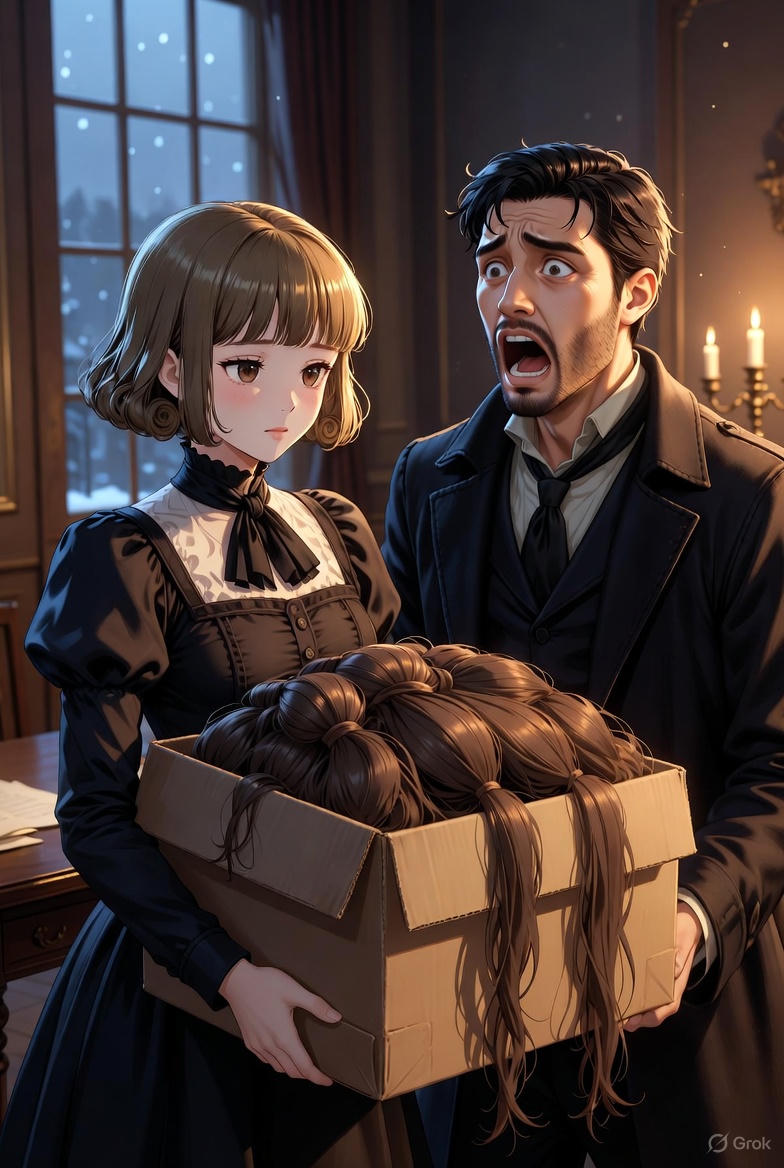
But when she came to the evening meal her hair was cut. She
looked like a page, her locks falling in curls around her boy’s head.
“Where is your hair?” he cried at her.
Calmly she said, “Here.”
She showed him a large cardboard box. In it lay the shiny meter
long bundles of hair.
He began, “Why did you cut it off?–Because I forbid it?–Out of
defiance then?”
Alraune smiled, “No, not at all. I would have done it anyway.”
“Then why?” he enquired.
She picked up the box and took out the seven long bundles. Each
one was tied and wrapped with a golden cord and there was a little
card attached to it. There were seven names on these seven cards,
Emma, Marguèrite, Louison, Evelyn, Anna, Maud and Andrea.
“Are those your school friends?” He asked. “You cut your hair
off to send them a keepsake? You foolish child.”
He was angry at this unexpected teenage sentimentalism. It
didn’t appeal to him at all. He had imagined the girl much more
mature and cold-blooded.
She looked straight at him, “No,” she said. “I don’t care about
them at all–only”–she hesitated–
“Only what?” urged the professor.
“Only,” she began again. “Only they should cut their hair off
too!”
“Why should they?” cried the old man.
Then Alraune laughed, “–cut their hair completely off! Much
more than I have, right down to the scalp. I’ll write them that I have
cut my hair right to the scalp–and then they must do it as well!”
“They wouldn’t be that stupid,” he threw back.
“Oh yes they will,” she insisted. “I told them that we should all
cut our hair off and they promised they would if I did it first. But I
forgot all about it and only remembered again when you spoke of my
hair.”
The Privy Councilor laughed at her, “People promise all kinds of
things–but they won’t do them. You alone are the fool.”
Then she raised herself up from her chair and came up close to
the old man.
“Yes they will,” she whispered hotly. “They will do it. They
know very well that I will rip their hair out myself if they don’t–They
are afraid of me, even when I’m not there.”
Stirred up and trembling slightly with emotion she stood there in
front of him.
“Are you that certain they will do it?” he asked.
She answered with conviction, “Yes, absolutely certain.”
Then the same certainty grew in him as well and he didn’t even
wonder why.
“So why did you do it then?” he asked.
In an instant she was transformed. All her strangeness had
disappeared and she was once more just a moody and capricious
child.
“Well,” she laughed shortly and her little hands stroked the full
bundles of hair. “Well, you see–it’s like this. It hurts me, this heavy
hair, and I sometimes get headaches from it. I also know that short
hair looks good on me but it doesn’t look good on them at all. The
senior class of Mademoiselle de Vynteelen will look like a monkey
house! The other students will scream at them and call them fools and
Mademoiselle will scold them. The new Miss and the Fräulein will
scream at them and scold them as well.”
She clapped her hands together laughing brightly with glee.
“Will you help me?” she asked. “How should I send them?”
The Privy Councilor said, “Individually, as samples of no value
and have them registered.”
She nodded, “Alright, that’s what I will do!”
During the evening meal she described to him how the girls
would look without their hair. The tall rangy Evelyn Clifford had thin
straight light blonde hair and full-blooded Louison always wore her
brown hair pinned up turban style. Then there were the two
Rodenberg Countesses, Anna and Andrea. Their long curly locks
encircled their hard bony Westfalen skulls.
“With all their hair gone,” she laughed, “they will look like
Meerkats! Everyone will laugh when they see them.”
They went back to the library. The Privy Councilor helped her
get the things she needed, got her cardboard boxes, twine, sealing wax
and postage stamps. Then he smoked his cigar, chewing half of it
while watching her write her letters, seven little letters to seven girls
in Spa.
The old family crest of the Brinkens was on the top of each
letter, John of Nepomuk, patron Saint and protector against floods,
was in the upper field, below was a silver heron fighting with a
serpent–The heron was the heraldic animal of the Brinkens.
He looked at her and a faint itch crept over his old skin. Old
memories began to grow in him, lustful thoughts of half-grown boys
and girls–She, Alraune, was both a boy and a girl. Moist spittle
dribbled down from his fleshy lips, soaking into the black Havana. He
squinted over at her, eager and full of trembling desire. In that minute
he understood what it was that attracted people to this slender petite
creature like the little fish that swim after the bait and don’t see the
hook.
But he could see the sharp hook very well and thought he knew a
way to avoid the hook and still consume the sweet morsel–
Wolf Gontram worked at the Privy Councilor’s office in the city.
His foster father had taken him out of school after one year and stuck
him in a bank as an apprentice. There he had forgotten everything he
had so laboriously learned at school. He settled into his job and did
just what was demanded of him. Then when his apprenticeship came
to an end he went to the Privy Councilor’s office to work as a
secretary.
It was a strange business, being a secretary for his Excellency.
Karl Mohnen, Ph.D. four times over, was office manager and his old
boss found him useful enough. He still went through life looking for
the right person to get married to. Wherever he went he made new
acquaintances and hung out with the new set. But it never led to
anything. His hair was long gone but his nose was still as good as
always–he was always sniffing around for something, a woman for
himself or a business opportunity for the Privy Councilor–and he was
good at it.
A couple of accountants kept the books in order well enough to
keep things going and there was a room that bore the sign “Legal
Business”. Legal Councilor Gontram and Herr Manasse, who had not
yet been promoted to Legal Councilor, sometimes spent an hour in it.
They took care of the Privy Councilor’s ample lawsuits as they
handsomely multiplied. Manasse took the hopeful ones that would
end in a victory and the old Legal Councilor took the bad ones,
prolonging them and postponing them until finally bringing them to
an acceptable compromise.
Dr. Mohnen had his own office as well. Wolf Gontram sat in this
office as his protégé and he sought to educate the boy in his own way.

Read Full Post »

Madame Bluebeard by Karl Hans Strobl and translated by Joe E Bandel

“Oh,” Schiereisen resisted, “I can’t just,
unannounced…”
“Yes, you can,” Ruprecht laughed, “come on.” He
took Schiereisen’s arm, ushering him out.
Downstairs, Rotrehl and Rauß stepped out the
door. Rotrehl bowed stiffly; Rauß glared at Ruprecht,
his gaze a mix of scorn and fanatical hate.
Ruprecht untied his horse from the fence, walking
beside Schiereisen down the hill.
The village below began ringing noon. The sound
arched grandly, brazenly over the valley, rising into
the sunlight, fading among spring sky’s lamb-white
clouds. Again and again, it swelled upward, resonant
and brazen, filling the world.
“It’ll end,” Rauß said venomously. “All this—the
ringing, praying, processions, banners… until
workers’ battalions march, thundering over the earth,
and the proletariat sweeps away all that didn’t heed in
time. No capital, no titles, no ‘Herr von’… all must
go… him down there too…”
Rotrehl gave no reply, staring skyward, as if
chasing the newspaper slogans’ flutter.
“You, Krampulljon,” Rauß said, grabbing
Rotrehl’s collar, “don’t dawdle. Join us. You’re a
proletarian too, even with your little house. We must
stand against exploiters. Farmers are too dumb to see
it. Who do those cider-heads toil for? After taxes and
usurers’ interest, what’s left? Barely enough to live.
And the gentry fund church banners! In our time…
instead of pensions or hospitals… or roads… We’ll
make ‘em pay. That banner’ll cost ‘em dear.”
Rotrehl shook his Napoleonic head. “I’m not for
such things. Leave me out. I’m neither for banners
nor proletarians. I don’t belong here… my French
blood…”
“Keep your French blood,” Rauß roared, furious.
“Let it sour, your French blood… you… clown.” He
seemed ready to punch Rotrehl but thought better,
yanked his cap’s brim forward, spat left and right,
and stormed off.
Rotrehl stood petrified, unable to move. What was
this, when people disrespected even bloodlines?
Where was the world headed? He’d never faced such
a thing. Regaining himself, he fumbled for his pipe
with trembling hands, stuffed it, and lit it. After a few
puffs, he forgot to smoke, the pipe dangling limply
between his teeth…
Slowly, he entered his room, stood before
Napoleon’s lithograph, and searched its features
anxiously, fearing it had heard the blasphemy.
Frau Helmina had fun with the lunch guest
Ruprecht brought. She recognized the comical man
who’d leapt before her carriage from the woods. A
scholar straight from a caricature—ponderously
formal, his clumsy solemnity failing to hide his
insecurity. His meticulous shoe-cleaning before
entering a room was a spectacle. He clung to carpets,
dreading bare floors.
When introduced, Helmina slyly noted they’d
already met, making Schiereisen blush and stammer
apologies. She let him flounder, offering no help, her
smiling silence relentless. Ruprecht stepped in—he
didn’t want the man crushed. Something drew him to
this simple soul, a liking, a wish to connect with
someone he could talk to. Trust began to sprout.
At the table, Helmina watched her guest’s anxious
care to avoid blunders. He glanced left and right,
touching no utensil until he saw its use. Lorenz and
old Johann served. Lorenz kept his iron mask;
Johann, too well-bred, hid his recognition.
Schiereisen nodded awkwardly at Johann, unsure if
he should acknowledge the tie. A prime specimen,
Helmina thought.
After the meal, Ruprecht showed the Celt scholar
his library, between the study and the Indian temple.
Schiereisen came alive, rifling books, climbing
ladders to upper shelves, rummaging eagerly, red-
faced, muttering a monologue more for himself than
Ruprecht. He splashed in tomes and folios like a fish
in water, visibly at ease.
Ruprecht watched, smiling. “Hope you find
something useful,” he said. “Come whenever you
like. Use the library freely. Take your time.”
After an hour, Schiereisen, sweat-soaked and
spent, collapsed onto a chair by a stacked pile of
books. “Yes—I must come often. There are splendid
old things here…”
“I believe Count Moreno laid the library’s
foundation. Some of his collection likely remains.”
“Is this the Moreno crest?” Schiereisen asked,
opening a dusty copperplate volume with a stamp on
its first page.
“Yes… Herr Dankwardt was keen on Indian
philosophy. That’s my interest too. I know the land
and try to understand it, though I’m just a dilettante.
Here’s the Indian temple he set up.”
Schiereisen followed Ruprecht into the adjacent
room, inspecting everything with polite attention, but
his heart wasn’t in it. It clung to ancient Celts,
leaving no room for other peoples. As Ruprecht
explained, animating painted landscapes and odd
artifacts with memories, Jana entered, reporting a
messenger from a distant farm with urgent news. His
gaze shifted from his master to the guest.
Ah, Schiereisen thought. The Malay, the Indian, as
they call him. He saved his master once. I’d know
what he knows. That look—like a wary dog, sizing up
anyone near. He’s guarding his lord.
Ruprecht excused himself for the pressing matter,
leaving with Jana. Schiereisen darted back to the
library, diving into his books. Dust swirled in small
clouds. He searched the shelves again. Earlier, behind
the hefty Theatrum Europaeum, he’d spotted a slim
booklet, the most vital of all. It outshone every
weighty Celtic tome. He’d nudged it out slightly to
find it later.
It was a manuscript, neatly bound in red leather,
adorned with baroque gold-pressed arabesques. The
first page held a watercolor view of Vorderschluder
Castle, sober but precise. The second bore the title:
Singular and Curious Description of the High-Count
Moreno’s Castle at Vorderschluder, Particularly of
All Hidden Passages, Stairs, Rooms, Secret Doors,
and Other Noteworthy Features, Compiled and
Brought to Light on the Occasion of His High-Count
Grace Louis Juan de Mereus’s Fiftieth Birthday by
Adam Zeltelhuber, Count’s Tutor, 1681.
A seventeenth-century tutor’s work. Schiereisen
owed Zeltelhuber gratitude. Honor his memory! He
couldn’t resist a quick peek. The text included neat
plans and cross-sections, marked with letters and
measurements, foolproof. A priceless find.
Hearing steps, Schiereisen slipped the booklet into
his breast pocket. Ruprecht found the Celt scholar
amid thick folios, wreathed in century-old scholarly
dust.

Read Full Post »

A Modern Inquiry into the Hermetic Mystery

Part III: Concerning the Laws and Vital Conditions of the Hermetic Experiment

Chapter 1: The Experimental Method and Fermentation, Part 7

Introduction: The Hermetic art purifies the soul’s essence through a fiery battle of transformation, emerging as divine light in the “Bath of Diana.” This section unveils the alchemical process of dissolving illusions to reveal the soul’s radiant quintessence, a sacred union of spirit and matter.

The Bath of Diana

The alchemical process, symbolized as the “Bath of Diana,” emerges from the soul’s inner conflict, where the pure spirit rises from chaos. Eirenaeus describes the soul’s essence as “Mercury,” a dry water flowing with secret fire, distinct from common mercury. This vital essence, akin to all metals, holds the potential for divine creation but lies dormant until purified. Through art, the adept reduces its impurities, uniting it with “true sulphur” to revive it as a healing essence—the philosopher’s stone.

This transformation, like Aeneas bathing in the river Numitius or Midas in the Pactolus, washes away mortality to reveal divine radiance. Myths of Adonis’ blood turning into roses or Medea’s herbs reviving Jason symbolize this rebirth, where the soul’s chaotic nature is refined into a “crystal fountain” of eternal light.

The Green Lion’s Triumph

The soul’s purification requires confronting its “original sin,” a rebellious force alchemists call the “Green Lion” or “Typhon.” This impure essence, though necessary, must be subdued through dissolution. Hermes instructs, “Remove the cloud from the water, the blackness from the sulphur, and death from the dross.” Maria adds, “This poison, resolved into subtle water, coagulates into pure silver.” The process mirrors heroic myths: Hercules burning on his pyre or the Phoenix rising from ashes, transforming the soul into a radiant, incombustible spirit.

Synesius declares, “The quintessence of our stone is the glorious soul, drawn from its mine by our art, engendering itself.” This radiant essence, the “sparkling firmament,” eclipses all but divine reason, uniting the soul with its source in a harmonious dance of love.

The Alchemical Miracle

This sacred art reveals a “spring of wealth,” a “Tree of Life” that heals all griefs. The soul, once trapped in Saturn’s prison, emerges as a vapor shining like pearls, a divine spark transcending earthly limits. Helvetius marvels, “This mystery, found in Jehovah’s center, is the miracle of the world.” The alchemical process, blending reason and divine fire, transforms the soul into a vessel of eternal light, as myths of Apollo, Pegasus, and the Hesperides’ gardens illustrate the soul’s ascent to divine perfection.

Closing: This section unveils the Hermetic art’s purification through the Bath of Diana, transforming the soul into divine light. The journey into Kabalistic insights deepens in our next post, unveiling further secrets of this sacred practice.

Read Full Post »

Homo Sapiens: In the Maelstrom by Stanislaw Przybyszewski and translated by Joe E Bandel

VIII

In the hallway he suddenly remembered that he had met a spy earlier. He lit a match, looked around everywhere, but he could discover no one.

Perhaps he had been mistaken, or, yes—perhaps a persecution mania was beginning to develop… He felt cold shivers run down his back. That was probably the fever again.

He walked and walked without knowing where he actually wanted to go. He thought.

Home? What for? To see people who tormented him through their love? No! He wanted no more love. That was repugnant to him. He could not see that. Everything came only from being loved. He had the cursed little pity for the few people who loved him. His heart was narrow, his interests were petty and yet he was born for something great. That is why his other, his great soul now took revenge, which kissed Czerski’s hand in ecstasy, naturally only to shame the small Falk.

But he did not let himself be shamed. What should he actually be ashamed of? Ha, ha, ha…

Then a dull, sick melancholy befell him, he stopped and looked thoughtfully at the ground.

A new life? No, he no longer had the strength for that; it would probably not be better than it is now. No, no; better that it ended.

Isa? Isa? Between him and her stood her past life: the other who separated them was always there…

He groaned.

And how much happiness she could have given him!

No, nonsense! Ridiculous that he sought a reason in that. He was simply falling apart. His psychic constitution was not calculated for all these experiences, it was too fine and crumbled under all this brutality.

What did he actually want in life anymore?

His art? He, he… I was an artist… I had to create because I had to. And I created. But suddenly in the middle of writing the idea overcomes me, what for? I see the people before me, I see the whole world that I let arise and I suddenly find all that so terribly ridiculous. And I ask you, dear Czerski, how can one create then?! For that one needs faith too, and perhaps another faith, the faith in posterity…

He laughed loudly.

Oh, he would gladly give the whole posterity together with the whole present to the first best servant for his bit of animal happiness, yes the whole world, the coming and the past and a piece more…

Humanity? To make it happy? But then one must also make it knowing at the same time… Why not rather let humans return to the animal: the knowing human cannot become happy.

A splendid reply! I should have answered that to Czerski. He stopped again.

What did he say? He had written to Stefan?

A paralyzing fright shot through his limbs. Written to Stefan… He had not understood it at first, he only heard the words… He now felt an unheard-of desire to go to Czerski and smash him with his fists, to twist his neck.

But in the next moment he had forgotten his rage. Only a feeling of trembling fear whipped the blood back into his heart. He breathed heavily and became very weak.

He walked on, but something heavy weighed on his chest as if a world had fallen down on him.

So it could by God not go on. That would destroy him completely. And he had to live, he had to become happy for Isa’s sake.

A strange energy poured into his brain. He began to walk with large steps and thought of her glory—yes, sun-like glory… Oh, if he had lived millions of years, they would still have shrunk into the second in which he looked into her eyes for the first time, so he would have spread over the whole world, so he would still have crept into this one glance, the one long glance of her love…

He, he—that was thought very beautifully, very beautifully… He started.

The disgusting picture rose in him again: she in a foreign embrace…

He crouched anxiously. Only that not, no, no!

He caught himself beginning to whistle a street melody. He had to become calm.

Yes, quite calm.

Right! A cigarette. Naturally, naturally. He stopped.

What time could it be now? Well, not yet half past ten. Yes, then… he lit the cigarette deliberately—then I could perhaps go to Olga… Chat a bit about humanity, about ideals… She is so good, and I need so much goodness…

Suddenly a strange idea fixed itself in his brain. He felt surrounded by detectives, perhaps in the next moment he would be arrested…

His fear grew foaming, he was so dazed by it that he could not think. He suddenly became so certain. The certainty that he would be arrested in the next moment brought him to despair.

He looked cautiously in all directions. It was dark on the street, he could not see well. There suddenly: not far from him stood a man. Falk trembled, but collected himself immediately and began to consider. Naturally it was a detective, only how should he get rid of him? He turned around, walked past him and looked at him sharply. The other seemed not to notice Falk and walked on.

Falk laughs scornfully.

This ridiculous trick! naturally only to lull me into security and suddenly appear in the decisive moment.

What should he do now?

Get into a cab? But what would that help?

He entered a restaurant, ordered beer and took a newspaper in front of him.

Immediately after him a man entered, sat down opposite him and observed him, as it seemed to Falk, with a strange impudence.

Falk looked away from his newspaper a few times, but each time their eyes met.

It was unbearable. A wild despair seized him, he threw the newspaper away, sat down broadly and began to examine the stranger scornfully.

Suddenly his heart stopped.

The stranger rose and walked toward him. Falk jumped up.

But the person doesn’t look like a spy at all. He is quite anxious and humble, it shot through his head.

“I have the honor to speak with Herr Falk?”

“Do you want to arrest me? Then not here, come to the street.”

Falk trembled and supported himself on the table.

The stranger looked at him astonished. Their eyes met in a long, questioning glance.

“I did not understand you,” the stranger finally said. Falk came to his senses and rubbed his forehead.

“Are you following me?”

“No! I met you by chance, quite by chance, I live nearby. I did seek you though, I wanted to speak with you.”

Was the man lying, did he want to lure him into a trap?

“So you have no direct arrest warrant? Well, if you want to speak with me, come to me.” Falk laughed scornfully. “I am not in the mood for such conversations now. Isn’t that so? You want something about my participation in the strike? He, he, come to me, then we will talk about it…”

Falk had to sit down, his heart beat so violently, his head was bursting full of blood.

The stranger looked at him with growing astonishment, but Falk stood up, paid and went.

On the street he breathed a sigh of relief. The whole scene suddenly seemed to him a few years distant in his thoughts. It seemed to him as if he had survived a danger…

He, he—that was strange, but everything in life is strange. What is not strange? he asked with a sick smile. He felt his facial muscles distort. What is not strange? Ha, ha, ha… The fear the man had of me. Naturally it was no spy. Absolutely no spy. Perhaps a person I saw somewhere once in society, with whom I even drank brotherhood; perhaps I told him that he was the most splendid person on earth, perhaps I told him that he was my only friend, the first person I met in my life.

Falk laughed long, almost convulsively.

To whom have I not said that? Is there a single person to whom I have not said that?

Ha, ha, ha; now the fellow will run around the whole city and tell that he met Falk in a quite neglected state, Falk was quite confused and spoke crazy talk… Ha, ha, ha…

He suddenly remembered that he wanted to go to Olga. He was quite nearby.

Read Full Post »

Alraune by Hanns Heinz Ewers and translated by Joe E Bandel

It wasn’t long before she received her deserved punishment for
denying her good mother. By the next day Alraune had already told
all the students about her mother’s cheese shop and it cost a lot of
effort to again win back the respect which she lost throughout the
Institute.
But things were much worse for Alraune’s schoolmates then they
were for the instructors. There was not one student in the entire school
that had not suffered because of her. Strangely enough it appeared
that every new bit of mischief seemed to make her even more popular.
She made a point to sacrifice everyone that appeared to stand against
her until they were all on her side. She was more popular than any of
the other girls.
Fräulein Becker reported some of the worst cases to the Privy
Councilor and they were mentioned in the leather volume.
Blanche de Banville had just returned from vacation with her
parents in Picardy. The hot-blooded fourteen-year-old had fallen head
over heels in love with her cousin who was the same age as she was.
She wrote to him from Spa as well and he answered, addressing her
letters B.d.B., hold at post office until claimed by addressee. Then he
must have found something better to do with his time, in any case no
more letters came.
Both Alraune and little Louison knew about her secret. Naturally
Blanche was very unhappy and cried through entire nights. Louison
sat with her and tried to comfort her. But Alraune declared that it was
wrong to console her, her cousin had been unfaithful and betrayed
her. Now Blanche needed to die of unrequited love. That was the only
way to repay her false lover and make things right. Then for the rest
of his life he would be tormented by the furies. She knew several
famous stories where it had been like that.
Blanche was agreeable to the dying part but it did not go well.
Food always tasted good to her despite her great pain. That’s when
Alraune declared that if Blanche couldn’t die of a broken heart she
must find some other way to bring it about. She recommended a
dagger or a pistol–but they didn’t have either one.
Blanche could not be persuaded to jump out the window, push a
hatpin into her heart or hang herself. She just wanted to swallow
something, nothing else. Soon Alraune had some new advice. There
was a bottle of Lysol in Mlle. de Vynteelen’s medicine chest–Louison
must steal it. Unfortunately there was only a little bit left in the bottle
so Louison had to scratch the phosphorus heads off a couple boxes of
matches as well.
Blanche wrote several farewell letters, one to her parents, the
principal and her traitorous lover. Then she drank the Lysol and
swallowed the matchheads–They both tasted horrible enough. Just to
be certain Alraune had her swallow three packets of needles–She
herself, by the way, was not present at this suicide attempt. She had
gone to her room under the pretence of being a lookout after Blanche
had sworn on the crucifix to follow her instructions exactly.
That evening little Louison sat on the bed with her friend. Crying
miserably she handed over first the Lysol, then the match heads and
finally the packets of needles. Blanche became very ill from these
threefold poisons and was soon writhing and screaming in pain.
Louison screamed with her and their screams roared through the
entire house. Then she ran out of the room and fetched the Head
Mistress and the teachers yelling that Blanche was dying.
Blanche de Banville did not die. A capable doctor quickly gave
her an effective emetic that brought the Lysol, phosphorus and needle
packets back up again. Still, one of the needle packets had opened up
in her stomach and a half dozen needles had gotten loose. They
wandered through her body and in the course of her life came out
again in all kinds of places painfully reminding the little suicide of her
first love.
Blanche lay in bed sick for a long time and had a lot of pain. It
appeared that she had been punished enough. Everyone sympathized
with her, was good to her and granted her slightest wish. She wished
for nothing else but that her two friends that had helped her, Alraune
and little Louison, not be punished. She pleaded and begged for so
long that the principal finally promised. That was why Alraune was
not thrown out of the school.
Then it was Hilde Aldekerk’s turn. She loved the Berlin style
cakes that were sold in the German confectionery at Place Royal. She
claimed she could eat twenty. Alraune bet that she couldn’t polish off
thirty. Whoever lost the bet had to pay for the cakes. Hilde Aldekerk
won–but she got so sick that she had to stay in bed fourteen days.
“Glutton,” said Alraune ten Brinken. “It serves you right!”
From that point on the only thing all the little girls called fat,
round Hilda was “Glutton”. She howled about it for awhile but then
got used to her new nickname and finally became one of Alraune’s
most faithful companions, just like Blanche de Banville.
Fräulein Becker reported that Alraune had only one time been
seriously punished at the school and strangely enough, unjustly. On a
full moon night the French teacher stumbled out of her room terrified.
She woke the entire household with her screams and yelled that a
white ghost was sitting on the balustrade of her balcony. No one
would go into her room until they finally woke up the porter who
armed himself with a club and went inside.
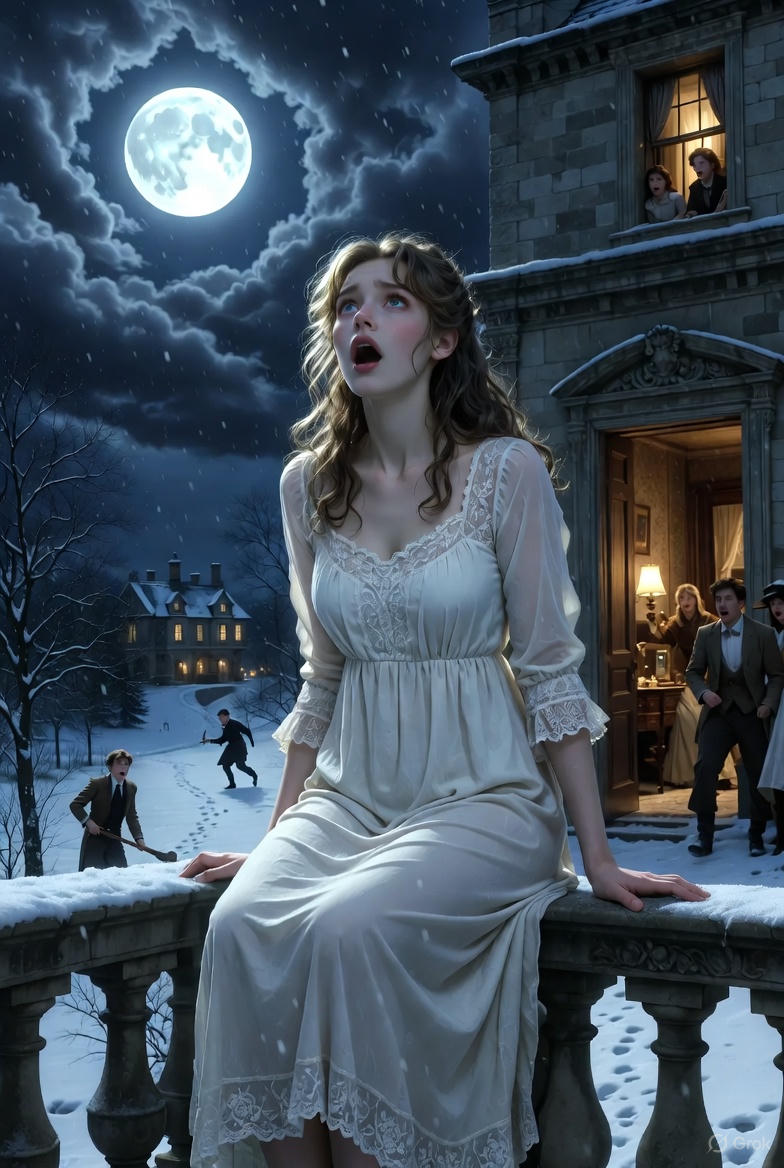
The ghost turned out to be Alraune who was sitting there in her
white night gown and staring with wide-open eyes into the moon. She
could not say how she got there. The principal took the playing ghost
as a very bad prank. Only much later did it come out that the girl had
been seen on several different occasions sleep walking under the
influence of the full moon.
Interestingly enough Alraune accepted this unjust punishment–to
copy a chapter out of “Tèlèmaque”–without protest and
conscientiously carried it out on a free afternoon. She would have
most certainly rebelled and resisted any just punishment.
Fräulein Becker concluded, “I fear that your Excellency will not
experience much joy from your daughter in the future.”
The Privy Councilor replied, “That might well be, but up to now
I believe that I am very well satisfied with her.”
He did not let Alraune come home for vacation the last two
years. Instead he permitted her to travel with her school friends, once
to Scotland with Maude McPherson, then with Blanche to her parents
in Paris and finally with the two Rodenburgs to their family estate in
Münster.
He didn’t have any reports from these episodes in Alraune’s life
and could only imagine how she occupied herself during these
vacations. It was a satisfaction to him to think of how this creature he
had created extended her influence outward in ever expanding circles.
In the newspaper he read that during the summer in which
Alraune was at Boltenhagen the green and white colors of the old
Count Rodenberg did exceedingly well at the track and his stud
brought in a considerable winnings.
He also learned that Mlle. de Vynteelen had received an
unexpected inheritance that placed her in the position of needing to
close the school so she didn’t take any new students and only kept her
old students until they graduated.
He attributed both of these things to the presence of Alraune and
was half convinced that she brought gold into the other houses she
had stayed at, the convent in Nancy, at Reverend McPherson in
Edinburgh and the home of the Banvilles on Haussmann Boulevarde.
She had made good threefold on her little deviltries.
He felt that all these people ought to feel gratitude to his child,
this strange girl that went abroad out into the world bringing gifts and
strewing roses upon the life paths of all those that had the fortune to
meet her. He laughed as it occurred to him that those roses also had
sharp thorns capable on inflicting many beautiful wounds as well.
“By the way,” he asked Fräulein Becker. “How are things going
with your dear mother?”
“Why thank you for asking, your Excellency,” she answered.
“Mother can’t complain. Her business has grown considerably better
during the last few years!”
“Really,” said the Privy Councilor and he gave orders that all
cheeses, the Emmenthall, Roquefort, Chester and old Höllander, from
now on were to be purchased from Frau Becker on Münster Street.

Read Full Post »

« Newer Posts - Older Posts »