Feeds:
Posts
Comments

Archive for November, 2025

Madame Bluebeard by Karl Hans Strobl and translated by Joe E Bandel

Indeed, the new and old faiths had collided. For
now, the new faith gripped the old by the scruff,
thrashing it. Bolstered by numbers and fueled by
fervor from the Hotel Bellevue, the new faith
outmatched the old, still seeking its zeal at the Red
Ox.
The banquet guests had barely settled at the long
tables in the Red Ox’s transformed dance hall when a
man burst in, shouting, “The socialists are coming!
They’ve a red flag and are all drunk!”
This news pierced Mathes Dreiseidel’s heart. He
feared losing his feast’s reward. He cursed his God
and parson for scheduling the rite before the meal,
robbing him of his due.
The district captain, seated at the head table to
Helmina’s left, set down his napkin and glared at the
alderman. “This is disastrous!” he said. “Such things
in my district. I don’t tolerate this. If only the
gendarmes were here. Such sloppiness…”
But the rebels were already there, launching a
furious assault on the pious crowd outside, scattering
them into alleys and over fences. They filled the
street, yelling, waving hats and cudgels, flaunting
their defiance of authority.
The plump, appetizing Red Ox landlady stood at
the kitchen door, lamenting Schorsch’s absence at
military drills. Glancing at the tables, she debated
clearing them before the brawl began. Half her dishes
were borrowed from Gars, and such occasions risked
breakage.
The parson stepped to the window, hoping to pour
soothing words over the uproar. But they drowned
him out with murderous howls, brandishing the red
flag to flaunt their oath.
The district captain tried next, pale but composed,
regretting no reporter was there to immortalize his
poise. He thrust out his chest, summoning his voice
to pierce the din. But his words were swept away like
a mandolin’s note in a gale.
He retreated, snapping at the alderman, “Now you
stand there, mute… why didn’t you prepare? This
happens in my district…”
The rebels, emboldened, surged forward. The door
flew open, Rauß stormed in, Maurerwenzel close
behind, and a dense throng of comrades packed the
steps, head to head.
The factory director mustered courage, advancing
toward them. “Dear people…!” he began.
Rauß flailed the air, bellowing, “What do you
want? Do what we want, and we’ll be your dear
people again. Not before! Got it? We’re here to
watch the gentry gorge on our sweat and blood…”
God, if Schorsch were here, the landlady thought,
ordering the tables cleared.
Rauß saw and roared, “Oh no—leave it! That’s set
for us too. We’ll sit at this table. We’ll show you the
future state!” From the stair’s crush, a voice shouted,
“Long live the republic!”
“Come,” Ruprecht said to Helmina, “we’re
leaving. I’ve had enough.”
“We can’t get out,” Helmina whispered, terrified.
“Just come!” He pulled her up, striding toward the
door. Rauß’s dull mind dredged up irony. “Your
Grace, Herr Baron… perhaps you’d like an honor
guard?”
“Let me out, I said,” Ruprecht repeated calmly.
“And the lovely Frau Baronin—no, that won’t do.
She gave so much for the banner; she can’t run now.
The best part’s coming. The real fun. Our
consecration.”
The workers jeered. Maurerwenzel slapped his
knees in glee. Ruprecht glanced around. Helmina’s
entourage stood frozen. Some twitched, but caution
quashed their bravery: a fight now would spark a
slaughter. The farmers’ faces gleamed with delight at
this woman’s humiliation, their instincts and wives’
gossip aligned against her.
Then, something unexpected happened. Ruprecht
released Helmina’s arm, stepping toward Rauß as if
to speak. Suddenly, two fists shot out, slamming like
steel pistons into the ruffian’s gut. Rauß yelped,
doubling over. In the same breath, Ruprecht seized
his arm, twisted it back, and hurled the lanky man
over his shoulder into the hall, landing at the district
captain’s feet—a lithe, tripping jiujitsu move from Japan.
The farmers gaped. Even the wildest fair hadn’t
seen such a feat.
Rauß groaned on the floor. Another followed—
Maurerwenzel, loyal aide, lunging to avenge his
leader. Ruprecht took Helmina’s arm and strode
down the steps through the rebels, who now parted
for him.
At the bridge, where baroque saints gazed at their
rippling reflections, their carriage trailed, dust
swirling. The coachman grinned, cracking his whip in
victory. Ruprecht and Helmina climbed in. Just then,
a cart with eight gendarmes rolled up from the other
side. The scrawny horses trotted frantically,
gendarmes clinging to seats and ladder rungs to
arrive intact for battle.
Their task was easy, the fight swiftly won. The
rebels glimpsed the eight cork helmets’ gleaming
spikes and felt the rifles’ persuasive butts, then fled.
With limping, whimpering Rauß and Maurerwenzel— sporting a swollen bruise over his
left eye—at their core, they retreated to the Hotel
Bellevue.
The red flag was found next day in the alderman’s
garden, drooping sadly in a thornbush, flapping
feebly.
The interrupted banquet resumed. The Red Ox
landlady reset what she’d cleared, and appetites
surged. Only Mathes Dreiseidel lacked hunger.
During the fray, he’d slipped into the kitchen behind
the dishes. To salvage something, he’d embraced a
platter of pork roast and kraut salad so fervently that
his insides had no room left.
When Helmina and Ruprecht returned to the
castle, she immediately retreated to her room and
locked the door. She wanted to see no one. She was
beside herself. Ruprecht’s victory over the rabble-
rouser Rauß felt like her own defeat. Two crushing
blows in one day for her. Two triumphs for Ruprecht.
He had thwarted her cunning with his vigilance and
caution. And he had lifted her from fear—yes, a
trembling fear. She had seen clear proof of his
regained strength. Helmina raged against herself. In
the afternoon, Lorenz knocked, reporting that Herr
Anton Sykora had arrived and wished to see her. But
she was ill, she’d stay in her room, she regretted…
Lorenz’s urgent tone availed nothing.
“No… no… no!” Helmina screamed. “Tell him to
go. I won’t see him!” Only in the evening did she
emerge from her lair. Ruprecht hadn’t approached
her door all day. He’d dined without her, chatted with
the children, and sent them off with Miss Nelson.
Now he sat in a fine, comfortable Biedermeier chair,
smoking a cigarette, awaiting Helmina.
She came. A hesitant shadow in the doorway.
Then she entered, slowly closing the door. A glowing
ember in the dark showed where Ruprecht sat. She
approached him slowly.
“Ruprecht!” she gasped.
“It’s you, Helmina,” his voice calm as ever.
She lunged at him, furious, hate-filled, biting his
hand, pressing her lips to his throat. Ruprecht smiled.
She couldn’t see it in the dark, but she felt it. She
gripped him fiercer, as if to kill that smile.

Read Full Post »

Alraune by Hanns Heinz Ewers and translated by Joe E Bandel

Chapter Ten
Describes how Wolf Gontram was put into the ground because
of Alraune.

KARL Mohnen was not the only one around that time that
fell under the deceptive wheels of his Excellency’s
magnificent machine. The Privy Councilor completely took
over the large People’s Mortgage Bank, which had been
under his influence for a long time. At the same time he took
possession and control over the wide many-branched Silver Frost
Association that had their little savings banks in every little village
under the flag of the church.
That didn’t happen without sharp friction since many of the old
employees that had thought their positions permanent were reluctant
to cooperate with the new regime.
Attorney Manasse, together with Legal Councilor Gontram, legal
advisor for these transactions, acted in as many ways as possible to
soften the transition without hindering it. His Excellency’s lack of
regard made things severe enough and everything that did not appear
absolutely necessary to him was thrown away out of hand without
further thought. Using right dubious means he pushed to the side
other little district associations and banks that opposed him and
refused to submit to his control.
By now his superior might extended far into the industrial district
as well–everything that had to do with the earth–coal, metals, mineral
water, water works, real estate, buildings, agriculture, road making,
dams, canals–everything in the Rhineland more or less depended on
him.
Since Alraune had come back into the house he handled things
with fewer scruples than ever. From the time he first became aware of
her influence on his success he showed no more regard to others, no
restraint or consideration.
In long pages in the leather volume he explained all of these
affairs. Evidently it gave him joy to speak of each new undertaking
that was of little value with almost no possibility of success–it was
only of these things that he would grab up–and finally attribute their
success to the creature that lived in his house.
From time to time he would solicit advice from her without
entrusting her with the particulars, asking only, “Should I do it?”
If she nodded, he did it and would drop it immediately if she
shook her head. The law had not appeared to exist anymore to the old
man for a long time now. Earlier he had spent long hours talking
things over with his attorneys, trying to find a way out, a loophole or
twist of phrase that would give him a back door. He had studied all
possible gaps in the law books, knew all kinds of tricks and whistles
that made outright evil deeds legally acceptable. It had been a long
time now since he had troubled himself with such evasions.
Trusting only on his power and his luck he broke the law many
times knowing full well that no judge would stand up with the
plaintiff to balance the scales. His lawsuits multiplied as well as the
complaints against him. Most were anonymous, including those the
authorities themselves entered against him.
But his connections extended as far into the government as they
did the church. He was on close terms with them both. His voice in
the provincial daily papers was decisive. The policies of the
ArchBishop’s palace in Cologne, which he supported, gave him even
greater backing. His influence went as far as Berlin where an
exceptionally meritorious medal was given to him at an unveiling of a
monument dedicated to the Kaiser. The hand of the All Highest
himself placed the medal around his neck and was documented
publicly.
Really, he had steered a good sum of money into the building of
the monument–but the city had paid dearly for the real estate on
which it stood when they were required to purchase it from him.
In addition to these were his title, his venerable age, his
acknowledged services to the sciences. What little public prosecutor
would want to press charges against him? A few times the Privy
Councilor himself pressed charges at some of these accusations. They
were seen as gross exaggerations and collapsed like soap bubbles.
In this way he nourished the skepticism of the authorities toward
his accusers. It went so far that in one case when a young assistant
judge was thoroughly convinced, clear as day, against his Excellency
and wanted to intervene, the District Attorney without even looking at
the records declared:
“Stupid stuff! Grumblers screaming–We know that! It would
only make us look like fools.”
In this case the grumbler was the provisional director of the
Wiesbaden Land Museum which had purchased all manner of
artifacts from the Privy Councilor. Now he felt defrauded and wanted
to publicly declaim him as a forger of antiquities.
The authorities didn’t take up the case but they did notify the
Privy Councilor who defended himself very well. He wrote his own
personal publication that was inserted into a special Sunday edition of
the “Cologne News”. The beautiful human-interest story carried the
title, “Taking care of our Museums”.
He didn’t go on about any of the accusations against him, but he
attacked his opponent viciously, destroyed him completely, placing
him as a know nothing and cretin. He didn’t stop until the poor
scholar lay unmoving on the floor. Then he pulled his strings, let his
wheels turn–after less than a month there was a different director in
the museum.
The head district attorney nodded in satisfaction when he read
the notice in the paper.
He brought the page over to the assistant judge and said, “Read
that, colleague! You can thank God that you asked me about it and
avoided such a fatal error.”
The assistant judge thanked him, but was not absolutely
convinced.
In early February on Candlemass all the sleighs and autos
traveled to “The Gathering”. It was the great Shrovetide Ball of the
community. The Royalty was there and around them circled anyone in
the city that wore uniforms or colored fraternity armbands and caps.
Professors circled there as well, along with those from the court,
the government, city officials, rich people, Councilors to the Chamber
of Commerce and wealthy industrialists.
Everyone was in costume. Only the declared chaperones were
allowed to dress as false Spaniards. The old gentleman himself had to
leave his dress suit at home and come in a black hooded robe and
cowl. Legal Councilor Gontram presided at his Excellency’s large
table. He knew the old wine cellar and understood it, the best vintages
and how to procure them.
Princess Wolkonski sat there with her daughter Olga, now
Countess Figueirea y Abrantes, and with Frieda Gontram. Both were
visiting her for the winter.
Then there was Attorney Manasse, a couple of private university
speakers, professors and even a few officers and of course the Privy
Counselor himself who had taken his little daughter out for her first
ball.
Alraune came dressed as Mademoiselle de Maupin wearing
boy’s clothes in the style of Beardsly’s famous illustrations. She had
torn through many wardrobes in the house of ten Brinken, stormed
through many old chests and trunks. She finally found them in a damp
cellar along with piles of beautiful Mechlin lace that an ancient
predecessor had placed there. It is certain the poor seamstress who
created them would have cried tears to see them treated like that.
This lacey women’s clothing that made up Alraune’s cheeky
costume netted still more fresh tears–she scolded the dressmaker that
could not get just the right fit to the capricious costume, the hair
dresser that Alraune beat because she couldn’t understand the exact
hair style Alraune wanted and who couldn’t lay the chi-chi’s just
right, and the little maid whom she impatiently poked with a large pin
while getting dressed.
Oh, it was a torture to turn Alraune into this girl of Gautier’s, in
the bizarre interpretation of the Englishman, Beardsly.
But when it was done, when the moody boy with his high sword-
cane strutted with graceful pomp through the hall, there were no eyes
that didn’t greedily follow him, no old ones or young ones, of either
men or women.
The Chevalier de Maupin shared his glory with Rosalinde.
Rosalinde, the one in the last scene–was Wolf Gontram, and never did
the stage see a more beautiful one. Not in Shakespeare’s time when
slender boys played the roles of his women. Not even later since
Margaret Hews, the beloved of Prince Rupert, was the first woman to
play the part of the beautiful maiden in “As You Like It”.
Alraune had the youth dressed and with infinite care had brought
him up to this point. She taught him how to walk, how to dance, how
to move his fan and even how he should smile.
And now, even as she appeared as a boy and yet a girl kissed by
Hermes as well as Aphrodite in her Beardsly costume; Wolf Gontram
embodied the character of his compatriot, Shakespeare, no less.
He was in a red evening gown and train brocaded with gold, a
beautiful girl, and yet a boy as well. Perhaps the old Privy Councilor
understood all of it, perhaps little Manasse, perhaps even Frieda
Gontram did a little as her quick look darted from one to the other.
Other than that it was certain that no one else did in that immense hall
of the Gathering in which heavy garlands of red roses hung from the
ceiling.
But everyone felt it, felt that here was something special, of
singular worth. Her Royal Highness sent her adjutant to fetch them
both and present them to her. She danced the first waltz with him,
playing the gentleman to Rosalinde, then as the lady with the
Chevalier de Maupin. She clapped her hands loudly during the minuet
when Théophile Gautier’s curly headed boy bowed and flirted with
Shakespeare’s sweet dream girl directly in front of her.
Her Royal Highness was an excellent dancer herself, was first at
the tennis courts and the best ice skater in the city. She would have
loved to dance through the entire night with only the two of them. But
the crowd wanted their share as well. So Mademoiselle de Maupin
and Rosalinde flew from one set of arms into another, soon pressing
into the muscular arms of young men, soon feeling the hot heaving
breasts of beautiful women.
Legal Councilor Gontram looked on indifferently. The Treves
punch bowl and its brewed contents interested him much more than
the success of his son. He attempted to tell Princess Wolkonski a long
story about a counterfeiter but her Highness wasn’t listening.
She shared the satisfaction and happy pride of his Excellency ten
Brinken, felt herself a participant in the creation and bringing into the
world of this creature, her Godchild, Alraune.
Only little Manasse was bad tempered enough, cursing and
muttering under his breath.
“You shouldn’t dance so much boy,” he hissed at Wolf. “Be
more careful of your lungs!”
But young Gontram didn’t hear him.
Countess Olga sprang up and flew out to Alraune.
“My handsome chevalier,” she whispered.
The boy dressed in lace answered, “Come here my little Tosca!”
He wheeled her around to the left and circled through the hall,
scarcely giving her time to breathe, brought her back to the table
breathless and kissed her full on the mouth.
Frieda Gontram danced with her brother, looking at him for a
long time with her intelligent gray eyes.
“It’s a shame that you are my brother,” she said.
He didn’t understand her at all.
“Why?” he asked.
She laughed, “Oh, you stupid boy! By the way, your answer
‘Why?’ is entirely correct. It shouldn’t make any difference at all
should it? It is only the last shred of those morals that our stupid
education has given us. Like putting lead weights in our virtuous
skirts to keep them long, stretched smooth and modest. That’s what it
is, my beautiful little brother!”

Read Full Post »

A Modern Inquiry into the Hermetic Mystery

Part III: Concerning the Laws and Vital Conditions of the Hermetic Experiment

Chapter 2: A Further Analysis of the Initial Principle, Part 6

Introduction: The Hermetic art transforms the soul’s divine essence into radiant light, uniting it with the eternal source through sacred insight. This section explores the soul’s journey to divine unity, guided by Neoplatonic wisdom and symbolic humility, as it transcends illusion to embrace true Being.

The Divine Essence and Humility

The soul’s essence, born with divine power, is a pure vessel for sacred revelation, as Iamblichus teaches. To unite with this “First Light,” the soul must shed all external illusions, embracing a humble state akin to the ass, a symbol of patience and simplicity. Agrippa praises this “asinine condition” as essential for wisdom, noting its endurance and purity, as seen in myths where the ass carries divine burdens, from Balaam’s clear-sighted beast to Apuleius’ transformation in Isis’ mysteries.

This humility allows the soul to enter the divine temple, leaving behind sensory images to perceive the uncompounded truth. Plotinus explains, “In divine union, the soul merges with the First Light, where understanding and light are one, free from duality.” This sacred union, achieved through faith and love, transforms the soul into a radiant vessel of eternal harmony.

The Path to True Being

The soul’s journey requires dissolving all external forms, as Porphyry advises: “Separate from non-being to become universal, present with your rational essence.” This process, akin to the alchemical dissolution, purifies the soul’s essence, allowing it to ascend to the “intelligible world.” The ass’s simplicity mirrors this state, where the soul, stripped of passion and imagination, becomes a clear mirror for divine light.

The Neoplatonists emphasize that this essence is both one and all, infinite yet formless, known through negation. By surrendering selfhood, the soul unites with the divine source, as the Emerald Tablet suggests: “Separate the subtle from the gross, gently, with sagacity.”

The Harmony of Divine Light

This divine union, where the soul becomes one with true Being, is the pinnacle of the Hermetic art. The soul, purified through humility and inner vision, radiates eternal light, harmonizing all creation. As Plotinus notes, “The light that illuminates is illuminated, a primary source shining within itself.” This alchemical stone, a crystalline vessel of divine wisdom, unites the soul with the eternal, fulfilling the Hermetic quest for unity through love.

Closing: This chapter unveils the soul’s divine essence, purified into radiant light through humility and sacred union. The journey into its practical revelation deepens in our next post, unveiling further secrets of this sacred practice.

Read Full Post »

Homo Sapiens: In the Maelstrom by Stanislaw Przybyszewski and translated by Joe E Bandel

He wanted to think, but the fear paralyzed his thinking: in his brain was a 

whirling, glowing confusion, around his eyes the world danced torn in purple flakes… 

In the next moment he became calm again. He went quickly forward, where did he go only? where? 

There! Yes, there the street ended and now came the park. 

He jerked violently. Fear and fever shook him, he could not go further, his knees wobbled, and again the world flickered before his eyes torn in millions of circling, scattering ball sparks. 

He did not know what happened to him. He closed his eyes, but something forced him to stare there, clearly at a point, at the terrible: there lay Grodzki. 

Now he felt no fear anymore, only a cruel curiosity. By the way, he did not see him quite clearly, it was only the head there. The eyes were closed and the mouth was open. He stared long at the mask face, but suddenly he became raging because he felt that he could not move from the spot. He tried tormentingly to lift the hand, it did not go. Now he had to apply all power to sink down and crawl away on the hands. He could not, he could also not turn the eyes away. 

A wild despair fevered in him. It suddenly seemed to him as if the eyelids of the death mask opened to a slit and winked at him maliciously. 

That was horrible! 

But the eyes blinked clearly, and gradually the half-open mouth distorted to a hideous grimace. Then he felt the ice-cold hand brush his skin, how the corpse cold glided over his whole body… 

He started up as if shot up from a terrible thrust. 

He looked around confused. Where was he? That was only a dream… The cursed fever! 

If only it did not come again. The fear tore at his brain. He took mechanically his collar off. The shirt button had fallen off. He searched for it with a strange eagerness for a time, he became more and more eager and angry, searched everywhere around, rummaged with a raging greed with the hands on the floor, crawled under the bed, searched under the desk, with growing rage, in a 

paroxysm of despair he threw the objects around and finally a kind of rabies seized him. He wept and gnashed his teeth and tore the carpet from the floor. There lay the button. Now he was satisfied. He was happy. He had never been so happy. He placed it carefully on the desk, looked again to see if it was really there and sat down with infinite satisfaction at the window. It was quite light. 

Suddenly he came completely to consciousness. So that was really a strong fever. Should he perhaps call Isa? Oh no, no, she would die of unrest. But he should have morphine in the house. That was an unforgivable negligence that he had not provided himself with it… 

Now he had to watch with all energy that he would not become unconscious. These horrible dreams… He stood up and opened the window, but the strength left him—only a little calm, quite a little. He lay down on the bed again. 

It became quiet. He saw a thousand lights flicker up on the wide moor ridges and disappear again. The willows on the way moaned and groaned like sarcophagus doors resting on old rusty hinges… Sarcophagus? No, no, absolutely no sarcophagus—it sounded like a distant ice drift, no—like wheel rolling on distant paths… He listened. From the nearby village he heard a dog bark, another answered him with long, whining lament… 

Suddenly he heard the same long, whining sound repeat behind his back. 

His heart stopped beating. 

Again, stronger… a horrible, suppressed sobbing, then again a shrill cry… 

He turned in convulsive fear agony: it was nothing. Nothing was there, but he felt it close behind him, he heard it incessantly whine and sob… 

A wild rage rose in him. What do you want? he cried. I didn’t do it! I am not to blame! I didn’t do it! he cried senselessly. Marit, Marit, let me go! 

But then it seemed to him as if he were whipped, that fiery welts ran down his back. He cried out shrilly and began to run. He had to get rid of it, he had to… But the ground was softened after the long rains, he did not get from the spot, then he sank into 

a deep ditch, panting he worked himself up, but in the same moment he felt a fist grab him from behind, it tore him back into the mud. He sank under, it tore him down, he suffocated, the mud poured into his mouth, but in the last death struggle he tore himself loose, crawled out, and again he began to run and again he felt it close behind him whining, sobbing. He lost his senses, his strength left him, he could not go further, it shot through his head in horrible despair. 

Suddenly he stopped as if rooted. An old man stood in the middle of the market and stared at him. He could not bear the gaze, he turned away, but wherever he looked, he saw a hundred cruel, greedy eyes that devoured his soul, tore at his nerves, eyes that spat revenge and surrounded him like a glowing fire wreath. He ducked, he wanted to steal away, but everywhere were these greedy eyes, desperately he looked ahead and saw the old man—Marit’s father! Murderer! he cried to him and suddenly a hundred fists rose that were to rain down on him and stamp him deep into the ground… With a mad leap he flew over the crowd, ran into his house, with a jump he sprang up the stairs and threw the door into the lock. 

He waited, crouched close to the wall. A while passed. It was like an eternity. He heard his blood pound so hot at the temples that he feared it could be heard and betray him. His throat constricted, tighter and tighter: in the next moment he would not be able to breathe. Now the strength left him completely. His teeth chattered and he sank to his knees. He crouched, he pressed himself against the wall, tighter, the wall had to hold him securely… 

It knocked. 

He started. His teeth chattered audibly. That was Marit! That was surely Marit! 

It knocked again. An eternity passed. 

Then he saw the door slowly begin to open. A mad fright stiffened his limbs, he threw himself with his whole body against the door, he braced himself against it with the last despair strength, but he was pushed further and further away, the door opened as if by itself, 

with horrible horror he saw the crack grow larger and larger, and there he saw two terrible eyes in which a madness pain had congealed. 

Falk let out a short, shrill cry. Before him stood a strange man. 

Was it a new vision? Was it reality? I have probably gone mad! it shot through his head like lightning. But by chance he saw the shirt button on the desk. It was no vision… A visit then. He climbed down from the bed, sat in the armchair and stared fearfully at the stranger who looked at him with a sick calm. 

They looked at each other a long time, probably two minutes passed. 

“Did you come from there?” Falk brought out with difficulty and pointed to the door. 

The stranger nodded. 

Falk brooded, a memory shot through his head. 

“I spoke with you yesterday in the restaurant?” 

“Yes. You don’t know me. But I know you. I have seen you often. Forgive me that I surprise you so, but I must speak with you… I believe you had a heavy dream. I know it, in the last time it was quite the same with me… You cried out, naturally, when one wakes so suddenly… You are namely a very nervous person and so I said to myself, I must stare at you, then you will wake immediately. You perhaps know that nervous and short-sighted people are awakened by firm staring. Now you don’t seem short-sighted, consequently you must be very nervous. I stared at you at most two seconds. By the way, I noticed it immediately yesterday when you asked me if I wanted to arrest you. You didn’t let me come to word. I did seek you for a whole time, but yesterday it was quite, quite by chance that I met you.” 

“How did you get in?” 

“The corridor door was open, here I knocked at random, and when no one answered, I entered. I have namely seen you often. A man spoke much of you. I saw you a few times in his company.” 

“But what do you want, what do you want from me,” Falk cried angrily at him. 

The stranger seemed to take no notice of his excitement. 

“I heard very much about you. The man by the way seduced my wife, no, forgive me, one doesn’t seduce women, I believe one is seduced by women.” 

“What do you want?” Falk cried almost unconscious. 

Again the stranger looked at him with the same calm gaze for a time. 

“Don’t interrupt me, Herr Falk… No, no, one doesn’t seduce women. I namely have a theory of my own there… Man is a louse, a slave of woman, and the slave doesn’t seduce the mistress.” 

“There are enough coachmen who have begotten children with their mistresses,” Falk threw at him with malicious scorn. 

The stranger seemed to overhear it. 

“Woman created man… Woman was the first… Woman forced man to develop his forces far beyond himself, to educate his brain beyond itself…” 

He suddenly confused himself and looked at Falk with mad, clumsy smile. 

“See,” he said after a while and smiled mysteriously, “what did primitive man take the club in his hand for the first time? Only in the fight for the female, only to beat his rival to death. Isn’t that so?” 

“No, it is not true,” said Falk harshly. 

“Well, you will naturally say that he swung the club in the so-called struggle for existence… No! You are wrong. The struggle for existence came only when it was about satisfying sex… through the means of sex nature first made clear to man that it is worth living at all and taking up the struggle for existence.” 

He suddenly became very pale and restless. 

“But I did not come to develop my theories to you. It is something else, something quite else.” 

Read Full Post »

Alraune by Hanns Heinz Ewers and translated by Joe E Bandel

The mixed Court of Honor, composed of officers and fraternity
members, were reasonable enough and settled on a single exchange of
bullets at twenty paces. That couldn’t do much mischief and honor
would be served.
Hans Geroldingen smiled as he heard the verdict and bowed in
agreement. But Dr. Mohnen turned very pale. He had calculated that
they would declare the duel unnecessary and demand each side to
apologize to the other. It was only one bullet but it could still strike!
Early the next morning they solemnly traveled out into Kotten
forest in civilian clothes. There were seven carriages, three Hussar
officers and the regiment doctor, then Dr. Mohnen and with him Wolf
Gontram, two Saxonia fraternity brothers, one from the Phalia
fraternity as the impartial guest official who was acting as umpire,
one for Dr. Peerenbohm, the fraternity doctor, an old gentleman from
the hills, along with carriages for the fraternity seconds and the two
officer seconds as well as an assistant for the regimental doctor.
His Excellency ten Brinken was there as well. He had offered his
medical help to his office manager, then searched out his old medical
case and had everything polished up like new.
For two hours they rode through the laughing dawn. Count
Geroldingen was in a very good mood. He had received a little letter
from Lendenich the evening before. There was a four-leaf clover
inside and a slip of paper with one word on it, “Mascot”. He put the
letter in his lower left vest pocket. It made him laugh and dream of all
kinds of good things.
He chatted with his comrades, make jokes about the childish
duel. He was the best pistol shot in the city and joked that he would
like to shoot a button off the doctor’s coat sleeve. But you could never
be sure of these things, especially with a strange pistol. It would be
much better to just shoot into the air. It would be a mean trick if the
good doctor got so much as even a scratch.
But Dr. Mohnen, who sat together in the carriage with the Privy
Councilor and young Gontram, said nothing at all. He had also
received a small letter that carried the large slanting letters of Fräulein
ten Brinken. It contained a dainty golden horseshoe. But he never
once really looked at his mascot, only murmured something about
childish superstition and threw the letter on his writing desk.
He was afraid, truly and horribly afraid. It poured itself like dirty
mop water over the short-lived enthusiasm of his love. He chided
himself for being a complete idiot, getting up this early in the morning
only to go riding out to the slaughter. He had a hot burning desire to
apologize to the cavalry captain and be done with it. This feeling
battled inside him against the feeling of shame that he would feel in
front of the Privy Councilor and perhaps even more in front of Wolf
who had believed all his tales of heroic deeds.
Meanwhile he gave himself a heroic appearance, attempted to
smoke a cigarette and look around calmly. But he was white as chalk
when the carriage stopped in the woods and they set off down a
narrow footpath to a broad clearing.
The doctors prepared their medical instruments. The umpire
opened the pistol case and loaded the murderous weapons. He
carefully weighed the powder so that both rounds were equally
powerful. They were beautiful weapons that belonged to the umpire.
The seconds chose for their clients, drew straws–short looses,
long wins. The cavalry captain smiled at all the solemnity, which no
one was really taking seriously. But Dr. Mohnen turned away and
stared at the ground. Then the umpire stepped out twenty paces taking
such immense leaps that the officers looked with disapproving faces.
It did not seem right to them that the umpire was making a farce of it
and that proper decorum meant so little.
“The clearing is too small!” Major Von der Osten cried out
sarcastically to him.
But the tall umpire answered calmly, “Then the gentlemen can
stand in the woods. That would be even better.”
The seconds led the principals to their places. The umpire once
more challenged them to reconcile, but didn’t even wait for an
answer.
“Since a reconciliation is refused by both sides,” he continued, “I
ask the gentlemen to wait on my command–”
A deep sigh from the doctor interrupted him. Karl Mohnen stood
there with trembling knees, the pistol fell out of his shaking hand, his
face was as pale as a shroud.
“One moment,” cried the fraternity doctor across to the other
side as he hurried with long strides up to him. The Privy Councilor,
Wolf Gontram, and both gentlemen from Saxonia followed.
“What’s wrong?” asked Dr. Peerenbohm.
Dr. Mohnen gave no answer; he was completely undone and
simply stared straight ahead.
“Now what’s wrong with you doctor?” repeated his second,
taking the pistol up from the ground and pressing it back into his
hand.
But Karl Mohnen remained quiet. He looked as if he were drunk.
Then a smile slid over the broad face of the Privy Councilor. He
stepped up to one of the Saxons and whispered into his ear:
“He had an accident.”
The fraternity brother didn’t understand him right away.
“What do you mean, your Excellency?” he asked.
“Can’t you smell!” whispered the old man.
The Saxons gave a quick laugh but kept the seriousness of the
situation. They only took out their handkerchiefs and pressed them
over their noses.
“Incontinentia alvi,” declared Dr. Peerenbohm appreciatively.
He took a little flask out of his vest pocket, put a couple drops of
tincture of opium on a lump of sugar and handed it to Dr. Mohnen.
“Here, chew on this,” he said and pressed it into the doctor’s
mouth. “Now pull yourself together. Seriously–a duel is a very
frightening thing!”
But the poor doctor heard nothing, saw nothing, and did not
notice the bitter taste of opium on his tongue. He confusedly sensed
that the people were leaving him.
Then he heard the loud voice of the umpire, “One.”
It rang in his ears–Then “Two,”–at the same time he heard a
shot. He closed his eyes, his teeth chattered, his head was spinning.
“Three.”
It sounded from the edge of the woods. Then his own pistol went
off and the loud explosion so close stunned him so that his legs gave
way. He didn’t fall, he collapsed like a dead pig, broadly setting down
on the dew fresh ground.
He sat like that for a minute, although it seemed like an hour.
Then it occurred to him that it was over.
“It’s over,” he murmured with a happy sigh.
He felt himself all over–no, he wasn’t wounded. Only, only his
trousers were ruined. But what was going on? Nobody was paying
any attention to him, so he got up by himself, amazed at the immense
speed with which his vitality returned to him.
With deep gulps he drank in the morning air. Oh how good it
was to be alive!
Over at the other end of the clearing he saw a tight cluster of
people standing together. He polished his Pince-nez and looked
through it. Everyone had their back turned toward him. He slowly
started across, recognized Wolf Gontram who was standing a long
way back. Then he saw two kneeling and someone lying down in the
middle. Was it the cavalry captain? Could he have been shot? Had he
even fired?
He made a little detour through the high fir trees, came out closer
and could now see perfectly. He saw how the count caught sight of
him, saw how he weakly beckoned with his hand. They all made
room for him as he stepped into the circle. Hans Geroldingen
stretched his right hand out to him. He kneeled down and grasped it.
“Forgive me,” he murmured. “I didn’t really want to–”
The cavalry captain smiled, “I know, old friend. It was a
coincidence. A God damned coincidence!”
Just then a sudden pain seized him; he moaned and groaned
miserably.
“I just wanted to tell you doctor, that I’m not angry at you,” he
continued weakly.
Dr. Mohnen didn’t answer; a violent twitch went around the
corners of his mouth. His eyes filled with tears. Then the doctors
pulled him to the side and occupied themselves once more with the
wounded man.
“Nothing can be done,” whispered the regimental doctor.
“We must try getting him to the clinic as quickly as possible,”
said the Privy Councilor.
“It would not do us any good,” replied Dr. Peerenbohn. “He
would die on us during the transport and only give him unnecessary
misery and pain.”
The bullet was in the abdomen; it had penetrated through all the
intestines and impacted against the spine where it was now lodged. It
was as if it had been drawn there by a mysterious force, straight
through Alraune’s letter, through the four-leaf clover and the beloved
word, “Mascot”.
It was the little attorney Manasse that saved Dr. Mohnen. When
Legal Councilor Gontram showed him the letter he had just received
from Lendenich, he declared that the Privy Councilor was the most
base, low down, scoundrel that he had ever known. He implored his
colleague to not deliver the letter to the District Attorney’s office until
the doctor was safe.
It was not about the duel–The authorities had begun proceedings
for that on the same day. No, it was about the embezzlement at his
Excellency’s office. The attorney himself ran to the delinquent and
hauled him out of bed.
“Get up!” he snapped. “Dress! Pack your suitcase! Take the next
train to Antwerp and board a ship as quickly as possible! You are an
ass! You are a camel! How could you do such a stupid thing?”
Dr. Mohnen rubbed the sleep out of his eyes. He couldn’t
understand what all the fuss was about. The way he stood with the
Privy Councilor–
But Herr Manasse didn’t let him finish.
“How you stand with him?” he barked. “Yes, you stand just
splendidly with him! Magnificent! Unsurpassed! You fool–It is his
Excellency himself that has ordered the Legal Councilor to go to the
District Attorney’s office because you have stolen money out of his
cash box!”
At that Karl Mohnen decided to crawl out of bed. It was
Stanislaus Schacht, his old friend, that helped him get away. He
studied the departure schedules, gave him the money that was needed
and hired the taxi that would take him to Cologne.
It was a sad parting. Karl Mohnen had lived for over thirty years
in this city. Every house, almost every stone held a memory for him.
His roots were here; here alone his life had meaning. Now he was
thrust forth, head over heels, out into some strange–
“Write me,” said fat Schacht. “What will you do?”
Karl Mohnen hesitated, everything appeared utterly destroyed,
collapsed and in pieces. His life had become a confused rubbish pile.
He shrugged his shoulders; his good-natured eyes had a forlorn
look.
“I don’t know,” he murmured.
But then the old habit crept across his lips and he smiled through
his tears.
“I will find a wife,” he said. “There are many rich girls over
there–in America.”

Read Full Post »

Madame Bluebeard by Karl Hans Strobl and translated by Joe E Bandel

At breakfast, Helmina asked casually where he’d
been.
“Oh,” Ruprecht replied just as casually, “at the
notary in Gars.”
Helmina perked up. “The notary? So you’re
buying the communal fields?”
“No, not as your steward—personal business.”
“I’m not allowed to know, of course,” she said
mockingly, masking unease. “You’ve been so
mysterious lately.”
“Why not tell you? I was there… about my will.”
Ruprecht spoke slowly, without emphasis, but
Helmina felt it like a harpoon.
“What’s that mean?” she snapped, turning sharply.
“I thought… those matters were settled by our
marriage contract.”
Ah, she was hit, writhing. Good. “I haven’t
touched that, Helmina,” Ruprecht said. “It stands,
naturally. I’d never dream of altering such an
agreement unilaterally… without telling you. How
could you think that? That’d lack gallantry. No, it
stays as is.”
Helmina stared, eyes wide, their sparkle gone,
gray and ashen. Ruprecht’s tone held menacing
confidence; she dropped her mask.
“I don’t understand how you’d think of this,”
Ruprecht continued, a light reproach dancing like
jest. “Have you given me reason to regret our
agreement? You’re a charming wife overall. Moody
at times? My God, what woman isn’t? I’m quite
content in our marriage. We still love each other,
don’t we? I feel fulfilled. I have my purpose. You’ll
grant I can be proud of my successes. If my
management plan holds and weather permits, your
estate will yield a much higher profit this year… it
was downright clever to plant beets and onions…”
He drifted, rambling about onions, beets, and
wine, as if that were the point, while Helmina’s throat
tightened, her fingers twitching. Behind his words,
she sensed a raised fist. “You still haven’t said what
you did at the notary,” she interrupted, unable to bear
the uncertainty.
“Oh, right…” Ruprecht said. “I just added a
codicil… to our inheritance contract… for my death.”
“Your death?” Helmina swallowed. Suddenly
facing danger, her instincts tensed. “Was that
necessary? Who thinks of dying?” she said warily.
“I decided after much thought, for precise reasons.
‘Step’ is too strong—it’s a steplet. Just conditions for
my death; I want assurance certain wishes dear to me
are followed. I’ve detailed what must happen if I die,
sealed it, and left it with the notary. No one will
know its contents until I’m gone… not even you,” he
added, smiling.
“I just think,” Helmina said, forcing steady
breaths, “you’ve time to ponder such things.”
Ruprecht shrugged, looking abashed. “You
know… death strikes swiftly. We’ve had a recent
example. Poor Jana… who’d have thought it?”
“That frightened you?” Helmina’s voice was clay-
heavy.
“And another thing,” Ruprecht went on. “I’ve felt
unwell lately. You must’ve noticed. A general
malaise… headaches, limb pain. I tried hiding it, but
it was stronger than me… I wasn’t at my best. You’ll
understand, in such weakness, one’s less resilient.
Thoughts of death creep in. You realize you’re frail,
with so many ways death can catch you.”
A pale, subterranean smile tried to rise on
Helmina’s face, failing to break through. “I say you
got scared.”
“Wouldn’t you call it caution? Lately, I’ve felt
much better. The apathy’s gone, I’m fresher, my
strength’s returning. Now I see how ill I was. Yes…
it was an illness. But I’m recovering.”
“Why didn’t you confide in me?” Helmina said.
“I’d have cared for you…”
“I know, Helmina. By the way, my friend Wetzl,
the chemist at our wedding… a top radium research
specialist, he says… I sent him a detailed account of
my condition, and he claims it matches all symptoms
of radium poisoning. Exactly the same effects as
prolonged radium exposure. He’s experienced in this.
My description fits perfectly, he says. The scalp
redness is especially telling. Prolonged exposure can
even kill. I’ve left a full account with him… for
science’s sake.”
Helmina stood, lightly bracing her right hand on
the table. No agitation showed. Her slender hands
were eerily lifeless, knuckles white, nails blue, as if
they’d endured a painful grip. “You’ll excuse me,”
she said. “I must dress. I’ll be late for the
consecration.”
She left. In her room, rage and fear overwhelmed
her. They’d been outwitted. Ruprecht had uncovered
everything, securing himself. No doubt the notary’s
document detailed it all. This explained his improved
health, which Lorenz dismissed as a fleeting rally
before collapse. They were trapped. Ruprecht had
donned armor, invulnerable, triumphant. Helmina felt
crushed, her inner beast raging.
From her dressing chair, she saw banners waving
in the valley. Cannon shots boomed from the hills, a
parade of plump, rolling beasts. She wanted to lash
out. Rage overpowered fear. Against Ruprecht’s
homespun cunning and Indian sharpness, they were
powerless. A long hatpin lay on her vanity. For a
moment, she was tempted to jab it into her maid’s
bared arm, as Roman matrons did with slaves.
When ready, she found Ruprecht waiting by her
carriage in the courtyard. “You’re coming?” she
asked, furious.
“Of course,” he said calmly. “I don’t like it, but I
won’t have people say we’re at odds. Let them see
we’re in harmony.”
Helmina shrugged, climbing in. They rode down
the castle hill in silence.
“Thank God, she’s here,” the parson said as their
carriage parted the crowd. The onlookers watched
silently as Helmina and Herr von Boschan alighted.
They knew she’d funded the banner most, yet she
hadn’t won their hearts. An instinctive resistance
held.
The parson’s study buzzed with activity.
Helmina’s followers dominated: factory clerks, her
staff, the stationmaster, and a telegraphist whose desk
brimmed with sweet verse. He was their secret king,
dreaming: If you knew, fair lady, what I could give,
none here could match. Blissful in his imagined sins,
he bowed thrice to Helmina, his life’s sacrament.
She dazzled, wearing a gray dress with black
diagonal trim accentuating her hips’ curve. The
deputy clerk gaped, entranced.
The district captain was introduced, offering witty
remarks on the day’s significance. Then Ruprecht
and Anton Sykora met. Helmina, hesitantly,
presented him as Dankwardt’s friend who’d visited
last winter. She sensed new suspicion in Ruprecht’s
measured gaze, gnashing inwardly at her wavering
confidence. A spiteful glee hissed: Sykora would
gape if he knew what had happened.
The ceremony began. The head teacher led the
white-clad girls from the garden, their song bright
and joyous. Flags fluttered in the warm air, cannons
roared. The Karl Borromaeus Society formed around
the banner. As the parson emerged, followed by
guests, the bells pealed. The procession crossed the
village square, a short path. The girls vanished into
the church’s wide door while the parsonage still
poured out dignitaries.
Among the crowd, unnoticed, stood Schiereisen.
Content to blend in, he sought to observe without
being seen. That morning, he’d passed Rotrehl’s
door, pausing to invite him. He found Rotrehl
communing with Napoleon, receiving a curt reply: let
the village fools sort their nonsense alone. Jérome
Rotrehl fit them like a sickle in a sheath or a violin in
a manger. Leave him be. Schiereisen saw the recent
beating had scarred Rotrehl’s proud, ancestral soul,
leaving bruises. He left him with Napoleon, and
downhill, violin notes trailed—soft, shy children.
Rotrehl was soothing his battered spirit.
On the square, Schiereisen joined Mathes
Dreiseidel, who stood puffing his pipe. His broad
back offered just enough cover for a stocky man like
Schiereisen. Mathes had his own story. A Karl
Borromaeus Society committee member, he’d been
excluded from the ceremony due to space limits and
the parson’s wish to balance peasant influence. Only
six of ten committee members could join, and Mathes
was among those ousted by lot. He’d rallied his
eloquence, vowing not to miss the feast if barred
from the rite as a dignitary.
After negotiations, the four excluded committee
members were allowed to attend the feast. Thus,
Mathes Dreiseidel stood among the onlookers with
mixed feelings. He belonged with those bareheaded
men circling the veiled banner toward the church.
Though humbled now, he’d be exalted later. The
church rite was more honorable, but the meal was
merrier. At the feast, no one would guess he’d missed
the ceremony.
The dignitaries emerged. The district captain
beside the parson, then Frau Helmina with Herr von
Boschan. Behind them—Schiereisen nearly jolted
forward—came Anton Sykora, head of Vienna’s
“Fortuna” matchmaking agency. He leaned in,
whispering to Helmina, who turned and nodded.
The church organ roared, all registers unleashed.
The head teacher, leading his white-clad girls to the
altar, raced to the loft, attacking the instrument with
frothing zeal. The last guests—Helmina’s clerks and
factory staff—entered, followed by the pressing
crowd. Mathes Dreiseidel parted from Schiereisen,
swept into the tide of the curious and devout, while
Schiereisen wandered through the village and down
the slope.
Under a linden, where a picnic bench stood
halfway up the hill, Schiereisen paused, tightening
his web’s threads. He was genuinely glad Ruprecht
looked hale today, as if fresh strength filled a once-
drained body. Perhaps his warning helped. Ruprecht
said nothing, and Schiereisen knew Helmina’s
husband wouldn’t aid his quest. A peculiar man, this
Boschan. Schiereisen’s focus had shifted—not
Helmina, shrouded in unsolved crimes, but Ruprecht,
whose clear confidence was more enigmatic, was
now central. Schiereisen wasn’t a mere detective; his
work was a calling, not a trade. Beyond solving
cases, he sought to deepen his understanding of
humanity, always tactful, never patronizing his
clients, upholding his profession’s dignity.
He sat a half-hour under the linden, watching
sunspots dance through trembling leaves. The bells,
the procession’s return, and their entry into the Red
Ox wove a faint tapestry of sound and color in his
mind. Suddenly, a loud jeering and howling erupted
from the village, jarring him from thought. Before the
Red Ox, a throng swirled—upraised arms with
cudgels, a red flag bleeding in the sunlight.
Schiereisen knew the old and new faiths had clashed.
But this wasn’t his concern. He dealt not with mass
unrest but errant individuals. For such spectacles, a
superior smile sufficed, rooted in his philosophical
calm.

Read Full Post »

A Modern Inquiry into the Hermetic Mystery

Part III: Concerning the Laws and Vital Conditions of the Hermetic Experiment

Chapter 2: A Further Analysis of the Initial Principle, Part 5

Introduction: The Hermetic art unveils the soul’s divine essence, uniting it with the eternal source through sacred insight. This section explores the journey to true Being, where the soul transcends illusion to embrace divine light, guided by ancient philosophical wisdom.

The Divine Essence of the Soul

Iamblichus teaches that the soul’s essence, born with the divine, is a perfect vessel for sacred revelation. Its infinite power, present in all yet transcending all, illuminates the soul’s path to unity. Plotinus recounts, “Retiring into my essence, I perceive an admirable beauty, confident in my divine nature. Fixed in this sublime repose, I transcend all, uniting with the eternal source.” This Theurgic union, beyond ordinary reason, merges the soul with divine light through faith and inner vision.

Porphyry explains, “To know true Being, dismiss external illusions and align with your rational essence. Adding non-being diminishes you, but uniting with your inner truth makes you universal.” This process frees the soul from sensory limits, revealing its eternal harmony.

The Path to True Being

The soul, trapped in the illusions of natural life, perceives only a shadow of its true self. Through Theurgic rites, it ascends to the “intelligible world,” where reason aligns with divine light. Plotinus notes, “The soul, roused from body, becomes divine, learning the excellence of this state through the experience of evil.” This contrast—darkness versus light—sharpens the soul’s perception, guiding it to eternal truth.

Aristotle describes this essence as a formless matter, neither quality nor quantity, known only through negation. By shedding all external definitions, the soul encounters the infinite, a “crass, obscure vacuity” that births divine light, as Plato’s Timaeus suggests.

The Harmony of Divine Light

The Hermetic art transforms the soul into a radiant vessel, uniting all creation in divine harmony. The soul, purified through inner descent and ascent, becomes one with true Being, as Virgil’s “vast, endless” abyss leads to the “ladder of Celsus” reaching heaven. This union, where love and faith dissolve illusions, mirrors the alchemical stone, a crystalline essence of eternal light.

Closing: This chapter unveils the soul’s divine essence, purified into radiant light through Theurgic art. The journey into its practical revelation deepens in our next post, unveiling further secrets of this sacred practice.

Read Full Post »

Homo Sapiens: In the Maelstrom by Stanislaw Przybyszewski and translated by Joe E Bandel

He looked again with wide, expressionless eyes at Falk. 

“I saw a picture. The man goes in patent shoes and turned-up trousers into the realm of death. The man goes without fear, with chic. Two lilies grow on each side. Below death yawns. The whole thing is boring for death. And the stupid humans make so much fuss about it… The picture made a great impression on me then… Do you understand the blasé death? Do you understand what that means: a death for which death is indifferent and boring?” 

He was silent long. 

“I also have no fear. I would have absolutely no fear if I wanted to shoot myself in the brain. But I want to die with dignity and in beauty, I don’t want my brain to splash out on all sides… Now you see: I have fear of the few seconds when my brain will still live after the heart is already dead. I will live through my whole life in these few seconds, live through again. An unheard-of life frenzy will befall me: everything I experienced will seem so beautiful to me. An unheard-of despair to come back into life will seize me, a raging fear that these few seconds will soon end, that in one second I perhaps can no longer think. I will see every blade of grass, I will count every leaf above me, I will think of a thousand small things to keep the brain awake… The thoughts will confuse themselves more and more. In the last thousandth of a second I will still think of her,—still a terrible jerk through the whole body, then a fiery circle begins to dance before my eyes, a circle in a wild, whirling movement. I will stare at it as it fades and shrinks together: now as big as a plate, now as a small ring… still a horrible jerk of fear that it should disappear now—but now it is only a tiny point, a laughing point in the glowing eye of nothingness—Grodzki smiled insanely—then it is over.” 

A terrible feeling of fear whirled in painful shiver over Falk’s whole body. But only for a moment. He became calm with a blow. At the same time he felt a tormenting curiosity stir and grow. He would like to suck himself into him now. There was a secret there that he did not know, that perhaps could make clear to him the last reasons of existence. But his brain was as if fogged, every moment it became black before his eyes and every time he reached for the wine glass. 

Suddenly he saw again with uncanny clarity Grodzki’s face. He involuntarily imprinted the features. So that is how one looks who wants to die in the next hour… Strange! No, not strange: the face resembled completely a death mask, not a muscle stirred in it; it was frozen. He bent far over the table and asked mysteriously. 

“Will you really do it?” “Yes… Today.” 

“Today?” “Yes.” 

They stared at each other for a time. But Grodzki seemed to see nothing more. He was quite absent-minded, no, not absent, he no longer thought at all. 

Suddenly Grodzki moved quite close to Falk and asked with mysterious eagerness. 

“Don’t you believe that the holy John erred when he said: in the beginning was the word?” 

Falk looked at him startled. Grodzki seemed suddenly confused. His eyes were unnaturally widened, they resembled two black, glowing balls. 

“That is lie. The word is only an emanation, the word was created from sex… Sex is the immanent substance of existence… See, in me the waves of its evolution broke. I am the last! You are only transition, a small link in the chain. But I am the last. I stand a thousand times higher than you. You are development dung and I am God.” 

“God?” asked Falk in growing horror. 

“I will become God immediately.” “God is the last of nothingness, the foam that nothingness threw up. I am more, for I am the last wave of being.” 

He stretched high, a proud triumph poured over his face. 

“God is the pity and the despair and the boredom of nothingness, but I am the will of the proudest creation of being. The will of my brain am I!” he cried triumphantly, but sank immediately again into himself. 

A morbid impatience suddenly began to rage in Falk. If it lasted longer, he would not be able to endure it. The fever would burst his brain. If the person would only go. If it would only be over quickly. The seconds became eternities to him. He had trouble sitting calmly. He could not wait, a rage of impatience trembled in him and his heart beat so violently as if it wanted to burst the chest. 

Suddenly Grodzki rose slowly, quite as if he did not know what he was doing, he went as in sleep to the door. Here he stopped thoughtfully. Suddenly he awoke. 

“You Falk, do you really believe that there are devil lodges?” 

“I believe nothing, I know nothing, perhaps in New York, in Rome, I don’t know…” he raged with impatience. 

Grodzki brooded. Then he went slowly out. 

Falk breathed relieved. But suddenly a terrible unrest grew in him. It seemed to him as if he had only now actually understood what Grodzki wanted to do. 

He wanted to think, but he could not. Only his unrest became greater with every second. An animal, unreflected fear rose in him, his heart stopped for a moment. 

He reached for his hat and put it away again, then he searched for money, with convulsive haste he rummaged through all pockets, finally found it in the vest pocket, called for the waiter, threw him everything he had in his hand and ran to the street. 

From afar he saw Grodzki standing at a street clock. 

Falk pressed himself anxiously against a wall so that Grodzki would not discover him by chance, and again he felt the raging impatience that it should finally end once. 

Now he finally saw him go. With strange clarity he saw every movement, he studied this peculiar, dragging gait. He believed he could calculate when the foot would rise and when it would come to stand again. He saw the balance of the body shift with the accuracy of a machine in the same path. 

Then he became distracted. He tried to go inaudibly. That took much effort and his toes began to hurt, but he became calmer by it. He could only not understand what this tormenting curiosity and this impatience meant. 

He followed Grodzki along the street and saw him disappear in a park. 

Falk became so weak that he had to lean against a corner house to not fall. Everything in him was so tense that the slightest sound hurt him. He heard a cab drive in the distance, then he heard a laugh… he trembled more and more violently, his teeth chattered. 

Now it must come… He closed his eyes. Now… now… his heart constricted. He suffocated. 

Then it shot through his brain, he could miss the shot. The blood roared and surged in his head. Perhaps he could not hear at all! 

He listened tensely. 

He will perhaps not shoot himself, he thought suddenly and clenched his fists in a paroxysm of rage. He only wanted to fool him. He will not shoot himself at all! he repeated in growing rage. 

“He only coquetted with the thought…” In this moment he heard the shot. 

A sudden fright shot through his limbs. He wanted to cry out, his soul struggled to cry, horribly to cry, but his throat was as if constricted, he could not bring out a sound. 

Suddenly he felt a wild joy that it was over, but in a moment his soul turned into a wild hate against this person who had caused him this torment. 

He listened. It was quiet. Now he devoured himself with every nerve into this quiet, he could not listen enough, it seemed to him as if this calm poured into him. 

Then he felt a hot, burning curiosity to see the man, to look into his eyes, the fading fire whirl… He made a step forward cautiously, stopped, drew deep breath, and with a jerk a horrible fear seized him, it seemed to him as if he had committed a murder, his knees trembled, the blood dammed to the heart. 

He began to go, trembling as if every limb had become independent, he went uncertainly, stumbled, staggered… 

Suddenly he heard steps behind his back, he remembered at once that he had heard them before too, he applied his last strength, began to go faster and faster and finally to run senselessly. His legs tumbled over each other. He could not get away fast enough. Something tore him back. He ran faster and faster, in the head it roared and pounded: in the next second all vessels would burst… 

Bathed in sweat, he came into the hallway of his house and collapsed on the stairs. 

How long he lay so, he did not know. When he came to consciousness again, he climbed slowly and quietly up the stairs, came noiselessly into his room and threw himself on the bed. 

Suddenly he found himself on the street again. He was very astonished. He did not know at all how he came out of the house. The door was locked though. He did not remember locking it, but he could remember very well the hand movement when turning the key. 

He stood thoughtfully. 

He had surely locked the door… Strange, strange… And there at the corner a new house. That he had not seen it earlier! He read on the front an inscription with huge letters: Mourning Magazine… He started… He really did not need to look at the house. He had no time for that, no, really no time at all. He only wondered that he suddenly became restless. Why so suddenly? A man passed. He had a long coat of which the lowest button was missing. He saw that quite clearly… 

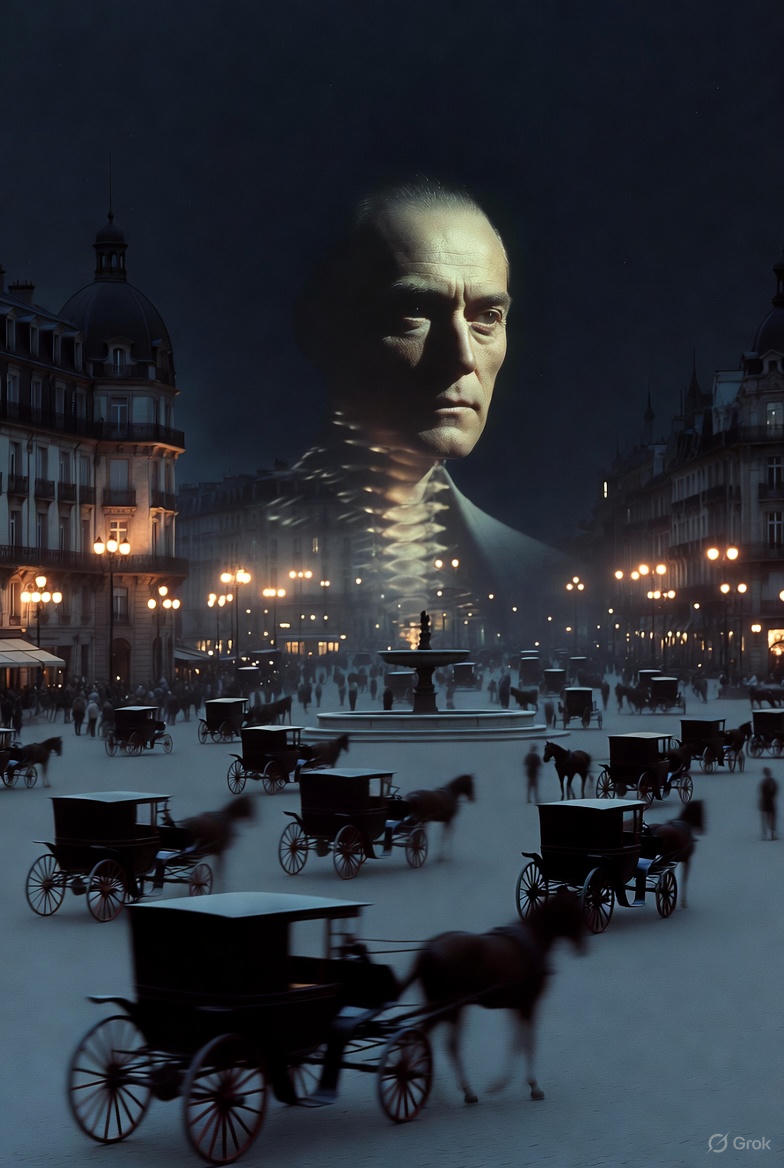
Now he came over a large square on which many carriages drove back and forth, but he saw no people and heard not the slightest noise, on the contrary: it was a death silence around him.  It became uncanny to him. A nameless fear crept unstoppably higher and higher up, from below up, from the root depths of his spinal cord—root depths?

Read Full Post »

Alraune by Hanns Heinz Ewers and translated by Joe E Bandel

Geroldingen sighed; Fräulein Clara was a teacher in an English
finishing school. Dr. Mohnen had met her at a local dance and later
introduced him to her. She loved the cavalry captain and he had hoped
that for once Dr. Mohnen would take her away from him. He had to
start thinking seriously about getting married. Sooner or later it had to
happen, his debts were growing and he needed to find some solution.
“Write her the same thing!” cried Karl Mohnen. “God, if I can do
it, you can do it as well. You’re just her friend! You have too much
conscience man, much too much conscience.”
He wanted to take the count with him to Lendenich, to give him
a reason for visiting with the little Fräulein ten Brinken.
He hit his friend lightly on the shoulder; “You’re as sentimental
as a freshman, count! I leave one sitting and you blame yourself,
always the same old song! But consider what stands to be won this
time, the richest heiress on the Rhine. No delay is permitted!”
The cavalry captain rode out there with his friend and fell no less
deeply in love with the strange creature who was so very different
from all the others that had offered their red lips for him to kiss. As he
went back home that night he felt the same way he had that time
twenty years ago when for the first time he had taken for himself the
girl that his friend adored.
Over the years this had happened so often and he had been so
successful at it that his conscience no longer bothered him. But he
was ashamed of himself now. This time it was entirely different. His
feelings toward this half child were different and he knew that his
friend’s emotions were different as well.
There was one thing that consoled him; Dr. Mohnen would
certainly not win Fräulein ten Brinken. His chances of doing that were
much less than they had been with any of the other women. Really,
this time he was not even sure if she would be interested in him.
When it came to this little doll all of his natural confidence had
completely deserted him.
As far as young Gontram was concerned, it appeared that the
Fräulein liked to have her handsome page, as she called him, around.
But it was just as clear that he was nothing more than a plaything for
Alraune without any will of his own.
No, neither of these two were rivals, not the smooth talking
doctor nor the handsome youth. The cavalry captain seriously
weighed his chances for the first time in his life. He was from an
ancient and noble family and the King’s Hussars were considered the
finest regiment in the West.
He was slender and well built, still looked young enough and
was soon to be promoted to Major. He was a dilettante, and versed
well enough in all the arts. If he had to be honest with himself he
would have to admit that it would not be easy to find a Prussian
cavalry officer with more interests or more accomplishments than he
had. Truthfully it was not surprising that both women and girls threw
themselves around his neck. Why shouldn’t Alraune do the same? She
could search for a long time before she found anyone better. Even
more, as the adopted daughter of his Excellency, she had the only
thing that he couldn’t offer, money, and she had it in such immense
abundance! The two of them would make an excellent couple, he
thought.
Wolf Gontram was in the house sacred to St. Nepomuk every
evening and at least three times every week he brought the cavalry
captain and the doctor along with him. The Privy Councilor withdrew
after the meal, coming in only occasionally for a half hour at a time,
listening to them, observing for a bit and withdrawing again, “testing
the waters” as he called it.
The three lovers sat around the little Fräulein, looking at her and
making love to her, each in their own way.
The young girl enjoyed the attention for awhile but then it began
to bore her. Things were getting too monotonous and a little more
color was needed to liven up the evenings in Lendenich.
“They should do something,” she said to Wolf Gontram.
The youth asked, “Who should do something?”
She looked at him, “Who? Those two! Dr. Mohnen and the
count.”
“Tell them what they should do,” he replied. “I’m sure they will
do it.”
Alraune looked at him astonished, “How should I know what
they should do? They have to figure that out themselves.”
She put her head in her hands and stared out into the room.
“Wouldn’t it be nice Wölfchen, if they dueled each other? Shot
each other dead–both of them?”
Wolf Gontram opined, “Why should they shoot each other dead?
They are best friends.”
“You are a stupid boy, Wölfchen!” said Alraune. “What does
that have to do with it? Whether they are best friends or not? Then
they must become enemies.”
“Yes, but why? There is no purpose to it.”
She laughed, grabbed his curly head and kissed him quickly right
on the nose.
“No, Wölfchen. There is no purpose at all–Why should there be?
But it would be something different, would be a change–Will you
help me Wölfchen?”
He didn’t answer. She asked again, “Will you help me
Wölfchen?”
He nodded.
That evening Alraune deliberated with young Gontram on how
they could arrange things to incite the two friends so that one of them
would challenge the other to a duel. Alraune considered, spinning one
plan after another and proposing it. Wölfchen Gontram listened and
nodded but was still hesitant.
Alraune calmed him.
“They don’t need to be serious about it. Very little blood is shed
at duels and afterward they will be like brothers again. It will
strengthen their friendship!”
That brightened him up and he helped her think things through.
He explained to her the various little weaknesses of them both, where
the one was sensitive and where the other–
So her little plan grew. It was no finely crafted scheme at all, was
much more quite childish and naïve. Only two people that were
blindly in love would ever stumble over such a crude stone.
His Excellency noticed that something was up. He questioned
Alraune and when she wouldn’t talk he questioned young Gontram.
He learned everything he wanted to from the boy, laughed and gave
him a few beautiful suggestions for the little plan as well.
But the friendship between the two was stronger than Alraune
had believed. Dr. Mohnen was so rock solidly convinced of his own
irresistible nature that it took her over four weeks to turn things
around and bring him to the impression that the captain might just
take the field this time and likewise to give the captain the impression
that for once the doctor might just triumph over him.
The count and Karl Mohnen both thought that it was time to
speak privately with each other and settle things but Fräulein ten
Brinken understood such confidential talks and always found ways to
hinder them. One evening she would invite the doctor and not the
cavalry captain. Next time she would go riding with the count and
leave the doctor waiting for her at some garden concert.
Each considered themselves as her favorite but also had to
recognize that her behavior toward the other was not entirely
indifferent either. It was the old Privy Councilor himself that finally
fanned the glowing spark into high flames.
He took his office manager to one side and had a long talk with
him, said that he was very satisfied with his performance and would
not be unhappy at all to see someone as dedicated as he was to
someday become his successor. Really, he would never try to
influence the decision of his child. Still, he wanted to warn him that
there was someone, whom he did not want to name, that was fighting
against him, in particular all kinds of rumors of his loose living were
spreading and reaching the Fräulein’s ear.
His Excellency then had almost the same talk with the cavalry
captain, except that in this case he remarked that he would not take it
unkindly if his daughter married into such a prestigious old family
like the Geroldingen’s.
During the next few weeks the two rivals strongly avoided any
encounters with each other while doubling their attentions toward
Alraune. Dr. Mohnen, especially, let none of her desires go
unfulfilled. When he heard that she craved a charming seven-stranded
pearl necklace that she had seen at a jeweler’s on Schilder Street in
Cologne he immediately went there and bought it. Then when he saw
that for a moment the Fräulein was really delighted over his gift he
believed he had most certainly found the way to her heart and began
to shower her with all kinds of beautiful jewels.
For this purpose he had to help himself to the money in the cash
box at the ten Brinken offices. But he was so sure of his cause that he
did it with a light heart and considered the little forced borrowing as
something he was entitled to that he would immediately replace as
soon as he received the dowry of millions from his father-in-law. He
was certain that his Excellency would only laugh over his little trick.
His Excellency did laugh–but a little differently than the good
doctor had thought. On the very same day that Alraune received the
strands of pearls he rode into the city and determined immediately
where the suitor had found the means for purchasing the gift. But he
didn’t say a word.
Count Geroldingen could give no pearls. There was no cash box
for him to plunder and no jeweler would loan him anything on credit.
But he wrote sonnets for the Fräulein that were really very beautiful!
He painted her in her boy’s clothing and played violin, not Beethoven
whom he loved, but Offenbach, whom she liked to listen to.
Then on the birthday of the Privy Councilor the collision finally
came. They had both been invited and the Fräulein had privately
asked each one to escort her to the table. They both came up to her
when the servant announced that dinner was served. Each considered
the intrusion of the other as tactless and each said–and half
suppressed–a few words.
Alraune waved Wolf Gontram over.
“If the gentlemen can’t agree–” she said, laughing and took his
arm.
It was a little quiet at the table at first. The Privy Councilor had
to do most of the talking. But soon both lovers were warm. They
drank to the health of the birthday child and his charming daughter.
Karl Mohnen gave a speech and the Fräulein threw a couple of
glances at him that made the hot blood pound in the cavalry captain’s
temples. But later, at dessert she laid her little hand lightly on the
count’s arm–only a second–but long enough to make the round fish
eyes of the doctor pop out of his head. When she stood up she allowed
both to lead her away; she danced with them both as well.
Then later while dancing a waltz separately with one she spoke
of the other, “Oh, that was so abominable of your friend! You won’t
really permit that will you?”
The count answered, “Certainly not!”
But Dr. Mohnen threw out his chest and declared, “You can
count on me!”
The next morning the little dispute appeared no less childish to
the count than it did to the doctor–but they both had the uneasy
feeling that they had promised something to Fräulein ten Brinken.
“I will challenge him to a duel with pistols,” said Karl Mohnen
to himself, never believing that it would ever happen.
But in any case that morning the cavalry captain sent a couple of
comrades to his friend–he wanted the court of honor to see what they
made of it. Dr. Mohnen negotiated with the gentlemen, explaining to
them that the count was his closest friend and that he didn’t wish to
harm him at all. The count only needed to apologize to him–then
everything would be fine. He wanted to tell them in confidence that
he would also pay off all his friend’s debts immediately on the day
after the wedding.
But the officers declared that while all that was very nice it had
nothing at all to do with them. The cavalry captain felt insulted and
demanded satisfaction. Their task was only to ask if he were
gentleman enough to accept the challenge, an exchange of three shots
at a distance of fifteen paces.
Dr. Mohnen started, “Three–three exchanges.” he stammered.
The Hussar officers laughed, “Now calm yourself Herr Doctor!
The Court of Honor would never in their lives allow such an insane
challenge for such a small offence. It is only in good form.”
Dr. Mohnen could see that. He counted on the healthy common
sense of the gentlemen of the Court of Honor as well and accepted the
challenge.
He did more than that, ran at once to his fraternity house with it
and requested seconds, then he sent two students in haste to challenge
the Captain for his side–five bullet exchanges at ten paces is what he
demanded. That would make him look good and most certainly
impress the little Fräulein.

Read Full Post »

Madame Bluebeard by Karl Hans Strobl and translated by Joe E Bandel

The farmers watched. Some, dull-witted, grasped
nothing of the stakes. Others, with schadenfreude,
relished the “gentry” taking a hit. But they didn’t join
in. The factory workers, mostly outsiders, found no
local allies. They gathered at the “Hotel Bellevue” at
the village’s lower end, stoking each other’s fervor.
They tore their foes apart in rhetoric, devouring one
with each meal. Meals still came—the strike
committee had secured ample funds from Vienna.
They could live and let live.
The Bellevue’s landlord profited. A sort of fallen
genius, he’d roamed the world before settling here,
marrying into a peasant family to the father’s dismay.
Gradually, he’d seized control. With the family’s
savings, he’d turned their farm into the “Hotel
Bellevue,” its “fine view” aimed at summer tourists’
wallets. The grand name was otherwise unearned.
Before the veranda, the Kamp flowed murky and
sullen, confined yet lacking the beauty of frothy
rapids. Across was a near-bare gneiss wall,
perpetually wet-looking. A few birches clung to
crevices, seeming to regret it, gazing miserably
down, yearning to escape. The rear windows faced a
gaping hole in the hillside, where the landlord had
dug clay for bricks. It always looked untidy, hardly
picturesque, despite what a kind soul might claim.
The “Red Ox” landlady held her own. Her clean,
cheerful, well-fed warmth was untouched by worry.
Guests preferred her plump comfort to the Bellevue
landlord’s frantic hustle.
Foiled in his capitalist dreams, the Bellevue
landlord sided with the workers. His hotel became
their meeting place, their headquarters.
Here, Rauß delivered fiery speeches, rousing his
followers to bold deeds. They began, per tradition, by
smashing the factory’s windows. Not one pane
survived in the director’s home.
Evenings, they roamed the village, shouting.
Farmhands and maids returning from fields endured
their jeers.
One fine early summer evening, someone was
beaten. None other than Jérome Rotrehl, the
“Krampulljon.” His ill fate had drawn him to the
village, where they needed a target. Rauß, impartial
despite old ties, joined in. Principles trumped people.
Farmers at the “Red Ox” discussed the events,
their schadenfreude gone, but they couldn’t decide
what to do. The head teacher recalled 1848,
proposing a citizens’ militia to keep order.
“We ain’t citizens,” grumbled the alderman. True
enough. The teacher’s idea fell on barren ground—no
one had heard of a farmers’ militia.
Later, Rauß and two comrades stormed into the
“Red Ox” taproom—an outrageous affront. He
belonged at the Bellevue! The farmers huddled,
glared darkly, and spat from their left mouth-corners,
except Peterlehner, who spat from the right, his
mouth skewed that way.
They listened as Rauß ranted, pounding the table,
cursing the “sulfur gang,” the “clay-scratchers”
needing holes drilled in their thick skulls for funnels
to pour in human rights. Buying a costly church
banner while workers starved and fought for survival
was vile—a pro-vo-ca-tion! They’d show them
tomorrow at the banner consecration. The working
folk wouldn’t be mocked—damn it all!
But the Red Ox landlady’s plump warmth hid a
heroic soul. She mustered the courage the men
lacked, confronting Rauß. She wouldn’t tolerate
brawls in her inn. This was a decent establishment,
and he should return to the Bellevue where he
belonged.
Rauß grew fiercer, pounding a rhythm for a glass-
dance, yelling she’d learn her place—she’d fattened
on workers’ sweat and blood.
That struck her reputation. She wouldn’t stand for
it. With blazing eyes, she declared his workers could
stay wherever, and if she was round, it was from
potatoes and maybe dumplings—not, fie!—sweat and
blood. She stormed out, slamming the kitchen door,
to her guests’ approving smirks.
Rauß held the battlefield, raging on. Not for long.
Schorsch, the Red Ox’s house servant, entered
meekly through the same door, asking Rauß if he
preferred the door or the window. Schorsch, the only
man in the village unafraid of Rauß, was a Kamptal
legend for feats during his service with Infantry
Regiment No. 49, Freiherr von Hess, in Brno. He’d
been with the machine-gun unit—a rare honor—
proving his worth. He stood before the troublemaker,
rolling his sleeves to his armpits.
Rauß, unyielding, sneered that throwing him out
took two. Schorsch wasted no time, grabbed him by
the collar, wrapped massive arms around his chest,
and carried him to the door, ejecting him with a twist
and a well-placed kick. The table and glasses toppled.
Rauß’s comrades, Maurerwenzel among them,
seemed poised to avenge him. But Schorsch raised
his right hand, palm open.
“Look here,” he said. That hand, a marvel in
peace, was a terror in conflict. Maurerwenzel glanced
at its calloused hide and splayed fingers, then
followed his leader out with his comrade.
“That’s right!” said Mathes Dreiseidel. “Should’ve
tossed him out sooner. Can’t let that slide.” He
rewarded himself with a hearty gulp, as if claiming
the deed.
The first assault was repelled. But this fine
ejection was Schorsch’s last feat in Vorderschluder
for now. He had a military drill summons in his
pocket and had to leave that evening.
The banner consecration was set for the next
morning.
Some thought it unwise, given the tense times, and
suggested postponing the festival. But what could be
done? Preparations were complete, invitations sent,
and even the district captain had confirmed his
attendance. Stubborn heads insisted they mustn’t be
intimidated or yield. This triumph couldn’t be
granted to the infernal enemy and his minions.
Recently, old Marianne from the castle had suffered a
fit in church, crying amid prayers and tears that the
vessel of sins was full and divine grace exhausted.
This shook superstitious minds. Was it a serious
warning? They sought the protection of the holy
patron Leopold, whose image was embroidered in
gold and silk on the new banner.
The festival began with cannon shots from the
hills above the Kamp. The sound rolled into the
valley, echoing off rock walls. The sky smiled kindly,
as if Saint Leopold sat on white summer clouds,
delighted by the fine gift.
Then the bells rang, lending Vorderschluder a
solemn air. Streets were strewn with boughs and
flowers, and in farmhouses, white-clad girls had their
curls singed and adorned with ribbons. From the
church tower’s three windows hung flags in papal,
imperial, and provincial colors. The parsonage was
draped in bunting, and above the door, a bough
wreath bore a motto:
“The banner leads us forth. We follow it with
faith…
The old flag was worn. We’ve gifted one afresh.”
The head teacher, the verse’s poet, passed the
parsonage thrice that morning to admire his work in
place. He basked in glory, feeling nearly the event’s
star, save for stomach unease. Expecting the feast,
he’d fasted almost entirely the previous day, and now
his hunger defied reason.
As morning flowed into forenoon, guests arrived:
local landowners, neighboring priests, officials, and
finally the district captain. From Vienna came Anton
Sykora, honorary chairman of the Christian Progress
Friends, claiming a right to celebrate, his association
having donated generously. Spectators gathered
before the parsonage. White-clad girls waited in the
garden under the head teacher’s lead. The dignitaries
assembled in the parson’s study. Only Frau Helmina
was missing; then they could begin. The parson had
wine served for fortification. They sat where they
could. In the corner stood the Karl Borromaeus
Society committee, freshly shaved, wiping their
mouths neatly with the backs of their hands after
drinking.
The district captain was affable, beckoning the
alderman. “You’ve had troubles lately… a strike,
worker unrest… nothing serious, I hope?”
The alderman assured him the agitation would
soon subside.
“Yes, yes!” the captain nodded. “See that peace
returns quickly. I don’t like this in my district. I’m
answerable in Vienna, you understand…” The
alderman quailed at this vast responsibility. “By the
way,” the captain continued, “let’s hope no
disturbances occur today. There’ve been rumors… I
dislike such festivals marred by reckless incidents.
What would that look like? The parson informed me.
Just in case—assuming your consent—I’ve
requisitioned gendarmes from Gars. They’ll arrive
this morning. You could’ve thought of that. What’s
the gendarmerie for? Call them in time. You
should’ve considered it.” After this fatherly rebuke,
his goodwill shone again. “Still, well done, dear
Hingler, the Karl Borromaeus Society’s efforts are
commendable. I’ll note your special merits.”
The slight man with weary eyes and wrinkled
cheeks turned with a kind nod, rejoining the parson.
He made distinctions: the alderman was summoned;
to the parson, he went.
“All’s quiet in the village, Reverend,” he said.
“No sign of the troublemakers.”
“They’re all at the Hotel Bellevue. They’re quiet
unless drunk. I’d like to start. If only Frau von
Boschan would come.”
Helmina struggled with her toilette, too agitated to
be satisfied by her maid. This stemmed from a
morning talk with Ruprecht, fueled by rage and fear.
The previous day, Ruprecht received a letter from
his friend Wetzl. It was a detailed report on a
substance Ruprecht sent, identified as radium. Wetzl
confirmed receipt, described its appearance and
properties, noted its weight, and pledged to preserve
it for Ruprecht, unaltered unless requested for
experiments. The sealed letter accompanying it
would be kept safe, released only on Ruprecht’s or
the Gars notary’s order.
After reading, Ruprecht locked himself in his
study, drafting a document across several sheets,
sealing them in a sturdy envelope with five wax
seals. At noon, he drove to Gars, returning late after
Helmina had retired.

Read Full Post »

« Newer Posts - Older Posts »