Madame Bluebeard by Karl Hans Strobl and translated by Joe E Bandel
Waking in a glorious resolve, sweat-soaked, he heard
fists pounding his door.
He stood in the doorway, shirt flapping, blinded
by a lantern’s glare. Someone ordered him to rise
quickly, speaking of a ladder, ropes, a pickaxe, and a
shovel from the tool shed behind the house. It
might’ve been Schiereisen. He had to dress; it
seemed urgent. When Rotrehl was ready and
Schiereisen explained the task, he wasn’t overly
surprised. It felt like a continuation of his
adventurous dreams, his mind brimming with
Cossacks and battle scenes, making him eager to
follow. Soon, they descended the hill, armed with
ladder, ropes, pickaxe, and shovel, like treasure
hunters or conjurers, cloaked in night’s mantle.
Stars began to adorn that mantle. Clouds had
cleared, and the night grew bright. Warm mist rose
from wet grass, spreading a thin, white fog over the
meadows. Midnight had long passed; in the east,
night’s veils thinned, stars peering large and anxious
through dawn’s weave. Light welled from the earth.
At her bedroom window, Helmina stood in a gray
travel dress, a small handbag ready. She sometimes
brushed her forehead, turning to check if the sounds
she heard were in her ears and blood or from outside.
At times, she thought someone approached along the
corridor, pausing at her door. Then she heard
breathing—the breath of sleepers, a whole castle
asleep while she alone watched, ready to flee. Short,
quick breaths stood out, those of children in their
beds. For a moment, Helmina distinguished them,
then they merged back into the collective slumber’s
weave. She made no effort to hear them again.
Motherly tenderness was alien to her; her soul knew
nothing of it. She preferred solitude, connected to
others only through her senses. She stared into a new
world, seeking the extraordinary. Was it power, a
searing, ruinous, blissful passion? She didn’t know. It
flowed darkly within her, driving her, and she yielded
without resistance. Sometimes, she felt not herself
but part of a cruel force spilling over the world…
She stood thus for two hours, staring at the bridge
deep in shadow, awaiting the signal. Her mocking
lips grew thinner, pressed tighter. Perhaps Fritz
Gegely wouldn’t come. Maybe he’d only boasted,
shirking the deed, and she’d have to leave without
him. He was merely a bridge, but if he failed her,
after so many defeats, she’d be utterly crushed. This
waiting was unbearable. Lorenz would be furious.
Time slipped away; they could’ve been far gone.
Half an hour more. Then Helmina must leave,
with or without Gegely.
But the signal came. On the bridge, an electric
lighter flashed thrice, three seconds each, like a
firefly. Helmina grabbed her bag, glancing around the
room. She left not as a victor… only her hate
remained.
Cautiously, she stepped out, unlocked a secret
door in the corridor, and descended a narrow, musty
staircase to the forecourt. It was safer; someone
might be on the main stairs. She crept across the
courtyard to the gate tower, opening the small door in
the large gate. It wouldn’t budge at first, rarely used
and swollen. She yanked the lock with all her
strength, tearing her delicate gloves.
Finally, she slipped out, leaving the door ajar.
Gegely stood under the chestnut trees.
“Where were you so long?” she asked, furious.
“Forgive me… she couldn’t sleep… I had to
wait… only a quarter-hour ago…”
“Forward!”
They were halfway down the castle hill when the
gate was flung open. Schiereisen leapt out, followed
by Jérome Rotrehl, clutching rope and spade as if
someone had thrust them into his hands and fled.
Both men’s faces, hands, and clothes were smeared
with mud, crusted with clay, speckled with white
patches of lime or mortar.
Schiereisen saw the two figures vanish into the
early morning’s dusk at the chestnut alley’s end.
They ran along the road, and soon he heard a
sound—a nerve-shredding, whipping noise, the
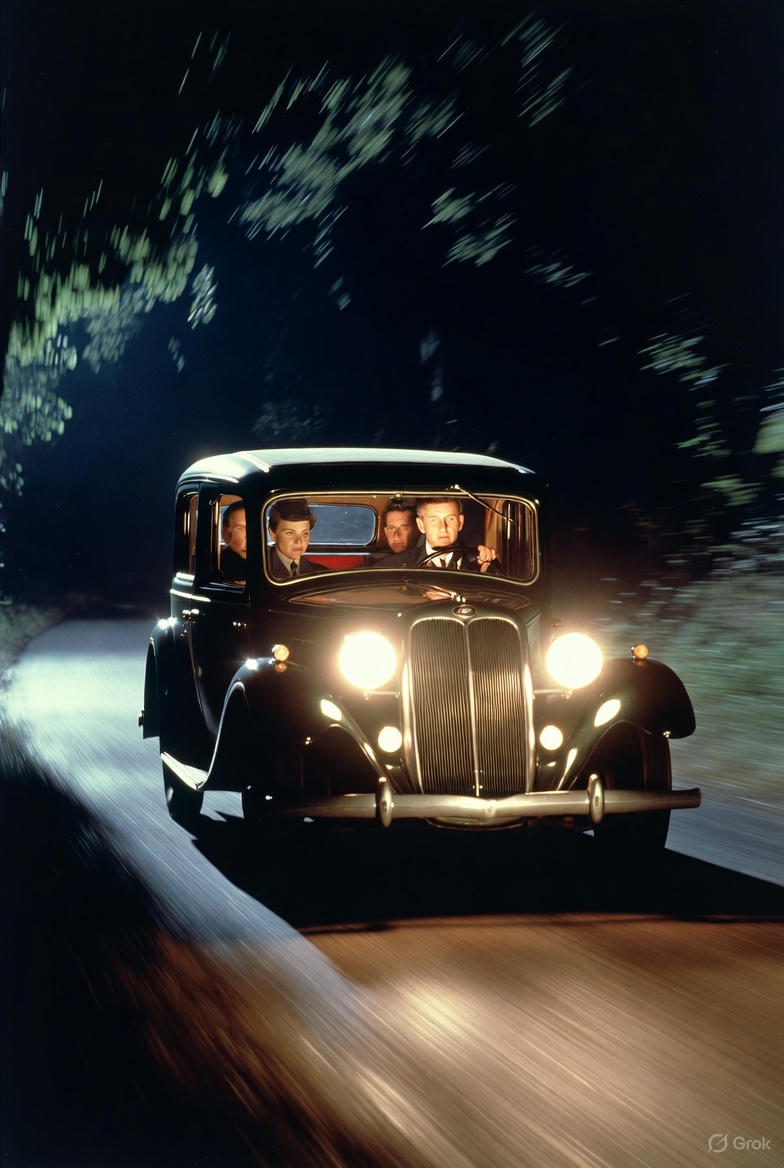
sputter of a car readying to drive. It drummed into the
dawn’s silence, like handfuls of peas hurled against
this glassy hour.
Schiereisen gauged the distance from the alley’s
mouth. He sprinted down the hill, first driven to
pursue, to halt the fugitives. Near the bottom, he
stopped abruptly, planting his feet, fists in his
pockets. No—she should flee.
The car’s starting roar sounded. Good… it’s
right… He finished his descent slowly, regulating his
breath with closed lips. On the bridge, the car was
gone. He broke into a trot, wanting to confirm who
Helmina fled with. The road stretched through the
valley, rising in wide curves to the highlands. A
steep, direct climb could cut off its loops.
Schiereisen plunged into the woods, scrambling
between trees, hooking from one to another at steep
spots. His lungs expanded, filling his chest, pushing
his heart to his throat. Sweat poured from his brow,
carving furrows through mud and grime, mixing a
sticky paste that tightened his skin. Several times, he
felt he couldn’t go on. But his immense resilience
drove him, making the impossible possible.
He reached the forest’s edge, where he’d first met
Helmina, standing in dense shrubs, their dampness
cloaking his steaming body. For a moment, all was
still, branches swaying softly. Seconds passed. Then
the car’s sputter burst in, sudden, as it rounded a
sound-catching forest bend.
Schiereisen knew he could’ve stopped it—
stepping into the road, Browning raised, an effective
warrant. But he stayed hidden.
The car roared up, shooting around the final curve,
snorting, racing uphill at full power… gone ten
heartbeats later. Schiereisen saw its occupants
clearly: Helmina, Herr Gegely—husband of the sick
woman—and Lorenz at the wheel.
The detective began his return. Near the house, he
met Rotrehl, lugging the gear alone. Seeing his
summer guest, the violin-maker stopped, staring. His
mind was saturated with the past hours’ events,
unable to grasp more. Bewilderment wrapped him in
soft veils. He could only shake his head.
“Come, Napoleon,” Schiereisen said, taking the
ladder. “Don’t think we’ve lost the battle. We’ll sleep
a little now. Later, I’ll explain everything.”


 Anarchistbanjo's World
Leave a comment