Alraune by Hanns Heinz Ewers and translated by Joe E Bandel
She turned and laughed at him, her bright teeth gleaming.
“Does she mean I should play her kitten?” he thought.
Her face became a little more serious, and her soft lowered voice
rang with a mocking, veiled threat.
He did not touch it with his paws
And ron, ron and small patapon
He did not touch it with his paws
He ate it with his jaws
Ron, ron, he ate it with his jaws
The shepherdess got angry
And ron, ron and small patapon
The shepherdess got angry
She killed the kitten
Ron, ron, she killed the kitten
“Very pretty,” he said. “Where did you learn that little nursery
rhyme?”
“In the convent,” she answered. “The sisters sang it.”
He laughed, “Imagine that–in a convent! I would have never
expected it–please finish it, little cousin.”
She sprang up from the piano stool, “I am finished. The kitten is
dead–that is how it ends!”
“Not entirely,” he declared. “But your pious nuns feared the
punishment–so they let the pretty shepherd girl go unpunished for her
evil sin! Play again. I will tell you what happened to the shepherd girl
after that.”
She went back to the piano, played the melody.
Then he sang:
She went to confession
And ron, ron and small patapon
She went to confession
To get forgiveness
Ron, ron, to get forgiveness
I confess, my Father
And ron, ron, and small patapon
I confess, my Father
To killing my kitten
Ron, ron, to killing my kitten
My daughter, for penance
And ron, ron and small patapon
My daughter, for penance
We will embrace
Ron, ron, we will embrace
Penance is sweet
And ron, ron, and small patapon
Penance is sweet
We will begin
Ron, ron, we will do it again
“Finished,” she asked.
“Oh yes, very much so,” he laughed. “How do you like the
moral, Alraune?”
It was the first time he had called her by her given name–that
astounded her so much she didn’t pay attention to his question.
“Good,” she replied indifferently.
“Isn’t it though,” he cried. “A pretty moral that teaches little girls
they will not be permitted to kill their kittens and go unpunished!”
He stood right in front of her and towered over her by at least
two heads. She had to look up at him to catch his eye.
She thought, “How much difference a stupid thirty centimeters
makes.”
She wished she were dressed in men’s clothing as well. Already
her skirts gave her a disadvantage. Then immediately it occurred to
her that she had never experienced these feelings with others. But she
stretched herself up, tossed her head lightly:
“Not all shepherdesses have to serve such penance,” she
twittered.
He parried, “And not all Father Confessors will let them off so
lightly.”
She searched for a reply and found none. That made her angry.
She dearly wanted to pay him back–in his own way. But this skill was
new to her–it was like an uncommon language that she could
understand completely, but couldn’t speak correctly herself.
“Good night, Herr Guardian,” she said quickly. “I’m going to
bed.”
“Good night, little cousin,” he smiled. “Sweet dreams!”
She climbed up the stairs, didn’t run up them as usual, went
slowly and thoughtfully. She didn’t like him, her cousin, not at all.
But he attracted her, stimulated her, and goaded her into responding.
“We will be done with him soon enough,” she thought.
And as the lady’s maid loosened her bodice and handed her the
long nightgown she said, “It’s good that he’s here, Katie. It breaks up
the monotony.”
It almost made her happy that she had lost this advance skirmish.
Frank Braun had long conferences with Legal Councilor
Gontram and Attorney Manasse. He consulted with the Chancery
Judge about his guardianship and with the probate Judge. He was
given the run around and became thoroughly vexed.
With the death of his uncle the criminal accusations were finally
cut off, but the civil complaints had swollen to a high flood. All the
little businessmen that had trembled at a squinting look from his
Excellency now came forward with new demands and claims, seeking
compensation for damages that were often quite dubious in nature.
“The District Attorney’s office has made peace with us,” said the
old Legal Councilor, “and the police won’t bother us either. But
despite all that, we still have the county court tightly packed with our
cases alone–the second court room will be the private institute of the
late Privy Councilor for the next six months.”
“His Deceasedness would enjoy it, if he could look out of his
hellish cauldron,” the lawyer remarked. “He only enjoyed such suits a
dozen at a time.”
He laughed as well, when Frank Braun handed him the
Burberger mining shares that were his inheritance.
“The old man would have loved to be here now,” he said, “to see
your face in half an hour! Just you wait, you’ve got a little surprise
coming.”
He took the shares, counted them, “A hundred eighty thousand
Marks.”
He reviewed them, “One hundred thousand for your mother–the
rest for you! Now pay attention!”
He picked up the telephone receiver, asked to be connected to the
Shaffhausen Trust Company and requested to speak with one of the
directors.
“Hello,” he barked. “Is that you, Friedberg?–A little favor, I have
a few Burberger shares here–what can I get for them?”
A loud laughter rang out of the telephone and Herr Manasse
joined in loudly.
“I thought so–” he cried out. “So they are absolutely worthless?
What? They expect new funding next year–the best thing is to throw
the entire lot away–well naturally!–A fraudulent investment that will
certainly sooner or later loose everything? Thank you, Herr Director,
excuse me for disturbing you!”
He hung up the phone and turned grimly to Frank Braun. “So
now you know. And now you are wearing exactly that stupid face that
your kindly uncle expected–excuse me for telling the truth! But leave
the shares with me–it is possible that one of the other mining
companies will take some interest in them and offer you a couple
hundred Marks. Then we can buy a few bottles of wine with it and
celebrate.”
Before Frank Braun had come back the greatest difficulty had
constituted the almost daily negotiations with the large Mülheim
Credit Bank. The bank had dragged on from week to week with
exceptional effort, remembering the Privy Councilor’s solemn
promise of assistance, always in the hope of receiving some small
portion of help from his heiress.
With heroic courage the Directors, the Gentlemen from the
Board of Directors, and the auditors managed to keep the leaky ship
above water, always aware that the slightest new impact might cause
it to capsize.
With the help of the bank, his Excellency had successfully
concluded many very risky speculations. To him the bank had been a
bright fountain of gold. But the bank’s own undertakings, which it
had taken at the Privy Councilor’s suggestion, were all failing–Really
his own fortune was no longer in danger, but that of the Princess
Wolkonski was, along with those of several other wealthy investors.
This included the savings of a great number of little people as
well, penny speculators that had followed the star of his Excellency.
The legal executors of the Privy Councilor’s estate had promised their
help, as much as it was in their power to do. But the hands of Legal
Councilor Gontram, as provisional guardian, were tied by law–
through the Chancery court–Money held in trust was sacred–all of it!
Really, there had been only one possibility, Manasse had found
it. They could declare the Fräulein ten Brinken of age. Then she
would be free to fulfill her father’s moral obligations. For that
purpose all of the parties worked together, pulling every last penny
out of their own pockets. Already, with the last of their strength they
had successfully survived a run on the bank that had lasted fourteen
days–The decision had to be made now.
Until then the Fräulein had shook her head. Now she listened
quietly to what the gentlemen were proposing, smiled, and said, “No.”
“Why should I become of age?” she asked. “I like the way it is
right now–and why should I give money away to save a bank that is
absolutely of no concern to me at all?”
The Chancery Judge gave her a long speech about preserving the
honor of her father. Everyone knew that he alone was the cause of
their present difficulties–it was her duty as his child to clear his good
name.
Alraune laughed in his face, “His good name?”
She turned around to Attorney Manasse: “Tell me, what do you
think of it?”
Manasse didn’t answer, curled up in his chair, spat and hissed
like a stepped on Tomcat.
“Not much more than I do, it appears!” said the Fräulein. “And I
won’t give a penny for it.”
Commercial Councilor Lützman, chairman of the Board of
Directors, proposed that she should have some consideration for the
old princess, who for so long had been an intimate friend of the house
of Brinken. What about all of the little people that would lose all of
their hard-earned money?
“Why did they speculate?” she replied calmly. “Why did they
put their money into such a dubious bank? If I wanted to give to
charity I know of better ways.”
Her logic was clear and cruel, like a sharp knife. She knew her
father, she said, and whoever invested in the same things he did was
certainly not very much better.
But it was not about charity, the Director returned. It was almost
certain that the bank would hold together with her help, if it could
only get over this current crisis she would get her money back, every
penny of it and with interest.
She turned to the Chancery Judge.
“Your Honor,” she asked, “is there a risk involved?”
Naturally unforeseen circumstances could always come up. He
had the professional duty to tell her–but as a human being he could
only add his urgent plea to that of the other gentlemen. She would be
doing a great and good work, saving the livelihoods of multitudes and
the possibility of loss in his opinion was ever so slight.
She stood up, interrupted him quickly.
“Well then, gentlemen. There is a risk,” she cried mockingly,
“and I don’t want to take any risk. I don’t want to save any
livelihoods and have no desire to do great and good works.”
She nodded lightly to the gentlemen, left, leaving them sitting
with fat, red little heads.
But still the bank continued, still battled on. Hope formed anew
when the Legal Councilor informed them that Frank Braun; the true
Guardian had arrived. The gentlemen immediately got in contact with
him, arranged a conference for the next day.
Frank Braun saw very well that he would not be able to leave as
quickly as he had believed. So he wrote his mother.
The old Frau read his letter, folded it carefully, and laid it in the
large black trunk that contained all of his letters. She opened them on
long winter evenings when she was completely alone. Then she read
to her brown little hound what he had written to her.
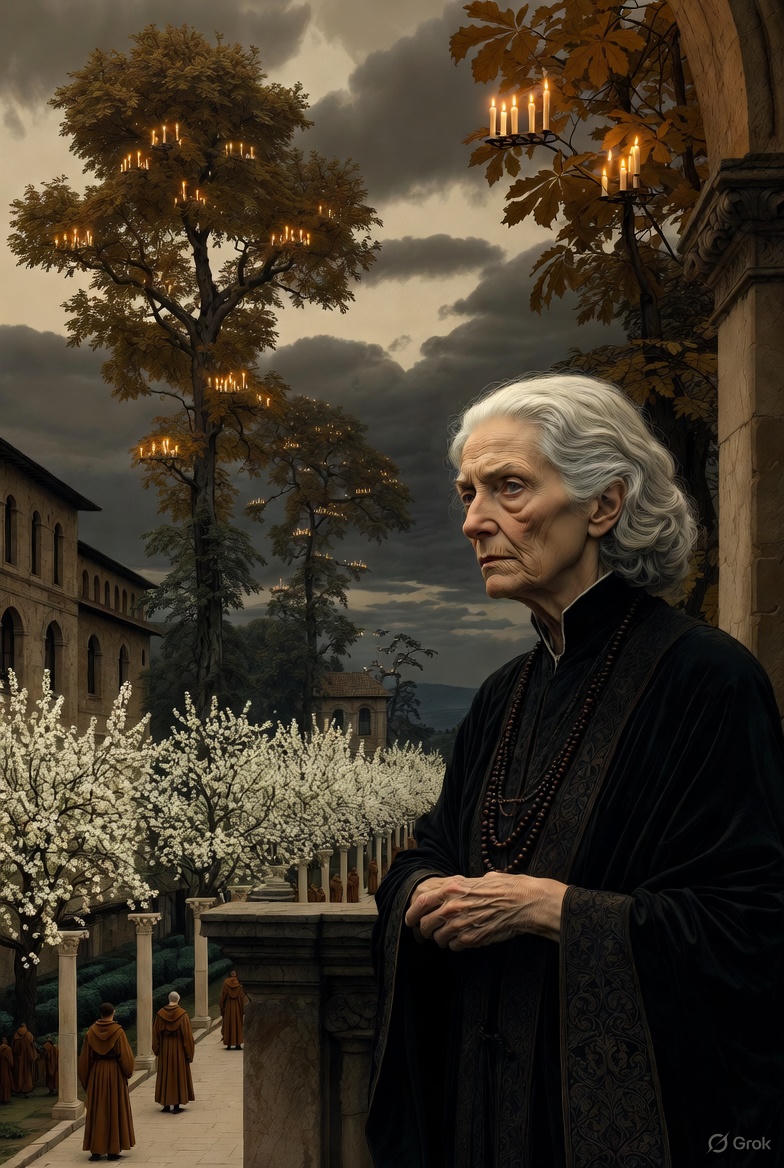
She went out onto the balcony, looked down at the high chestnut
trees that carried glowing candles in their mighty arms, looked down
on the white blooming trees of the monastery under which brown
monks quietly wandered.
“When will he come, my dear boy?” she thought.


 Anarchistbanjo's World
Leave a comment