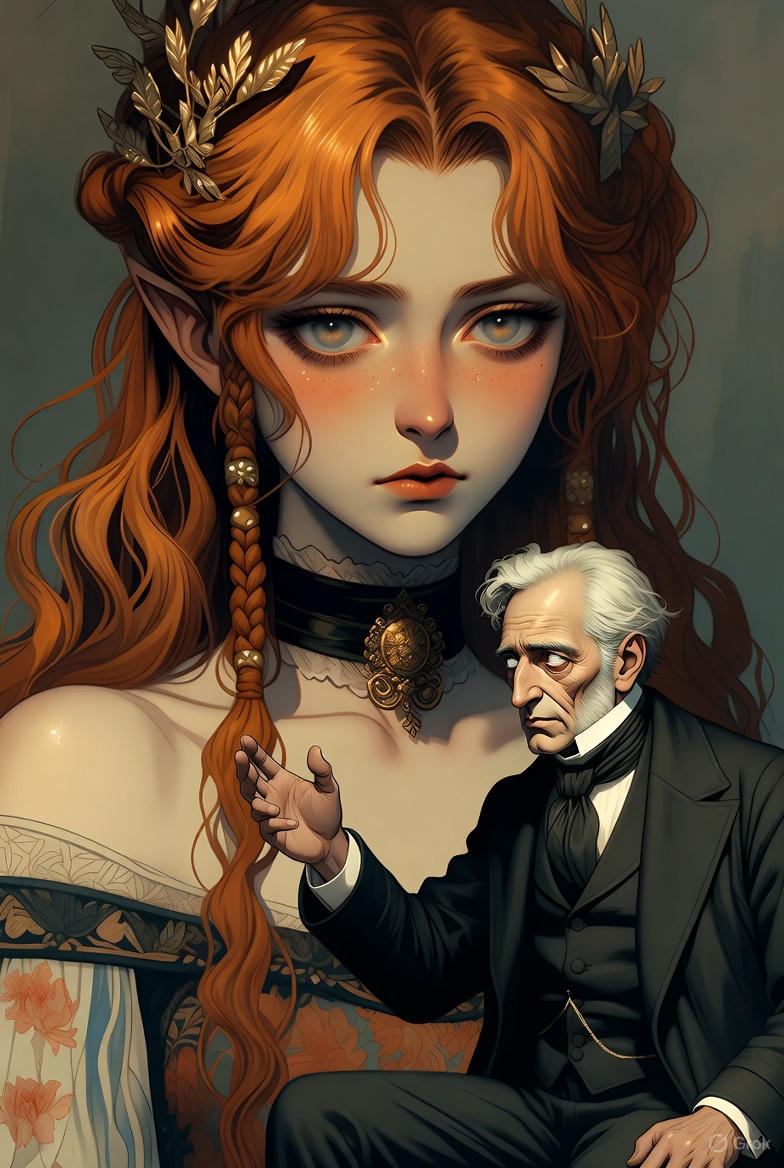
Alraune by Hanns Heinz Ewers and translated by Joe E Bandel
He searched for Alraune and took it as a good omen that no
guests were there. He heard from the maid that she had dined alone
and was now in her rooms so he went up there. He stepped inside at
her, “Come in.”
“I must speak with you,” he said.
She sat at her writing desk, looked up briefly.
“No,” she cried. “I don’t want to right now.”
“It is very important,” he pleaded. “It is urgent.”
She looked at him, lightly crossed her feet.“Not now,” she
answered. “–Go down–in a half hour.”
He went, took off his fur coat, sat down on the sofa and waited.
He considered how he should tell her, weighed every sentence and
every word. After a good hour he heard her steps.
He got up, went to the door–there she stood in front of him, as an
elevator boy in a tight fitting strawberry red uniform.
“Ah,” he said, “that is kind of you.”
“Your reward,” she laughed. “Because you have obeyed so
beautifully today–now tell me, what is it?”
The Privy Councilor didn’t gloss things over, he told her
everything, like it was, each little detail without any embellishments.
She didn’t interrupt, let him speak and confess.
“It is really your fault,” he said. “I would have taken care of it all
without much trouble–but I let it all go, have been so preoccupied
with you, they grew like the heads of the Hydra.”
“The evil Hydra”–she mocked, “and now she is giving poor,
good Hercules so much trouble! By the way, it seems that this time
the hero is a poisonous salamander and the monstrous Hydra is the
punishing avenger.”
“Certainly,” he nodded, “from the viewpoint of the people. They
have their ‘justice for everyone’ and I have made my own. That is
really my only crime. I believed that you would understand.”
She laughed in delight, “Certainly daddy, why not? Am I
reproaching you? Now tell me, what are you going to do?”
He proposed his plans to her, one after the other, that they had to
flee, that very night–take a little trip and see the world. Perhaps first
to London, or to Paris–they could stay there until they got everything
they needed. Then over the ocean, across America–to Japan–or to
India–whatever they wanted, even both, there was no hurry. They had
time enough, then finally to Palestine, to Greece, Italy and Spain.
Where ever she wanted–there they could stay and leave again when
they had enough. Finally they could buy a villa somewhere on Lake
Garda or on the Riviera. Naturally it would be in the middle of a large
garden. She could have her horses and her cars, even a yacht. She
could fill the entire house with people if she wanted–
He wasn’t stingy with his promises, painted in glowing colors all
the tempting splendors that awaited her, was always finding new and
more alluring reasons that she should go.
Finally he stopped, asked his question, “Now child, what do you
say to that? Wouldn’t you like to live like that?”
She sat on the table with her slender legs dangling.
“Oh yes,” she nodded. “Very much so–only–only–”
“Only?”–he asked quickly, “If you wish something else–say it! I
will fulfill it for you.”
She laughed at him, “Well then, fulfill this for me! I would very
much like to travel–only not with you!”
The Privy Councilor took a step back, almost fell, grabbed onto
the back of a chair. He searched for words and found none.
She spoke, “With you it would be boring for me–you are
tiresome to me–I want to go without you!”
He laughed, attempting to persuade himself that she was joking.
“But I am the one that must be leaving right away,” he said. “I
must leave–tonight yet!”
“Then leave,” she said quietly. “I’m staying.”
He began all over again, imploring and lamenting. He told her
that he needed her, like the air that he breathed. She should have
compassion on him–soon he would be eighty and wouldn’t be a
burden to her very much longer.
Then he threatened her again, screamed that he would disinherit
her, throw her out into the street without a penny.
“Just try it,” she threw back at him.
He spoke yet again, painting the wonderful splendors that he
wanted to give her. She should be free, like no other girl, to do and
have as she desired. There was no wish, no thought that he couldn’t
turn into reality for her. She only had to come with–not leave him
alone.
She shook her head. “I like it here. I haven’t done anything–I’m
staying.”
She spoke quietly and calmly, never interrupted him, let him talk
and make promises, start all over again. But she shook her head
whenever he asked the question.
Finally she sprang down from the table and went with soft steps
toward the door, passing him.
“It is late,” she said. “I am tired. I’m going to bed–good night
daddy, happy travels.”
He stepped into her way, made one last attempt, sobbed out that
he was her father, that children had a duty to their parents, spoke like
a pastor.
She laughed at that, “So I can go to heaven!”
She stood near the sofa, set down astride the arm.
“How do you like my leg?” she cried suddenly and stretched her
slender leg out toward him, moving it back and forth in the air.
He stared at her leg, forgot what he wanted, thought no more
about flight or danger, saw nothing else, felt nothing–other than her
slender strawberry red boy’s leg that swung back and forth before his
eyes.
“I am a good child,” she tittered, “a very dear child that makes
her stupid daddy very happy–kiss my leg, daddy–caress my beautiful
leg daddy!”
He fell heavily onto his knees, grabbed at her red leg, moved his
straying fingers over her thigh and her tight calf, pressed his moist
lips on the red fabric, licked slowly along it with his trembling
tongue.
Then she sprang up, lightly and nimbly, tugged on his ear, and
patted him softly on the cheek.
“Now daddy,” her voice tinkled, “have I fulfilled my duty well
enough? Good night then! Happy travels–and don’t get caught–it
would be very unpleasant in prison. Send me some pretty picture
postcards, you hear?”
She was at the door before he could get up, made a bow, short
and stiff like a boy and put her right hand to her cap.
“It has been an honor, your Excellency,” she cried. “And don’t
make too much noise down here while you are packing–it might
disturb my sleep.”
He swayed towards her, saw how quickly she ran up the stairs.
He heard the door open upstairs, heard the latch click and the key turn
in it twice. He wanted to go after her, laid his hand on the banister.
But he felt that she would not open, despite all his pleading. That door
would remain closed to him even if he stood there for hours through
the entire night until dawn, until–until–until the constable came to
take him away.
He stood there unmoving, listening to her light steps above him,
back and forth through her room. Then no more. Then it was silent.
He slipped out of the house, went bare headed through the heavy
rain across the courtyard, stepped into the library, searched for
matches, lit a couple of candles on his desk. Then he let himself fall
heavily into his easy chair.
“Who is she,” he whispered. “What is she? What a creature!” he
muttered.
He unlocked the old mahogany desk, pulled a drawer open, took
out the leather bound volume and laid it in front of him.
He stared at the cover, “A.T. B.”, he read, half out loud.
“Alraune ten Brinken.”
The game was over, totally over, he sensed that completely. And
he had lost – he held no more cards in his hand. It had been his game;
he alone had shuffled the cards. He had held all the trumps–and now
he had lost anyway. He smiled grimly, now he had to pay the price.
Pay the price? Oh yes, but in what coin?
He looked at the clock–it was past twelve. The people would
come with the warrant around seven o’clock at the latest–he still had
over six hours. They would be very considerate, very polite–they
would even bring him into custody in his own car. Then–then the
battle would begin. That would not be too bad–he would defend
himself through several months, dispute every move his opponents
made.
But finally–in the main case–he would lose anyway. Manasse
had that right. Then it would be–prison–or flee–but alone, entirely
alone? Without her? In that moment he felt how he hated her, but he
also knew as well that he could think of nothing else any more, only
her. He could run around the world aimlessly, without purpose, not
seeing, not hearing anything but her bright twittering voice, her
slender swinging red leg.
Oh, he would starve, out there or in prison–either way. Her leg–
her sweet slender boy’s leg! Oh how could he live without that red
leg?
The game was lost–he must pay the bill, better to pay it quickly,
this very night–with the only thing of value he had left–with his life.
And since it wasn’t worth anything any more, perhaps he could bring
someone else down with him.
That did him good, now he brooded about whom to take down
with him, someone that would give him a little satisfaction to give one
final last kick.
He took his last will and testament out of the desk, which named
Alraune as his heir, read through it, then carefully tore it into small
pieces.
“I must make a new one,” he whispered, “only for whom?–for
whom?”
There was his sister–was her son, Frank Braun, his nephew–
He hesitated, him–him? Wasn’t it him that had brought this
poisonous gift into his house, this strange creature that had now
ruined him?
He–just like the others! Oh, he should pay, even more than
Alraune.
“You will tempt God,” the fellow had said. “You will put a
question to him, so audacious that He must answer.”
Oh yes, now he had his answer! But if he inexorably had to go
down, the youth should share his fate. He, Frank Braun, who had
engendered this thought, given him the idea.
Now he had a bright shiny weapon, her, his little daughter,
Alraune ten Brinken. She would bring him as well to the point where
he was today. He considered, rocked his head and grinned in
satisfaction at this certain final victory.
Then he wrote his will without pausing, in swift, ugly strokes.
Alraune remained his heir, her alone. But he secured a legacy for his
sister and another for his nephew, whom he appointed as executor and
guardian of the girl until she came of age. That way he needed to
come here, be near her, breathe the sultry air from her lips, and it
would happen, like it had happened with all the others!
Like it had with the Count and with Dr. Mohnen, like it had with
Wolf Gontram, like with the chauffeur–and finally, like it had
happened with he, himself, as well.
He laughed out loud, made still another entry, that the university
would inherit if Alraune died without an heir. That way his nephew
would be shut out in any case. Then he signed the document and
dated it.
He took the leather bound volume, read further, wrote the early
history and conscientiously brought everything up to date. He ended it
with a little note to his nephew, dripping with derision.
“Try your luck,” he wrote. “To bad that I won’t be there when
your turn comes. I would have been very glad to see it!”
He carefully blotted the wet ink, closed the book and laid it back
in the drawer with the other momentos, the necklace of the Princess,
the alraune of the Gontrams, the dice cup, the white card with a hole
shot through it that he had taken out of the count’s vest pocket.
“Mascot” was written on it. Near it lay a four leaf clover–several
black drops of clotted blood still clung to it–
He stepped up to the curtain and untied the silk cord. With a long
scissors he cut the end off and threw it into the drawer with the others.
“Mascot”, he laughed. “Luck for the house!”
He searched around the walls, climbed onto a chair and with
great difficulty took down a mighty iron cross from a heavy hook, laid
it carefully on the divan.
“Excuse me,” he grinned, “for moving you out of your place–it
will only be for a short time–only for a few hours–you will have a
worthy replacement!”
He knotted the cord, threw it high over the hook, pulled on it,
considered it, that it would hold–and he climbed for a second time
onto the chair–
The police found him early the next morning. The chair was
pushed over; nevertheless the dead man stood on it with the tip of one
toe. It appeared as if he had regretted the deed and at the last moment
tried to save himself. His right eye stood wide open, squinting out
toward the door and his thick blue tongue protruded out–he looked
very ugly.


 Anarchistbanjo's World
Leave a comment