Madame Bluebeard by Karl Hans Strobl and translated by Joe E Bandel
Fifteenth Chapter
The colors of summer grew ever darker and
deeper. Each day showered new gifts, every hour
seemed to weave something strange. Strength pulsed
everywhere in the fine fabric of existence. The
farmers, unaware, lived as part of nature; city
dwellers felt their weary bodies renewed, worn atoms
replaced by fresh ones. But once past initial delight,
they paid little heed to the splendor.
Only one person remained ever grateful for each
day and hour, never letting pure joy dull—Frau
Hedwig. She had Maurerwenzel guide her wheelchair
wherever it could go, marveling with clear eyes at the
summer world. For the first time in ages, she was
utterly happy. Carried along, she forgot her paralyzed
limbs. So potent was summer’s joy, the hum of
constant cheer. Her husband was sullen and irritable
alone with her, showering her with tenderness when
watched, but she didn’t mind, enduring his moods
and mild kindness. Each day brought an hour that
shone brightly from morning’s awakening. Every
afternoon, she met Ruprecht.
Among the summer society, a new alignment had
formed: Helmina and Ruprecht, Gegely and Frau
Hedwig, Hugo and Major Zichovic! Two beautiful
women—one drawing desire and admiration, the
other pity; Gegely gravitated to Helmina, Ruprecht
quietly joined Hedwig. He remained calm, finding,
like her, a transfiguration of twenty-four hours in
their afternoon meetings. Gegely, however, unfurled
his full grandeur, bestowing his graces on
Vorderschluder’s small world, radiating regally, yet
ensuring Helmina felt her beauty fueled such favor
and light.
Hugo and Zichovic were the group’s linking
members, bound by rivalry for favor. Hugo fought
with mocking superiority, earnestly sought but not
always successful. The Major was simpler, content
with quips he deemed witty. Yet he sometimes joined
petty, spiteful alliances. Gegely let his shield be
peppered with their barbs, as if dueling such foes
wasn’t worth his effort.
An excursion to Rosenburg was planned. That
morning, Helmina suffered a great vexation. War
rumors swirled. A risky stock speculation, launched
with nervous haste and without her usual caution, had
collapsed utterly—a painful loss. Recently, she’d
been forced to settle, abandoning her claims under
Baron Kestelli’s will. Defeat followed defeat. Worse,
her confidence wavered. The sensual bond with
Ruprecht was loosening. With bitter scorn, she noted
he was “spiritualizing” himself at Hedwig’s
wheelchair. He no longer desired her. The twilight of
her reign had come. To top it, Lorenz, fresh from
Vienna, pressed her. Anton Sykora sent word: she
must be ready to leave with them. Staying was
impossible; no hope remained. Ruprecht had evaded
all danger, and now only his goodwill kept him from
attacking. Herr Diamant’s advances were barely
resistible. The Galician oil venture was defunct. New
possibilities slumbered in a new world. Lorenz was
ordered to resign and withdraw first. He was relieved,
long feeling he trod quaking bog in this castle, as if
he might sink any moment. His bold confidence was
gone.
Before departure, he stood before Ruprecht,
requesting dismissal. He felt uneasy, unsure how
much Ruprecht knew or if he’d let an enemy slip his
grasp.
But Ruprecht was elated. A fine day beckoned. He
glanced at Lorenz’s uncertain face. So, he wanted
out—his role was done. Fine, let him go. Ruprecht
had no wish to serve the police again.
“Good,” he said. “Leave when you wish. I won’t
hold you. If you’ve found a better post, you needn’t
serve your two weeks. You’ll need the Baroness’s
permission, of course.”
Lorenz felt a master above him—a fist, a whip.
Oh, to throttle this man, to erase the shame of failed
plots. He longed to unleash his giant strength in a
furious wrestle. But he could only bow and leave.
Ruprecht grabbed his gloves and bounded
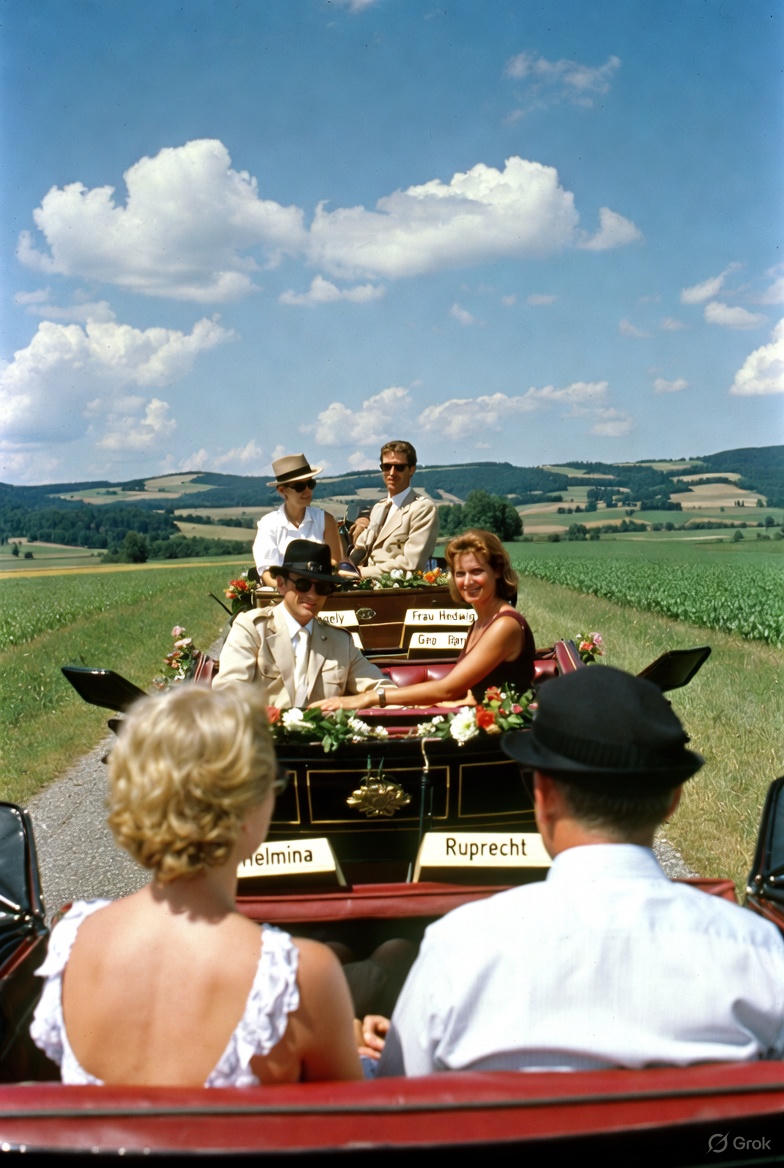
downstairs. Two carriages waited. They met the
others at the bridge below. Hedwig turned from Saint
John Nepomuk, now a dear friend, to Ruprecht. They
laughed together. Ruprecht rejoiced at her rosy
cheeks. Her arms no longer lifted wearily as in early
days but playfully, her hands gripping firmly.
He told her so. “Perhaps you’ll be fully well
again,” he added, eyes gleaming with joy.
She shook her head. “I no longer hope for it,” she
said softly, “…nor am I sure I wish it.”
They lifted her into the carriage with Ruprecht and
the Major. The wheelchair was stowed behind, and
Maurerwenzel climbed to the driver’s seat. He no
longer minded being seen. He and Rauß had clashed.
The General called his adjutant a capitalist slave; the
adjutant called the General a people’s cheat living off
strike funds. A duel ensued at the Hotel Bellevue,
costing Maurerwenzel a tuft of hair above his right
ear and a canine, but not his new conviction. The
paper factory workers, back at work, watched without
interfering, leaving Maurerwenzel uplifted, as if
they’d wished him victory.
In the second carriage sat Helmina, Fritz Gegely,
and Ernst Hugo. The poet of Marie Antoinette wore a
strange, sack-like coat of yellow checkered cloth,
once Dostoevsky’s. His vest was Paul Verlaine’s, and
the walking stick with a Moor’s head between his
knees was bought as Balzac’s from a Paris junk
dealer. As always, he wore his purple velvet
slippers—his personal signature, preserved through
all changes. Gegely ignored Ernst Hugo’s mocking
glances, addressing Helmina alone with a discourse
on landscape in Gottfried Keller.
They drove through the wooded valley’s curves,
revealing only slivers of the world, then climbed
slowly to the plain, where the gaze reveled in frothy
freedom. Rooftops gleamed above waves of ripening
grain, church spires stood like lighthouses in a sea of
fertility. It was a sunny, wind-bright day. Bedding
aired on garden fences, as if the region had conspired
to adorn the landscape with blue and red blankets and
cushions.
Ruprecht watched Hedwig’s forehead curls dance
in the breeze, fluttering back under her hat brim.
“Why didn’t you bring the children?” she asked.
“It’s such a lovely day.”
“They’ll join us with Miss Nelson after their
lessons. Work before pleasure. I don’t want them
forming other notions of order. A person unable to
delay pleasure for serious work can’t be taken
seriously.”
Hedwig looked at Ruprecht. A tender gravity
shone in his eyes. She was always touched when he
spoke of the children. They weren’t unprotected; he
loved them like a father. Yet she pitied them, sensing
they lacked a mother. Helmina, in rare bursts of
animal whimsy, played with them like a cat with
kittens, relishing their small, warm bodies. Hedwig
saw this sharply, her world shaped by maternal
longing—a heavy sacrifice, recognizing such joy as
unattainable after her catastrophe. She found
Helmina’s ingratitude her gravest fault. So richly
blessed, yet lacking life’s piety, the constant
reverence with which Hedwig marveled at each hour,
each sunbeam, every flower, and the horses’ lithe
trot.
She leaned back, gazing at the sky. It was pure
blue, with white clouds trailing like paper boats set
adrift by playful children on a stream.
As Ruprecht and Hedwig were silent, the Major
had free rein. They listened kindly, without
interrupting. He regretted that war threats might force
his departure soon but spoke with bold trumpet blasts
of battle and victory. He hoped diplomacy would
dispel the storm clouds, at least until the Emperor’s
jubilee year. Then he spun anecdotes, each capped
with his own booming laugh.
The Rosenburg is the centerpiece of the Kamp
valley. Where the Taffa stream joins the Kamp, and
the river itself shifts from an eastern to a southern
course, the castle stands on the tip of the high
plateau. It neither towers nor defies like other
German fortresses; it simply exists, unassumingly. It
doesn’t soar boldly as a lookout, like Aggstein or
Götzens’ robber-knight nest, Hornberg. Nor is it built
around a grand hall, like the Wartburg, where the
core purpose is clear. It seeks no special distinction,
and despite its sprawling, picturesque charm, it boasts
nothing, free of any pose. This makes it the perfect
expression of its landscape’s essence, where vanity
and ostentatious splendor are alien. From the Kamp
valley, it looks mighty. But from the plateau, a wide
road leads straight to the tournament courtyard.


 Anarchistbanjo's World
Leave a comment