Madame Bluebeard by Karl Hans Strobl and translated by Joe E Bandel
“Fritz Gegely…” he called, “and Frau Hedwig…
Frau Hedwig… you… what…? Oh God… yes… I’m
quite…” His voice broke free, wavering, a voice that
had fallen to its knees, kissing the hem of her dress.
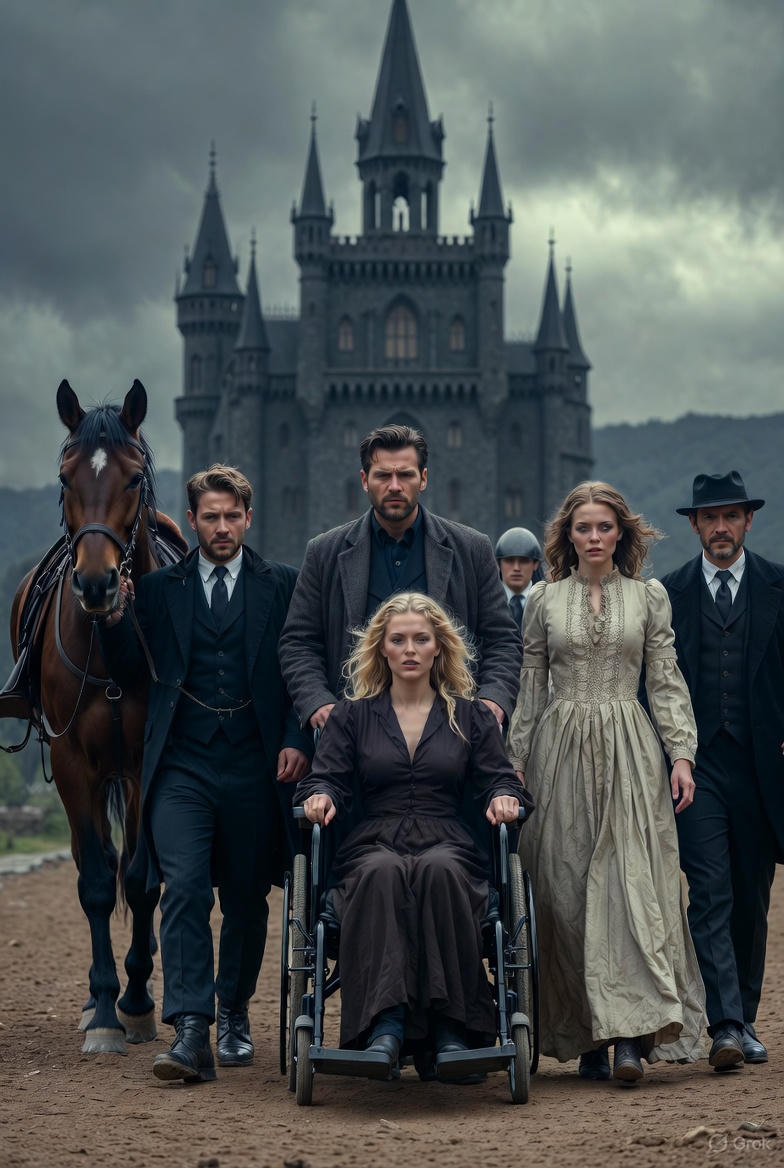
Ruprecht dismounted, left his horse to itself, and
approached the wheelchair. His hand hesitated
toward Hedwig. She offered hers, forgetting Fritz
Gegely. A flood of sweet, trembling harmony, a
comforting tremor, something blue, warm, radiant
surged through her.
“Isn’t it so?” she said, smiling through tears at
Ruprecht. Oh, she felt he was still as he was then.
Not changed at all. And now, there was no Fritz
Gegely, no Frau Helmina who played tennis so
beautifully and gracefully. Their words were trivial.
With her free hand, she smoothed her dress and softly
repeated, “Isn’t it so?” That was enough.
Ruprecht stood moved.
So this is how life has rewarded you, he thought.
The buoyant mischief, the blooming carefree spirit
are gone, you stand in shadow, with longing in your
eyes.
Fritz Gegely made himself known. “We haven’t
seen each other in ages!” he said with grandeur. His
face was regal, gracious, like a king delighting and
astonishing subjects with a sharp memory—Frederick
the Great or Julius Caesar calling soldiers by name.
Yet it barred familiarity. No one should think Fritz
Gegely needed to court public favor, despite
certain… incidents.
But Ruprecht von Boschan offered his hand
without reserve or pretense of impartiality. “By my
faith, that’s true,” he said simply. “It’s been an
eternity. You’ve become a famous man.”
Gegely eyed his friend suspiciously. But
Ruprecht’s innocence lay before him like a serene
summer lake, unclouded. “My Marie Antoinette
belongs to world literature,” the poet declared, the
rustle of laurels audible around his head. “Fleeting
fame means little to me. But it’s true, this time the
world hasn’t embarrassed itself. I, as I said, care
nothing for newspaper chatter. I never read them.
Hedwig handles that for me, don’t you, dearest?” He
leaned tenderly over his wife, his arm caressing and
protective on her shoulders. “We’re one. It’s as if
I’ve read it all. She knows what I need and shares it
in summary. She even found out you’re settled in
Vorderschluder. You’ve proven yourself a guardian
of order here.”
Ruprecht glanced at Maurerwenzel, who had
slipped away earlier. The wheelchair wouldn’t roll
off, but Ruprecht’s horse had grown restless.
Maurerwenzel had taken its reins and now stood like
Ruprecht’s groom, fearing Rauß might see him and
end his repute. “Yes… sometimes you have to step
in,” Ruprecht said.
“You’ve thoroughly studied all sorts of boxing
tricks and athletic grips,” Fritz said from his pedestal,
implying: you’re mired in physical prowess, blind to
the spirit’s flights.
Now Frau Helmina approached with her two
companions. They’d waited, hoping Ruprecht might
break away. Now they could linger no longer.
“Here’s my wife!” Ruprecht said. “And let me
introduce Major Zichovic and Court Secretary Ernst
Hugo, our schoolmate. Fritz, you recognize him?”
Of course, Fritz Gegely recognized the
schoolmate. But it was a cool meeting. Fritz wrapped
himself tighter in his purple robes, rising higher on
his pedestal. Ernst Hugo couldn’t hide his unease,
despite spotting Gegely from afar and bracing
himself. His armor of composure buckled under
Gegely’s piercing hauteur. The anthology’s editors
had dared return Gegely’s contribution—two-
hundred-carat, sparkling aphorisms—with polite
regrets.
Ruprecht stood by Hedwig’s wheelchair again,
gazing warmly at her. So, she’d been granted the joy
of understanding with her beloved. Life hadn’t
cheated her here. Her heart could rejoice, her love
radiant in spring’s glory. A sudden fear gripped him:
she might leave soon, finding Vorderschluder
unappealing. He asked, “Will you stay long?”
She smiled. “I hope the whole summer.”
Helmina saw this smile. She instantly understood:
old feelings from youth’s dawn had rekindled,
sparkling bridges of past affection. Then she turned
to Fritz Gegely, probing him thoroughly. “I’m
delighted to meet you… a famous poet is a rarity in
Vorderschluder. Our simple summer retreat gains
higher consecration!”
Fritz shook his laurel tree. Yes—his Marie
Antoinette had made him known. But fame meant
little… He warmed, stepping down from his pedestal
toward Helmina. She noticed, sinking her cold probe
deeper.
Good, she thought. If I offered my little finger,
he’d seize the whole hand. She smiled into him,
feigning a thirst for intellectual treasures, attentive
and understanding.
They walked toward the castle. Maurerwenzel
pushed the wheelchair, Ruprecht led his horse by the
reins alongside. Helmina walked with Fritz Gegely,
while Ernst Hugo and the Major trailed, united in
annoyance at this intruder disrupting their circle.
Noon bells floated broadly, golden, through the
Kamp valley, a cascading stream, a sonorous echo of
the river between wooded slopes.
At the bridge with its twisting baroque saints, they
parted. But they’d meet again, gather, with summer
as their ally. Fritz Gegely nodded gracious consent.
Hedwig glanced at Saint Nepomuk, wondering if
he’d turn a page, and smiled gently at his stone
solemnity. Her wheelchair rolled toward the village.
Ernst Hugo and the Major accompanied Ruprecht
and Helmina partway up the castle hill. Helmina
drew the secretary close. He was still fuming. At
parting, Gegely had asked about the anthology with
such mocking majesty that Hugo nearly burst.
“It’s a great success… we’ve earned much praise,”
Hugo had said, trembling with rage.
“I’m glad,” Gegely replied. “I know nothing of it;
you know I don’t read papers… Literature’s a
business. I hate businesses. I’ve decided not to
publish for ten years. Perhaps I’ll write nothing more.
I won’t make my art a market commodity.”
Now Helmina asked about Gegely. “He’s an
aesthetic dandy,” Hugo huffed, “a snob posing as a
museum. Look at him. Every piece of his outfit’s a
literary relic. He’s always had such quirks!”
“He seems very wealthy,” Helmina said calmly.
“Yes—he can afford it. He has no profession but
self-display. His father was a major cloth
manufacturer. The fortune’s immense. He denied
himself nothing.”
“And his wife?” Helmina asked cautiously. “My
husband knew her before, didn’t he?”
“Yes…” Hugo grunted. “She’s a Linz councilor’s
daughter. She was Ruprecht’s youthful love. But she
chose Fritz Gegely, and if she hadn’t, Ruprecht
wouldn’t have the most beautiful wife…”
“Oh, you!” Helmina smiled. “You always bring
that up…”
When Frau Hedwig and Fritz were back at the Red
Ox, she braced for his displeasure. She shrank. But
nothing came. Her husband moved cheerfully
through the rooms, criticizing some arrangements and
shrugging at the late Ox landlord’s portrait. Then he
stood at the window, looking toward the castle.
“Except for that fool Ernst Hugo,” he said, “the
company’s quite likable.”


 Anarchistbanjo's World
Leave a comment