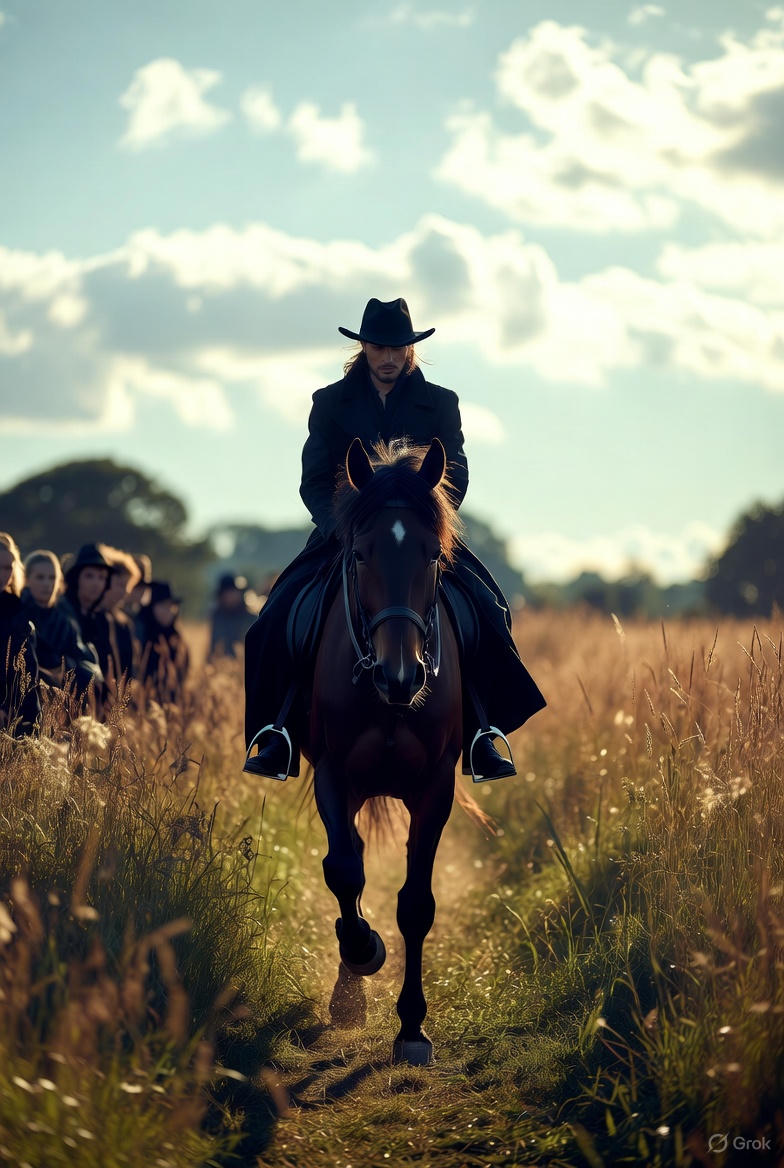
Madame Bluebeard by Karl Hans Strobl and translated by Joe E Bandel
People like me come once a generation. Who grasps the irresistible
urge of a soul whose sole element is beauty? Beauty
as the condition, the air, the only law. We few should
take whatever we need to nurture our genius. Private
property loses meaning before us. For the artist,
there’s no private property; we’re the rightful owners
of beauty in all forms. Everything bows to us. What
our consecrated hands touch is ours—by right. We
craft new beauty, gifting it to the world. What do
those dull Heidelberg scholars get from a
manuscript? They count syllables, write
commentaries, and every decade, one pens a
monograph, borrowing a few artist’s phrases to dress
up their dry drivel. Who among them feels the
delicate wonders of an old monk’s manuscript, the
scent rising from its lines, the symbolism of its
images, the deep, glowing colors that sear our souls,
birthing bold, unheard thoughts… but you’re like
them. You wield the tongs, grasping the coal to spare
the bourgeois parlor’s floor from burns.”
Hedwig fell silent. When Fritz Gegely reached this
point, he had to go to the bitter, painful end. He
paced behind the table. “You’ll drive me to…
renounce my name… I won’t hide—in a place like
Vorderschluder…”
A clatter arose on the stairs. Gegely opened the
door. The luggage and wheelchair arrived. The
stableman, the butcher, and two other Cyclopes
panted and sweated up the steps. The landlady had
marshaled all her male staff. The chambermaid led,
switching on electric lights everywhere. They
brought the baggage piece by piece, a considerable
haul. The rooms filled with trunks and boxes. It
looked chaotic. Fritz Gegely fled. “You, country
lass,” he addressed the chambermaid, “you’ll unpack
the trunks under my wife’s supervision.”
“Oh, yes,” the girl, who’d stood reverently, said
with eager goodwill.
Hedwig beckoned her husband, wanting to speak,
but, realizing it was futile to hold him back, only
nodded. “Don’t let time drag, dearest,” he said. “I’ll
be back soon. My heart stays with you. You know
that, don’t you?” He returned from the door, leaned
over, and kissed her forehead with a tender, soft kiss.
The chambermaid melted. It was like the finest
novels. My heart stays with you! he’d said. She must
remember that. Her next letter to Schorsch, the
gallant Forty-Niner, would end with this phrase,
which seemed imbued with magic.
She set to work, guided by Hedwig’s brief
instructions. She was rarely so deft and willing.
When unpacking ran smoothly, Hedwig gazed out the
window. Below, summer guests spoke softly. A girl’s
laughter swirled playfully. The evening was gentle,
as if the day had lived much and grown wise and
infinitely kind. Twilight lingered over rooftops,
forested hills, and the castle opposite. It fell from the
sky like fine, soft cigar ash, settling on green
shingles, golden-brown thatch, or rust-red tiles. As
impartial as all heavenly messages, for the just and
unjust alike. So Hedwig mused, looking out. A
distant accordion stretched and sighed in yearning
tones. Suddenly, a goose shrieked, as if jolted from
sleep by a rough grasp. The castle up there, Hedwig
thought—how it stands, firm and sure like him. She
remembered him thus, as he was then, and surely still
was. He’d have breathed his spirit into those old
walls; he needed no setting to create, shaping his
world to his will. Tomorrow, perhaps, she’d see him.
The thought surged like a hot wave, but its glow
faded, leaving her chilled. She trembled, fearing his
gaze. Why had she come?
These thoughts followed her into the first night’s
sleep. They say, she thought before drifting off, the
dream of the first night in a new place comes true,
with special power. But Hedwig dreamed nothing,
though she urged herself somewhere deep within to
dream. No images formed. Only a gentle floating in
lightness remained, a caress like comforting hands,
silencing all sobs. That was as good as a dream.
Morning brought dense fog to the Kamp valley.
The village was submerged, only houses jutted with
green-black shingles, golden-brown thatch, and rust-
red tiles from the curdled milk. The castle basked in
morning clarity. As the sun climbed, boldly
beckoning the wooded valley, the fog dissolved,
retreating to the forests, lingering as a thin,
opalescent haze over the Kamp. By noon, Frau
Hedwig could venture out for the first time.
Through the Red Ox landlady, Gegely had found a
man to push Hedwig’s wheelchair. It was
Maurerwenzel, jobless and pleased with the task, as it
required no shift from his “slow” gait.
Gegely walked beside his wife’s wheelchair.
Summer guests watched, confident these were people
worth gossiping about. The spectacle wasn’t baseless.
A beautiful, young, paralyzed woman in a
wheelchair, and Gegely, never lifting his hand from
the chair’s armrest, tenderly poised to fulfill her
wishes. He’d traded his pressed travel suit’s
correctness for a bohemian nonchalance, signaling:
here I’m at home. He wore purple velvet slippers,
loose bohemian trousers, and a velvet jacket once
owned by Gustave Flaubert. His walking stick, with
an ivory duck-bill handle, came from Jules de
Goncourt’s estate, and for larger bills, he used a
crocodile-leather wallet embossed with Oscar
Wilde’s name in tiny gold letters.
They went down the village street and over the
bridge with its twisting baroque saints, who turned
their heads to the invalid, lamenting their stone forms
couldn’t help.
“That’s Saint Nepomuk,” Maurerwenzel said of
one. “When he hears midnight strike, he turns a
page… in the book he holds…”
“A folk tale?” Hedwig smiled kindly.
Maurerwenzel grinned. “Nah… he turns when he
hears… but does he hear?”
“Oh, a jest!” Fritz Gegely said, his glance adding:
You’re hired to push, not joke.
Maurerwenzel nodded, pleased. A jest! For a
Social Democrat, who knew the divide between
capital and labor, this was much. Had steadfast Rauß
heard, he’d have chewed him out.
They followed the Kamp a stretch, on the soft
meadow path to the paper factory. On the tennis court
behind, balls flew back and forth. A slender, lithe
woman deftly caught and returned them with graceful
precision. Hedwig halted, wanting to watch. She took
selfless joy in beautiful movement, with just a faint
ache in her heart. Having been so near death, she was
grateful for life’s remaining light and joy.
“Who’s the lady?” she asked the tamed
Maurerwenzel.
When he named her, she flinched slightly. So, that
was Helmina von Boschan, Ruprecht’s wife. Such
radiance, elegance, beauty, and grace. The ache in her
heart reared, threatening her eyes.
Fritz Gegely grew alert. “What did you say,
Helmina von Boschan?” he asked Maurerwenzel.
“What’s her husband’s name?”
He learned Ruprecht von Boschan resided at
Vorderschluder Castle, noting the respectful tone.
Maurerwenzel couldn’t deny respect for a man who’d
once so neatly floored Rauß and himself.
“Did you know, Hedwig?” Fritz turned to his wife.
“Did you know Ruprecht lives here?”
This was the question Hedwig had dreaded. Fritz
wouldn’t erupt before a third party, but she felt his
tension. She couldn’t lie. “Yes,” she said. “Some
time ago, I read his name in a paper, a report about a
festival in Vorderschluder. There were riots, and it
said the district captain and… Herr von Boschan’s
decisive actions prevented the worst. That’s how I
knew he’s settled here.”
Maurerwenzel held back details of Ruprecht’s
decisive actions. Hedwig looked at her husband; his
quivering nostrils signaled rising menace. But with a
third party present, no outburst came. “And so you
thought we should spend the summer here,” he said.
She placed her hand on his, feeling angry,
twitching fingers. “Yes… I believe his calm and
balance will do you good. You were friends. You’ll
see, he’s as he was… I didn’t tell you, or you
might’ve refused…” That was a lie, but unavoidable.
“Yes, yes, I know,” Gegely said venomously.
“Ruprecht, the flawless knight, free of prejudice.
He’ll shake Fritz Gegely’s hand.”
The game on the white-lined court, between high
wire nets, ended. Two men joined Helmina for lively
talk, soon turning toward the wheelchair. One stared
steadfastly over.
“I think there’s another acquaintance,” Fritz
Gegely said. “Shall we move on?”
But a rider approached along the meadow path,
trotting past the onlookers. A fleeting glance fell on
them, the horse took a few more steps… a jolt ran
through man and beast. The rider turned and came
back…


 Anarchistbanjo's World
Leave a comment