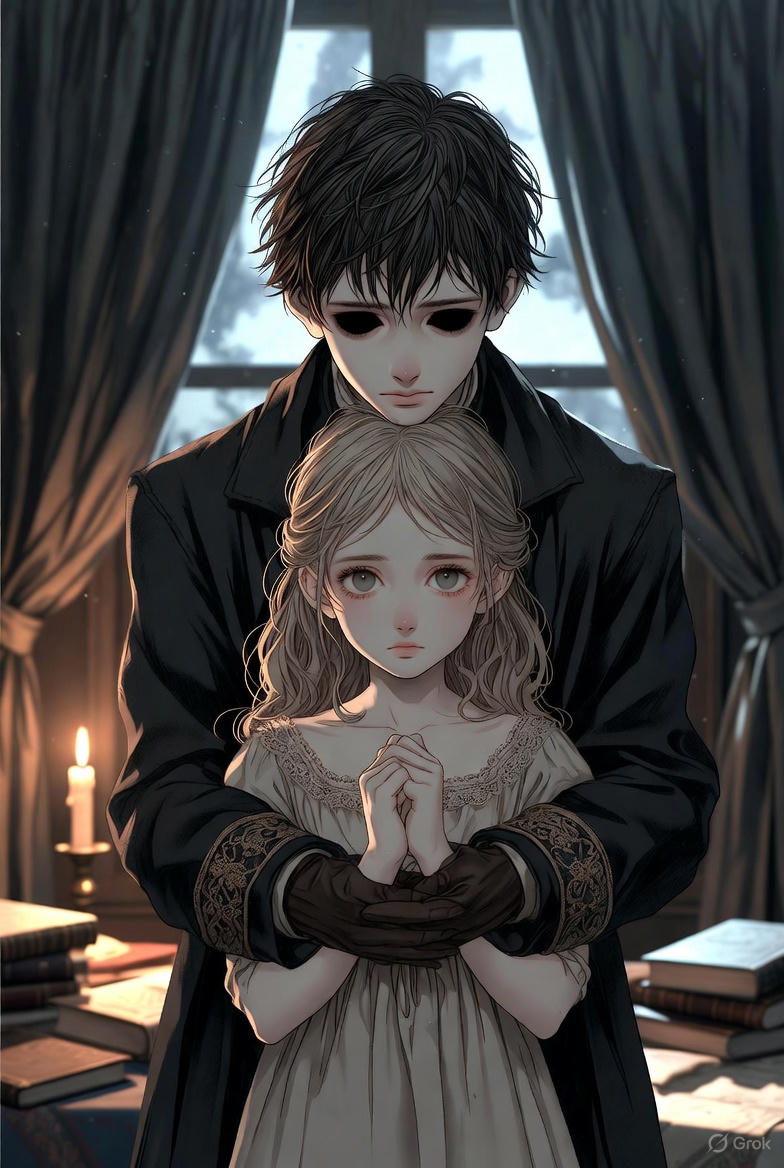
Alraune by Hanns Heinz Ewers and translated by Joe E Bandel
Chapter Six
Deals with how the child Alraune grew up.
THE acquisition of the dice cup is mentioned by the Privy
Councilor in the leather bound book. From that point on it
was no longer written in the distinct and clear hand of Dr.
Petersen but in his own thin, hesitating and barely legible
script.
But there are several other short entries in the book that are of
interest to this story. The first refers to the operation taken to correct
the child’s Atresia Vaginalis performed by Dr. Petersen and the cause
of his untimely demise.
The Privy Councilor mentions that in consideration of the
savings he had made through the death of the mother and the good
help of his assistant doctor through the entire affair he granted a three
month summer trip vacation with all expenses paid and promised a
special bonus of a thousand Marks as well. Dr. Petersen was
extremely overjoyed about this trip. It was the first big vacation he
had ever taken in his life. But he insisted upon performing the simple
operation beforehand even though it could have easily been put off for
a much longer time without any special concern.
He performed the operation a couple days before his scheduled
departure with excellent results for the child. Unfortunately he,
himself, developed a severe case of blood poisoning–What was so
astonishing was that despite his almost exaggerated daily care for
cleanliness–it was scarcely forty-eight hours later that he died after
very intense suffering.
The direct cause of the blood poisoning could not be determined
with certainty. There was a small wound on his left upper arm that
was barely perceptible with the naked eye. A light scratch from his
little patient might have inflicted it.
The professor remarked how already twice in this matter he had
been spared a great sum of money but did not elaborate any further.
It was then reported how the baby was kept for the time being in
the clinic under the care of the head nurse. She was an unusually quiet
and sensitive child that cried only once and that was at the time of her
holy baptism performed in the cathedral by Chaplain Ignaz Schröder.
Indeed, she howled so fearfully that the entire little
congregation–the nurse that carried her, Princess Wolkonski and
Legal Councilor Sebastian Gontram as the godparents, the Priest, the
sexton and the Privy Councilor himself–couldn’t even begin to do
anything with her. She began crying from the moment she left the
clinic and did not stop until she was brought back home again from
the church.
In the cathedral her screams became so unbearable that his
Reverence took every opportunity to rush through the sacred
ceremony so he and those present could escape from the ghastly
music. Everyone gave a sigh of relief when it was all over and the
nurse had climbed into the carriage with the child.
It appears that nothing significant happened during the first year
in the life of this little girl whom the professor named “Alraune” out
of an understandable whim. At least nothing noteworthy was written
in the leather bound volume.
It was mentioned that the professor remained true to his word
and even before the child was born had taken measures to adopt the
girl and composed a certified will making her his sole heir to the
complete exclusion of all his other relatives.
It was also mentioned that the princess, as godmother, gave the
child an extraordinarily expensive and equally tasteless necklace
composed of gold chain and two strands of beautiful pearls set with
diamonds. At the center surrounded by more pearls was a hank of
fiery red hair that the Princess had cut from the head of the
unconscious mother at the time of her conception.
The child stayed in the clinic for over four years up until the time
the Privy Councilor gave up the Institute as well as the attached
experimental laboratories that he had been neglecting more and more.
Then he took her to his estate in Lendenich.
There the child got a playmate that was really almost four years
older than she was. It was Wölfchen Gontram, the youngest son of the
Legal Councilor. Privy Councilor ten Brinken relates very little of the
collapse of the Gontram household. In short sentences he describes
how death finally grew tired of the game he was playing in the white
house on the Rhine and in one year wiped away the mother and three
of her sons.
The fourth boy, Joseph, at the wish of his mother had been taken
by Reverend Chaplain Schröder to become a priest. Frieda, the
daughter, lived with her friend, Olga Wolkonski, who in the meantime
had married a somewhat dubious Spanish Count and moved to his
house in Rome. Following these events was the financial collapse of
the Legal Councilor despite the splendid fee he had been paid for
winning the divorce settlement for the princess.
The Privy Councilor puts down that he took the boy in as an act
of charity–but doesn’t forget to mention in the book that Wölfchen
inherited some vineyards with small farm houses from an aunt on his
mother’s side so his future was secure. He remarks as well that he
didn’t want the boy to feel he had been taken into a stranger’s house
and brought up out of charity and compassion so he used the income
from the vineyards to defray the upkeep of his young foster-child. It is
to be understood that the Privy Councilor did not come up short on
this arrangement.
Taking all of the entries that the Privy Councilor ten Brinken
made in the leather bound volume during this time one could
conclude that Wölfchen Gontram certainly earned the bread and
butter that he ate in Lendenich. He was a good playmate for his
foster-sister, was more than that, was her only toy and her nursemaid
as well.
The love he shared with his wild brothers for living and
frantically running around transferred in an instant to the delicate little
creature that ran around alone in the wide garden, in the stables, in the
green houses and all the out buildings. The great deaths in his parent’s
house, the sudden collapse of his entire world made a strong
impression on him–in spite of the Gontram indolence.
The small handsome lad with his mother’s large black dreamy
eyes became quiet and withdrawn. Thousands of boyish thoughts that
had been so suddenly extinguished now snaked out like weak tendrils
and wrapped themselves solidly like roots around the little creature,
Alraune. Whatever he carried in his young breast he gave to his new
little sister, gave it with the great unbounded generosity that he had
inherited from his sunny good-natured parents.
He went to school in the city where he always sat in the last row.
At noon when he came back home he ran straight past the kitchen
even though he was hungry. He searched around in the garden until he
found Alraune. The servants often had to drag him away by force to
give him his meals.
No one troubled themselves much over the two children but
while they always had a strange mistrust of the little girl, they took a
liking to Wölfchen. In their own way they bestowed on him the
somewhat coarse love of the servants that had once been given to
Frank Braun, the Master’s nephew, so many years before when he had
spent his school vacations there as a boy.
Just like him, the old coachman, Froitsheim, now tolerated
Wölfchen around the horses, lifted him up onto them, let him sit on a
wool saddle blanket and ride around the courtyard and through the
gardens. The gardener showed him the best fruit in the orchards; cut
him the most flexible switches and the maids kept his food warm,
making sure that he never went without.
They thought of him as an equal but the girl, little as she was,
had a way of creating a broad chasm between them. She never chatted
with any of them and when she did speak it was to express some wish
that almost sounded like a command. That was exactly what these
people from the Rhine in their deepest souls could not bear–not from
the Master–and now most certainly not from this strange child.
They never struck her. The Privy Councilor had strongly
forbidden that, but in every other way they acted as if the child was
not even there. She ran around–fine–they let her run, cared for her
food, her little bed, her underwear and her clothes–but just like they
cared for the old biting watchdog, brought it food, cleaned its
doghouse and unchained it for the night.
The Privy Councilor in no way troubled himself over the
children and let them completely go their own way. Since the time he
had closed the clinic he had also given up his professorship, keeping
occupied with various real estate and mortgage affairs and even more
with his old love, archeology.
He managed things as a clever and intelligent merchant so that
museums around the world paid high prices for his skillfully arranged
collections. The grounds all around the Brinken estate from the Rhine
to the city on one side, extending out to the Eifel promontory on the
other were filled with things that first the Romans and then all their
followers had brought with them.
The Brinkens had been collectors for a long time and for ten
miles in all directions any time a farmer struck something with his
plowshare they would carefully dig up the treasure and take it to the
old house in Lendenich that was consecrated to John of Nepomuck.
The professor took everything, entire pots of coins, rusted
weapons, yellowed bones, urns, buckles and tear vials. He paid
pennies, ten at the most. But the farmer was always certain to get a
good schnapps in the kitchen and if needed money for sowing, at a
high interest of course–but without the security demanded by the
banks.
One thing was certain. The earth never spewed forth more than
in those years when Alraune lived in the house.


 Anarchistbanjo's World
Leave a comment