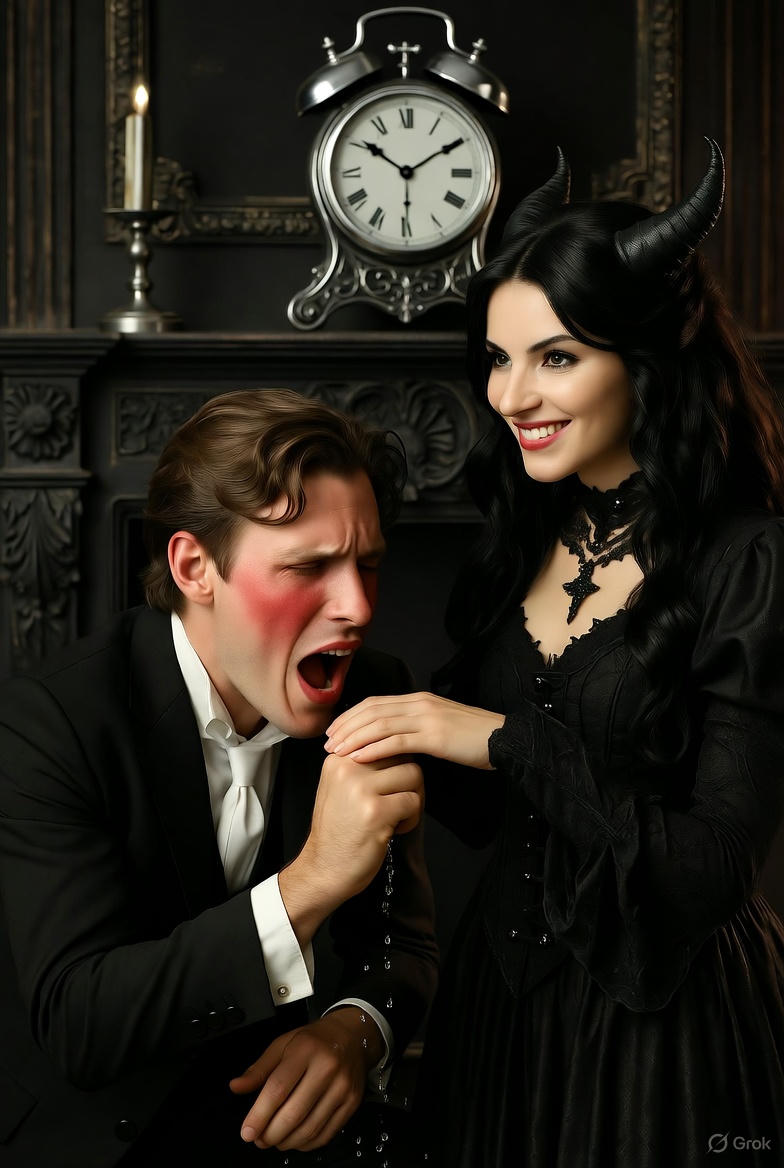
Madame Bluebeard by Karl Hans Strobl and translated by Joe E Bandel
Ninth Chapter
Court Secretary Ernst Hugo was brewing a grand
scheme. He felt it was time to step forward, to draw
the world’s gaze upon him. People should speak of
Ernst Hugo. It needed to be something colossal, like
that Abbazia festival, but on a vastly grander scale.
Something monumental—striding like Behemoth,
towering like the Colossus of Rhodes, roaring like the
Minotaur, forcing all to turn and look. Hugo
rummaged through his historical and biblical
knowledge, pulling open every drawer of his learning
for comparisons. It had to be surprising, distinctive,
unprecedented.
The Emperor’s jubilee year had arrived.
Here was a chance to shine, to catch his superiors’
eyes. He’d shown his Hofrat newspaper clippings of
the Abbazia event, earning a nod of approval. Now,
he aimed for something no mere nod could dismiss.
Ernst Hugo just didn’t know what…
That was the only hitch. He racked his brain until
his skull seemed to crack. A grand procession was
being planned, festive performances, jubilee
foundations—tributes of all kinds. He needed
something extraordinary to stand out.
At the artists’ café where he was a regular, Hugo
finally shared his woes with friends. A gaggle of
young men and two actresses shouted ideas. A
sculptor, hoping to fame with a complex lovers’
statue titled Ardor, suggested a monument. A painter
proposed a vast circular painting of the Battle of
Custoza. A young baron, included for his recent
inheritance, thought living tableaux would do.
Bystritzky, the poet, stirred his black coffee,
fishing out a half-dissolved sugar cube to pop on his
tongue. “You aristocrats,” he said, “always the
same… when asked, it’s ever: living tableaux. Fits
every occasion. Weddings: Gretchen at the spinning
wheel… christenings: Gretchen at the spinning
wheel… imperial honors: Gretchen at the spinning
wheel…”
“We could do something else,” the baron
countered. “Like: Austria blessing her children…”
“Sure, so the children start brawling. I’ve a better
idea. We compile an anthology… an anthology of
Austrian poets, got it? We all pitch in: I’ll edit, Franzl
does the book design and illustrations, Prandstetter
handles newspaper ads and writes reviews, the ladies
can recite from it at every chance. And Secretary
Hugo signs as publisher, raising the funds.”
Hugo pondered. An anthology wasn’t special, not
unique. Bystritzky dispelled his doubts: it would be
an exceptional, singular anthology, its presentation
the pinnacle of book artistry. Each copy a jewel of
unparalleled allure. The others backed Bystritzky’s
plan, except the sculptor, excluded from it.
Hugo was finally persuaded. “When the festival’s
waves have ebbed,” he declared with flourish, “and
nothing remains of the celebrations but
cinematographic reels, this book will endure… it will
permeate cultured circles, a living testament to
Austria’s spirit in this momentous year.”
“Bravo!” cried the painter. Prandstetter seized
Hugo’s hand, murmuring approval, as one does with
ministers promising much.
Hugo had the waiter bring a sheet of blank paper
and, using a new volume of Bystritzky’s poetry, drew
the fateful grid of subscription lines. The baron was
made to sign first, opening the dance.
With this dagger, Hugo prowled through Carnival.
He brandished it at every chance, against all comers.
Mid-lively chat, he’d produce it with a few words. A
paralyzing hush of enthusiasm followed. One by one,
they took the offered gold fountain pen, glancing
covertly at prior entries, and wrote the sum they
could muster.
Hugo noted most lived by proverbs. “A scoundrel
gives more than he has,” said every third. “Little, but
heartfelt,” was common too. Latinists, to the pen’s
scratch, intoned, “Bis dat, qui cito dat.” Charming
and frequent was, “Mr. Would-Be plans, but Mr.
Can’t delivers.” It was like a cornerstone laying, each
feeling obliged to say something apt with the
hammer’s strike.
This Carnival was Hugo’s busiest yet. For his
lofty goal, he couldn’t miss a social event. The sheet
filled with signatures and figures, but the insatiable
Bystritzky insisted it wasn’t enough.
At the Vienna City Ball, amid the throng of
dancers, Hugo spotted Frau Helmina. He trailed her
through the crowd, pouncing the moment her partner
moved to escort her to her seat. It was a waltz on soft
clouds. Helmina lay pliant in his arms. Hugo burned.
He felt the lit hall, swirling music, gallery carpets,
flower nooks, and bronze statues were all for him.
“I had no idea you were here,” he said, leading her
to a side room where Ruprecht von Boschan sat with
Major Zivkovic and two other officers.
Helmina laughed. “Oh—I must recover from
Krems. I danced there last Saturday.” She gave a
lively account of the ball, her laughter like the
delicate chime of champagne glasses raised in merry
toast.
Ruprecht was as exuberant as Helmina. His robust
joy was evident, his footing sure. His eyes held a
bold, calm gaze. Every word sang with zest for life. It
was an extraordinarily cheerful evening. They danced
eagerly at first. By morning, the conversation grew so
light, refined, and sparkling that the dusty, stuffy
ballroom lost its draw. The sense of floating persisted
here. They spoke refined nonsense, bacchic wit
bubbling from Helmina’s lips…
As Hugo stood in dawn’s gray light before his
door, fumbling with an aluminum key in the lock’s
innards, he realized he’d forgotten to wield his
dagger. “Oh, I won’t let you off,” he muttered. “I’ll
get you. It’s a chance… a splendid chance… Always
leave a bridge…”
The next Sunday, he traveled to Vorderschluder.
He could hardly wait to see Gars’s long ruinous
castle front. It wasn’t far then. After some effort, he
found a carriage. From the rising road, the Kamp
valley’s forests stretched below. Thaw had set in,
mist rising like smoke from the heavy black woods.
On the rolling high plain, Wolfshofen’s scattered
farmsteads shimmered through thin blue veils.
Vorderschluder’s towers rose from a ridge. The road
dipped back to the Kamp, bypassing its curve.
Hugo found Frau Helmina alone.
“I’m intruding, madam,” he said, kissing her hand.
“What must you think… I should’ve announced
myself, no?”
“Oh, I’m fond of pleasant surprises,” Helmina said
graciously. “My husband’s out, of course… You’re
just in time to keep me company.”
“I’m at your service.” Hugo was slightly flustered.
“Tell me about Vienna, then.”
“It’s still where you left it, but a bit forlorn. You
should always be there, madam. The city dims
without you. It’s mere memories now.”
“You think I could boost tourism?”
“You can do anything you wish.”
Hugo reveled in his boldness, swept away by
fervor. His tributes grew warmer. Her smiling
attention seemed more than courtesy—it was
encouragement. The demonic air Abbazia attributed
to Helmina was merely a woman’s curiosity, testing
how far a man would dare. She’d see he was no
coward. Lost in this, Hugo faltered, and when the
little Empire clock on the mantel chimed twelve
silver notes and Helmina said, “Ruprecht will be here
soon,” he fell to his knees, showering her hand with
kisses.
“Stand up, Herr Secretary,” Helmina said with
gentle firmness. “What do you think of me?”
“I think nothing—I only know I love you.”
“No, no, please… stand up, I insist.” She pushed
him back. “What are you doing? Ruprecht’s your
friend. Shouldn’t we… remain friends?”
“Of course!” Hugo looked up at her calm face,
unmarred by surprise.
“If I’m to trust you, end this scene.”
Hugo obeyed, rising.
“That’s right. See, if I ever need a friend, I’ll turn
to you. I’m sure you’d help me. Now, let’s chat.”
She’d barely begun when Ruprecht arrived. He
greeted the court secretary with warm cordiality.
Hugo froze, thinking of his recklessness. How easily
he could’ve been caught. Helmina’s demonic
gentleness had made him forget all danger.
During the meal, he regained his composure.
“You don’t even know why I came?” he asked.
“I’m glad you did,” Ruprecht replied politely.
“You might be less thrilled to hear I’m here to tap
you. You’ve been generous before—dangerous
move. Now I’m back… I need money…” Hugo
unveiled his plan, displaying his subscription list,
touting the project and the notable contributors
already secured.
Ruprecht, naturally, agreed to contribute.


 Anarchistbanjo's World
Leave a comment