Madame Bluebeard by Karl Hans Strobl and translated by Joe E Bandel
“I’ll come,” he said. “You don’t think I’m above
such things. A warm, bright ballroom, festive
women, soft music—there’s much life and splendor
in that.”
He only wished she’d broached it another time.
Helmina watched, knowing his thoughts. It was like
preparing for a wrestling match. They faced off,
probing for weaknesses, ready to seize any opening
with a firm grip. But when evening fell, when will’s
weariness set in and night loomed, their senses
stirred. The urge of their bodies surged, forging peace
to wage battle on another field.
One evening in late January, when Lorenz was
briefly alone with Helmina, he said, “Brother writes.
He won’t wait longer. You must act.”
Helmina paused. “Fine—tomorrow!” she said
decisively. The next morning brought a glorious
winter day. As she sat with the children at breakfast,
she heard snowshoes clatter in the antechamber.
Ruprecht entered, early from outdoors, brimming
with youthful vigor, master of the world’s riches.
“Coming along later?” he asked. “Perfect ski weather
today.”
Helmina agreed, changed quickly after breakfast,
and plunged with Ruprecht into winter’s wonders.
Fresh snow had fallen, its surface crusted by swift
frost. They glided with a bird’s speed, transcending
flaws, reveling in the joyous outpour of strength, the
rushing motion.
Ruprecht let Helmina lead. Her red knitted jacket
sang against the white snow. She leapt down a slope,
legs tight, knees bent, and sped on below. They
climbed a gentle hill. At the forest’s edge, blue
shapes jutted from the snow. “Soldiers,” Ruprecht
said, his eyes honed on South America’s vast
pampas. Indeed, soldiers—four men and a volunteer,
72freezing on outpost duty. All five gaped as Helmina
zoomed past. The volunteer’s awe crystallized into a
cry: “Sapperment!”
But the pair was already gone, vanishing among
the trees.
“Must be a winter maneuver,” Ruprecht guessed.
In the valley furrow beyond the forest, they met
another outpost. Footprints led up the far slopes.
Helmina followed them. Atop the high plain, a
village lay at the end of a rutted, brownish hollow
way. Huddled against the cold, its cottages seemed
baked together for warmth, buried to their windows
in snow. On either side of the hollow way, a blue-
black swarm stirred—an ant-like frenzy. Ruprecht
and Helmina glided along the path’s edge, where
snow was less trampled. Below, troops marched.
They passed countless upturned faces, a river of
gazes. Then came a wide, empty gap, followed by a
knot, a jam. The hollow way was clogged with
soldiers, murmuring, pressing forward. Something
had happened.
Soldiers lined the path’s rims, peering in, making
it hard to pass. Something had happened. At a gentler
slope, Helmina pushed down into the hollow.
Soldiers glanced back, startled. A sharp revolver
crack burst from the dense crowd ahead. Helmina
shoved soldiers aside, thrusting forward with her ski
pole, wading through the throng. A fierce craving
drove her, blazing on her face.
She nearly collided with a tall major. He stared,
surprised, at the lady emerging among the rabble,
then recognized her, saluting with utmost courtesy.
Helmina knew him too—Major Zivkovic, from her
Abbazia entourage.
“What’s happened?” she asked urgently. The
major positioned himself to block her view. “Nothing
for ladies! No—please, don’t look. It’s not pretty…
you might have nightmares.”
A wild glee lit Helmina’s face. “An accident?”
“Yes—a regrettable mishap… no, really, madam,
please don’t look… I couldn’t take responsibility…”
Helmina laughed. “Who do you take me for, dear
Major? Think I’ll faint… or have fits?”
“You’d need strong nerves, madam.”
“I believe you know from Abbazia I’m not
nervous. Let me through…”
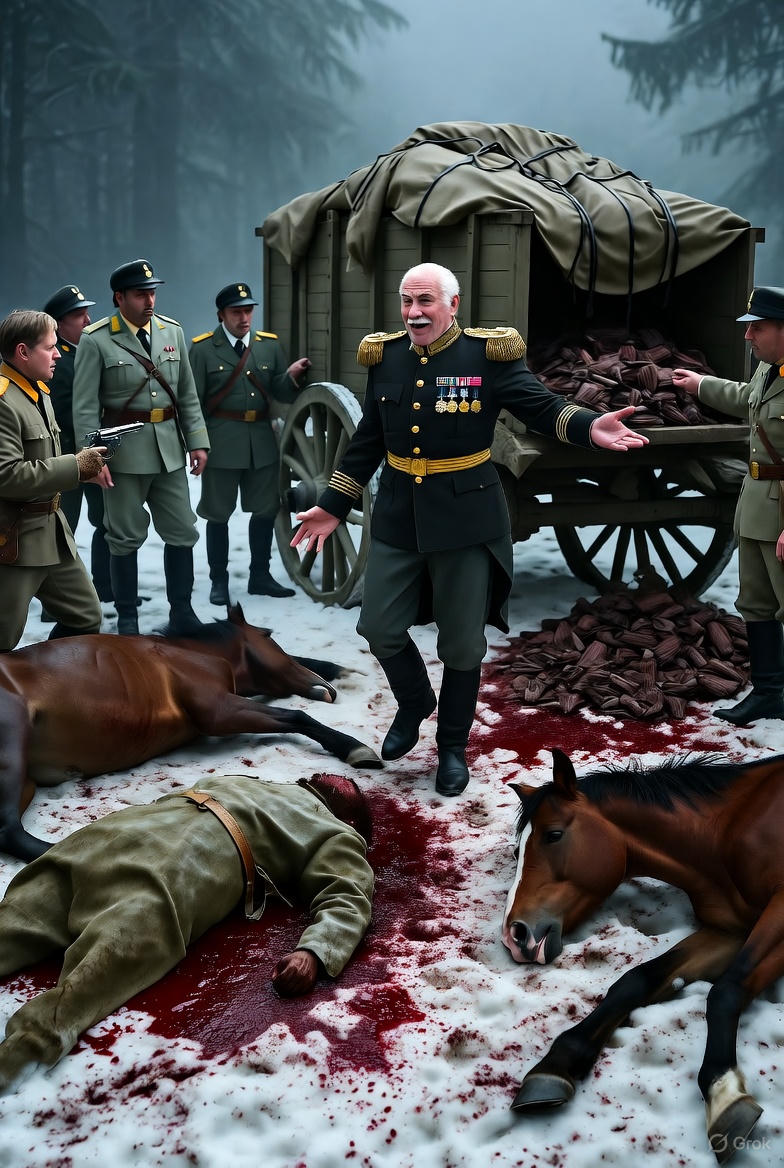
Shrugging, the major stepped aside. Amid the
soldiers lay an overturned, heavily laden supply
wagon, shattered. The surrounding snow was
trampled, mixed with mud, streaked red in places.
Nearby, under coarse wagon tarps, two bodies lay in
a blood pool. The three horses were horribly
mangled, legs broken. Two were dead; one still lived,
thrashing so wildly no mercy shot could be fired. A
lieutenant stood by with a revolver, vainly seeking a
clear moment.
The major explained the wagon had been driven
carelessly, too close to the path’s edge, and plunged.
The drivers were crushed instantly, the horses lost.
Helmina unstrapped her skis and approached the
lieutenant. “Give me the revolver,” she commanded.
Ruprecht saw relentless cruelty on her face, a raging
urge to kill. A barbaric instinct erupted from her core.
Stunned, the lieutenant resisted. “But madam
surely doesn’t…”
“Give me the revolver,” she ordered again. The
beardless young man dared no further objection,
handing her the weapon. Horror crept into his eyes.
Helmina gripped the revolver, stood tall, and stepped
smiling toward the horse. That smile was terrifying.
She stood, staring sharply at the animal. Slowly, she
raised the weapon, aimed calmly, and fired the
moment the horse jerked its head toward her, straight
between its eyes. It twitched, convulsed, then
stretched out, dead.
“Thank you, Lieutenant,” Helmina said, smiling as
she returned the weapon.
“You’re a daring Amazon, madam,” the major
said, paling, his voice dry. He cleared his throat, a
pun surfacing to save the moment. “Truly valiant…
ha… ha!” He was known as an aging wit.
“Christian duty, dear Major,” Helmina replied.
“One can’t let the creature suffer so long.”
“Unlike a man,” the major added, with a gallant
flourish he prided himself on. Helmina introduced
Ruprecht—her retort.
“So you’ve been merciful to at least one man,” the
major said, then inquired with utmost charm about
Ruprecht’s health. Ruprecht smiled. This tall man,
with his habitual gallantries and incorrigible knightly
minstrelsy, harmless as a child, amused him. He
invited him to visit Schloss Vorderschluder.
Helmina strapped on her snowshoes, bid the
officers farewell, and skied ahead of Ruprecht up the
slope they’d descended. The blue swarm of soldiers
soon fell behind. Across the Kamp, the pilgrimage
church of Dreieichen gleamed in the sunlight.
Neither spoke.
Only the soft scrape of snowshoes and the caw of
a large crow, startled from a furrow, broke the
silence. After a while, Helmina stopped, bent, and
scooped a handful of snow. She hadn’t yet replaced
the sturdy ski glove she’d removed. A faint blood
spatter marked her left hand. She rubbed it with
snow, tinging the soft white mass a pale red.
Ruprecht recalled the day Helmina stood by Baron
Kestelli’s corpse, her fingers also stained with blood.
“Oh, yes!” Helmina said, drying her hand with a
handkerchief. “It just occurred to me—I’ve been
meaning to discuss a business matter with you. It’s
rather urgent. You should join a venture I’m
planning. I’m certain Galician petroleum can make a
fortune. The issue is capital. Those oil and naphtha
wells are exploited primitively. A smarter hand could
turn it around. You could double your wealth
overnight.”
“I must tell you, I’ve no entrepreneurial spirit.
You know I prefer safe investments.”
“You’re such a coward in this. To win, you must
risk. I’ve enough enterprise for both of us. You can
trust me when I say it’s a good deal.” Helmina laid
out details, displaying such understanding and
expertise one might think she’d studied for years. She
grew animated, persuading, coaxing, enticing.
The talk clashed with the landscape. Dreieichen’s
tower shimmered across the valley. Below, the Kamp
traced a silver arabesque through blue-black forests.
And Helmina spoke of Galician petroleum.
Ruprecht admired her. She was wholly herself in
all she did—a multifaceted gem, each facet blazing
with different fire. He might’ve been swayed, but
then he recalled her demanding the revolver from the
lieutenant, standing cold-blooded and smiling by the
writhing horse.
“No,” he said calmly, “I’d rather not invest.”
“Oh! You’re not the least bit gallant.”
“Gallantry in money matters, dearest? No! Must I
remind you of our agreement? We’re to keep our
independence, even in this.”
Helmina shrugged. “Your loss if you don’t.”
Ruprecht tried to meet her gaze, but she was
skiing down a slope, ahead of him.
“By the way,” he said, catching up, “I’ll at least
ask Siegl—to show my good faith.”
Siegl, however, had no intention of encouraging
the venture. Reading the banker’s letter, Ruprecht
saw him vividly—the paper’s watermark, firm
letterhead, and florid signature conjured a dancing
pince-nez on a thick nose, a rippling belly in a white
vest, the elegant curve of bowed legs. Siegl wrote:
“Keep your hands off such things. What’s Galician
petroleum to you? How do you get such outlandish
ideas? It’s not for you.” The letter wasn’t typed but
penned by Siegl’s own hand, private and intimate, as
if he spoke with thumbs in his waistcoat pockets.
“You see, Helmina,” Ruprecht said after reading
her the letter, “Siegl’s against it. He’s my oracle. I
must heed him.”
“Then I’ll invest alone,” Helmina replied. “I won’t
let such a chance slip. I’ve had a very attractive
offer.”
“I wish you every success. I won’t envy your
fortune.”
After dinner, when the children were taken away
and Ruprecht had stepped out briefly, Lorenz, serving
tea, whispered, “What did he say?”
“He won’t.”
“Then he’s got to go.”
“I’m just worried it’ll cause a stir this time. We
should wait…”
“We don’t have time.”
“Then at least three days…” Helmina interjected.
“You mean three nights,” Lorenz murmured. “I
said you’re in love.”


 Anarchistbanjo's World
Leave a comment