Alraune by Hanns Heinz Ewers and translated by Joe E Bandel
Chapter Five
Informs about her father and how Death stood as Godfather
when Alraune came to life.
DR. Karl Petersen brought the Privy Councilor a large
beautifully bound book that he had prepared especially for
this project. The old ten Brinken family crest showed on
the upper left corner of the red leather volume. In the
middle glowed the large golden letters ATB.
The first page had been left blank. The professor had reserved it
to write some early history himself. The next page began with a
paragraph in Dr. Petersen’s hand. He wrote of the short and simple
life history of the mother and of her character and demeanor.
He had asked the prostitute to tell her life story and then quickly
wrote it down. Even her previous convictions were mentioned. Alma
had been sentenced twice for vagrancy; five or six times due to
violations of police regulations concerning her profession and once
because of theft–Yet, she maintained that she was innocent of the
theft–the gentleman had given her the diamond pin.
Further down in the second paragraph Dr. Petersen had written
down things about the presumptive father, the unemployed miner,
Peter Weinland Noerissen, who had been condemned by a court and
jury and sentenced to death in the name of the King.
The public prosecutor had presented the facts in an amiable,
charming fashion. It appeared that P. Noerissen had been predestined
to such a fate from infancy. His mother had been a notorious drinker.
His father, an occasional worker, had been previously convicted
because of frequent crude misdemeanors. One of his brothers was
even now serving ten years in prison on similar grounds.
Peter Weinland Noerissen had become apprenticed to a
blacksmith after he finished school. This had played an important part
in the proceedings because of the skill and strength that had been
displayed in the murder. Many witnesses gave evidence of his
displays of unusual strength. He had a history of pushing himself on
females even when they said they were not interested.
He had been released from military service because of a
congenital defect. He was missing two fingers on his left hand. He
worked in several diverse factories before finally coming to the
Phoenix mine in the Ruhr industrial district. He was not a member of
any trade union, not the old socialist union, the Christian or the
mysterious Elks.
He was fired from the mine when he pulled a knife on an
overseer. This was a serious violation and he received his first
sentence of a year in jail. He was released after his counsel for the
defense argued during appeal that the conviction was only based upon
the word of the overseer with no real evidence that it was attempted
manslaughter.
After that he was on the road, had crossed over the Alps twice
and fought his way from Naples to Amsterdam. While he did work
occasionally, he spent most of his time as a vagabond or hobo and
was further convicted of a few other petty crimes. It was enough for
the public prosecutor to assume that in the course of seven or eight
years he had become a hardened criminal with no conscience.
The crime that he was now condemned for was not that clear
either. It was still not entirely certain if it had been a robbery gone
wrong or an intentional sex murder. The defense tried to portray it as
if the accused had only intended to rape the well dressed and well
endowed nineteen year old daughter of the home owner, Anna Sibilla
Trautwein, when he encountered her in the Ellinger Rhine meadow
that fateful evening.
That when he tried to rape the strong and vigorous girl she
started screaming and he pulled his knife only to threaten her into
silence. It didn’t work and she fought back more vigorously and in the
struggle was stabbed. He only finished her off out of the fear of
discovery. It was then only natural that he take her petty tip money
and jewelry to help him make good his escape.
This account did not match the condition of the corpse itself. It
was established that the terrible dismemberment of the victim’s vitals
was most skillfully done and the cut almost workman like. The public
prosecutor ended with a plea that the appeal to the Imperial court be
refused, that there was no need for further reprieve and that the
execution take place early in the morning on the following day at six
o’clock.
In conclusion the book stated that the delinquent did agree to Dr.
Petersen’s request on the condition that he be brought two bottles of
whiskey that evening around eight o’clock.
The Privy Councilor finished reading and then gave the book
back.
“The father is cheaper than the mother!” he laughed.
“You will attend the execution as well. Don’t forget to bring the
common salt solution and other things you will need. Hurry back as
soon as possible. Every minute counts, especially in a situation like
we have here. There will scarcely be enough time. I will expect you at
the clinic early in the morning. Don’t bother finding an attendant. The
princess will assist us.”
“Princess Wolkonski, Your Excellency?” Dr. Petersen asked.
“Certainly,” nodded the professor. “I have my reasons for
bringing her into this little operation–Besides, she is very interested in
such things. By the way–how is our patient today?”
The assistant doctor said, “Ah, your Excellency. It is the same
old story, always the same now for the two weeks that she has been
here. She cries, screams and raves–In short, she wants out. Today she
smashed a couple of wash basins to pieces.”
“Have you seriously tried to talk with her again?” asked the
professor.
“I tried, but she scarcely let me get a word out,” answered Dr.
Petersen. “It is fortunate that tomorrow is finally almost here–How we
can ever keep her here until the child comes into the world is a puzzle
to me.”
“That won’t be your problem Petersen,” the Privy Councilor
clapped him benevolently on the shoulder. “We will find a way–Just
do your duty.”
The assistant doctor said, “Your Excellency can count on me for
that.”
The early morning sun kissed the honeysuckle leaves in the arbor
and clean gardens where the Privy Councilor’s white women’s clinic
lay. It lightly fondled the many colored dahlias in their dew fresh beds
and caressed the large deep blue clematis on the wall.
Many colored finches and large thrushes ran across the smooth
path, scurried through the evenly mown lawn and quickly flew off as
eight iron hoofs struck sparks as they lightly hit the cobblestones of
the street.
The princess climbed out of the carriage and came with quick
strides through the garden. Her cheeks glowed, her strong bosom
breathed heavily as she climbed the high steps up to the house. The
Privy Councilor came up and opened the door for her.
“Come in, I’ve just had some tea made for you.”
She said–in a panting and hurried voice–“I just came from–there.
I saw it. It–it was fabulous–exciting.”
He led her into the room. “Where have you just come from, your
Highness? From the– execution?”
“Yes,” she said. “Dr. Petersen will be here soon–I received a
ticket–just last night. It was intense–very intense.”
The Privy Councilor offered her a chair. “May I pour for you?”
She nodded, “Please, your Excellency. Very kind of you! A pity
that you missed it! He was a splendid fellow–tall–strong.”
“Who?” He asked, “The delinquent?”
She drank her tea, “Yes, certainly, him! The murderer! Muscular
and strapping–a powerful chest–like a boxer. He wore some kind of
blue sweater–it was open at the neck. No fat, only muscle and sinews.
Like a bull.”
“Could your Highness see the execution clearly?” asked the
Privy Councilor.
“Perfectly, your Excellency!” she cried. “I stood at the window
in the hall. The guillotine was right in front of me. He swayed a bit as
he stepped up. They had to support him.”
“Please, another piece of sugar, your Excellency.”
The Privy Councilor served her. “Did he say anything?”
“Yes,” said the princess. “Twice, but each time only one word.
The first time as the attorney read the sentence. That’s when he cried
out half-loud–but I can’t really repeat it–”
“But your Highness!” The Privy Councilor grinned and patted
her lightly on the hand. “You certainly don’t need to get embarrassed
in front of me.”
She laughed, “No, certainly not. Well then–but reach me another
slice of lemon. Thank you. Put it right there in the cup! Well then–he
said, no–I can’t say it.”
“Highness,” said the professor with mild reproof.
She said, “You must close your eyes first.”
The Privy Councilor thought, “Old monkey!” but he closed his
eyes. “Now?” he asked.
She still hesitated, “I–I will say it in French–”
“That’s fine–in French then!” he cried impatiently.
Then she pressed her lips together, bent forward and whispered
in his ear, “Merde!”
The professor bent backward, the princess’s strong perfume
bothered him. “So that’s what he said?”
“Yes,” she nodded. And he said it as if he was indifferent to it
all. I found it very attractive, almost gentleman like.”
“Certainly,” confirmed the Privy Councilor. “Only a pity that he
didn’t say it in French as well. What was the other word he said?”
“Oh, that was bad,” the princess sipped her tea, nibbled at a
cookie. It completely ruined the good impression he had made on me!
Just think, your Excellency, just as the executioner’s assistants seized
him, he suddenly began to scream and cry like a little child.”
“Well,” said the professor. “Another cup, your Highness?–And
what did he scream?”
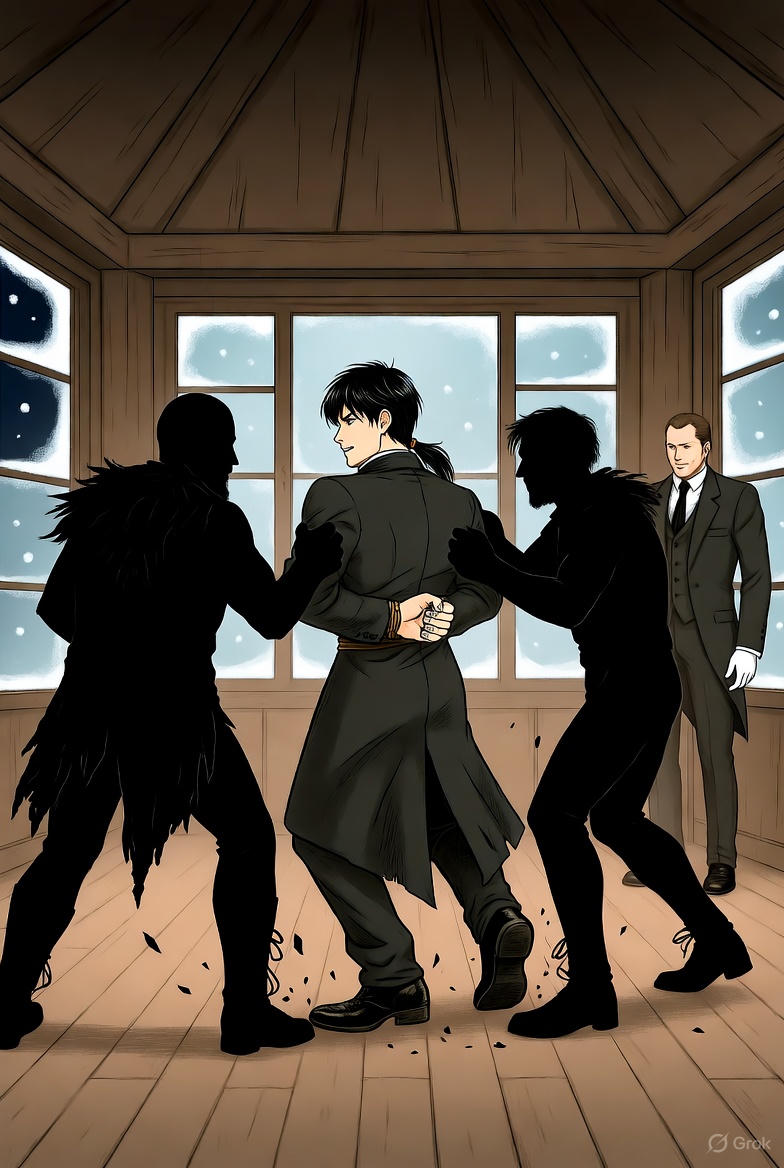
“First he defended himself,” she explained. “The best he could,
silent and powerfully even though both hands were tightly tied behind
his back. There were three assistants and they threw themselves on
him while the executioner stood there watching quietly in his dress
suit and white gloves. At first it pleased me, how the murderer threw
off the three butchers, how they tore at him and pushed without
bringing him one step closer. Oh, it was terribly exciting, your
Excellency.”
“I can only imagine, your Highness,” he blurted out.
“But then,” she continued. “Then it all changed. One grabbed his
leg while another pushed his bound arms high and he stumbled
forward. At that moment he must have felt his resistance was useless,
that he was lost. Perhaps–Perhaps he had been a little drunk–and was
now suddenly very sober –Pfui–That’s when he screamed.”
The Privy Councilor smiled, “What did he scream? Must I close
my eyes again?”
“No,” she cried. “You can leave them open, your Excellency–He
became a coward, a pathetic coward, full of fear. He screamed,
‘Mama!–Mama!–Mama!’ dozens of times while they had him on his
knees, dragged him to the guillotine and pushed his head into the
circular opening of the board.”
“Was he still crying for his mama at the last moment?” asked the
Privy Councilor.
“No,” she answered. “Not at the very last. After the hard board
was locked firmly around his neck with his head sticking out the other
side he became very quiet. Something seemed to be going on inside of
him.”
The professor became very attentive, “Could you see his face,
your Highness? Could you guess at what was going on inside him?”
The princess said, “I could see him just as clearly as I see you
right now sitting in front of me–What was going on inside him–I
don’t really know–there was just an instant–After the executioner
looked around one last time to see that everything was ready–when
his hand pressed the button that released the blade. I saw the eyes of
the murderer, they stood wide open, with insane passion, saw his
mouth panting and his features contorted with desire–”
She stopped.
“Was that all?” inquired the Privy Councilor.
She finished, “Yes, then the guillotine fell and his head sprang
into the sack that one of the assistants held open- Please, reach me the
marmalade, your Excellency.”
There was a knock at the door. It opened and Dr. Petersen
stepped inside. In his hand swung a long glass tube, tightly corked
and wrapped in wadding.
“Good morning, your Highness,” he said. “Good morning, your
Excellency–Here–here it is.”
The princess sprang up, “Let me see–”
But the Privy Councilor held her back. “Slow down, your
Highness. You will see it soon enough. If it is all right with you, we
will get right to work.”
He turned to the assistant doctor, “I don’t know if it will be
important, but just in case it would be a good idea if you–”
His voice sunk as he put his lips to the ear of the doctor.
He nodded, “Very well, your Excellency. I will give the orders
immediately.”
They went through the white corridors and stopped just in front
of No. seventeen.
“Here she is,” said the Privy Councilor as he carefully opened
the door.
The room was entirely white, radiant with sunlight. The girl lay
deeply asleep in bed. A bright ray scurried in from the tightly barred
windows, trembled on the floor, clambered up a golden ladder, darted
across the sheets and nestled lovingly on her sweet cheek, plunging
her red hair into glowing flames. Her lips were moving–half-open–as
if she were lightly whispering words of love.
“She’s dreaming of her prince,” said the Privy Councilor.
Then he laid his cold, moist hand on her shoulder and shook it.
“Wake up Alma.”


 Anarchistbanjo's World
Leave a comment