Feeds:
Posts
Comments

Archive for October, 2025

Madame Bluebeard by Karl Hans Strobl and translated by Joe E Bandel

Fifth Chapter
Early in the morning, Ruprecht rushed into the
garden. The rain had stopped, and the sky had
lightened. In the west, a patch of clear, cold blue was
visible, with clouds framing the opening like jagged
rocks around a cave of blue ice. One could peer deep
into the heavens. Far back, a demon sat on a throne of
frozen air, playing a gentle, ardent melody—a demon
resembling an archangel, whose robes concealed hot,
yearning flesh craving embrace.
The leaves on the trees were brown, curled,
trembling on branches as if in mortal fear.
Ruprecht strode firmly through the garden on
sodden paths. Brown muck splashed around his
shoes, clods of earth clung to his heels. He paused
before a bed of tall, red flowers. Most blooms had
been torn and broken by yesterday’s storm, their
fleshy petals drooping, wilted, scorched. The reedy
stems bore yellow and brown patches, signs of decay.
Only one flower stood tall and erect on a taut stem—
a blazing red blossom, its base a cluster of yellow
stamens.
As if it sprang from this night, Ruprecht thought.
This night! That vast, heavy roar, full of thunderous
blows and chaos’s wonders. How to name this
night—terrible bliss! Oh—and far, far off, those
sounds: shrieking weathervanes, old Marianne’s
howling and whimpering, until Lorenz silenced her.
Ruprecht had just cleaned his shoes on a grassy
strip but stepped back into the wet, black, sticky earth
of the flowerbed, snapping off the proud, fiery
bloom. He’d bring it to Helmina.
He passed the old tower and through a echoing
gate arch, its walls hung with rusty chains, into the
courtyard.
The estate manager, Augenthaler, had just ridden
in and dismounted, speaking with the overseer.
Augenthaler was the first to accept the inevitable,
recognizing Ruprecht as the new master. A talk over
the wedding feast had shown him Ruprecht’s
expertise in farming. He needed to curry favor,
abandoning resistance.
With a courteous greeting, he approached
Ruprecht. The overseer stepped back.
Ruprecht noticed Augenthaler’s unease, like one
with something to say but unsure how to say it.
“What is it?” he asked.
“It’s not good news,” Augenthaler forced out.
“The morning after… well, after a wedding, one
should bring only good news…”
“Speak, then—speak,” Ruprecht urged. What
people deem a calamity is often just a mishap, easily
fixed. He smiled: not just happiness, but misfortune
means different things to different people.
“Yeees!” Augenthaler said, tapping drying mud
from his leather gaiters with his riding crop. “When a
wedding guest… folks say it means something…”
“Please, I don’t understand a word.”
“Well… Baron Kestelli shot himself last night.”
“Shot himself?”
“Yes—with an army revolver, clean through the
temple.”
Ruprecht pictured the baron, his twitching face,
struggling to offer congratulations yesterday. Then, at
the feast, he’d given a jocular speech. Oh—a ghastly
jest before a revolver’s muzzle. Death had
breakfasted with them. Who could’ve known? With
his high, lisping voice, the baron delivered one of
those merry toasts typical of such occasions. His
shoulders quaked as if lashed. His face was a mask.
Ruprecht climbed thoughtfully to the breakfast
room. This was truly unpleasant news. A vile affair!
How to tell Helmina? Should he mimic Augenthaler,
circling like a cat around hot porridge? No—Helmina
was strong enough to bear it.
He found her in the room. The balcony door had
just been shut, and the large green tiled stove hadn’t
yet warmed the air. Helmina sat shivering at the table
in her green kimono, arms crossed, hands tucked
away. As Ruprecht entered, she yawned like a cat,
revealing a rosy throat.
“Good morning, dearest,” he said, kissing her
lightly on the forehead. “I brought you a flower. I
was in the garden. It’s the very last.”
“Thank you,” Helmina said, placing the bloom on
the snowy tablecloth. Like a bloodstain on linen,
Ruprecht thought. He braced himself—no beating
around the bush.
“Please, don’t be alarmed. It’s a sad matter. Baron
Kestelli shot himself last night.”
Helmina’s eyes widened, fixed. She stared at
Ruprecht, a green glow in her gaze. She rose, limbs
taut and strong, as if to cry out. Her small fist rested
beside the red flower on the cloth. Her kimono
parted, baring a sliver of white throat. She no longer
shivered.
“Ah… so he did!” she said.
“What, did you expect it?”
Her face paled. Her hair seemed to writhe!
Medusa! Ruprecht thought. She smiled now.
“Expect? Not exactly. But he always talked of
doing it. I laughed at him.”
“Tell me, does he have family?”
“An uncle, I think, and a married sister. By the
way…” Helmina turned to the stove, her back to
Ruprecht, “has he… left a will? They haven’t
searched yet, I suppose?”
“The manager didn’t mention one.”
“I’d like… I’d like to see him again. I’ll ride over
after breakfast. Will you come?”
Ruprecht found her wish odd. Everyone knew the
baron loved her. Such a move would spark bold
rumors. Still, he didn’t want to seem petty or narrow.
Let the world talk.
After breakfast, Helmina had horses saddled, and
they rode to Rotbirnbach. The sky shone in pure,
vaulted, ringing white. Autumn’s last beauty was
trapped beneath, refined and spiritualized by Earth’s
forces. Helmina chatted as if heading to a picnic.
“Oh… his relatives always wanted him under
guardianship. Now he’s tricked them, slipped away.
He spent too much of their money. There won’t be
much left, but something… Old Kestelli had a vast
fortune.”
They reached Rotbirnbach, riding into the castle.
All was in disarray. An old maid wept by a trough
where pigs fed, rubbing her eyes with filthy fists,
gray streaks smearing her face. A servant, his livery
vest half-buttoned, led them to the bedroom where
the baron lay temporarily. In haste, they’d moved the
bed under its silk canopy to the room’s center. On
two chairs at the headboard, long candles burned in
silver holders, too thick for them, shaved down to fit.
Shaved wax bits littered the floor around the holders.
A linen sheet draped the body, outlining human
contours. At the head, a bloody stain bloomed.
Helmina approached the bed with steady steps,
then hesitated. She lifted the sheet, lowered her head,
and stared at the mute, mangled skull.
Ruprecht stood behind his wife, watching her
back. Strands of hair floated around her delicate ears
in the breeze from open windows.

Read Full Post »

Alraune by Hanns Heinz Ewers and translated by Joe E Bandel

“Around eleven o’clock?” The assistant doctor made a somewhat
dubious face. “Isn’t that a little late? His Excellency is in the habit of
going to bed around that time and after such a strenuous day.”
“His Excellency must exert himself a little bit longer today
doctor.” Frank Braun decided. “Deliver the message. The hour is
certainly not too late for our purpose. It’s almost too early–In fact, it
would be better if it were twelve o’clock instead–That way if poor
uncle is too tired he can rest a bit ahead of time. Goodbye Doctor–
until this evening.”
He stood up, nodded curtly and left. He bit his teeth together,
feeling at the same moment as his lips closed just how childish, how
much of a mad mess it all was. He was almost ashamed of how he had
treated the good doctor, how small he had been, how cheap his joke
was. All of his nerves and sinews screamed for action–and instead he
let his thistle headed brain scatter in a thousand directions–while he
played childish pranks!
Dr. Petersen watched him go.
“He is full of pride,” he said to himself. “Not once did he offer to
shake my hand.”
He ordered another coffee, added a little cream and deliberated
while smearing butter on another slice of bread.
Then with innermost conviction, “Pride goes before the fall!”
Very satisfied with this wholesome common wisdom he bit into
the white bread and raised the cup to his mouth.
It was closer to one o’clock that evening when Frank Braun
finally appeared.
“Excuse me uncle,” he said lightly.
“Now dear nephew,” replied the Privy Councilor. “We have been
waiting way too long!”
“I had something better to do uncle, and by the way you are not
waiting here because of me but only because of your purpose.”
The professor squinted over at him. “Youngster–” he began, but
he controlled himself. “No, let it go. I am grateful that you have come
here to help me nephew. Are you ready to go now?”
“No,” declared Frank Braun blinded in childish defiance. “I will
have a whiskey soda first. We have enough time.”
That was his nature now, driving everything to the limit,
sensitive and thin skinned to every little word, taking offence at even
the slightest provocation. He always said harsh things to others but
couldn’t endure the softest rebuke or criticism himself. He could feel
how the old gentleman was hurt by his actions but knew the real
reason his uncle was hurt was because he needed his stupid young
nephew, that is what really sickened and offended his uncle.
It almost felt like a put down that the Privy Councilor was so
completely oblivious, couldn’t see through the shabby surface
behavior, couldn’t understand the blonde defiance for what it really
was. While he on the other hand had to resist whether he wanted to or
not, be more of a pirate than he really was, pull the mask still tighter
and go his insolent way like he had discovered on the Montmartre,
shock the bourgeois.
He leisurely emptied his glass, then stood up negligently like a
bored, melancholy prince, “Whenever you gentlemen are ready.”
He looked down on his guests from above as if they were
infinitely beneath him.
“Innkeeper, a cab.”
They left. The Privy Councilor was quiet, his upper lip hung
down deeply, fat tear ducts drained over his cheeks. His mighty ears
stuck out on both sides and the glittering right eye shone green in the
dark.
“He looks like an owl,” thought Frank Braun. “Like an ugly old
owl searching for a mouse.”
Dr. Petersen sat open mouthed in the front seat. He couldn’t
comprehend the unbelievable behavior of the nephew towards his
uncle.
It wasn’t long before the young man once more found his
equilibrium–Why should he get angry at the old ass? In the end his
good side came out as he helped the Privy Councilor out of the cab.
“Here we are,” he cried. “Please step inside.”
“Café Stern” it said on the large sign illuminated with electric
lights. They went inside, down long rows of small marble tables and
through a crowd of noisy and yelling people. Finally they sat down.
This was a good place. Many women sat around all decked out with
enormous hats and colorful silk blouses, multitudes of flesh waiting
for customers. They were spread out lounging around like window
displays.
“Is this one of the better places?” the Privy Councilor asked.
The nephew shook his head. “No Uncle Jakob, not at all. We
wouldn’t find what we wanted there–This might even be too good.
We need the bottom dregs.”
In the back a man in a greasy tight fitting suit sat at a piano
continually playing one popular song after another. At times a few
drinkers bellowed out words to the songs until the bouncer came over
to quiet them down and tell them that this was a respectable place and
they couldn’t do that.
Little clerks ran around and a couple good citizens from the
province sat at a nearby table making advances and talking dirty to
the prostitutes. A waiter swung between the tables bringing an
unappetizing brown sauce in glasses and a yellow one in cups. It was
called bouillon and the other Melange. He also carried a full carafe of
schnapps with little striped shot glasses.
Two women came up to their table and asked for coffee. It was
no big deal; they just sat down and ordered.
“The blonde perhaps?” whispered Dr. Petersen.
But the attorney waved him away. “No, no not at all–She is only
flesh. Not much better than your monkeys.”
A short one in the back of the room caught his eye. She was dark
and her eyes seethed with eagerness. He stood up and waved to her.
She loosened herself from her companion and came over to him.
“Listen–” he began.
But she said, “Not tonight, I already have a gentleman–
Tomorrow if you want.”
“Get rid of him,” he urged. “Come with us. We are looking for
something special.”
That was tempting. “Tomorrow– can’t it wait until tomorrow
darling? I really can’t tonight. He’s an old customer. He paid twenty
Marks.”
Frank Braun gripped her arm, “I will pay much more, a lot more.
Do you understand? You will have it made. It’s not for me–It’s for the
old man over there. He wants something special.”
She stopped. Her gaze followed his eyes to the Privy Councilor.
“Him, over there?”
She sounded disappointed. “What would he be wanting?”
“Lucy,” screamed the man at her table.
“I’m coming,” she answered. “Not tonight. We can talk about it
tomorrow if you want. Come back here around this time.”
“Stupid woman,” he whispered.
“Don’t be angry. He will kill me if I don’t go with him tonight.
He’s always that way when he’s drunk. Come tomorrow–do you hear
me? And leave the old man–Come alone. You won’t need to pay if
you don’t like it.”
She left him standing and ran over to her table.
Frank Braun saw how the dark gentleman with the starched felt
hat bitterly reproached her. Oh yes, she had to remain true to him–for
tonight. He went through the hall slowly looking at the prostitutes but
couldn’t find any that looked corrupt enough. There was still a last
residue of self-respect, some instinctive certainty of belonging to
some other class of society.
No, there were none of the lowest of the low. The pert and saucy
ones that had their own way, that knew what they wanted to be,
whores. He could hardly define what it was that he was looking for. It
was a feeling. She must love what she does, he thought, and want no
other. She would not be like these others that through some chance
unfortunate coincidence had wound up here.
These upright little women would have been workers, waitresses,
secretaries or even telephone operators if their lives had only been just
a little bit different. They were only prostitutes because the coarse
greed of males made it that way.
No, the one he was looking for should be a prostitute. Not
because she couldn’t be anything else, but because every inch of her
body screamed for new embraces, because under the caresses of one
lover, her soul already longed for the kisses of another. She needed to
be a prostitute just like he–he hesitated. What was he? Tired and
resigned, he finished his thought, just like he needed to be a dreamer.
He returned back to the table, “Come uncle. She is not here. We
will go some other place.”
The Privy Councilor protested but his nephew wouldn’t listen.
“Come uncle,” he repeated. “I promised you that I would find
someone and I will find her.”
They stood up, paid, went across the street and then further to the
north.
“Where,” asked Dr. Petersen.
The attorney didn’t answer, just kept walking, and looking at the
big signs on the coffeehouses. Finally he stopped.
“Café–Drinks–Gentlemen,” he murmured. “That would be
right.”
These dirty rooms were furnished in every style imaginable. To
be sure, the little white marble tables stood here as well and plush red
sofas were stuck against the walls. The rooms were lit with the same
electric bulbs and the same flat-footed waiters shoved through the
crowd in sticky suit coats.
But there was no pretense. Everything appeared just as it really
was. The air was bad, smoky and stuffy, but when you breathed it in
you felt better and freer somehow. There was no constraint and
students sat at nearby tables drinking their beer and talking dirty with
the women. They were all confident, sure of themselves, as mighty
floods of filth flowed out of their lips. One of them, small and fat with
a face full of dueling scars appeared inexhaustible and the women
neighed and bent over writhing with resounding laughter.
Pimps sat around on the walls playing cards or sitting alone,
staring at the drunken musicians and whistling along while drinking
their schnapps. Once in awhile a prostitute would come in, go up to
one of them, speak a few hurried words and then disappear again.
“This will do!” Frank Braun said. He waved to the waiter,
ordered cherry water and told him to send a few women over to the
table. Four came but as they sat down he saw another going out the
door, a tall, strong woman in a white silk blouse with luxurious fiery
red hair springing out from under a little hat. He leaped up and rushed
out into the street after her.
She went up the road slowly, indolently, lightly rocking her hips.
She curved to the left and entered into a doorway. Glowing red letters
arched over it, “North Pole Dance Hall”. He stepped across the dirty
yard after her and entered into the smoky hall almost the same time
she did but she didn’t notice. She stood standing out in front looking
over the dancing crowd.
It was noisy with yells and shouts; men and women whirled
around moving their legs till the dust flew high as the harsh words of
the Rix Dorfer howled through the music. It was rough, crude and
wild as the dancers pushed through each other and the crowd was
certainly growing.
He liked the Croquette and the Likette that they danced over on
the Montmartre and in the Latin Quarter on the other side of the Seine
and fell into them easily. They were lighter, more grand and full of
charm. There was none of that in this shoving, seething mass, not the
slightest twinge of what the French girls called “focus”.
But a hot blood screamed out of the Rix Dorfer, a wild passion
was driving the dancers crazy throughout the dance hall. The music
stopped and the dance master collected money in his dirty sweaty
hands from the women, not from the men. Then he bowed to the
audience and gestured grandly for the band in the gallery to start a
new dance.
But the crowd didn’t want the Rhinelander. They screamed at the
conductor, yelling at him to stop but the orchestra played on battling
against the will of the dance hall, secure high above and behind their
balustrade.
Then the Maitre pressed out onto the floor. He knew his women
and his fellows, held them solidly in his hand and would not be
intimidated by drunken yells or threatening raised fists. But he also
knew when he had to give in.
“Play the Emil,” he called up. “Play the Emil!”
A fat female in a huge hat wound her arm around the dance
master’s dusty suit coat.
“Bravo, Justav. That was well done!”
His influence spread like oil over the raging crowd. They
laughed, pressed onto the dance floor, cried “Bravo”, and slapped him
whole heartedly on the back or playfully punched him in the belly.
Then, as the waltz began he broke out in song, screaming and hoarse:
“Emil, you are a plant,
You climb all over me!
Are always quick to kiss
And that’s why I love you!”
“Alma,” cried out someone in the middle of the room. “There’s
Alma!”
He left his partner standing, sprang up and grabbed the red haired
prostitute by the arm. He was a short dark fellow with smooth hair
curling tight against his forehead and bright piercing eyes.
“Come,” he cried, grabbing her tightly around the waist.
The prostitute danced. More daring than the others, she pranced
the waltz letting her partner whirl her quickly around. After a few
beats she was completely into the dance, throwing her hips around,
bending forward and backward, pressing her body up against her
partner in constant contact. It was shameless, vulgar and brutally
sensual.
Frank Braun heard a voice near him, saw the dance master
watching the prostitute with keen appreciation.
“Damn, that whore can swing her ass!”
Oh yes, she could swing her ass! She swung it high and cheeky
like a flag, like a storm filled banner of naked lust, like the Baroness
Gudel de Gudelfeld swung hers for the applause of the Crown Prince.
She doesn’t need any ornaments thought Frank Braun as his eyes
followed her down the hall and back. He quickly stepped up to her as
the music stopped and laid his hand on her arm.
“Pay first,” the dark haired man laughed at him.
He gave the man a coin. The prostitute looked him over with a
quick look, examining him from top to bottom.
“I live nearby,” she said. “Scarcely three minutes in the–”

Read Full Post »

A Modern Inquiry into the Hermetic Mystery

Part II: A More Esoteric Consideration of the Hermetic Art and Its Mysteries

Chapter 3: The Mysteries Continued, Part 2

Introduction: The ancient mysteries guide the soul through a perilous descent into its chaotic depths, purifying it to reveal divine wisdom. This section explores the transformative journey past deceptive apparitions, led by the rational intellect’s golden light.

The Soul’s Perilous Descent

Plato likens the soul’s descent into the “oblivious realms of generation” to an earthquake, shaking its core with nature’s convulsions. Psellus describes two types of visions in the Chaldaic rites: “suspections,” mere apparitions of light or figures, and true divine revelations. The Oracle warns, “If you see such a light, do not heed it or its voice, for these are false, born of the soul’s passions.” These apparitions, like the poet’s satyric Pan in monstrous disguises, affright seekers, as Virgil depicts Aeneas, trembling yet resolute, facing shadowy forms.

This “pneumatic vehicle,” the soul’s imaginative essence, condenses like clouds, forming deceptive images—demons, beasts, or human shapes—that haunt the mysteries’ initiatory stage. Proclus explains, “Before the gods’ presence, terrestrial demons appear, drawing unpurified souls to matter, separating them from truth.” Only through purification do initiates enter the temple’s inner sanctum, receiving divine illumination and shedding their illusory garments.

The Alchemical Purification

The alchemists’ “Mercury of Philosophers” emerges from this purified spirit, freed from the chaotic “Black Saturn” or “Urinus Saturni,” a fetid, heavy essence that Sendivogius uses to nurture the soul’s solar and lunar aspects. This is the “mineral tree,” bearing transformative waters, as another adept notes: “From my sea rise clouds, bearing blessed waters to irrigate the earth and bring forth herbs and flowers.” Hermes urges, “Extract the shadow and obscurity from the ray, purifying the watery, corrupted nature until its redness shines.” This process, visiting “the interiors of the earth rectifying,” yields the true medicine—the philosopher’s stone.

The soul, likened to Plato’s marine Glaucus, deformed by foreign weeds, appears beastly until purified. Vaughan describes this chaotic essence as ever-changing, like clouds driven by wind, persecuted by the “fire of nature”—the rational light of the mysteries. Raymond Lully calls it “fugitive spirits condensed in monstrous shapes,” moving unpredictably, yet holding the seed of divine wisdom when purified.

The Rosicrucian Allegory

A Rosicrucian letter illustrates this journey: “In the earth’s center lies a mountain, small yet great, soft yet hard, far yet near, invisible by divine providence. It holds treasures beyond worldly value, guarded by cruel beasts and ravenous birds. Only the worthy, through self-labor, can reach it. Go at midnight, armed with courage and prayer, following a guide who appears unbidden.” This guide, a divine light, leads to the mountain’s heart, where the soul confronts its chaotic depths, requiring heroic resolve to prevail.

Closing: This section unveils the mysteries’ descent into the soul’s chaotic depths, purifying deceptive apparitions to reveal divine wisdom. The transformative journey continues, promising deeper revelations of the Theurgic art in our next post.

Read Full Post »

Homo Sapiens: In the Maelstrom by Stanislaw Przybyszewski and translated by Joe E Bandel

In the Maelstrom

I.

Janina looked at Falk thoughtfully. 

How he had changed in recent times. This restlessness! As if he expected some misfortune any moment. Then he could suddenly sink into a strange apathy for a whole hour and forget everything around him… What was wrong with him? No, he was not open with her. He made excuses. He calmed her with empty phrases… Now and then she saw his face twitch nervously, then he made a violent hand gesture and smiled. This smile—this ugly smile—he had brought from Paris. 

Falk seemed to wake up. He straightened up on the sofa, took a few pieces of sugar and threw them into an empty glass. 

“Do you have hot water?” 

“You shouldn’t drink so much grog, Erik, it makes you even more restless.” 

“No, no, on the contrary.” He seemed impatient. Janina hurried to bring the water. 

Falk prepared the grog carefully. He looked at her: She was so eager, as if she wanted to make up for daring to contradict him. He became very friendly: 

“No, on the contrary. That calms me. These are my calmest hours here with you… Sitting like this and drinking one glass after another… Yes, here with you…” 

He suddenly fell silent. He seemed to be thinking of something entirely different. 

“You have changed a lot since you came from Paris.” “Do you think so?” 

“You weren’t like that before. You have become so restless and so nervous.” Falk looked at her without answering. He drank, looked at her again and leaned back on the sofa. 

“It’s strange how good you are.” He spoke with a friendly smile. “I feel so well with you.” 

“Is it true?” 

“Yes, I always come back to you.” 

“Yes, when you are tired… Oh, Erik, it was not good to leave me here in this terrible torment for three years. Not a word did you write to me.” 

“I wanted you to forget me.” “Forget you! No, one cannot.” 

He looked at her silently. A long pause ensued. 

“Just tell me, Jania—” he suddenly became very lively—”tell me honestly: did nothing happen between you and Czerski? Be completely honest, you know how I think about it…” 

“We were practically engaged… But why do you ask? I have already told you the same thing a hundred times.” 

“Well, the whole thing interests me very much, and I am so forgetful. Your brother wanted it?” 

“Yes, they were the best friends.” “And you?” 

“I had nothing against it. I had completely given you up. He was very good to me. What should I wait for? I had great respect for him…” 

“If he hadn’t been imprisoned, you would now be an honorable housewife… Hm, hm… I’m really curious how that would suit you…” 

Janina did not answer. They were silent for a while. “Did you visit him in prison?” 

“Yes, a few times at first.” 

“And your brother successfully crossed the border?” “You know that.” 

“Hm, hm…” Falk stood up restlessly and walked back and forth a few times. “Did they ever talk about me?” 

“Who?” 

“Well, your brother and Czerski.” 

“Of course, very often. You sent money to Czerski. Have you forgotten?” 

“And did they know anything about our relationship?” 

“No! I always acted as if I had never known you. I was afraid of the two of them. They are so fanatical.” 

“So they didn’t know at all that you knew me before?” 

“No. But did you never talk to my brother in Paris about me? He was with you often.” 

Falk rubbed his forehead. 

“Yes, he came now and then; but we almost always talked about agitation… Yes, though: he once told me that he had a sister and that she would soon marry; besides, I left Paris soon after… Well, let’s leave it…” 

Again he walked restlessly around. 

“You, Erik, did you never long for me?” He smiled. 

“Oh yes, sometimes.” “Only sometimes?” He smiled again. 

“I came back after all.” “But you don’t love me.” Her voice trembled. 

“I love no one, but I longed for you.” 

He looked at her, her face twitched. She would probably burst into tears any moment. 

Falk sat down beside her.  

“Listen, Jania, I must not love. I must hate when I love.” “Have you ever loved?” 

“Yes, once. And I hated the woman I had to love. No, let’s not talk about it.” 

He became serious. The thought of his wife tormented him. 

“No, no. One is not free when one loves. The woman pushes herself into everything. One must take a thousand considerations, one must take her, one must also have the same bedroom—well, that’s not absolutely necessary, but—well, yes, you understand me… I must be free, I hate every feeling that restricts my freedom, oh, I cannot tell you how I hate it.” 

He took her hand and stroked it mechanically. 

“It’s strange, Jania, that you love me so.” 

“Why?” 

“I am so cold here—here…” he pointed to his forehead. Janina swallowed her tears. 

“You are enough for me like this. I don’t want you any other way. I demand nothing more from you.” 

“That’s good. That’s why I feel so well with you.” He was silent for a long time, then suddenly straightened up. 

“Do you believe I can love?” “Perhaps earlier.” 

“But if I now, now, understand, loved someone, if I loved her so that this person—this woman became a kind of fate to me?” 

Janina looked at him suspiciously. 

“If I loved this woman so that I couldn’t live a day without her?” 

She started. 

Falk looked at her for a long time, suddenly recollected himself and laughed. “God, what a child you are! How you stare at me!” 

Janina looked at him with growing unease. What was he saying? What did he want? “Erik, tell me openly what is wrong with you. Do you think I don’t see that you are suffering and want to hide it from me?” Her eyes filled with tears. Falk became very lively. 

Read Full Post »

Madame Bluebeard by Karl Hans Strobl and translated by Joe E Bandel

“He’s still very young,” Helmina replied
carelessly, brushing her lips with a tiny batiste
handkerchief, “and very much in love.”
Helmina and the children accompanied Ruprecht
by carriage to the train, a two-hour journey to the
next station. From the forested basin cradling
Vorderschluder, the road wound between mountain
spurs to the high plateau. Each loop, each turn
seemed like the forest had thrown up barriers to
hinder the road’s climb and block the world’s path to
the secluded village.
Ruprecht walked arm-in-arm with Helmina across
the Gars platform. The stationmaster, in his red cap,
passed by, saluted, and stole a glance. He leaned to
the open window of the telegraphist’s office,
whispering, prompting the young clerk to crane his
neck and roll his eyes. The girls had found the
stationmaster’s old dog in a corner, tugging its long
black tufts, but darted to Ruprecht every moment.
“You must come back soon, Papa!” “What will you
bring me, Papa?” “Will you race down the castle hill
with us, Papa?”
“That’s him, then. Must be fabulously rich,” the
stationmaster muttered, picturing a roasted peacock
and an automobile—his symbols of vast wealth.
The young telegraphist sighed. In dreams, he’d
embraced this young widow, claiming her by the
poet’s right, his desk drawer stuffed with a half-kilo
of tender verses. Done! Finished! The world’s
brutality had won.
The train approached. The stationmaster scurried
from one end of the platform to the other, as if
restraining a frantic crowd. He was thrilled to wear
his new trousers with crisp creases. If only his wife
would leave her window post, he’d have seized the
chance to offer Frau Dankwardt—still Frau
Dankwardt—some respectful homage. One must
make an impression. Perhaps an invite to the wedding
feast…
Ruprecht took his leave. Two children’s kisses,
then a red, full, fragrant mouth. All aboard!
Oh, it was only for a few days… A grating screech
jolted the train, rattling teeth. Then, farewell!
Two heron feathers nodded. A luxurious blue-gray
fur glimmered softly around her lovely shoulders…
the train rounded the castle hill…
Ruprecht von Boschan dove into work. There was
plenty to do. First, he gathered all papers needed for
the wedding. He loathed bureaucracies—offices,
waiting rooms, clerks, petitions, stamps. He’d lived
as if such things didn’t exist. Now, he needed them
all, a humbling crawl. Each errand required
overcoming inner resistance.
He also wanted to finish a project. With the clear,
untheorized gaze of a traveler, he’d formed
judgments on economic conditions. Many differed
from common assumptions. It would benefit his
homeland to learn where it lost or gained. He’d
begun a book on these matters and now aimed to
complete it, writing late into the night. Looking up
from his manuscript, he saw two white heron feathers
and a softly shimmering blue-gray fur.
Finally, his financial affairs needed settling.
He visited his bank, requesting a meeting with the
director. Sunk in a gray leather club chair, he outlined
his plan to Herr Siegl, who sat opposite. Siegl’s short,
stout, bowed legs formed an O wide enough to roll a
barrel through. A black-rimmed pince-nez quivered
on his thick nose’s tip, dangling as if begging to fall,
saved by its cord. His bulging belly rippled in his
white vest.
Above them, electric light burned in a milky tulip,
iron tendrils hanging down. Outside was bright day,
but here, year-round, this flame glowed. One might
think it an underground vault. With iron shutters and
padded doors, the room seemed built to guard secrets.
A faint metallic clink hummed—gold coins rubbing
together or stacked in rolls.
“Well, Herr von Boschan,” Siegl said after
Ruprecht explained his financial strategy, “I’d
recommend a marriage contract stipulating complete
separation of assets.”
“Why? Doesn’t that seem mistrustful? Have you
specific reasons for this suggestion?”
“Why? What can I say, Herr von Boschan? Better
safe than sorry! Frau von Dankwardt plays the stock
market.”
“Does she? And you think? With what success?”
Siegl rocked his head, his pince-nez dancing, the
ripple in his vest disrupted.
“Well… as one does on the market. You win, you
lose!”
“You may be right, Director,” Ruprecht said
thoughtfully.
“Right? Of course I’m right!” Siegl leaned
forward, placing a plump hand on Ruprecht’s knee.
“And then—someone inquired about your finances
here. Twice, Herr von Boschan!”
“Who?”
“I don’t know. Not the one who asked, at any
rate.”
“What did you say?”
“What did we say? Are we an inquiry bureau for
our clients? We said, ‘The man’s solid.’ What more
needs knowing?”
Ruprecht decided to follow Siegl’s advice.
Every other day, a fragrant letter arrived from
Vorderschluder. The one responding to his request
for asset separation smelled less sweet. The beautiful
writer was hurt, indignant. “Oh, that leaves a sting!”
Helmina wrote. Ruprecht wanted no thorn in his
bride’s soul. He replied that, while insisting on
separation, he was open to mutual inheritance
provisions.
“Let’s not overvalue such things,” Helmina wrote
back. “Have it your way. I agree. The date nears. We
have more pressing matters.”
The date arrived.
Ruprecht reached Vorderschluder the evening before the wedding.
Jana, the Malay, managed the luggage. Village
youths gaped, awestruck. They’d never seen such a
figure. “Well, there’s all sorts in the world,” said the
Red Ox’s kindly landlady, and even the headmaster
had to agree.
The bachelor party was intimate—the estate
manager, head forester, priest, factory director, and
bookkeeper attended, along with the notary who’d
witnessed the marriage contract’s signing. Baron
Kestelli, invited, had excused himself but would
attend the ceremony. That relatives of Helmina’s last
husband stayed away was understandable.
The next morning, Ruprecht’s witnesses arrived:
Ernst Hugo, the court secretary, and another old
friend, Wetzl, a quiet, dark chemist famed for radium
experiments.
Hugo flung his arms like windmill blades,
enveloping Ruprecht. “Man,” he shouted, “all I’ll say
is: when a man’s lucky, he’s lucky!”
Turning to Frau Helmina, he placed a hand on his
impeccable frock coat’s left flap. “If you knew,
madam… I admired you in Abbazia. I was promised
an introduction the next day. The next day, you were
gone.”
Helmina, in a simple gray dress, smiled and
offered her hand. “My husband’s friends are mine.”
God! Hugo thought. That look. I’m lost. I’ll dream of
her.
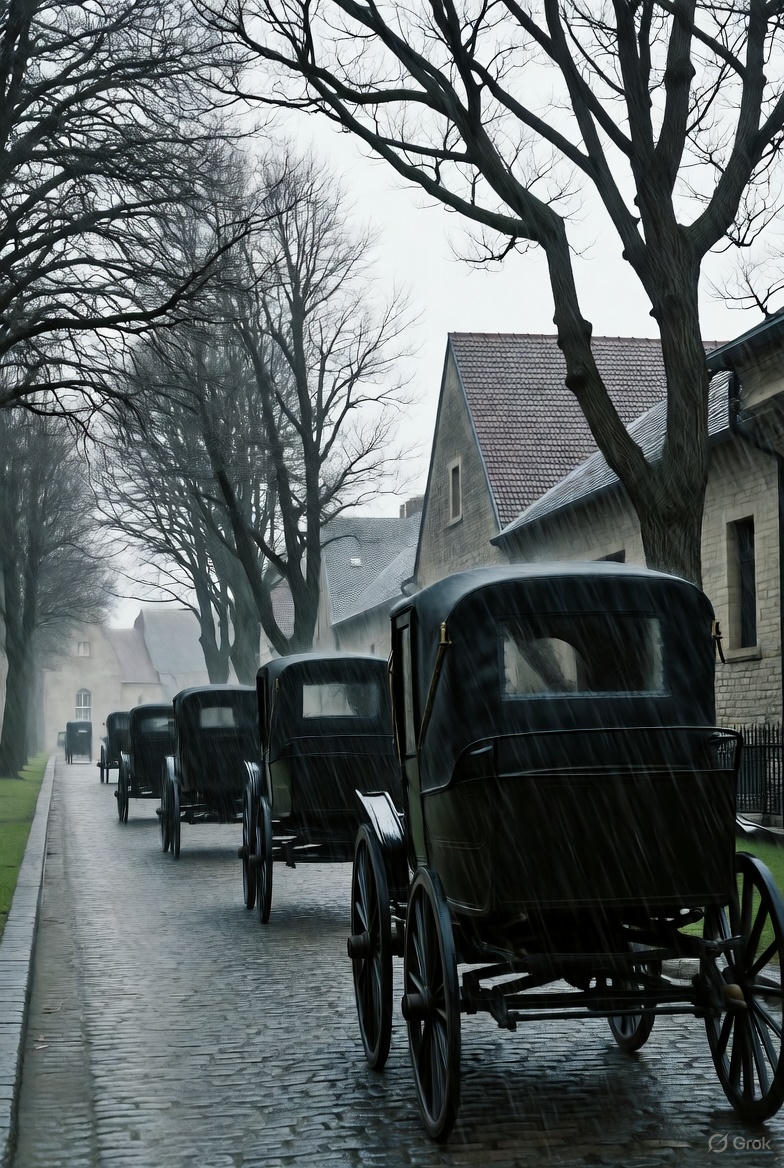
Carriages waited in the courtyard. They drove
slowly, brakes grinding, between bare chestnut trees
down the castle hill. The weather was unkind. A cold
November wind raged in the forested basin, plunging
from a gray sky, whipping rain showers. Castle
weathervanes shrieked, naked branches clashed.
The peasants stood before their houses, straining
to peer into the closed carriages. No cheers, no
greetings, nothing… they wore dark, hostile scowls.
“Your honeymoon’s to the south, naturally,” Hugo
said to Ruprecht.
“We’re not taking a honeymoon. We’re staying
home.”
“Oh!” Hugo pictured warm, cozy rooms, crackling
fires, shrieking weathervanes, humming teakettles,
and soft, flowing silk-and-lace nightgowns. Good
heavens!
Ruprecht sensed his friend’s envy. He felt it like a
cloud over the congregation in the church. The
guests’ strained postures, their polite smiles, were
mere grimaces, hiding nothing from him. Yet, from
this, he drew strength to prevail. Calmly, confidently
smiling, he led Helmina to the altar. She turned her
face to him. Her eyes shimmered with iridescent
brilliance. Oh, this danger—this wondrous, blissful,
sweet danger of the love-battle he was entering!
What is life without this danger?
The priest delivered his words, binding them in an
unbreakable union.
Then they received congratulations. First, Baron Kestelli, Helmina’s
witness, approached. His face was contorted. He
could say nothing.

Read Full Post »

Alraune by Hanns Heinz Ewers and translated by Joe E Bandel

But the overseer of the prison was not satisfied. “What! To the
commander? But Herr Doctor, you have no leave of absence to go
down to the city, and you still want to go to the commander?”
Frank Braun laughed, “Yes indeed. Straight to him! Namely, I
must go to the commander and pump some money out of him.”
The Sergeant-major didn’t say another word. He stood there not
moving with a wide-open mouth, completely petrified.
“Give me ten pennies, boy,” Frank Braun cried to his valet, “for
the toll bridge.”
He took the coins and went with quick strides across the yard,
into the officer’s garden and from there onto the slope leading up to
the ramparts. He swung up onto the wall, grabbed the bough of a
mighty ash tree on the other side and climbed down the trunk. Then
he pushed through the thick underbrush and climbed down the rocks.
In twenty minutes he was at the bottom.
It was the route they always took for their nightly escapades. He
went along the Rhine to the toll bridge and then across to Coblenz. He
learned where the commander lived and hurried there.
He showed the general the telegram and said that he came on
very urgent matters. The general let him in and he put the telegram
back in his pocket.
“How can I help you with this?”
Frank Braun said, “I need a leave of absence your Excellency. I
am a prisoner at the fortress.”
The old general stared at him unkindly, visibly annoyed at the
intrusion.
“What do you want? By the way, how did you get down into the
city? Do you have a pass?”
“Certainly, Your Excellency,” said Frank Braun. “I have church
leave.”
He lied, but knew very well the general only wanted an answer.
“I came to Your Excellency to ask for a three day pass. My uncle is in
Berlin and dying.”
The commander blurted out, “What is your uncle to me? It’s
entirely out of the question! You are not sitting up there at your
convenience. It’s because you have broken the law, do you
understand? Anyone could come to me with a dying uncle or aunt. If
it’s not at least a parent I deny such a pass strictly on principle.”
“I remain dutiful, your Excellency,” he replied. “I will inform
my uncle, his Excellency, the Privy Councilor ten Brinken,
immediately by telegraph that unfortunately his only nephew is not
allowed to hasten to his deathbed for his weary eyes to look upon.”
He bowed, turned toward the door, but the general held him back
as he had expected.
“Who is your uncle?” he asked in hesitation.
Frank Braun repeated the name and the beautiful title. Then he
took the telegram out of his pocket and handed it over.
“My poor uncle has one last chance for deliverance in Berlin but
unfortunately the operation is not successful very often.”
“Hmm,” said the commander. “Go my young friend. Go
immediately. Perhaps it will be helpful.”
Frank Braun made a face, lamented and said, “Only God knows–
Perhaps my prayers can do some good.”
He interrupted himself with a beautiful sigh and continued, “I
remain dutiful, your Excellency. There is just one other thing I have
to ask.”
The commander gave him the telegram back. “What?” he asked.
Frank Braun burst out, “I have no travel money. May I ask your
Excellency to loan me three hundred Marks.”
The general looked suspiciously at him. “No money–Hmm–so
no money either–But wasn’t yesterday the first? Didn’t your money
come?”
“My money came promptly, your Excellency,” he replied
quickly. “But it was gone just as quickly that night!”
The old commander laughed at that.
“Yes, yes. That is how you atone for your crimes, your
misdeeds! So you need three hundred Marks?”
“Yes, your Excellency! My uncle will certainly be very happy to
hear how you have helped me out of this predicament, if I am
permitted.”
The general turned, went to the writing desk, opened it and took
out three little pieces of paper and a moneybox. He gave the prisoner
quill and paper and told him what to write down on the receipt. Then
he gave him the money. Frank Braun took it with a light easy bow.
“I remain dutiful, your Excellency.”
“Think nothing of it,” said the commander. “Go there and come
back right away–Give my compliments to yours truly, his
Excellency.”
“Once again I remain dutiful, your Excellency.”
One last bow and he was outside. He sprang over the six front
steps in one leap and had to restrain himself not to shout out loud.
That was great!
He called a taxi to take him to the Ehrenbreitstein train station.
There he leafed through the departure times and found he still had
three hours to wait. He called to the valet that was waiting with his
suitcase and commanded him to quickly run over to the “Red Cock”
and bring back the ensign from Plessen.
“But bring the right one boy!” he said sharply. “The young
gentleman that just got here not to long ago, the one that wears No.
six on his back. The one that–Wait, your pennies have earned
interest.”
He threw him a ten Mark piece. Then he went into the wine
house, considered carefully, ordered a select supper and sat at the
window looking out at the Sunday citizens as they wandered along the
Rhine.
Finally the ensign came. “What’s up now?”
“Sit down,” said Frank Braun. “Shut up. Don’t ask. Eat, drink
and be merry!”
He gave him a hundred Mark bill. Pay my bill with this. You can
keep the rest–and tell them up there that I’ve gone to Berlin–with a
pass! I want the Sergeant-major to know that I will be back before the
end of the week.”
The blonde ensign stared at him in outright admiration, “Just tell
me–how did you do it?”
“My secret,” said Frank Braun. “But it wouldn’t do you any
good if I did tell you. His Excellency will only be good-natured
enough to fall for it once. Prosit!”
The ensign brought him to the train and handed his suitcase up to
him. Then he waved his hat and handkerchief.
Frank Braun stepped back from the window and forgot in that
same instant the little ensign, his co-prisoners and the fortress. He
spoke with the conductor, stretched out comfortably in his sleeper,
closed his eyes and went to sleep. The conductor had to shake him
very hard to wake him up.
“Where are we?” he asked drowsily.
“Almost to Friedrichstrasse station.”
He gathered his things together, climbed out and went to the
hotel. He got a room, bathed, changed clothes and then went down for
breakfast. He ran into Dr. Petersen at the door.
“Oh there you are dear Doctor! His Excellency will be
overjoyed!”
His Excellency! Again his Excellency! It sounded wrong to his
ears.
“How is my uncle?” he asked. “Better?”
“Better?” repeated the doctor. “What do you mean better? His
Excellency has not been sick!”
“Is that so,” said Frank Braun. “Not sick! That’s too bad. I
thought uncle was on his deathbed.”
Dr. Petersen looked at him very bewildered. “I don’t understand
at all–”
He interrupted him, “It’s not important. I am only sorry that the
Privy Counselor is not on his deathbed. That would have been so
nice! Then I would have inherited right? Unless he has disowned me.
That is also very possible–even more likely.”
He saw the bewildered doctor standing before him and fed on his
discomfort for a moment.
Then he continued, “But tell me doctor, since when has my uncle
been called his Excellency?”
“It’s been four days, the opportunity–”
He interrupted him, “Only four days! And how many years now
have you been with him–as his right hand?”
“Now that would be at least ten years now,” replied Dr. Petersen.
“And for ten years you have called him Privy Councilor and he
has replied back to you. But now in these four days he has become so
completely his Excellency to you that you can’t even think of him any
other way than in the third person?”
“Permit me, Herr Doctor,” said the assistant doctor, intimidated
and pleading. Permit me to–What do you mean anyway?”
But Frank Braun took him under the arm and led him to the
breakfast table.
“Oh, I know that you are a man of the world doctor! One with
form and manners–with an inborn instinct for proper behavior–I know
that–and now doctor, let’s have breakfast and you can tell me what
you have been up to in the meantime.”
Doctor Petersen gratefully sat down, thoroughly reconciled and
happy that was over with. This young attorney that he had known as a
young schoolboy was quite a windbag and a true hothead–but he was
the nephew–of his Excellency.
The assistant doctor was about thirty-six. He was average and
Frank Braun thought that everything about him was “average”. His
nose was not large or small. His features were not ugly or handsome.
He was not young anymore and yet he wasn’t old. The color
of his hair was exactly in the middle between dark and light. He
wasn’t stupid or brilliant either, not exactly boring and yet not
entertaining. His clothes were not elegant and yet not ordinary either.
He was a good “average” in all things and just the man the Privy
Councilor needed. He was a competent worker, intelligent enough to
grasp and do what was asked of him and yet not intelligent enough to
know everything about this colorful game his master played.
“By the way, how much does my uncle pay you?” Frank Braun
asked.
“Oh, not exactly splendid–but it is enough,” was the answer.
“I’m happy with it. At New Years I was given a four hundred Mark
raise.”
The doctor looked hungrily as the nephew began his breakfast
with fruit, eating an apple and a handful of cherries.
“What kind of cigars do you smoke?” the attorney inquired.
“What I smoke? Oh, an average kind–Not too strong–he
interrupted himself. But why do you ask doctor?”
“Only because,” said Frank Braun, “it interests me–But now tell
me what you have already done in these things. Has the Privy
Councilor shared his plans with you?”
“Certainly,” the doctor nodded proudly. “I am the only one that
knows–except for you of course. This effort is of the highest scientific
importance.”
The attorney cleared his throat, “Hmm–you think so?”
“Entirely without a doubt,” confirmed the doctor. “And his
Excellency is so extremely gifted to have thought it all out, taking
care of every possible problem ahead of time. You know how careful
you have to be these days. The foolish public is always attacking us
doctors for so many of our absolutely important experiments. Take
vivisection–God, the people become sick when they hear the word.
What about our experiments with germs, vaccines and so on? They
are all thorns in the eyes of the public even though we almost always
only work with animals. And now, this question of artificial
insemination of people–
His Excellency has found the only possibility in an executed
murderer and a paid prostitute. Even the people loving pastor would
not have much against it.”
“Yes, it is a splendid idea,” Frank Braun confirmed. “It is well
that you can recognize the capacity of your superior.”
Then Dr. Petersen reported how his Excellency had made several
attempts in Cologne with his help. Unfortunately they had not had any
success in finding an appropriate female. It turned out that these
creatures in this class of the population had very different ideas about
having to endure artificial insemination. It was nearly impossible to
talk to them about it at all, much less persuade one to actually do it. It
didn’t matter how eloquent his Excellency spoke or how hard he tried
to make them understand that it would not be dangerous at all; that
they would earn a nice piece of money and be doing the scientific
community a great service. One had screamed loudly that she would
rather service the entire scientific community–and made a very rude
gesture.
“Pfui!” Frank Braun said. “If only she could!”
It was a very good thing that his Excellency had the opportunity
to travel to Berlin for the Gynecological Conference. Here in the
metropolis there would no doubt be a much wider selection to choose
from. The women in question would not be as stupid as in the
province, would have less superstitious fear of the new and be more
open and practical regarding the money they could make and the
important service they could provide to the advancement of science.
“Especially the last!” Frank Braun emphasized.
Dr. Petersen obliged him with:
“It is unbelievable how old fashioned their ideas are in Cologne!
Every Guinea pig, yes, even every monkey is infinitely more
insightful and reasonable than those females. I almost lost my faith in
the towering intellect of humanity. I hope that here I can regain that
shaken belief and make it solid once more.”
“There is no doubt about it,” the attorney encouraged him. “It
would be a real shame indeed if Berlin’s prostitutes couldn’t do any
better than Guinea-pigs and monkeys!
By the way, when is my uncle coming? Is he up already?”
“Oh, he’s been up for a long time now,” declared the assistant
doctor zealously. “His Excellency left immediately. He had a ten
o’clock audience at the Ministry.”
“And after that?” Frank Braun asked.
“I don’t know how long it will last,” reasoned Doctor Petersen.
“In any case his Excellency requested I wait for him in the auditorium
at two o’clock. Then at five o’clock his Excellency has another
important meeting with a Berlin colleague here in the hotel and
around seven his Excellency is invited to eat with the university
president.
Herr Doctor, perhaps you could meet in between–”
Frank Braun considered. Basically he was in favor of his uncle
being occupied the entire day. Then his uncle wouldn’t be around to
interfere with his day.
I want you to deliver a message to my uncle,” he said. “Tell him
we will meet up downstairs in the hotel around eleven o’clock.”

Read Full Post »

A Modern Inquiry into the Hermetic Mystery

Part II: A More Esoteric Consideration of the Hermetic Art and Its Mysteries

Chapter 3: The Mysteries Continued, Part 1

Introduction: The ancient mysteries guide the soul through purificative rites to uncover its divine essence. This chapter explores the transformative process of dissolving sensory bonds, revealing a profound wisdom beyond modern mesmerism’s reach.

The Lesser Mysteries and Initial Revelation

The Lesser Mysteries, open to all, introduced aspirants to the soul’s inner life, a fertile field of contemplation where imagination roamed freely without discipline. Like modern mesmerism, which reveals trance phenomena such as insensibility, healing, and mental exaltation, these rites offered a glimpse of another life but effected little change. Mesmerism, working with the same vital spirit, shows the soul’s intrinsic intelligence—its ability to perceive hidden truths—but its revelations, like those of the Lesser Mysteries, remain superficial, satisfying only the curious.

The ancients, seeking deeper truth, passed beyond these initial phenomena to investigate the soul itself. Roger Bacon declares, “I wish to dissolve the philosophers’ egg and explore the parts of the philosophical man, for this is the beginning of greater things.” Theurgists aimed to concentrate the soul’s vitality, purify its essence, and know it in unity, not merely to roam its sphere but to penetrate its divine source through disciplined art.

The Art of Dissolution

Theurgic rites dissolved the soul’s sensory bonds, unlike mesmerism’s temporary trances. Alchemists described this as a “perfect solution,” where the dense, earthy spirit of sense is rarified into a passive, flowing essence. Albertus Magnus explains, “The work begins with dissolution, making the fixed volatile and the volatile fixed, perfecting the solar and lunar forms through repetition.” This process, akin to dissolving alkali with acid, transforms the soul’s animal nature into a receptive, spiritual state.

Modern theories of mesmerism suggest the sensible medium is overcome or drawn away, but alchemists insisted it must be dissolved, freeing the spirit from its dark dominion. This dissolution, veiled from the uninitiated, prepared aspirants for deeper mysteries, requiring rigorous ordeals to ensure only the worthy proceeded.

The Descent to the Infernal Regions

The Greater Mysteries involved a perilous descent into the soul’s chaotic depths, depicted as Hades or Avernus. Virgil’s Aeneid describes this as a dark, vast cave surrounded by “deep forests and impenetrable night,” with Cocytus’ sable waves. This is no physical realm but a vital submersion, a state of consciousness drawn to the soul’s primal chaos, the “Black Saturn” of adepts—corrupt, fetid, yet the origin of transformation. Sendivogius calls it “Urinus Saturni,” watering the soul’s lunar and solar aspects, while others name it a “mineral tree,” bearing blessed waters to nurture new life.

The descent is easy, as Virgil’s Sybil warns: “The gates of Dis stand open night and day. But to retrace your steps to the upper air—that is the labor.” Only those favored by divine virtue or Jupiter’s love succeed. The soul, purified of sensory illusions, must wield a rational will to resist the dark sphere’s temptations, guided by the “golden bough”—a symbol of divine intellect, flexible and radiant, penetrating the murky ether to reach the soul’s true essence.

Closing: This chapter unveils the mysteries’ purificative rites, dissolving sensory bonds to prepare the soul for its perilous descent into divine truth. The transformative journey deepens, promising further revelations of the Theurgic art in our next post.

Read Full Post »

Homo Sapiens: Under Way by Stanislaw Przybyszewski and translated by Joe E Bandel

XII.

Falk woke around noon. He couldn’t lift his head from the pillows; it was heavy like a lead ball, and sparkling sparks danced before his eyes. 

With difficulty he adjusted the pillows, finally sat up, and tried to fix an object in his gaze. 

It worked. 

But a terrible compulsion laid itself on his organism. He was as if hypnotized: he had to say something to Marit. 

What? 

He didn’t know. 

But it was something; he had to go to her at any price, he had to say something to her. 

With superhuman effort he crawled out of bed. Yes, he had to say something. 

He checked himself. 

That was certainly a compulsion. Yes. But still: he had to go to Marit. 

He stood up, but had to sit again. 

The soles touched the floorboards. A soothing, almost painful cold prickled through his body. 

Oh, how good that was! 

He needed a little more air, a little morning air. Yes, what time was it actually? 

“So late, so late; but it will probably be cool outside. Was there really a storm? or did he only dream it?” 

His clothes lay in a puddle of water on the floor. A great fear seized him. 

“No, no: Mother can’t have seen it, otherwise the things wouldn’t be lying here.” 

He felt stronger, went to the wardrobe and changed the suit. 

God, God, how his head hurt. With difficulty he dressed. 

Like a thief he crept to the door of the room his mother occupied. 

She wasn’t there! 

Falk breathed a sigh of relief. It hurt him. 

“Only say that one thing… say to Marit… then I’ll crawl back into bed… then I can be sick. But only say it.” 

He went out. 

When Marit saw him, she jumped up in alarm. Falk smiled forcedly. 

“No; it’s nothing; I only caught a little cold in the night. I have a little fever. By the way, I should have stayed home. But I absolutely had to come to you. I don’t know why. Just quickly give me some cognac…” 

He hastily drank a large glass of cognac. 

“You see; I got up; it was so terribly hard. But if I lay on my deathbed, I would have had to come to you. Oh: The cognac did very well. It lowers the temperature. That’s namely my standing phrase. I just don’t understand: why not lying?” 

Falk began to babble, but controlled himself again. Marit looked at him in horror. 

“No, no, leave me; you see, it’s so terribly uncanny what an animal such an overman is. For I am an overman. You understand that? There I suddenly get, probably in sleep, such inspirations. I wake: I know nothing of the whole story; I remember only the final result. No; I don’t remember; for I don’t know if I dreamed something similar; but I know that I had to come to you. I am sick; very sick. But I had to come to you.” 

Again his strength left him. 

He saw a fire-garland before his eyes, a reddish-green fire-garland; it split into seven lightnings and tore a willow apart. 

Marit stared at him, in growing despair. 

“Erik my God, what is it with you? You are sick—you must go home—oh God, God, why do you stare at me so horribly?” 

“No, just leave it. On the way stands a willow; it is split in two parts; when I went—to you—yes, to you—wasn’t I with you? Yes right: when I went to you, there I examined the willow and searched in the trunk for the thunderbolt. I always did that as a child.” 

A lightning, a thousand lightnings killed the little dove. 

“But what I wanted to say to you. For I must say something to you. Pour me more cognac.” 

“Erik, for heaven’s sake, you must go home! I will immediately have the carriage hitched. I will bring you home.” 

Marit ran out… 

“What he had to say… had to?!” 

Little dove and lightnings… then house, dream… life… destruction… Yes! Destruction! He—a hurricane—an overman—who strides over corpses—and begets life. 

Yes, yes: destroy… Destroy! 

A wild, jubilant cruelty grew up in him; a joyful, mad lust for torment. He had to see that! yes: that, how the frog writhed under his scalpel, how it slid up the four nails to the nail heads. Then cut out the heart… How it twitches on the table, how it jumps! 

Before Falk’s eyes the objects began to dance. Marit stood before him, ready for travel, in helpless fear. 

“Come, Erik; come! my only one, come!” She kissed his eyes. 

“Still… still once…” He begged like a small child. “Come now! Come, my sweet, only man you.” 

“No—still—let! I must say something to you. There sit down—opposite me—on the chair.” 

So, Marit, listen: I am not your husband at all, I am married. Yes, really: married. My wife is in Paris. Yes right: Fräulein Perier is my wife. She really is. Don’t you believe it? No, wait, my marriage contract… 

He began nervously searching in his pockets. Suddenly he came to his senses. 

He smiled idiotically. 

“No you, what black holes do you have in your head? You look like a skull. No, don’t look at me like that—don’t look at me—no, let—let—I go—I go.” 

Falk ducked in growing fear. 

“I go, I go already…” He whimpered like an animal, “I go—yes—yes…” 

He ran out. 

“No, get in here!” called the coachman. “I’ll drive you!” 

“Get in? Yes, get in…” Falk climbed into the carriage that was waiting. 

“Where is my hat? No, the hat isn’t there…” Falk held it in his hands… “But that’s strange! – –” 

Marit sat in the room with the hat on her head; she was completely paralyzed. 

There he drove, yes. Really? No. Yes; yes. Yes. 

Not a single thought! So she was dead. No, she dreamed. No, she didn’t dream. 

And again she saw clearly, as once before, Falk’s face: it bit her with sucking vampire eyes, it gnawed at her soul with grinning scorn… Liar… 

She knew, she saw it: now finally he had told the truth. So she sat probably an hour long. 

So he was married! 

“Married—” she repeated coldly and harshly. 

She felt how her interior froze to ice; everything crawled in her together to one point; the warmth ebbed and ebbed. Everything shrank to the one, small, tiny point: Married… 

She saw his uncannily glowing eyes. Her head grew confused. 

She jumped up.  

No, how could she have forgotten that! She quickly undressed; her gaze fell into the mirror. 

No, with the hat on her head she couldn’t possibly go to the kitchen; that would be droll. 

She smiled dully to herself. 

She went to the kitchen; bread was to be baked. She ordered it. 

She was active with feverish unrest. Then she came back to the room. 

Above the sofa hung a picture that consisted only of letters; there in such strange flourishes and with glaring Byzantine initials the Lord’s Prayer was printed. 

She examined it attentively. 

“How hideous this dragon around the U…” She read: And forgive us our sins… 

“No, wait, Marit…” She sat on the chair. 

“Yes, there sat Falk. Now he said…” 

Married! it sounded steel-hard in her ears. “Yes really: married to Fräulein Perier.” She went to the window and looked out. 

“How the day drags. Yes! until June 21 the days get longer.” 

She looked at the clock. It was five in the afternoon. 

Now the brother would soon come from gymnastics: she had to get him coffee. 

A carriage rolled into the yard… 

“You, Marit, Falk is terribly sick…” 

The brother told hastily, tumbling over himself… When Hans brought him home, he had to be lifted from the carriage; he couldn’t recognize any person. His mother cried terribly, and then came the district physician… 

“So, Falk is sick…” 

Marit wanted to tell the brother that Falk was married, but she controlled herself. 

Now his wife will come, and will nurse the poor, nicotine-poisoned man, and bear his moods like an angel… yes… 

She went up to her room. 

One should not disturb her; she would lie down a little to sleep… Falk is terribly sick… he had to be carried… his mother

cried… 

Marit walked restlessly back and forth… I must go to him… immediately… he will die. 

Her head was bursting; she grasped high with both hands. Married! Married! it droned continuously. 

“I will make you so happy, so happy, and will never leave you!” 

A weeping rage rose choking in her throat: God! God! How he had lied! 

And a shame and foaming indignation. 

Good Lord: had it really happened? Yes… oh yes… happiness. 

She felt how he gently rocked her body; back and forth. She felt his hot, greedy lips; on her whole body. She saw herself undressed; he embraced her… And from all corners hideous ghosts emerged, wild, laughing, distorted mask-faces that grinned at her and spat at her. 

She crawled into herself; she threw herself on the bed, buried herself in the pillows. 

With her own nails dig herself a grave! Oh shame… shame… On the misery of the human child the Madonna stared with stupid smile… 

It grew dusk… 

Beyond the lake the sun disappeared behind the peaks of the forest and poured blood-red lights over the treetops. 

Marit listened. 

She heard the clatter of the stork and the laughter of the maids who below in front of the house peeled potatoes for supper. 

Then she heard singing. It was her brother. Then she fell asleep…  

When she woke, it was night. 

She sat on the edge of the bed; thought. But the thoughts kept scattering. She stared thoughtlessly into the room. 

She was damned; cast out by God. Now everything was indifferent. Everything. 

She thought what might not be indifferent? No, there was nothing. 

“Falk is sick; but Falk betrayed her. He promised her happiness, endless happiness, and he was married. Now his wife comes and will nurse him; his Marit is damned. If she goes to him, she will be driven away. And then she will stand outside like a dog in the rain, crouched before the door. No, she had no right to him—nothing, nothing at all in the world. 

Now everything is gone. Father gone, mother gone; God doesn’t exist. Yes, Falk said that. Falk is right. Otherwise God couldn’t torment his child so terribly. Everything gone…” 

Finally she stood up. She made light; she wanted to arrange her hair. She stepped before the mirror. 

Oh God, how she looked… No, how thin; how thin… oh, it’s indifferent… 

The whole house slept. 

“The happiness… the endless happiness… Yes: he gave it to me…” She took hat and coat and went to the lake. 

She sat on the stone: “Cape of Good Hope” she had called it when she waited here day in, day out for Erik. 

In the forest opposite stood the little fisherman’s cottage. A light, a tiny dot, crawled out the window and sank strangely torn in the trembling waves of the lake… torn… 

She stared at the light and at the black water… How it pulled… how the water pulled at her… 

Everything, everything is indifferent. 

She was alone; no person her own. She was driven out into wind and weather like a dog before the door… 

Yes, now the wife comes; she takes him away; and I remain alone! Almighty, merciful God: alone… No, no, no! Enough! Finished! 

He drives away. No father. No mother. No God… 

Her fear grew and grew. She feverishly fumbled at her dress. Suddenly a terrible thought rose in her: 

The world is going under! Everything, everything will go under! The flood! 

She jumped up abruptly: 

There was a whirlpool… there it is deep… a farmhand drowned there last year… with both horses. 

She ran there. In her head it droned and roared. She saw nothing; she heard nothing. 

Something was in her that drove her. She only needed to run. She ran. “Yes, here!” 

“No, still the little bend there… there!” 

She screamed shrilly in the water… wildly… she struggled. Life! The whirlpool… Bliss…

XIII.

After a week Falk regained consciousness. At his bedside sat his wife, asleep. 

He was not at all astonished. He looked at her. 

It was her. 

He sank back into the pillows and closed his eyes. Now everything was good. A reddish fire-garland he suddenly saw, which split into seven lightnings; then he saw a willow by the road fall apart. Marit was probably dead. 

He fell asleep again.

End

Kongsvinger (Norway), June 1894.

Read Full Post »

Alraune by Hanns Heinz Ewers and translated by Joe E Bandel

Chapter Four
Gives the particulars of how they found Alraune’s mother

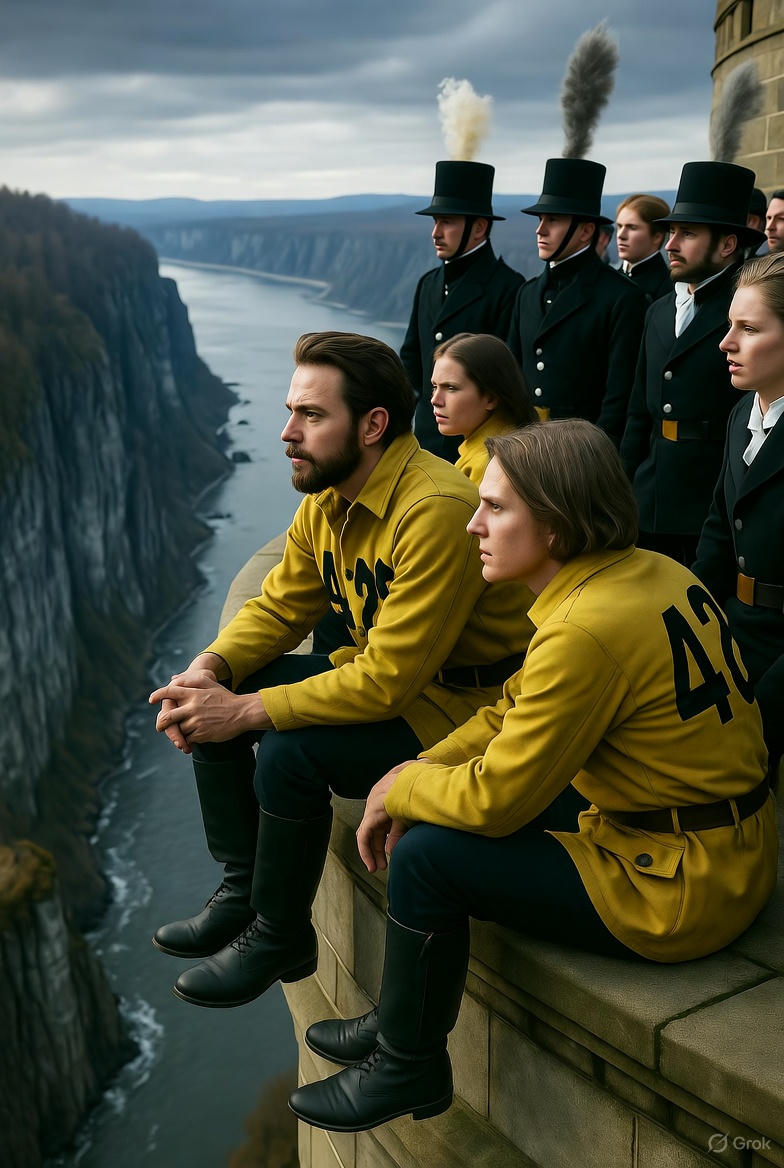
FRANK Braun sat above on the ramparts of Festung
Ehrenbreitstein, a fortified castle overlooking Koblentz. He
had sat there for two months already and still had three
more to sit, through the entire summer. Just because he had
shot a hole through the air, and through his opponent as well.
He was bored. He sat up high on the parapet of the tower, legs
dangling over the edge looking at the wide broad view of the Rhine
from the steep cliffs. He looked into the blue expanse and yawned,
exactly like his three comrades that sat next to him. No one spoke a
word.
They wore yellow canvas jackets that the soldiers had given
them. Their attendants had painted large black numbers on the backs
of their jackets to signify their cells. No.’s two, fourteen and six sat
there; Frank Braun wore the number seven.
Then a troop of foreigners came up into the tower, Englishmen
and Englishwomen led by the sergeant of the watch. He showed them
the poor prisoners with the large numbers sitting there so forlorn.
They were moved with sympathy and with “oohs” and “ahs” asked
the sergeant if they could give the miserable wretches anything.
“That is expressly forbidden,” he said. “I better not see any of
you doing it.”
But he had a big heart and turned his back as he explained the
region around them to the gentlemen.
“There is Koblenz,” he said, “and over there behind it is
Neuwied. Down there is the Rhine–”
Meanwhile the ladies had come up. The poor prisoner stretched
out his hands behind him, held them open right under his number.
Gold pieces, cigarettes and tobacco were dropped into them,
sometimes even a business card with an address.
That was the game Frank Braun had contrived and introduced up
here.
“That is a real disgrace,” said No. fourteen. It was the cavalry
captain, Baron Flechtheim.
“You are an idiot,” said Frank Braun. “What is disgraceful is that
we fancy ourselves so refined that we give everything to the petty
officers and don’t keep anything for ourselves. If only the damned
English cigarettes weren’t so perfumed.”
He inspected the loot.
“There! Another pound piece! The Sergeant will be very happy–
God, I made out well today!”
“How much did you lose yesterday?” asked No. two.
Frank Braun laughed, “Pah, everything I made the day before
plus a couple of blue notes. Fetch the executioner his block!”
No. six was a very young ensign, a young pasty faced boy that
looked like milk and blood. He sighed deeply.
“I too have lost everything.”
“So, do you think we did any better?” No. fourteen snarled at
him, “And to think those three scoundrels are now in Paris amusing
themselves with our money! How long do you think they will stay?”
Dr. Klaverjahn, marine doctor, fortress prisoner No. two said, “I
estimate three days. They can’t stay away any longer than that
without someone noticing. Besides, their money won’t last that long!”
They were speaking of No.’s four, five and twelve who had
heartily won last night, had early this morning climbed down the hill
and caught the early train to Paris–“R and R”–a little rest and
relaxation, is what they called it in the fortress.
“What will we do this afternoon?” No. fourteen asked.
“Will you just once think for yourself!” Frank Braun cried to the
cavalry captain.
He sprang down from the wall, went through the barracks into
the officer’s garden. He felt grumpy, whistled to get inside. Not
grumpy because he had lost the game, that happened to him often and
didn’t bother him at all. It was this deplorable sojourn up here, this
unbearable monotony.
Certainly the fortress confinement was light enough and none of
the gentlemen prisoners were ever injured or tormented. They even
had their own casino up here with a piano and a harmonium. There
were two dozen newspapers. Everyone had their own attendant and all
the cells were large rooms, almost halls, for which they paid the
government rent of a penny a day. They had meals sent up from the
best guesthouses in the city and their wine cellar was in excellent
condition.
If there was anything to find fault with, it was that you couldn’t
lock your room from the inside. That was the single point the
commander was very serious about. Once a suicide had occurred and
ever since any attempt to bring a bolt in brought severe punishment.
“It was idiotic thought,” Frank Braun, “as if you couldn’t commit
suicide without bolts on your door!”
The missing bolt pained him every day and ruined all the joy in it
by making it impossible to be alone in the fortress. He had shut his
door with rope and chain, put his bed and all the other furniture in
front of it. But it had been useless. After a war that lasted for hours
everything in his room was demolished and battered to pieces. The
entire company stood triumphant in the middle of his room.
Oh what a company! Every single one of them was a harmless,
kind and good-natured fellow. Every single one–to a man, could chat
by themselves for half an hour–But together, together they were
insufferable. Mostly, it was their comments, that they were all
depressed. This wild mixture of officers and students forgot their high
stations and always talked of the foolish happenings at the fortress.
They sang, they drank, they played. One day, one night, like all the
rest. In between were a few girls that they dragged up here and a few
outings down to the town below. Those were their heroic deeds and
they didn’t talk about anything else!
The ones that had been here the longest were the worst, entirely
depraved and caught up in this perpetual cycle. Dr. Burmüller had
shot his brother-in-law dead and had sat up here for two years now.
His neighbor, the Dragoon lieutenant, Baron von Vallendar had been
enjoying the good air up here for a half year longer than that. And the
new ones that came in, scarcely a week went by without them trying
to prove who was the crudest and wildest–They were held in highest
regard.
Frank Braun was held in high regard. He had locked up the piano
on the second day because he didn’t want to listen any more to the
horrible “Song of Spring” the cavalry captain kept playing. He put the
key in his pocket, went outside and then threw it over the fortress
wall. He had also brought his dueling pistols with him and shot them
all day long. He could guzzle and escape as well as anyone up here.
Really, he had enjoyed these summer months at the fortress. He
had dragged in a pile of books, a new writing quill and sheets of
writing paper, believing he could work here, looking forward to the
constraint of the solitude. But he hadn’t been able to open a book, had
not written one letter.
Instead he had been pulled into this wild childish whirlpool that
he loathed and went along with it day after day. He hated his
comrades–every single one of them–
His attendant came into the garden, saluted:
“Herr Doctor, A letter for you.”
A letter? On Sunday afternoon? He took it out of the soldier’s
hand. It was a special express letter that had been forwarded to him up
here. He recognized the thin scrawl of his uncle’s handwriting. From
him? What did his uncle suddenly want of him? He weighed the letter
in his hand.
Oh, he was tempted to send the letter back, “delivery refused”.
What was going on with the old professor anyway? Yes, the last time
he had seen him was when he had traveled back to Lendenich with
him after the celebration at the Gontrams. That was when he had tried
to persuade his uncle to create an alraune creature. That was two years
ago.
Ah, now it was all coming back to him! He had gone to a
different university, had passed his exams. Then he had sat in a hole
in Lorraine–busy as a junior attorney–Busy? Bah, he had set out in
life thinking he would travel when he got out of college. He was
popular with the women, and with those that loved a loose life and
wild ways. His superior viewed him very unfavorably.
Oh yes, he worked, a bit here and there–for himself. But it was
always what his superior called public nuisance cases. He sneaked
away when he could, traveled to Paris. It was better at the house on
Butte Sacrée than in court. He didn’t know for sure where it would all
lead. It was certain that he would never be a jurist, attorney, judge or
other public servant. But then, what should he do? He lived there, got
into more debt every day–
Now he held this letter in his hand and felt torn between ripping
it open and sending it back like it was as a late answer to a different
letter his uncle had written him two years ago.
It had been shortly after that night. He had ridden through the
village at midnight with five other students, back from an outing into
the seven mountains. On a sudden impulse he had invited them all to
a late midnight meal at the ten Brinken house.
They tore at the bell, yelled loudly and hammered against the
wrought iron door making such a noise that the entire village came
running out to see what was happening. The Privy Councilor was
away on a journey but the servant let them in on the nephew’s
command. The horses were taken to the stable and Frank Braun woke
the household, ordered them to prepare a great feast. Frank Braun
went into his uncle’s cellar and brought out the finest wines.
They feasted, drank and sang, roared through the house and
garden, made noises, howled and smashed things with their fists.
Early the next morning they rode home, bawling and screaming,
hanging on to their nags like wild cowboys, one or two flopping like
old meal sacks.
“The young gentlemen behaved like pigs,” reported Aloys to the
Privy Councilor. Yet, that wasn’t it. That wasn’t what had made his
uncle so angry. He didn’t say anything about it.
On the buffet there had been some rare apples, dew fresh
nectarines, pears and peaches out of his greenhouse. These precious
fruits had been picked with unspeakable care, wrapped in cotton and
laid on golden plates to ripen. But the students had no reverence at all
for the professor’s loves, were not respectful of anything that had
been there. They had bitten into these fruits, then because they were
not ripe, had put them back down on the plates. That was what he was
angry about.
He wrote his nephew an embittered letter requesting him to never
again set foot in his house. Frank Braun was just as deeply hurt over
the reason for the letter, which he perceived as pathetically petty.
Ah yes, if he had gotten this letter, the one he was now holding,
while living in Metz or even in Montmartre–he wouldn’t have
hesitated a second before giving it back to the messenger. But he was
here–here in this horrible boredom of the fortress.
He decided.
“It will be a diversion in any case,” he murmured as he opened
the letter.
His uncle shared with him that after careful consideration he was
willing to follow the suggestions his nephew had given him to the last
letter. He already had a suitable candidate for the father. The stay of
execution for the murderer Raul Noerrissen had been denied and he
had no further appeals possible. Now his uncle was looking for a
mother.
He had already made an attempt without success. Unfortunately
it was not easy to find just the right one but time pressed and he was
now asking for assistance in this matter from his nephew.
Frank Braun looked at his valet, “Is the letter courier still here?”
he asked.
“At your command Herr Doctor, ” the soldier informed him.
“Tell him to wait. Here give him some drink money.”
He searched in his pockets and found a Mark piece. Then he
hurried back to the prisoner’s quarters letter in hand. He had scarcely
arrived at the barracks courtyard when the wife of the Sergeant-major
came towards him with a dispatch.
“A telegram for you!” she cried.
It was from Dr. Petersen, the Privy Councilor’s assistant. It read:
“His Excellency has been at the Hotel de Rome in Berlin since
the day before yesterday. Await reply if you can meet. With heartfelt
greetings.”
His Excellency? So his uncle was now “ His Excellency” and
that was why he was in Berlin–In Berlin–that was too bad. He would
have much rather traveled to Paris. It would have been much easier to
find someone there and someone better as well. All the same, Berlin it
was. At least it would be an interruption of this wilderness.
He considered for a moment. He needed to leave this evening but
didn’t have a penny to his name and his comrades didn’t either. He
looked at the woman.
“Frau Sergeant-major–” he began. But no, that wouldn’t work.
He finished, “Buy the man a drink and put it on my tab.”
He went to his room, packed his suitcase and commanded the
boy to take it straight to the train station and wait for him there. Then
he went down. The Sergeant-major, the overseer of the prison house,
was standing in the door wringing his hands and almost broken up.
“You are about to leave, Herr Doctor,” he lamented, “and the
other three gentlemen are already gone to Paris, not even in this
country! Dear God, no good can come out of this. It will fall on me
alone–I carry all the responsibility.”
“It’s not that bad,” answered Frank Braun. “I’m only going to be
gone for a few days and the other gentlemen will be back soon.”
The Sergeant-major continued to complain, “It’s not my fault,
most certainly not! But the others are so jealous of me and today
Sergeant Bekker has the watch. He–”
“He will keep his mouth shut,” Frank Braun replied. “He just got
over thirty Marks from us–charitable donations from the English–By
the way, I’m going to the commander in Coblenz to ask for a leave of
absence–Are you satisfied now?”

Read Full Post »

Madame Bluebeard by Karl Hans Strobl and translated by Joe E Bandel

Chapter Four
After dinner, Ruprecht wandered into the castle
garden. Frau Helmina, weary, had asked to retire
early. But Ruprecht wasn’t sleepy. Everything in him
was alert, poised, expectant.
The autumn evening was cool, dry leaves rustling
on the paths. This old castle had its romance. It must
once have been vast, for the garden was laid over a
field of ruins. Crumbling walls enclosed it; fragments
of ramparts stood among trees and shrubs. Ruprecht
passed pointed door arches or windows framed by
massive stones, upright amid rubble heaps. Near one
wing, linked by a covered wooden passage, stood a
stout tower, less decayed than the rest. Squat and
solid, it rose in a small birch grove, their white trunks
like shivering skeletons. Ruprecht pushed to the
round tower wall, spotting high above a black
opening—one of those inaccessible tower doors
reachable only by ladder.
It wasn’t exactly cozy here. The waning moon’s
light was pale and mournful, shrinking shyly from
darker shadows. Squinting, leaving only a narrow
slit, it seemed as if everything—ruined walls, trees,
shrubs—swam in a phosphorescent haze, the air of a
distant, alien star.
Ruprecht thrust his hands into his pockets, puffed
his cigar, and turned back toward the castle. Yellow-
red lights glowed in a few windows. Perhaps one was
Helmina’s bedroom. Yes—it was time to clarify
everything. Ruprecht wasn’t one for lingering
indecision. He knew Helmina drew him like no
woman since… since that one—oh, enough! He
pushed back old, painful memories. What use were
they now? A decision was needed.
Let’s be honest, dear fellow, he told himself.
We’ve already decided. Helmina retired to give you
time to think. It’s superfluous. Tomorrow, I’ll ask her
to be my wife. Oh—how beautiful she is, how
dangerous. I readily believe she killed her three
husbands—the mountaineer, the stroke candidate, the
bookworm. Cripples of life, poor devils, no match for
this splendid beast. But we, Frau Helmina, we have
fists and teeth. I’m eager to show you, lovely lady.
She’s cruel as a tigress. How she dismissed that poor
baron today—one, two, three, a stab to the heart. No
sentimentality to fear from her. I doubt she has tear
ducts. At dinner tonight, for instance. I ask, “Baron
Kestelli’s your neighbor, isn’t he?” She replies, “Oh,
he passes my time now and then.” Her teeth flashed
like a toothpaste ad, her words dripping venomous
scorn, a ruthless slaughter. Oh… I believe her soul
has regions like… like this garden—dark, filled with
secrets, whispering shadows, perhaps ruins of the
past. Let’s enter this garden… something new
awaits.*
His cigar had gone out. Striking a match, he saw
his cupped hands, shielding the flame, glow red
briefly, then darkness returned. Only the cigar’s
ember pulsed near his mouth. He walked slowly to
the castle, climbed the narrow, winding stair to his
room, and began undressing. Both windows stood
open. As he was about to lie down, a strange howling
began—starting low, rising to a high, thin quiver, like
vocal cords stretched to their limit. It was followed
by empty jabbering, clearly a prayer, words hopping
like peas on tin. Ruprecht peered out. In the servants’
wing below, a lit room glowed. Leaning forward, he
glimpsed part of it. A woman with gray, tangled hair
knelt at a table, head pressed to its edge. The
jabbering and clattering gave way to howling, now
weaving through varied modulations. Ruprecht found
it intriguing but unsettling. It didn’t last. Footsteps
crossed the courtyard. A broad back blocked the
window. “This whining again?” growled a muffled
bear’s voice. It was Lorenz, the robust valet, a mix of
sailor and masseur. A window slammed, glass
rattling.
Ruprecht withdrew. The castle fell silent, and
sleep drifted from the ceiling’s beams and the thick
Persian prayer rugs on the walls.
In the morning, Ruprecht met the castle’s mistress
in the breakfast room. The balcony door was open, a
crisp breeze wafting from the steaming meadows
around the castle. Mist prickled damply on the skin.
From the balcony, one looked down on the courtyard,
the ancient linden, and beyond the castle wall, the
chestnut treetops lining the path in double rows.
Helmina wore a wide kimono of green silk,
adorned not lavishly but tastefully with gold
embroidery. Ruprecht loved such loose, comfortable
garments. He smiled. As if she knew, he thought.
“How did you sleep?” Helmina asked.
“So well, I wish I could always sleep somewhere
not too far from you.” Ruprecht looked straight at
her. She lowered her eyes, but not fast enough to hide
a glint of triumph. No doubt—she reveled in her
victory.
“I hear,” Helmina said after a brief pause,
preserving the weight of his words, “our old
Marianne had another fit last night. I hope it didn’t
disturb you too long. I can’t turn the old woman out.
She’s served me for years. Some religious mania
grips her. She must atone for our sins, so she prays
and sings in the night.”
“Nothing could spoil my stay with you.”
Helmina raised her head. Morning sunlight, soft
and golden, slid across her brow. “Thank you for
your kindness, Herr von Boschan. But please, no
such talk before others. Young widows are too easily
slandered.”
“Listen, madam, I’m independent. My wealth lets
me live as I please. I’ve no relatives, no one with
claims on me.”
With soft steps, Helmina moved to the balcony.
Ruprecht followed. They sat in low, deeply curved
wicker chairs, facing each other. Helmina leaned
back, hands clasped behind her head. “Why tell me
this, Herr von Boschan?” she asked. Her mouth
twitched with lively muscle play, shifting its
expression constantly.
“Can’t you guess?”
“Let me tell you something: I’ve been married
three times.”
“I hope that won’t stop you from trying a fourth.”
“I know you’re restless. You’ve traveled far.
Soon, that urge will return. You’ll want to leave,
unhappy if you can’t. I’m quite comfortable,
disinclined to great exertions.”
“That’s your guarantee. I’m done with it. I want to
take root somewhere. Have a purpose. The land calls
to hold me fast. I regret selling my estates when I set
out to see the world—a castle in Styria, a farm in
Upper Austria. Now my wealth sits in a bank. I’d be
happy to become a farmer again.”
“Oh! You’d have to forgo living on your estates. I
can’t leave this old nest.”
Ruprecht took her hand. “That’s half a yes,
Helmina,” he said.
“Take it as a full one, Ruprecht,” she replied. She
rose, and he stood too. They faced each other, chest
to chest. “I’m young. I’m tired of widowhood.” Her
eyes burned. He raised his arms, embraced her, and
kissed her. They trembled with fierce desire.
Two children’s voices squealed in the courtyard.
“Mama!” Lissy called.
Helmina leaned over the balcony railing. “Come
up,” she said. “You’ll find the Papa you wished for.”
Ruprecht settled into his new role with happy
ease, noting without regret that he was engaged.
Sometimes he smiled, imagining his friends’
reactions. They’d soon be surprised. In a month,
Helmina’s mourning year would end, and the
wedding would proceed without delay.
Helmina allowed Ruprecht only eight more days
at the castle. Propriety demanded the groom be kept
from the bride. Jana, his Malay servant, was
summoned from Vienna with suitcases. During those
days, Ruprecht rode with Helmina across the fields.
He found them poorly managed—much work needed
here. He resolved to oversee it himself. “What do you
expect?” Helmina laughed. “My stewards are useless.
I know it. They’re all too in love with me to run my
estate properly.”
She was right. Her stewards fumed seeing her with
Ruprecht, even before learning he was her fiancé.
The paper factory clerks glared too. Ruprecht was the
intruder, shattering a host of rapturous hopes. Despite
Helmina’s ban, news of her engagement leaked from
the castle, turning anger into silent, envious hatred.
The day before his departure, returning from a
morning forest walk, Ruprecht found Baron Kestelli
with Helmina. His entrance cut their talk short. The
baron rose, bowed to Ruprecht, and left. His face
showed he couldn’t bear the groom’s presence.
“He must be deeply in love,” Ruprecht said,
unable to suppress the victor’s thrill, despite a twinge
of pity for the young man. “He looks tortured, unable
to control himself.”

Read Full Post »

« Newer Posts - Older Posts »