Madame Bluebeard by Karl Hans Strobl and translated by Joe E Bandel
“He’s still very young,” Helmina replied
carelessly, brushing her lips with a tiny batiste
handkerchief, “and very much in love.”
Helmina and the children accompanied Ruprecht
by carriage to the train, a two-hour journey to the
next station. From the forested basin cradling
Vorderschluder, the road wound between mountain
spurs to the high plateau. Each loop, each turn
seemed like the forest had thrown up barriers to
hinder the road’s climb and block the world’s path to
the secluded village.
Ruprecht walked arm-in-arm with Helmina across
the Gars platform. The stationmaster, in his red cap,
passed by, saluted, and stole a glance. He leaned to
the open window of the telegraphist’s office,
whispering, prompting the young clerk to crane his
neck and roll his eyes. The girls had found the
stationmaster’s old dog in a corner, tugging its long
black tufts, but darted to Ruprecht every moment.
“You must come back soon, Papa!” “What will you
bring me, Papa?” “Will you race down the castle hill
with us, Papa?”
“That’s him, then. Must be fabulously rich,” the
stationmaster muttered, picturing a roasted peacock
and an automobile—his symbols of vast wealth.
The young telegraphist sighed. In dreams, he’d
embraced this young widow, claiming her by the
poet’s right, his desk drawer stuffed with a half-kilo
of tender verses. Done! Finished! The world’s
brutality had won.
The train approached. The stationmaster scurried
from one end of the platform to the other, as if
restraining a frantic crowd. He was thrilled to wear
his new trousers with crisp creases. If only his wife
would leave her window post, he’d have seized the
chance to offer Frau Dankwardt—still Frau
Dankwardt—some respectful homage. One must
make an impression. Perhaps an invite to the wedding
feast…
Ruprecht took his leave. Two children’s kisses,
then a red, full, fragrant mouth. All aboard!
Oh, it was only for a few days… A grating screech
jolted the train, rattling teeth. Then, farewell!
Two heron feathers nodded. A luxurious blue-gray
fur glimmered softly around her lovely shoulders…
the train rounded the castle hill…
Ruprecht von Boschan dove into work. There was
plenty to do. First, he gathered all papers needed for
the wedding. He loathed bureaucracies—offices,
waiting rooms, clerks, petitions, stamps. He’d lived
as if such things didn’t exist. Now, he needed them
all, a humbling crawl. Each errand required
overcoming inner resistance.
He also wanted to finish a project. With the clear,
untheorized gaze of a traveler, he’d formed
judgments on economic conditions. Many differed
from common assumptions. It would benefit his
homeland to learn where it lost or gained. He’d
begun a book on these matters and now aimed to
complete it, writing late into the night. Looking up
from his manuscript, he saw two white heron feathers
and a softly shimmering blue-gray fur.
Finally, his financial affairs needed settling.
He visited his bank, requesting a meeting with the
director. Sunk in a gray leather club chair, he outlined
his plan to Herr Siegl, who sat opposite. Siegl’s short,
stout, bowed legs formed an O wide enough to roll a
barrel through. A black-rimmed pince-nez quivered
on his thick nose’s tip, dangling as if begging to fall,
saved by its cord. His bulging belly rippled in his
white vest.
Above them, electric light burned in a milky tulip,
iron tendrils hanging down. Outside was bright day,
but here, year-round, this flame glowed. One might
think it an underground vault. With iron shutters and
padded doors, the room seemed built to guard secrets.
A faint metallic clink hummed—gold coins rubbing
together or stacked in rolls.
“Well, Herr von Boschan,” Siegl said after
Ruprecht explained his financial strategy, “I’d
recommend a marriage contract stipulating complete
separation of assets.”
“Why? Doesn’t that seem mistrustful? Have you
specific reasons for this suggestion?”
“Why? What can I say, Herr von Boschan? Better
safe than sorry! Frau von Dankwardt plays the stock
market.”
“Does she? And you think? With what success?”
Siegl rocked his head, his pince-nez dancing, the
ripple in his vest disrupted.
“Well… as one does on the market. You win, you
lose!”
“You may be right, Director,” Ruprecht said
thoughtfully.
“Right? Of course I’m right!” Siegl leaned
forward, placing a plump hand on Ruprecht’s knee.
“And then—someone inquired about your finances
here. Twice, Herr von Boschan!”
“Who?”
“I don’t know. Not the one who asked, at any
rate.”
“What did you say?”
“What did we say? Are we an inquiry bureau for
our clients? We said, ‘The man’s solid.’ What more
needs knowing?”
Ruprecht decided to follow Siegl’s advice.
Every other day, a fragrant letter arrived from
Vorderschluder. The one responding to his request
for asset separation smelled less sweet. The beautiful
writer was hurt, indignant. “Oh, that leaves a sting!”
Helmina wrote. Ruprecht wanted no thorn in his
bride’s soul. He replied that, while insisting on
separation, he was open to mutual inheritance
provisions.
“Let’s not overvalue such things,” Helmina wrote
back. “Have it your way. I agree. The date nears. We
have more pressing matters.”
The date arrived.
Ruprecht reached Vorderschluder the evening before the wedding.
Jana, the Malay, managed the luggage. Village
youths gaped, awestruck. They’d never seen such a
figure. “Well, there’s all sorts in the world,” said the
Red Ox’s kindly landlady, and even the headmaster
had to agree.
The bachelor party was intimate—the estate
manager, head forester, priest, factory director, and
bookkeeper attended, along with the notary who’d
witnessed the marriage contract’s signing. Baron
Kestelli, invited, had excused himself but would
attend the ceremony. That relatives of Helmina’s last
husband stayed away was understandable.
The next morning, Ruprecht’s witnesses arrived:
Ernst Hugo, the court secretary, and another old
friend, Wetzl, a quiet, dark chemist famed for radium
experiments.
Hugo flung his arms like windmill blades,
enveloping Ruprecht. “Man,” he shouted, “all I’ll say
is: when a man’s lucky, he’s lucky!”
Turning to Frau Helmina, he placed a hand on his
impeccable frock coat’s left flap. “If you knew,
madam… I admired you in Abbazia. I was promised
an introduction the next day. The next day, you were
gone.”
Helmina, in a simple gray dress, smiled and
offered her hand. “My husband’s friends are mine.”
God! Hugo thought. That look. I’m lost. I’ll dream of
her.
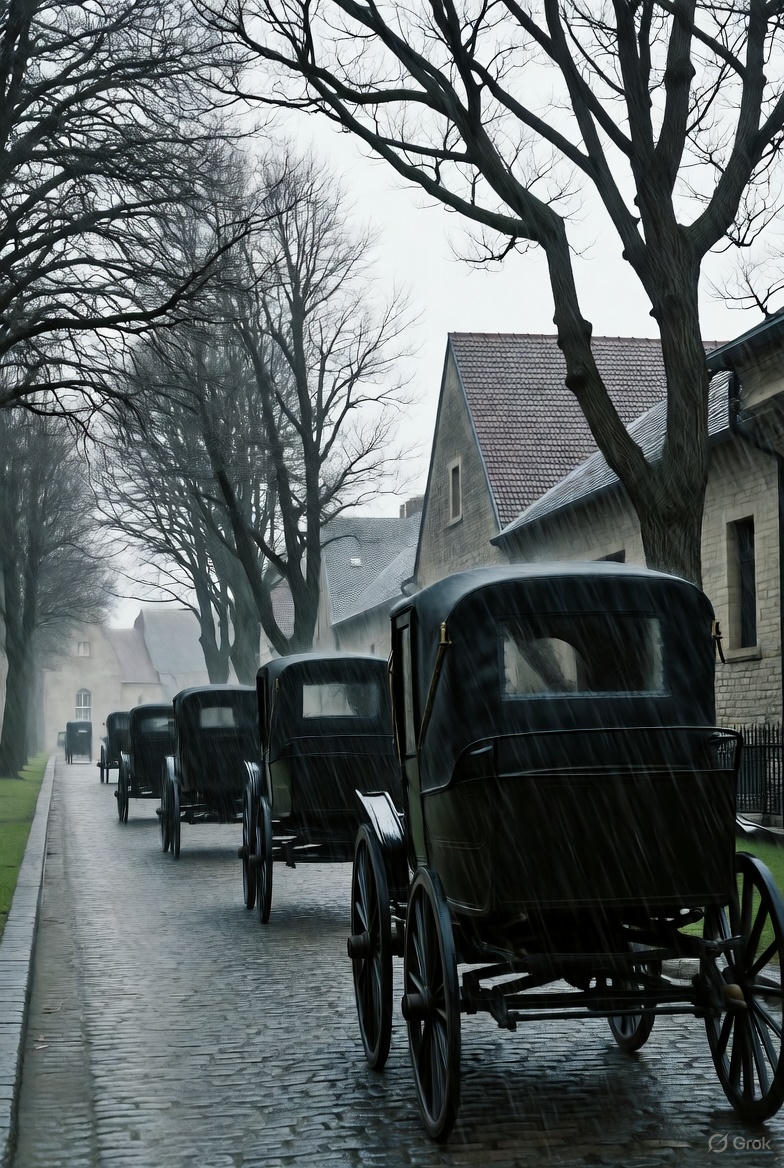
Carriages waited in the courtyard. They drove
slowly, brakes grinding, between bare chestnut trees
down the castle hill. The weather was unkind. A cold
November wind raged in the forested basin, plunging
from a gray sky, whipping rain showers. Castle
weathervanes shrieked, naked branches clashed.
The peasants stood before their houses, straining
to peer into the closed carriages. No cheers, no
greetings, nothing… they wore dark, hostile scowls.
“Your honeymoon’s to the south, naturally,” Hugo
said to Ruprecht.
“We’re not taking a honeymoon. We’re staying
home.”
“Oh!” Hugo pictured warm, cozy rooms, crackling
fires, shrieking weathervanes, humming teakettles,
and soft, flowing silk-and-lace nightgowns. Good
heavens!
Ruprecht sensed his friend’s envy. He felt it like a
cloud over the congregation in the church. The
guests’ strained postures, their polite smiles, were
mere grimaces, hiding nothing from him. Yet, from
this, he drew strength to prevail. Calmly, confidently
smiling, he led Helmina to the altar. She turned her
face to him. Her eyes shimmered with iridescent
brilliance. Oh, this danger—this wondrous, blissful,
sweet danger of the love-battle he was entering!
What is life without this danger?
The priest delivered his words, binding them in an
unbreakable union.
Then they received congratulations. First, Baron Kestelli, Helmina’s
witness, approached. His face was contorted. He
could say nothing.


 Anarchistbanjo's World
Leave a comment