Alraune by Hanns Heinz Ewers and translated by Joe E Bandel
Chapter Four
Gives the particulars of how they found Alraune’s mother
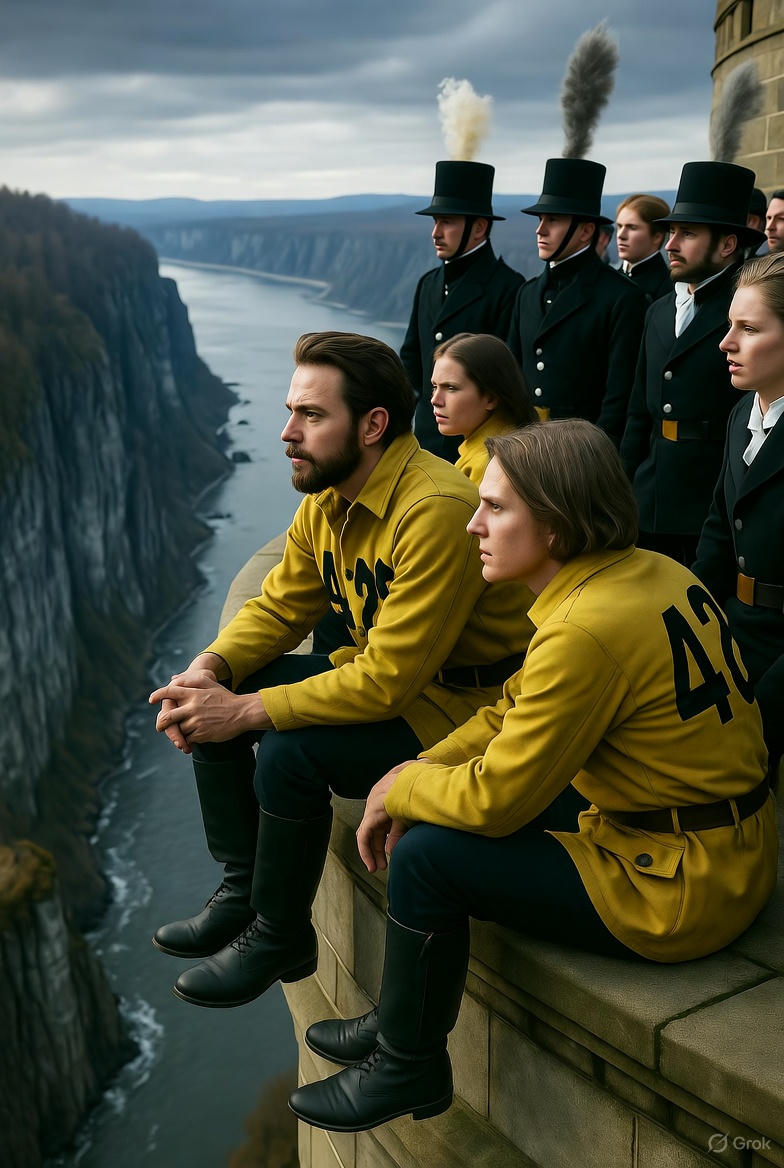
FRANK Braun sat above on the ramparts of Festung
Ehrenbreitstein, a fortified castle overlooking Koblentz. He
had sat there for two months already and still had three
more to sit, through the entire summer. Just because he had
shot a hole through the air, and through his opponent as well.
He was bored. He sat up high on the parapet of the tower, legs
dangling over the edge looking at the wide broad view of the Rhine
from the steep cliffs. He looked into the blue expanse and yawned,
exactly like his three comrades that sat next to him. No one spoke a
word.
They wore yellow canvas jackets that the soldiers had given
them. Their attendants had painted large black numbers on the backs
of their jackets to signify their cells. No.’s two, fourteen and six sat
there; Frank Braun wore the number seven.
Then a troop of foreigners came up into the tower, Englishmen
and Englishwomen led by the sergeant of the watch. He showed them
the poor prisoners with the large numbers sitting there so forlorn.
They were moved with sympathy and with “oohs” and “ahs” asked
the sergeant if they could give the miserable wretches anything.
“That is expressly forbidden,” he said. “I better not see any of
you doing it.”
But he had a big heart and turned his back as he explained the
region around them to the gentlemen.
“There is Koblenz,” he said, “and over there behind it is
Neuwied. Down there is the Rhine–”
Meanwhile the ladies had come up. The poor prisoner stretched
out his hands behind him, held them open right under his number.
Gold pieces, cigarettes and tobacco were dropped into them,
sometimes even a business card with an address.
That was the game Frank Braun had contrived and introduced up
here.
“That is a real disgrace,” said No. fourteen. It was the cavalry
captain, Baron Flechtheim.
“You are an idiot,” said Frank Braun. “What is disgraceful is that
we fancy ourselves so refined that we give everything to the petty
officers and don’t keep anything for ourselves. If only the damned
English cigarettes weren’t so perfumed.”
He inspected the loot.
“There! Another pound piece! The Sergeant will be very happy–
God, I made out well today!”
“How much did you lose yesterday?” asked No. two.
Frank Braun laughed, “Pah, everything I made the day before
plus a couple of blue notes. Fetch the executioner his block!”
No. six was a very young ensign, a young pasty faced boy that
looked like milk and blood. He sighed deeply.
“I too have lost everything.”
“So, do you think we did any better?” No. fourteen snarled at
him, “And to think those three scoundrels are now in Paris amusing
themselves with our money! How long do you think they will stay?”
Dr. Klaverjahn, marine doctor, fortress prisoner No. two said, “I
estimate three days. They can’t stay away any longer than that
without someone noticing. Besides, their money won’t last that long!”
They were speaking of No.’s four, five and twelve who had
heartily won last night, had early this morning climbed down the hill
and caught the early train to Paris–“R and R”–a little rest and
relaxation, is what they called it in the fortress.
“What will we do this afternoon?” No. fourteen asked.
“Will you just once think for yourself!” Frank Braun cried to the
cavalry captain.
He sprang down from the wall, went through the barracks into
the officer’s garden. He felt grumpy, whistled to get inside. Not
grumpy because he had lost the game, that happened to him often and
didn’t bother him at all. It was this deplorable sojourn up here, this
unbearable monotony.
Certainly the fortress confinement was light enough and none of
the gentlemen prisoners were ever injured or tormented. They even
had their own casino up here with a piano and a harmonium. There
were two dozen newspapers. Everyone had their own attendant and all
the cells were large rooms, almost halls, for which they paid the
government rent of a penny a day. They had meals sent up from the
best guesthouses in the city and their wine cellar was in excellent
condition.
If there was anything to find fault with, it was that you couldn’t
lock your room from the inside. That was the single point the
commander was very serious about. Once a suicide had occurred and
ever since any attempt to bring a bolt in brought severe punishment.
“It was idiotic thought,” Frank Braun, “as if you couldn’t commit
suicide without bolts on your door!”
The missing bolt pained him every day and ruined all the joy in it
by making it impossible to be alone in the fortress. He had shut his
door with rope and chain, put his bed and all the other furniture in
front of it. But it had been useless. After a war that lasted for hours
everything in his room was demolished and battered to pieces. The
entire company stood triumphant in the middle of his room.
Oh what a company! Every single one of them was a harmless,
kind and good-natured fellow. Every single one–to a man, could chat
by themselves for half an hour–But together, together they were
insufferable. Mostly, it was their comments, that they were all
depressed. This wild mixture of officers and students forgot their high
stations and always talked of the foolish happenings at the fortress.
They sang, they drank, they played. One day, one night, like all the
rest. In between were a few girls that they dragged up here and a few
outings down to the town below. Those were their heroic deeds and
they didn’t talk about anything else!
The ones that had been here the longest were the worst, entirely
depraved and caught up in this perpetual cycle. Dr. Burmüller had
shot his brother-in-law dead and had sat up here for two years now.
His neighbor, the Dragoon lieutenant, Baron von Vallendar had been
enjoying the good air up here for a half year longer than that. And the
new ones that came in, scarcely a week went by without them trying
to prove who was the crudest and wildest–They were held in highest
regard.
Frank Braun was held in high regard. He had locked up the piano
on the second day because he didn’t want to listen any more to the
horrible “Song of Spring” the cavalry captain kept playing. He put the
key in his pocket, went outside and then threw it over the fortress
wall. He had also brought his dueling pistols with him and shot them
all day long. He could guzzle and escape as well as anyone up here.
Really, he had enjoyed these summer months at the fortress. He
had dragged in a pile of books, a new writing quill and sheets of
writing paper, believing he could work here, looking forward to the
constraint of the solitude. But he hadn’t been able to open a book, had
not written one letter.
Instead he had been pulled into this wild childish whirlpool that
he loathed and went along with it day after day. He hated his
comrades–every single one of them–
His attendant came into the garden, saluted:
“Herr Doctor, A letter for you.”
A letter? On Sunday afternoon? He took it out of the soldier’s
hand. It was a special express letter that had been forwarded to him up
here. He recognized the thin scrawl of his uncle’s handwriting. From
him? What did his uncle suddenly want of him? He weighed the letter
in his hand.
Oh, he was tempted to send the letter back, “delivery refused”.
What was going on with the old professor anyway? Yes, the last time
he had seen him was when he had traveled back to Lendenich with
him after the celebration at the Gontrams. That was when he had tried
to persuade his uncle to create an alraune creature. That was two years
ago.
Ah, now it was all coming back to him! He had gone to a
different university, had passed his exams. Then he had sat in a hole
in Lorraine–busy as a junior attorney–Busy? Bah, he had set out in
life thinking he would travel when he got out of college. He was
popular with the women, and with those that loved a loose life and
wild ways. His superior viewed him very unfavorably.
Oh yes, he worked, a bit here and there–for himself. But it was
always what his superior called public nuisance cases. He sneaked
away when he could, traveled to Paris. It was better at the house on
Butte Sacrée than in court. He didn’t know for sure where it would all
lead. It was certain that he would never be a jurist, attorney, judge or
other public servant. But then, what should he do? He lived there, got
into more debt every day–
Now he held this letter in his hand and felt torn between ripping
it open and sending it back like it was as a late answer to a different
letter his uncle had written him two years ago.
It had been shortly after that night. He had ridden through the
village at midnight with five other students, back from an outing into
the seven mountains. On a sudden impulse he had invited them all to
a late midnight meal at the ten Brinken house.
They tore at the bell, yelled loudly and hammered against the
wrought iron door making such a noise that the entire village came
running out to see what was happening. The Privy Councilor was
away on a journey but the servant let them in on the nephew’s
command. The horses were taken to the stable and Frank Braun woke
the household, ordered them to prepare a great feast. Frank Braun
went into his uncle’s cellar and brought out the finest wines.
They feasted, drank and sang, roared through the house and
garden, made noises, howled and smashed things with their fists.
Early the next morning they rode home, bawling and screaming,
hanging on to their nags like wild cowboys, one or two flopping like
old meal sacks.
“The young gentlemen behaved like pigs,” reported Aloys to the
Privy Councilor. Yet, that wasn’t it. That wasn’t what had made his
uncle so angry. He didn’t say anything about it.
On the buffet there had been some rare apples, dew fresh
nectarines, pears and peaches out of his greenhouse. These precious
fruits had been picked with unspeakable care, wrapped in cotton and
laid on golden plates to ripen. But the students had no reverence at all
for the professor’s loves, were not respectful of anything that had
been there. They had bitten into these fruits, then because they were
not ripe, had put them back down on the plates. That was what he was
angry about.
He wrote his nephew an embittered letter requesting him to never
again set foot in his house. Frank Braun was just as deeply hurt over
the reason for the letter, which he perceived as pathetically petty.
Ah yes, if he had gotten this letter, the one he was now holding,
while living in Metz or even in Montmartre–he wouldn’t have
hesitated a second before giving it back to the messenger. But he was
here–here in this horrible boredom of the fortress.
He decided.
“It will be a diversion in any case,” he murmured as he opened
the letter.
His uncle shared with him that after careful consideration he was
willing to follow the suggestions his nephew had given him to the last
letter. He already had a suitable candidate for the father. The stay of
execution for the murderer Raul Noerrissen had been denied and he
had no further appeals possible. Now his uncle was looking for a
mother.
He had already made an attempt without success. Unfortunately
it was not easy to find just the right one but time pressed and he was
now asking for assistance in this matter from his nephew.
Frank Braun looked at his valet, “Is the letter courier still here?”
he asked.
“At your command Herr Doctor, ” the soldier informed him.
“Tell him to wait. Here give him some drink money.”
He searched in his pockets and found a Mark piece. Then he
hurried back to the prisoner’s quarters letter in hand. He had scarcely
arrived at the barracks courtyard when the wife of the Sergeant-major
came towards him with a dispatch.
“A telegram for you!” she cried.
It was from Dr. Petersen, the Privy Councilor’s assistant. It read:
“His Excellency has been at the Hotel de Rome in Berlin since
the day before yesterday. Await reply if you can meet. With heartfelt
greetings.”
His Excellency? So his uncle was now “ His Excellency” and
that was why he was in Berlin–In Berlin–that was too bad. He would
have much rather traveled to Paris. It would have been much easier to
find someone there and someone better as well. All the same, Berlin it
was. At least it would be an interruption of this wilderness.
He considered for a moment. He needed to leave this evening but
didn’t have a penny to his name and his comrades didn’t either. He
looked at the woman.
“Frau Sergeant-major–” he began. But no, that wouldn’t work.
He finished, “Buy the man a drink and put it on my tab.”
He went to his room, packed his suitcase and commanded the
boy to take it straight to the train station and wait for him there. Then
he went down. The Sergeant-major, the overseer of the prison house,
was standing in the door wringing his hands and almost broken up.
“You are about to leave, Herr Doctor,” he lamented, “and the
other three gentlemen are already gone to Paris, not even in this
country! Dear God, no good can come out of this. It will fall on me
alone–I carry all the responsibility.”
“It’s not that bad,” answered Frank Braun. “I’m only going to be
gone for a few days and the other gentlemen will be back soon.”
The Sergeant-major continued to complain, “It’s not my fault,
most certainly not! But the others are so jealous of me and today
Sergeant Bekker has the watch. He–”
“He will keep his mouth shut,” Frank Braun replied. “He just got
over thirty Marks from us–charitable donations from the English–By
the way, I’m going to the commander in Coblenz to ask for a leave of
absence–Are you satisfied now?”


 Anarchistbanjo's World
Leave a comment