Alraune by Hanns Heinz Ewers and translated by Joe E Bandel
You know better than I what happens then, how to bring about
with humans what you have already done with monkeys and guinea
pigs. Get everything ready, ready for the moment when the
murderer’s bleeding head springs into the basket!”
He jumped up, leaned over the table, looked across at his uncle
with intense forceful eyes. The Privy Councilor caught his gaze,
parried it with a squint like a curved dirty scimitar parries a supple
foil.
“What then nephew?” he said. “And then after the child comes
into the world? What then?”
The student hesitated, his words dripped slowly, falling, “Then–
we–will–have–a–magickal–creature.”
His voice swung lightly, yielding and reverberating like musical
tones.
“Then we will see what truth there is in the old legend, get a
glimpse into the deepest bowels of nature.”
The Privy Councilor opened his lips to speak but Frank Braun
wouldn’t let him get a word in.
“Then we can prove whether there is something, some
mysterious power that is stronger than all the laws of science that we
know. We can prove whether this life is worth the trouble to live–
especially for us.”
“Especially for us?” the professor repeated.
Frank Braun said, “Yes Uncle Jakob–especially for us! For you
and for me–and the few hundred other people that stand as Masters
over their lives–and then prove it even for the enslaved, the ones on
the street, for the rest of the herd.”
Then suddenly, abruptly, he asked, “Uncle Jakob, do you believe
in God?”
The Privy Councilor clicked his lips impatiently, “Do I believe in
God? What does that have to do with it?”
But his nephew pressed him, wouldn’t let him brush it away,
“Answer me Uncle Jakob, answer. Do you believe in God?”
He bent down closer to the old man, held him fast in his gaze.
The Privy Councilor said, “What do you mean boy? According
to the understanding that everyone else uses, what I recognize as true
and believe is most certainly not God. There is only a feeling–but that
feeling is so uncontrollable, something so–”
“Yes, yes, uncle,” cried the student. “What about this feeling?”
The professor resisted like always, moved back and forth in his
chair.
“Well, if I must speak candidly–there are times–very rare–with
long stretches in between–”
Frank Braun cried, “You believe–You do believe in God! Oh, I
knew it! All the Brinkens do–all of them up to you.”
He threw up his head, raised his lips high showing rows of
smooth shiny teeth, and pushed out every word forcefully.
“Then you will do it Uncle Jakob. Then you must do it and I
don’t need to speak with you any more about it. It is something that
has been given to you, one out of a million people. It is possible for
you–possible for you to play at being God!
If your God is real and lives he must answer you for your
impertinence, for daring to do such a thing!”
He became quiet, went back and forth with large strides through
the long room. Then he took up his hat and went up to the old man.
“Good night Uncle Jakob,” he said. “Will you do it?”
He reached out his hand to him but the old man didn’t see it. He
was staring into space, brooding.
“I don’t know,” he answered finally.
Frank Braun took the alraune from the table, shoved it into the
old man’s hands. His voice rang mocking and haughty.
“Here, consult with this!”
But the next moment the cadence of his voice was different.
Quietly he said, “Oh, I know you will do it.”
He strode quickly to the door, stopped there a moment, turned
around and came back.
“Just one more thing Uncle Jakob, when you do it–”
But the Privy Councilor burst out, “I don’t know whether I’ll do
it.”
“Ok,” said the student. “I won’t ask you any more about it. But
just in case you should decide to do it–will you promise me
something?”
“What?” the professor inquired.
He answered, “Please don’t let the princess watch!”
“Why not?” the Privy Councilor asked.
Frank Braun spoke softly and earnestly, “Because–because these
things–are sacred.”
Then he left. He stepped out of the house and crossed the
courtyard. The servant opened the gate and it rattled shut behind him.
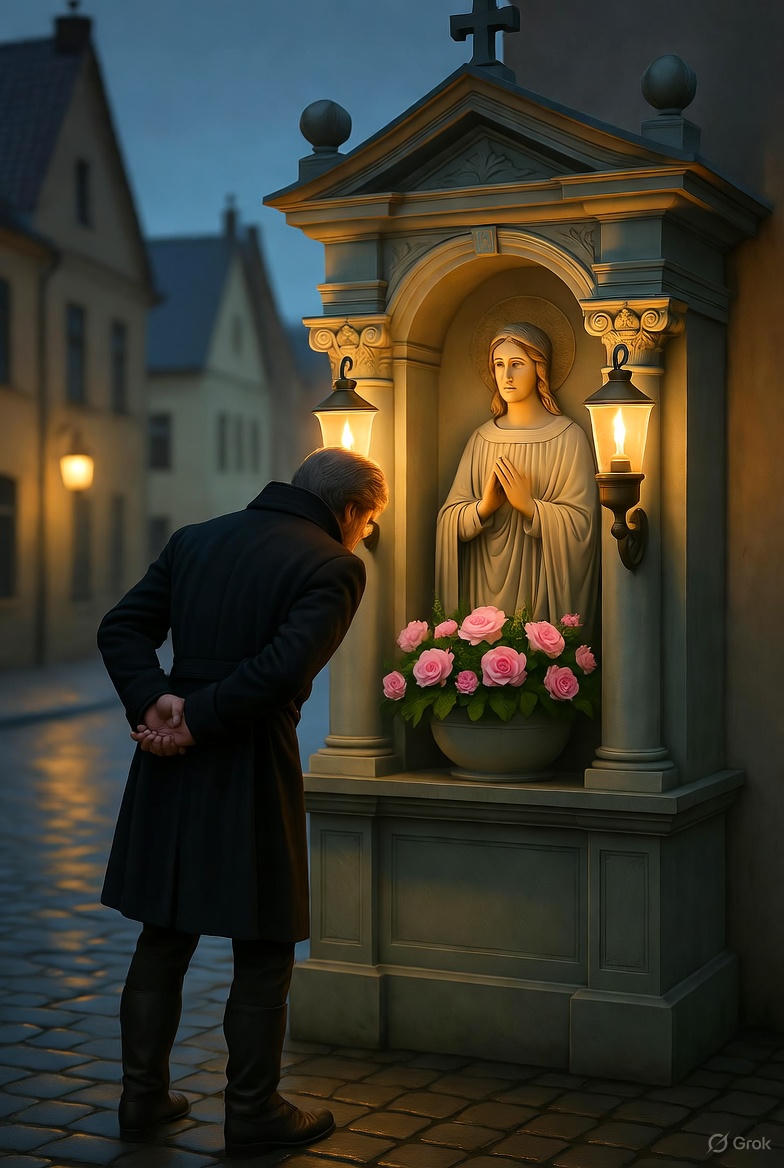
Frank Braun walked down the street, stopped before the shrine of
the Saint and examined it.
“Oh, Blessed Saint,” he said. “People bring you flowers and
fresh oil for your lamps. But this house doesn’t care for you, doesn’t
care if your shelter is preserved. You are regarded only as an antique.
It is well for you that the folk still believe in you and in your power.”
Then he sang softly, reverently:
“John of Nepomuk
Protector from dangerous floods.
Protect my house!
Guard it from rising waters.
Let them rage somewhere else.
John of Nepomuk
Protect my house!”
“Well old idol,” he continued. “You have it easy protecting this
village from dangerous floods since the Rhine lays three quarters of
an hour from here and since it is so regular and runs between stone
levies.
But try anyway, John of Nepomuk. Try to save this house from
the flood that shall now break over it! See, I love you, Saint of stone,
because you are my mother’s patron Saint.
She is called Johanna Nepomucema, also called Hubertina so she
will never get bitten by a mad dog. Do you remember how she came
into this world in this house, on the day that is sacred to you? That is
why she carries your name, John of Nepomuk! And because I love
her, my Saint–I will warn you for her sake.
You know that tonight another Saint has come inside, an unholy
one. A little manikin, not of stone like you and not beautifully
enshrined and dressed in garments–It is only made of wood and
pathetically naked. But it is as old as you, perhaps even older and
people say that it has a strange power. So try, Saint Nepomuk, give us
a demonstration of your power!
One of you must fall, you or the manikin. It must be decided who
is Master over the house of Brinken. Show us, my Saint, what you can
do.”
Frank Braun bowed, paid his respects, crossed himself, laughed
shortly and went on with quick strides through the street. He came up
to a field, breathed deeply the fresh night air and began walking
toward the city. In an avenue under blooming chestnuts he slowed his
steps, strolled dreamily, softly humming as he went along.
Suddenly he stopped, hesitated a moment. He turned around,
looked quickly both ways, swung up onto a low wall, sprang down to
the other side and, ran through a still garden up to a wide red villa.
He stopped there, pursed his lips and his wild short whistle
chased through the night, twice, three times, one right after the other.
Somewhere a hound began to bark. Above him a window softly
opened, a blonde woman in a white nightgown appeared. Her voice
whispered through the darkness.
“Is that you?”
And he said, “Yes, yes!”
She scurried back into the room, quickly came back again, took
her handkerchief, wrapped something in it and threw it down.
“There my love–the key! But be quiet–very quiet! Don’t wake up
my parents.”
Frank Braun took the key out, climbed the small marble steps,
opened the door and went inside. While he groped softly and
cautiously upward in the dark his young lips moved:
“John of Nepomuk
Protector from dangerous floods.
Protect me from love!
Let it strike another
Leave me in earthly peace
John of Nepomuk
Protect me from love!”


 Anarchistbanjo's World
Leave a comment