OD by Karl Hans Strobl and translated by Joe E Bandel
Chapter 25
“Shall I take the coffee set with the rose pattern?” Frau Professor Fechner asked, opening the door to her husband’s study, where he seemed to shiver in a woolen vest and fur cap despite the sun-warmed room.
“Yes, take the rose pattern!” her husband replied softly over his shoulder. The door closed, but it opened again, and the professor’s wife asked once more, “Or perhaps the forget-me-not one?”
“You can take the forget-me-nots too,” Fechner answered.
The door closed, but Fechner had only time to let out a small sigh of resignation before it opened again: “But the rose pattern is prettier!”
“That’s what happens,” the Professor smiled patiently, “when you have two coffee sets. By the way, Freiherr von Reichenbach is coming from Vienna, where they have the best coffee in the world, but he’s not coming to drink our Leipzig flower coffee, but for his Od.”
“What does he want from you?”
“What does he want?” Fechner pushed the green-tinted glasses he wore for his eye condition up onto his forehead. “He’s coming to me because I’m his last hope. The others have all abandoned him. Now he clings to me, hoping I’ll save him.”
“He wants to hitch his wagon to your reputation.”
The Professor’s wife was a diligent and ambitious housewife, yet she sometimes had a sharp understanding of her husband’s standing and influence. Her words carried a hint of concern for Fechner’s scientific reputation.
“Exactly,” Fechner confirmed. “It’s a questionable matter, this Od. Dangerous to get involved and oppose the general disbelief. But if it’s the truth, I’ll have to bear witness to it. And then they’ll call me as much a fantasist as this Reichenbach.”
“Very unpleasant!” said the Professor’s wife. She had little taste for scientific martyrdom; she preferred successes. Why should her husband risk his achievements for such a dubious cause? “He’s bombarded me with letters,” Fechner continued, “he’s berated me because I found a flaw in his research in my Moon Book. But since I’m the only one among his opponents who leaves room for understanding, he’s latched onto me. I declined his visit, was rude to the point of coarseness. But he’s unstoppable; he’s coming anyway.”
“I’ll take the forget-me-not pattern after all,” the Professor’s wife decided after a moment’s thought, and with that, she had settled the matter of Od as far as she was concerned.
But even the forget-me-not pattern wasn’t used. The Freiherr declined coffee, claiming he’d just had some, but the real reason was his agitation, too great to waste time on trivialities. He was eager to get to the heart of the matter and learn whether Fechner could be convinced. Everything seemed to hinge on this man; the fate of his entire doctrine rested on him. Never had the Freiherr been so wrought up. Fechner, this quiet man with a wise, refined face etched with patiently borne suffering, stood before him as the appointed judge, more authoritative than all the pompous, self-important scholars before who dispensed superior science.
“I turned to you,” he said, gripping Fechner’s hand tightly, unwittingly digging into his palm with trembling fingers, “because you defend the day-view of universal ensoulment against the night-view of soullessness that dominates science.”
“Yes, yes,” Fechner deflected, “it’s the idea that matters, but it can’t wander the world without proof. Even fully provable ideas require the strength to push them through. Think of poor Semmelweis…”
“What?” Reichenbach asked, cupping his ear.
Fechner realized he needed to speak louder and raised his voice. “Semmelweis! Lucky he didn’t have to endure the full misery of the asylum. Strange that he died of blood poisoning. It’s as if the demon he fought his whole life took revenge. The doctor who sought to stop infection in maternity wards cuts his finger during an operation and dies from it.” He had intended to bring up Semmelweis, not without the purpose of a cautionary comparison.
“Indeed,” said Reichenbach, “but the finest part of your letters is where you say you’re as cautious in belief as in disbelief. That’s the true impartiality of an honest and upright man of science. But most colleagues—”
“I would have liked,” Fechner interrupted, “to assemble a commission, but the colleagues refused to engage with a matter considered settled.”
“It’s already in my book: The Sensitive Human and Its Relation to Od,” Reichenbach said, speaking almost past Fechner. “Much depends on the sensitives. I’ve brought my best sensitive—my housekeeper, Fräulein Ruf, the daughter of a dear friend.”
Only now did Fechner turn his attention to the woman who had entered with Reichenbach and lingered by the door. She gave a shy, beaten impression, as if emphasizing her subservient role before the two men through her humble demeanor, though Reichenbach’s words were like outstretched hands, striving to draw her forward and place her as an equal beside him.
Yes, the Freiherr had showered Friederike with kindness and radiant warmth at home. He granted her days of rest and recovery, refraining from urging her to travel to Leipzig immediately, though he was eager to make the trip and force a decision. He spared her experiments—not a single one—knowing her gift wasn’t a skill to be trained like physical strength but a talent always present, ready for use. She should rest, gather herself, regain her self-assurance. Reichenbach could imagine the horrors she’d endured, ghastly, helplessly subjected to that monstrous will. His compassionate understanding was so great that he didn’t even ask—not even how she was ultimately saved. He respected her silence. Once, he said his eyes had only now opened to the vile old hag who held power over him, as if offering his own humiliation as comfort for hers. That he did, and he took her to the city to outfit her anew, as befitted the daughter of his dearest friend.
Yes, he had revealed this strange truth to her, perhaps to shock her back to herself, to help her regain a sense of her own worth.
All that had happened, but it couldn’t change that she still felt crushed, defiled, and unworthy of any love or kindness. At times, she suddenly couldn’t comprehend why she had returned to the Freiherr; she hadn’t accounted for it, and now it sometimes felt as if she should run away. Perhaps it would have been better to stay on the road—in a hayloft, a ditch, perishing somewhere in the dark.
So empty was she, drained, incapable of higher feeling, filled only with a bottomless fear of what was to come.
Professor Fechner understood the warm introduction from Reichenbach; he had before him a young lady, not a mere servant, and kindly invited her to sit. But then he thought it time to get to the point.
“We’ve corresponded about the basic experiments to start with,” he said. “We can move to others later. First, the simple facts. Everything is prepared as agreed. Here’s the horseshoe magnet, on the table with only the poles exposed, the rest covered with a cloth. The poles are unmarked, save for a small, invisible mark I’ve made for myself on one arm. You’re to use your left hand to distinguish the cooler North Pole from the other.”
He asked the Freiherr to stand farther away by the window—not out of mistrust, of course, just a precaution to rule out unintentional influence. “When you’re ready, we’ll begin.”
Friederike stood before the magnet. She raised her left hand and brought it near the two ends. There was no sensation in her hand—neither cool nor warm; just a piece of iron, with no living currents flowing into her. She lowered her hand and fixed a pleading gaze on Reichenbach. His face was tense and agitated; she had never seen the Freiherr like this. She knew everything for him now hung in the balance. Almost dazed, she raised her hand and pointed at one pole at random.
Fechner lifted the cloth, checked, and without comment, noted something in his notebook. Then he turned the magnet several times, placed it back, and covered it again. Friederike had tried to peek over his shoulder; no mark was visible. She was so confused she would have been ready to cheat.
“Please,” said Fechner.
He repeated the experiment seven times, then reviewed his notes and said with an awkward cough, “I’m sorry I can’t report a better result. Out of seven tries, the Fräulein identified the North Pole correctly only three times. By the principles of probability, that’s insufficient for proof.”
Reichenbach stood gray in the window’s light. He pulled a chair close and leaned on its back.
“Perhaps today I’m…” Friederike smiled desperately.
“Shall we move to the second experiment?” Reichenbach said after a pause.
A sulfur plate and a zinc plate lay on the table, both covered with paper, and Friederike was to determine, by holding her hand over them, which was sulfur and which was zinc.
Her hands felt dead. No sensation at all; she wanted to throw herself to the floor and scream. “I don’t know,” she said with a smile that strangely moved Fechner.
“It’s incomprehensible…” came a hoarse voice from the window. “Let’s try the pendulum experiment.”
“Perhaps it’s best we leave it for another time,” Fechner suggested. He pitied the woman, seeing her gesture—correctly interpreting it as a fleeting impulse to flee. But she knew how much was at stake for Reichenbach. He was here, refusing to back down, an old man with fading hearing and weakened sight. He had been unspeakably kind to her, asking only one thing in return: proof of his doctrine.
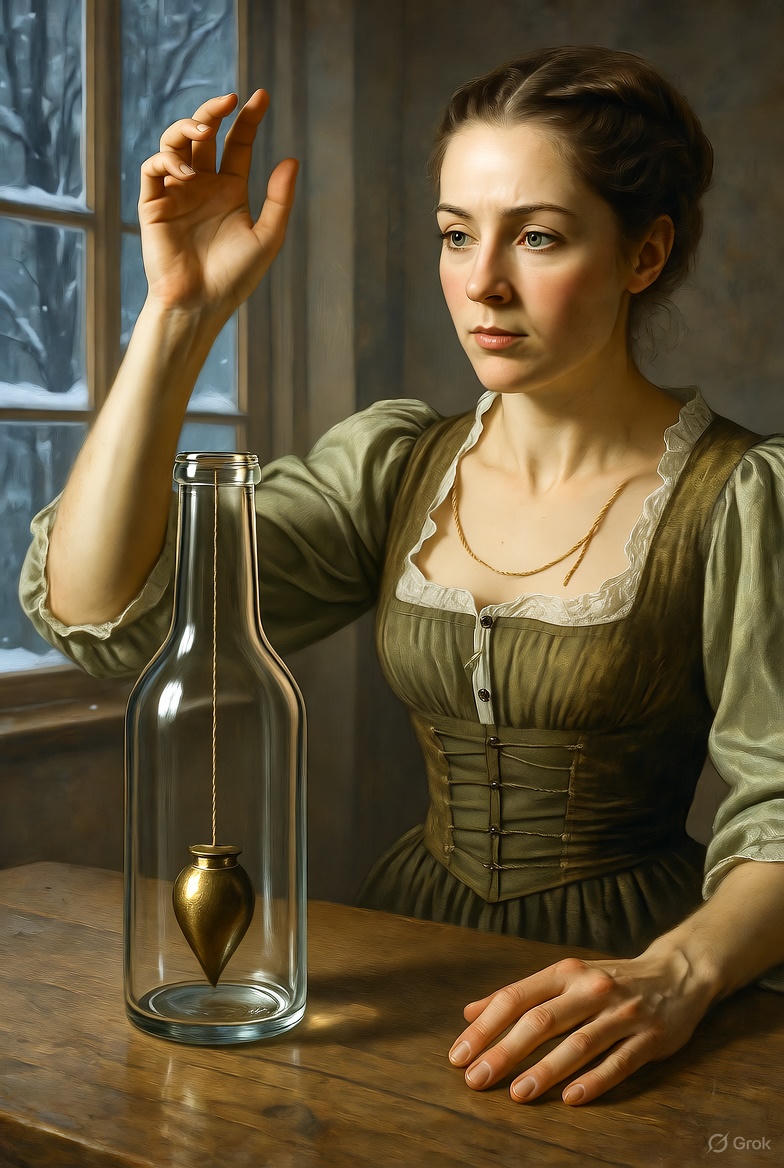
“Here’s the pendulum you sent me,” Fechner said, placing a bottle on the table, a small lead weight hanging from a thread inside its neck. It was agonizing waiting until the lead weight hung still; no one tried to break the oppressive silence.
Then Friederike raised her lifeless hand. She strained now, rattling the locked gates of her inner self, trying to force the currents that might make the pendulum swing. The pendulum didn’t budge; it hung rigid inside the bottle.


 Anarchistbanjo's World
Leave a comment