OD by Karl Hans Strobl and translated by Joe E Bandel
“Nothing!” said Fechner. He knew he was passing judgment, but what could he do? It was about science; no allowances could be made. Under other circumstances, he might have been relieved that the experiments failed, sparing him from taking a stand for Reichenbach. But one look at the Freiherr told him how merciless he’d had to be in the name of science. He said “Nothing” softly, but despite his hearing loss, Reichenbach caught the word.
“I can’t explain it,” Reichenbach murmured to himself. “Friederike has done far greater things. It may be… the long journey from Vienna to Leipzig, always along the telegraph wires. That must have had an odically adverse effect. The telegraph wires had an unfavorable odic influence.”
That was an explanation one couldn’t accept. But Reichenbach likely didn’t expect a response from Fechner; he raised his gaze like a sick beggar: “Now you’ll probably think me a fool or a fraud?”
“Certainly not,” Fechner hastened to assure him. He had to be cruel for science’s sake. Humanly, it was different. “We can try again later, perhaps. Or with another sensitive.”
“Yes, yes, with another sensitive,” Reichenbach said, and just then the door opened slightly, and the Professor’s wife poked her head in. It had taken long enough; the gentlemen should be done, and perhaps now a cup of coffee—
No, thank you, no coffee, much obliged, but it’s really time to go.
Reichenbach craves fresh air; sunshine is odically negative, he needs revitalization, a surge of life’s source. He pauses between the columns of the Roman House where Fechner lives, on the steps leading to the park. Hat off, Reichenbach wipes his damp forehead.
A hand reaches for his; he gently pushes it back. Yes, Friederike failed, utterly failed. Telegraph wires? Nonsense! Physics at all? Perhaps all physics is a night-view against the day-view. It was a grace, a grace of her purity. And that grace has been taken from Friederike.
About two weeks later, Friederike goes to Reichenbach’s room to bring him coffee, but he doesn’t answer her knock. They’re staying with the widow of a royal court porter from Dresden, who, after her husband’s death, rents rooms in her native Leipzig, taking in long-term guests with full care. Reichenbach’s and Friederike’s rooms are adjacent, so she’s always at hand. She insists on tending to the Freiherr, bringing his meals, and when she comes with coffee, he’s usually already working. He writes dozens of letters daily—to old friends, scientists, former sensitives. Though he doesn’t say so, Friederike believes he’s marshaling everything for a final battle to defeat the skeptics, summoning witnesses, perhaps urging sensitives to come to Leipzig for new experiments.
No replies have come yet. The only letter for the Freiherr was from Vienna.
“From Hermine,” Reichenbach said. “She writes that she regrets not seeing me before I left. And she asks if I’d allow her to come to Leipzig.”
Friederike expected this letter; she had written to Hermine, suggesting she come. Perhaps Reinhold could be persuaded too—not that Reichenbach is in danger, but it might help to distract him from his relentless brooding and surround him with love.
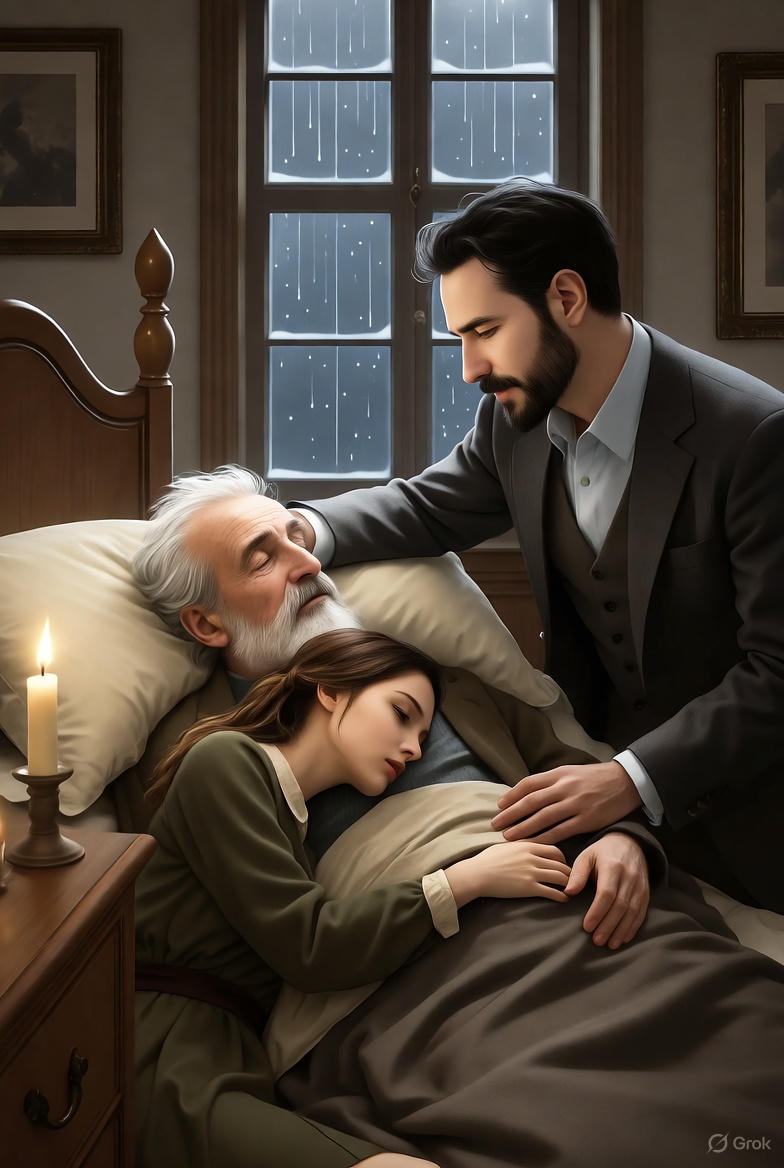
Now Reichenbach doesn’t answer Friederike’s knock, and when she enters, he lies in bed, staring at her with horrified eyes. His left hand hangs motionless over the bed’s edge; the right moves slightly, gesturing toward his mouth. Friederike realizes his speech is gone.
She doesn’t lose her composure, sending the porter’s widow for a doctor while staying with the patient. No, it’s surely not serious, she reassures his silent questions—a passing episode, a nervous collapse; in a few days, all will be well.
The doctor examines, asks questions, and declares it a minor stroke, temporary, insignificant—a few days’ rest, and all will be fine. Friederike had no doubts; there were signs already—his hearing loss, blurred vision, likely precursors.
Despite the doctor’s assurances, it’s a pitiful sight to see this man, who couldn’t seize enough life and sent his mind on endless conquests, now languishing, unable to help him.
But a few days later, as Friederike unfolds the newspaper to read to Reichenbach, he suddenly says, “Friederike.”
The words are thick, labored, but he speaks again; the silence has lifted. Friederike drops the paper, grasps his hands, and kisses them. Unable to restrain herself, she weeps.
“Friederike,” says the Freiherr, “how did it happen? How did you come back?” Has he been pondering this all along? He never asked until now. Should Friederike tell how it happened? She doesn’t know—perhaps a poison, paralyzing her soul. She can’t speak of the journey; it’s too horrific to recall. Only the end she remembers. She fled a dozen times, forced back, until a forester found and hid her in the woods. The poison must have lost its power then.
That’s how it was. And why did she return? She can’t say—it was all that remained in the world. Should she confess she’s loved Reichenbach since she could think, that he’s been her life’s center? No, she can’t speak it; it’s impossible—she’d sooner die than say it in dry words.
Reichenbach hasn’t taken his eyes off her as she speaks. Now he says, “I fear I’m to blame. Yes, yes… it could have been different.”
Then he turns his head toward a chair near the bed. Someone sits there, who must have entered during Friederike’s halting confession. “Final insights,” the Freiherr says, as if speaking to someone in the chair, “that may be true. I swore by physics and chemistry my whole life, but where are the boundaries, the transitions?”
He tilts his head, as if listening to a reply, then nods: “Indeed! Proofs—what do they mean? What’s subject to external proof ceases to be spirit. Truth can only be received and explained with the power of a believing heart. Faith is the same as love. Only love believes, and faith is the pinnacle of love.”
Friederike marvels at this dialogue with an empty chair. She doesn’t know it’s her father, Count Hugo, with whom Reichenbach speaks. But Reichenbach sees him in the chair; woods rustle around them, a faint light flickers, a bottle of wine stands on the table—likely Förster Hofstück’s.
“Yes,” Reichenbach smiles, “you’re right; the visible always flows into the invisible, the tangible into the incomprehensible, the sensory into the transcendent. Perhaps Od shapes our body, a radiant body that detaches and seeks those it loves. But even Od isn’t the final truth. When graves cease to glow odically, there’s still no end… no end…”
Reichenbach’s eyes close; he seems to have fallen asleep. But the sleep isn’t deep; he blinks occasionally and moves his lips.
After a quarter-hour, the alert gaze returns, strikingly bright: “Did you see my wife go out?” he asks.
Friederike isn’t afraid, not in the least, but she doesn’t know how to reply.
Reichenbach doesn’t wait for an answer: “She told me,” he continues, “that Hermine and Reinhold will come to me tomorrow.”
That’s possible; Friederike sent an urgent call to Vienna. They might arrive tomorrow if they hurry. Then Reichenbach drifts off again, through the evening into the night. His hand remains in Friederike’s, and she knows he’s overcome his disappointment, no longer holding her failure against her, nor the loss of the grace within her.
Around two in the morning, the Freiherr stirs again, as if Friederike’s thoughts have reached him, as if her thoughts crossed an odic bridge into him: “It’s not so important anymore… let those after me rack their brains… the great things must be found more than once.”
At noon the next day, Hermine, Schuh, and even Reinhold arrived. They couldn’t bring the child; the journey was too far. But there was a child, yes, a delightful little boy, and the grandfather had never seen him. They had brought him once, stood before the grandfather’s door, and had to leave without success. Then other things intervened—this trip to Leipzig, you see, always something came up; it must have been meant to be. But they wouldn’t let bitterness linger; now all obstacles were cleared, even Reinhold was here. Did the father know yet that he was now engaged and would soon marry? Yes, they’d arrange things differently henceforth, once the father was back on his feet and home.
Reichenbach’s eyes wandered from one to another but always returned to Friederike, who stayed modestly in the background. She wasn’t family; she didn’t want to take any love from those who came to give and receive it. But as Reichenbach’s gaze kept finding her, she felt boundless wonder and delight at how deeply connected they were again. She knew his thoughts without words; his looks said, “Go on, girl, we’ll stick together!” Yes, he spoke Swabian to her again, happy to see his kin, but with her, he spoke Swabian.
Toward evening, the court porter’s widow knocked and announced another visitor. The candles were already burning; Hermine knelt sobbing by the bed, and the two men sat silently across from each other at the table.
Professor Fechner was there; Professor Fechner wished to speak with the Herr Baron.
Professor Fechner had felt it his duty to come in person to report to the Freiherr. He had repeated the pendulum experiment with his wife as the subject, and it showed a clear deflection, then with a magnetic needle that was diverted—remarkable results, prompting him to reconsider his stance.
But when he saw the burning candles and Friederike about to open the window, he was startled and said awkwardly, “I’m sorry, I meant to bring good news.”
What remained of Freiherr von Reichenbach was beyond good or bad news. But a thought lingered, nourished by the blood of a living being, now set free, living on its own. It could rise above imperfection, return to its origins, and wait for its time to settle in other minds. That’s the superiority of thoughts over people: thoughts have time.


 Anarchistbanjo's World
Leave a comment