Homo Sapiens: Under Way by Stanislaw Przybyszewski and translated by Joe E Bandel
But I can imagine the astonishment of the Poles; just listen! When Bismarck expelled a few thousand Polish families from Prussia, he received the highest papal order; yes, the Order of Christ is very beautiful, and also very valuable. Now further! Hardly had the news of the insane murders subsided, which the Russians, with the approval of the Russian government, committed on the Polish Uniates in Kroze—by the way, murders that repeat themselves every day in Lithuania—when the Pope issues an encyclical to the bishops of Poland, in which he praises the great benevolence of the Tsardom with much praise—yes, please very much, it expressly states there, the Tsar is filled with the most intimate benevolence toward the Poles, he wants only their best.
No, Reverend Father, don’t take it amiss, but I didn’t like it at all when in your last sermon you tried to prove that the Pope once again let his paternal heart for the oppressed shine in unheard-of splendor.
That is superficial estimation; the matter hangs together quite differently. The Pope is determined by the French, with whom he sympathizes very much; yes, he is prompted by French policy to continually flirt with the Russians. In the whole encyclical, which I read very attentively, I find no paternal heart, on the contrary quite crude Vatican interests. And since I belong to the Catholic parish, it pains me deeply that church policy is so unbeautiful, yes—I want to express myself reservedly—unbeautiful, hypocritical, and uses cloaks of faith, hope, love for very earthly interests.
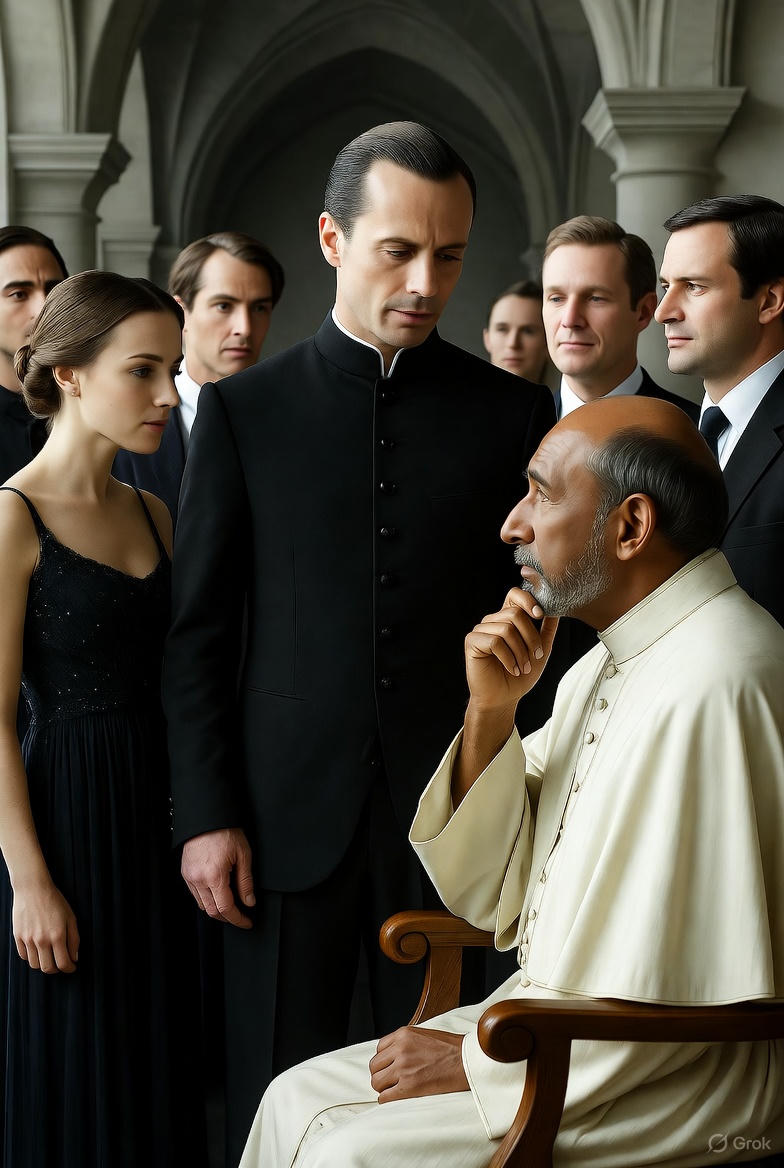
All those present looked at each other. They didn’t know what to say to it. That was really unheard-of bold, spoken in the presence of the monastery pastor. All eyes turned alternately to Falk and the pastor.
Marit had listened with pounding heart; mouth half-open, breath catching, she sat there and awaited the explosion.
The pastor was completely pale.
“You know, young man: You are much too young to solve the most important church questions with your intellect, infected by the heresy of foreign lands, and even less are you entitled to mock about it.”
Falk didn’t lose his composure for a moment.
“Yes, Reverend Father, what you say is very beautiful. In the end, it doesn’t concern me at all what you or the Pope or the German government do; that’s completely indifferent to me. But I permit myself to doubt whether the Church has really taken out a lease on all worldly wisdom from Providence. I actually permit myself to doubt that most excellently. It has recently immortalized itself in the question of Darwinism or rather in the dispute over the evolutionary principle.”
“And then, yes: can you tell me at which council the infallibility of the Pope in matters of politics was proclaimed?
Yes, yes; I know very well that according to tradition this kind of infallibility also exists, but I think that the papal nepotism in the Middle Ages is hardly the best recommendation for this kind of infallibility.
By the way, this is a topic that could lead to heated discussions, and that I want to prevent at all costs; one understands each other or one doesn’t, and I don’t feel called to force any suggestions on the company.”
It grew quiet; only the editor of the *Kreisblatt*, who had a reputation for social-democratic ideas, seemed very pleased.
He absolutely wanted to push Falk further: the man took no leaf before his mouth; he spoke as the beak grew.
“Yes, tell me, Herr Falk, you are an ultra-revolutionary, as I see. You now live in a monarchical state. Naturally you are not satisfied with such a condition. What do you say to a monarchical state constitution?”
The editor was already delighted to find his ideas confirmed before the reactionary elements.
“Hm; you know, Herr Editor, you pose a tricky question there. I was once in Helsingborg, and indeed with a friend who is an anarchist, but at the same time also a great artist. We stood on the ferry and looked at a splendid, ancient castle that Shakespeare already mentions in *Hamlet*.
Do you know what my friend, the anarchist, said? Yes, he said that what he would now say would certainly very much surprise me, but he had to admit that such splendid works were only possible under monarchical rule. Yes, absolutely; just look at the rule of the Bourbons in France, and compare it with the rule of the first republic. Look at the second empire and the infinitely rich artistic traditions that arose in it and that can only thrive in the splendor, extravagance, and lust of a royal court. Now you have here in Prussia a Frederick William IV, in Bavaria a Maximilian and a Ludwig. Take in hand the history of art, yes the
history of refinement of taste, of ennoblement of the human race, and you will decide for yourself.
No, I don’t want democracy; it flattens and vulgarizes humanity, makes it crude and directs it into narrow interest economics. Then the shopkeepers come to power, the tailors, tanners, and peasants, who hate everything beautiful, everything high. No, I don’t want the plebeian instincts unleashed against everything higher-bred.
The whole society seemed suddenly reconciled with Falk. But now came the backlash.
He sympathized nevertheless with all revolutionary ideas. Yes, he really did. He himself was not active; life interested him too little for that. He only watched and followed the development, somewhat like an astronomer in the eyepiece of his telescope follows the orbit of a star.
Yes, he really sympathized with the Social Democrats. For he had a faith that rested on the following premises. The postulated economic equality must by no means be confused with an equality of intelligences. He was now convinced that in a future association of humanity an oligarchy of intelligences would form, which would gradually have to come to power. Then of course the course of things would begin anew; but he hoped that such a rule would be a better beginning than that of the present cultural epoch, which had begun with wild barbarism.
The ruling class was impoverished, degenerated through inbreeding and excessive refinement. The danger of a crude, disgusting parvenu rule, the rule of money-bling and unclean hands, loomed. No, a thousand times no: that he didn’t want to live to see. Better to overthrow! He would gladly join.
The editor recovered; he seemed satisfied.
“Just one more question… What does Falk think of the current government?”
“The current government is the Kaiser, and for the Kaiser he had much sympathy. Yes, really; he pleased him extraordinarily. He had recently suddenly appointed the captain of the fire brigade to chief fire marshal. And why? Because he had excellently cordoned off the palace square during a parade. The appointment had not followed
bureaucratic principles; but therein lay precisely the beauty, the arbitrariness, the great soul. In short, everything so immensely to be appreciated: No, he really had very much sympathy for the Kaiser, and he drinks to the health of the German Kaiser!”
Those present looked at each other dumbfounded. But all rose and joined the toast.
The social-democratically tinged editor thought he would fall under the table; but he contented himself with a meaningless grin.
The table was cleared.
Falk instinctively felt two burning eyes fixed on him. He looked to the side and met Marit’s gaze hanging admiringly on him.
She lowered her eyes.
Falk went to her. They were very close; they were pushed forward by the many people crowding out of the dining room and pressed tightly against each other.
A warm stream flowed over Falk.
“Erik, you are splendid… a great man…” A dark flood wave colored her face.
Falk looked at her hotly. A glow of pride and love transfigured her features. “You are a real devil!” Herr Kauer came up. “That’s what I call speaking like a man! One of us would also like to say this and that sometimes, but we don’t dare. Just don’t spoil the girl for me; you mustn’t speak so revolutionarily to her.” Falk wanted to object.
“Now, now,” Herr Kauer soothed, “I have unconditional trust in you; you wear your heart on your tongue. Live well for me. In a week I’m back. You mustn’t leave on me, understand?”
Herr Kauer went.
“Oh, how splendidly you spoke… You can’t believe…” Marit looked at Falk full of admiration.
“Oh no, Fräulein Marit, that wasn’t spoken splendidly at all; against every one of these sentences a thousand objections could be made. But that may well be good for the gentlemen who draw their wisdom from the *Kreisblatt* and at most from some conservative newspaper that only has God and the Kaiser in its mouth. By the way, you also found what I said about the Pope well spoken?”
Marit hurried to answer.
“Yes certainly; she had now thought a lot, very much about all these things, and she had to give him complete right. Yes, he was right in most things, that she now saw.”
Falk looked at her astonished. He hadn’t expected that. That was really a strange metamorphosis.
“Why didn’t you come these whole two days? I expected you continuously and tormented myself unheard-of. Yes, I tormented myself very much, I must tell you openly.”
“Dear, good, gracious Fräulein, you probably know that best. I simply didn’t want to disturb the peace of your conscience. Yes, and then, you know, I am very nervous and mustn’t give myself too much to the sweet torment, otherwise the string might snap.”
Falk smiled.
Meanwhile, the editor joined them. He couldn’t digest the toast to the German Kaiser and now wanted to lead Falk onto thin ice.
“He would like to know how Herr Falk stood toward the anarchist murder acts. He was surely a soul-knower, a psychologist; how would he explain them?”


 Anarchistbanjo's World
Leave a comment