OD by Karl Hans Strobl and translated by Joe E Bandel
Chapter 24
With Professor Semmelweis, things had finally reached a point where serious measures were needed.
In recent years, he had been somewhat unpredictable, torn by striking mood swings, often losing control. When speaking to his audience about how his doctrine was disregarded and sidelined, his eyes would suddenly fill with tears, he’d begin sobbing, unable to stop, and finally a fit of weeping forced him to end the lecture.
When he thought a student hadn’t grasped his doctrine’s spirit during an exam, he flew into a frenzy, raging and lashing out, barely restrained from attacking the unfortunate examinee with his fists.
Yet he could have been satisfied. His doctrine gained followers, prevailing against skeptics as science’s big names voiced approval. But Semmelweis grew indifferent to recognition, hypersensitive to doubt or attack. He heard only his enemies, enraged by criticism, deaf to praise, endlessly seeking reports of maternity ward conditions, as if relishing death’s march through hospital halls. He saw death smear poison on doctors’ and nurses’ hands, marking their doomed victims.
His Pest friends initially thought a cold-water cure in Gräfenberg would restore his nerves. But then came oddities suggesting more than mere nervous breakdown.
Semmelweis accosted strangers on the street, ranting about his foes. He ran naked through his apartment, singing and dancing, then hurling glasses and plates at invisible threats. He visited patients only at night—a cunning tactic, he thought, as his enemies slept, unable to sabotage his orders. His once-healthy appetite turned voracious. Did they begrudge him satisfying his hunger and thirst? He eyed his wife, host, and guests suspiciously, then propped his feet on the table among plates and glasses, playing a comb wrapped in tissue paper.
Now in Vienna, en route to Gräfenberg, for a brief stay, Hebra wouldn’t let him go on without seeing his new sanatorium.
The next morning, Semmelweis was gone. He’d left the house, likely roaming Vienna, causing who-knows-what mischief. Hebra and Bathory searched everywhere he might be—nowhere. At home, his wife wept in fear, helpless; they had to call the police.
But by evening, Semmelweis returned. His whistling echoed on the stairs, cheerful and content. He’d seen Vienna—that’s why he was here. A fine city, but why mark every third cobblestone with a black cross? No need to be reminded of death at every step.
“I know, I know,” he soothed Hebra, who tried to dissuade him, “I’m a sick man. But you’ll make me well. You’re the only one I trust.”
How painful that Semmelweis voiced such trust in Hebra. It was a patient’s trust, and Hebra, now the doctor, was fated to be cruel and unrelenting. “Perhaps it’s best you stay a few days in my sanatorium,” Hebra said. “If it suits you and does you good, we may not need Gräfenberg.” He took Semmelweis’s hand and noticed a painful flinch.
“What’s wrong with your finger?” he asked. Semmelweis’s middle finger on his left hand was red and swollen.
Semmelweis studied his hand thoughtfully: “I don’t know… I think… two days ago in Pest, I operated on a woman… I might have cut myself a little.” He shook his hand as if to fling off the pain, then bent down and opened his arms. His two-year-old daughter Antonie ran to him; he lifted her high, dancing around the room: “My little mouse! My sweet treasure! Papa’s going to the sanatorium and will come back all well.” He swung the child, her legs twirling, then stumbled dizzily toward Hebra’s wife. “Whoops!” he cried. “Remember, dear lady, when your boy came into the world, and I shouted, ‘It’s a boy!’?”
Fearfully, Frau Marie took the child from her husband as Hebra leaned out the window, calling back, “The carriage is here!”
“Today already?” Semmelweis asked, surprised.
“Why not? I think you should try sleeping in my sanatorium tonight.”
“Come, Herr Professor,” Bathory urged. “We’ve already sent your night things over.”
It’s all quite harmless and natural—why shouldn’t Semmelweis try sleeping in the sanatorium tonight? Surely Hebra has set up something exemplary; everything he does is impeccable. The women casually accompany the three men to the carriage, chatting about Hungarian national dishes, recipes for Frau Marie, the splendid cook, to add to the Hebra household.
“Aren’t you coming?” Semmelweis asks his wife as he boards. Frau Marie leans against the doorframe, child in hand, trembling, unable to answer.
“What’s she supposed to do in your dull sanatorium?” Frau Hebra replies for her. “She’ll stay with me and the girl.”
The carriage rolls through the streets, and the men continue discussing the differences between Viennese and Hungarian cuisine, weighing their merits. “You know,” Semmelweis says, “I won’t let myself be starved on a diet in your sanatorium.”
It’s Lazarettgasse where the vehicle stops before a massive, iron-bound gate topped with spikes. “Your sanatorium looks like a knight’s castle,” Semmelweis laughs.
A tall, elegantly dressed gentleman receives the visitors.
“My director!” Hebra introduces, and they begin the tour at once. Everything is new and clean, the corridors carpeted to muffle steps. Sturdy orderlies stand about.
“You have only men here?” Semmelweis asks.
“In the men’s ward, we have only male orderlies,” the director explains courteously. “In the women’s ward, only nurses.”
The residents seem quite content; a distant burst of loud laughter is so contagious that Semmelweis joins in.
“Here’s the room we’ve set aside for you,” Hebra says.
Quite nice, new and clean like everything here, the bed bolted to the floor, table, bench, and cabinet fixed to the wall. The windows overlook a large garden.
“Why are the windows so heavily barred?” Semmelweis wonders.
“For safety,” the director replies smoothly.
“Ah, I see. Well, I’ll give it a try. If I can’t stand it, I’ll move out.” Semmelweis claps Hebra’s shoulder to affirm his decision.
“Shall we go to the garden?” the director suggests. Though it’s grown dark, the summer night is so mild it’s pleasant to stroll under the large trees. Semmelweis and the director lead, while Hebra and Bathory lag behind. Before Semmelweis realizes, he’s drawn into a discussion about septic processes, prompted by the director’s knowledgeable questions. When Semmelweis talks science, the outside world fades; he doesn’t hear the shrill screams from the neighboring wing or the monotonous muttering of someone at a barred window, perhaps praying or reciting memorized lines.
After a while, the director suggests they return.
“Where are Hebra and Bathory?”
Hebra and Bathory are gone, lost in the darkness.
“They must have grown impatient,” the director supposes. “They’ll come back tomorrow.”
The light in Semmelweis’s room, a dim glow high on the ceiling, is already on. His nightclothes are spread on the bed; he sheds his street clothes, slipping into underwear, nightshirt, and slippers. Time to check on his patients—they must be waiting impatiently.
But as he steps from his room to the corridor, two men block the door—sturdy fellows barring his way.
“Where to, Herr Professor?”
Another grabs his right wrist with a vile, paralyzing grip.
“What do you want? I must make my rounds.” It’s outrageous to seize him and hinder his profession. Semmelweis breaks free, but they grab him again, each from one side.
“Stay calm at home,” one says casually. “No time for visits now.”
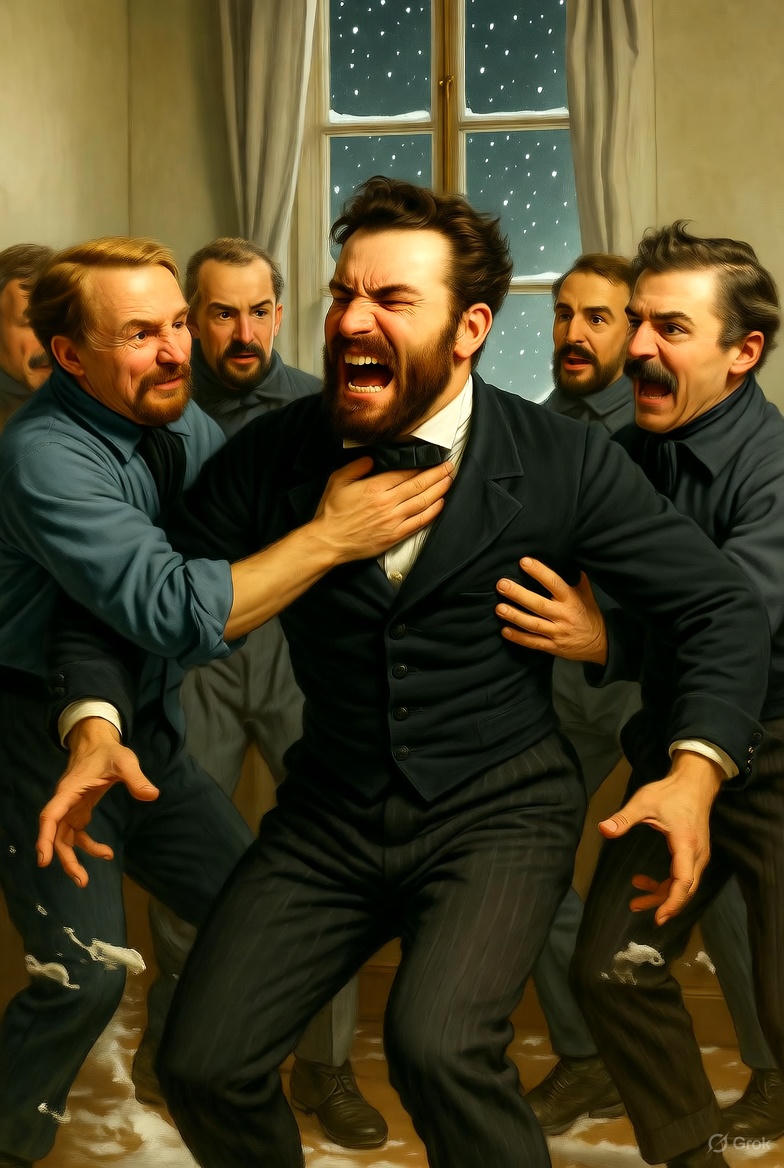
Why not? Why not indeed? Suddenly, Semmelweis realizes what’s happening. His enemies have hired these men to eliminate him; they’ve trapped him. As strong as the two orderlies are, Semmelweis’s rage is stronger, despite the searing pain in his hand. He pulls them toward him, smashes their heads together so their skulls crack, and hurls them against the walls. Then he runs. But he doesn’t get far—before reaching the stairs, two more men leap from a hiding spot, the first two already on his heels. Suddenly, one is on his back. The weight drags him down; they roll on the floor. Semmelweis bites wildly, sinking teeth through a sleeve into an arm, tearing cloth and flesh. They pin his arms behind him, nearly wrenching them from their sockets, almost breaking bones, stuffing a cloth in his mouth. Six men finally overpower him, throw a straitjacket over him, and shove him into a black hole—a padded room with no up or down, no front or back, only stifled, silent raging and roaring.


 Anarchistbanjo's World
Leave a comment