OD by Karl Hans Strobl and translated by Joe E Bandel
“Let the old fool be. He’s bursting with envy and pride.”
“He unfortunately doesn’t burst,” snorted Semmelweis. “He complains to the ministry; he has a host of petticoats and clerical robes behind him, and that carries more weight in this blessed Austria than the most conscientious research. And what does the ministry do? They appoint me private lecturer, yes, because they can’t do otherwise, with the venia legendi for lectures on obstetrics—with practical exercises—but only on a phantom! Do you understand what that means, not on cadavers, only on a phantom?” Semmelweis broke into a bitter, angry fit of laughter.
Reichenbach shook his head. “You just need a little patience. Klein and your other enemies are old men. How long will it take before they must leave the stage? Then the path will be clear for you…”
“Patience? I’ve had more patience than I should have. Enlightenment is dawning everywhere, except in Vienna. I’ve had enough of Vienna.”
“Yes, with us…” Reichenbach mused thoughtfully. “Austria! It has always known how to suppress, destroy, or drive out its best talents. Anyone who achieves something here must brace themselves to be mocked or persecuted.” Suddenly, he realized how similar his own fate was to this man’s. They were allies in the battle against the inertia of minds.
Semmelweis clapped his broad-brimmed hat on his head. “What do I care about Austria? I’m going back to my homeland. I’m Hungarian.” He stamped toward the door. “By the way, what I meant to say… your daughter! She was my best assistant.” “Because they’ve all been like that. I’d like to take her with me to Pest; perhaps she’d be willing. She could bring much good.”
He might have thought this a kind farewell gesture to Reichenbach. But he shouldn’t have said it. Didn’t this man understand that in this house, Ottane’s misstep was buried under a tombstone of silence? Why did he drag this shameful story into the light? Should Reichenbach rejoice that his daughter had taken up this dirty, repulsive trade instead of leaving it to the women of the lower classes, who were meant for it? Should he consider it an honor that Ottane was praised for her competence? For Reichenbach, it was a barbed fire arrow; his pride was mortally wounded. As he escorted the doctor to the door, he pondered how a paternal command could put an end to this scandal.
He himself wanted nothing to do with this renegade who dragged the family’s reputation into the mud; Hermine, Hermine should deliver Ottane his order.
When he entered Hermine’s room, Hermine and Karl Schuh hastily dissolved a suspiciously intimate moment into a somewhat awkward innocence. Just what he needed—Schuh making himself at home and plotting with Hermine.
“Oh, has Paris returned you to us?” he asked mockingly. He knew, of course, that Schuh hadn’t reached Paris and that his entire venture had failed. But he wanted the satisfaction of forcing a confession of failure, and somehow his resentment had to vent.
Schuh had risen: “I’ve come back to discuss the future of your daughter Hermine with you.”
Oh, so…! So it had come to this—that this man dared to discuss Hermine’s future with him. “Do you mean,” he asked with a mocking glint, “that you are to be that future?”
Schuh had resolved to ignore insults. “Yes!” he said earnestly.
“So I should place my daughter’s future in your hands? And you presumably already have her consent?”
“Yes,” Schuh answered with calm certainty to both questions…
“Into the hands of a wandering nobody who is nothing and has nothing. A vagabond, a shoemaker’s apprentice by birth, a barber in Berlin until his twentieth year, then ran off, sniffed around at everything but knows nothing thoroughly—a scientific freebooter who turns his scant knowledge into a business?”
Schuh had grown very pale. “I know I lack thorough training; I know I’m not yet anything substantial, but you yourself have acknowledged my abilities. You drew me into your experiments and sought my opinion. And you’ve said more than once that it’s not about the credentials one holds but what one carries within. Moreover, I may inform you that I have accepted a position, and there’s a prospect of soon becoming a partner in a galvanoplastic institute.”
“Father,” Hermine adds, “you have no right to insult Herr Schuh.”
Reichenbach turns on her with clenched fists. “Silence! Unfortunate girl! And you want to throw yourself away on this hollow talker, this man who doesn’t even own a button on his coat, whom I’ve driven from my house, who wheedled money from me for his dubious ventures…?”
Schuh lowers his head. “You gave me money, that’s true. But you offered it, Herr Baron! Offered it!! And you will get it back; I give you my word!”
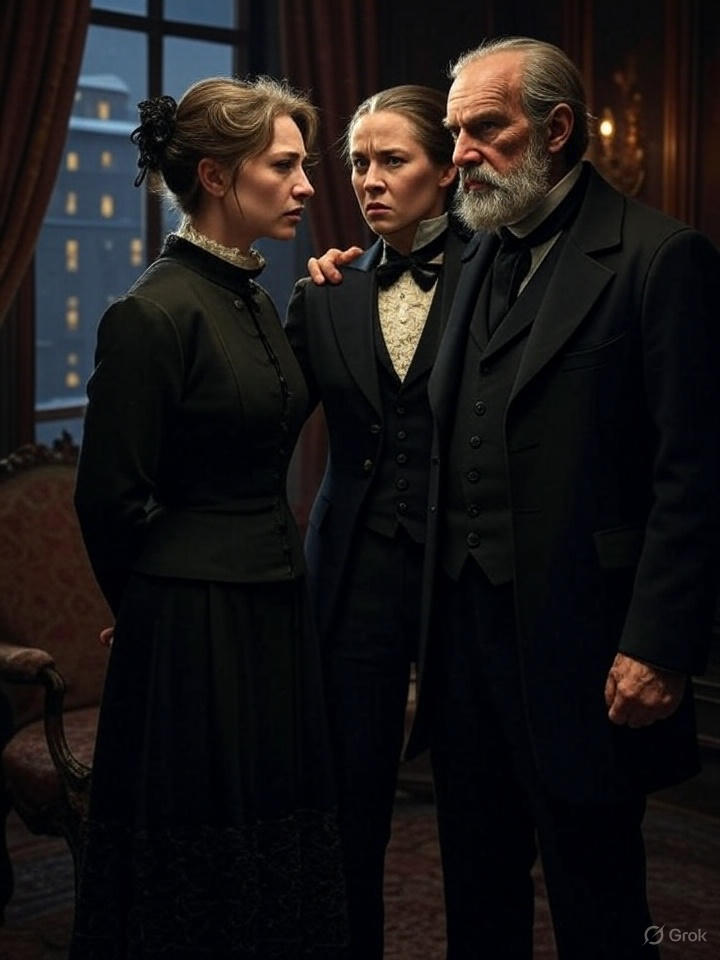
And now something happens that the Freiherr would never have dreamed possible. Hermine steps to the young man, places her arm around his shoulder, and says, “Your insults won’t succeed in separating us.” It’s unbelievable—Hermine dares, before his very eyes, the eyes of her father, to put her arm around the young man’s shoulders and declare that he won’t succeed in parting them. They form a kind of united front, embodying their inner bond, and Hermine even ventures to add, “I’m of age, Father; I’m thirty years old and can determine my own fate.” So he’s to lose Hermine too—the only one of his children still with him.
“Very well, very well,” says the Freiherr, momentarily shaken, “so you want to marry into a family of shoemakers, barbers, and wandering jugglers?”
“Feelings and innermost convictions are every person’s free possession.”
But the Freiherr has already regained control. “Your wild, deluded sister is already a public scandal, and you want to follow her example? Have you taken a cue from Reinhold too? This new insolence has gone to all your heads? I only regret I can’t kill you or simply lock you in a convent. I’m going out to Kobenzl now, and you’ll follow me within two days, or I’ll exercise my rights as father and householder and have the police fetch you. You won’t throw yourself away on a worthless man.”
The gray tufts of hair on either side of his imposing forehead flare like burning thorn bushes. Before the stately, broad-shouldered man stands the slim, agile Schuh, a head shorter, crouched as if to spring. At last, all restraint ends—father or not, one can’t endlessly tolerate being spat in the face. Now Schuh’s anger too breaks free, and though the Freiherr looms powerfully and confidently before him, the young man knows that if it came to a physical struggle, he wouldn’t come off worse. He would duck under his opponent and is already choosing the spots to grab him. At the very least, it’s time now to remind him of a certain letter to remind him of—a letter whose suppression was no heroic deed.
But it’s unnecessary; Hermine shows she’s her father’s daughter, matching him in stubbornness and tenacious pursuit of a goal. “You’ll have to realize, Father,” she says calmly, “that I can’t be intimidated by threats. It’s about my happiness, and if you withhold your consent, I’ll take it without it. Wouldn’t we be better off settling this in peace?”
Settle in peace—indeed, she says settle in peace, even though she hears her father is entirely against it. Reichenbach stares at the united pair, utterly baffled.
But in Karl Schuh, something entirely new emerges. He isn’t one for the grand tones of passion; his natural disposition is to blunt all violence and turn every situation into something cheerful. A sense of superiority floods him; he has the delighted certainty that Reichenbach’s power is ineffective, casting everything in a light of inner joy.
“Tell me, dear friend,” he asks gently and conciliatory, “why are you so angry with me? I wouldn’t have come to your house if you hadn’t invited me. I know you despise people, using them as long as they seem useful. You squeeze them like lemons and then discard them. But with me, you’ve encountered a lemon that won’t stand for it.”
The metaphor is bold, but it has the advantage of leaving Reichenbach speechless. A tool that rebels, a nobody who suddenly rises up.
“I think we can go,” says Schuh, since Reichenbach still offers no reply. Schuh evidently believes the matter is settled to this extent—the Freiherr now knows how things stand and that they won’t wait for his consent. He adds only, “And as for the money, for which I’ll always be grateful, please be assured it won’t be lost to you. You’ll have it back within a few days.”
Schuh has no idea where he’ll get it, but he’ll find a way, and this conviction completes his victory. He leaves, and Hermine goes with him, leaving the Freiherr in boundless astonishment at the depths and limitless possibilities of a woman’s heart.


 Anarchistbanjo's World
Leave a comment