OD by Karl Hans Strobl and translated by Joe E Bandel
Chapter 11
Before the door on the third floor of the old house on Kohlmarkt, Ottane had to pause for a moment to catch her breath, so quickly had she run up the stairs. She always felt anxious when she came here, and today she had proof that her concern about being caught was not unfounded.
Was someone following her? She leaned over the stair railing and looked into the dark depth. On the first floor, two women stood in the hallway, talking loudly and excitedly. But no one followed her, and Ottane was just digging the key out of her little bag when the door opened, and a hand grabbed her arm, pulling her inside.
Kisses overwhelmed her—wild, famished kisses in the dark—as if she hadn’t been here three days ago but three years. The terror of the past minutes threw her into the passionate embrace like a refuge.
Inside the meticulously kept little room, Max Heiland helped her out of her coat and took off her hat.
“Imagine,” said Ottane, still distraught, “I ran into Frau Hofrätin Reißnagel. The Hofrat lives two houses over, and I’ve always thought I’d meet him or her someday, and they’d ask what I’m doing here.”
“Did she see you?” asked Max Heiland, concerned.
“I don’t think so. I suddenly stood before her; I couldn’t dodge anymore, but I think she didn’t notice me. She passed by stiffly and stared straight ahead.”
“Then it’s all right,” said the painter, quickly reassured. “You must have an excuse ready for all cases. Something to get rid of people, because if you ever kept me waiting in vain, I might lose my mind.”
“And there were so many people on the street. I think a lot of them were workers; they had angry, grim faces and carried sticks; they moved in groups, shouting and singing. It was hard to get through.”
“Yes, I believe they want something from the government. I passed by Stephanskirche; they posted a placard there last night, calling on the Viennese to free the good Emperor Ferdinand from the bonds of his enemies, and it says that whoever wants Austria’s rise must wish for the downfall of its state leaders. They mean Metternich. And it’s said the students want to move to the country house in Herrengasse and demand that their wishes be brought before the Emperor.” He laughed cheerfully and placed his hands on Ottane’s hips: “But what do we care about the Hofräte, the workers, the students, Metternich, and the addresses and placards? You’re with me, and now the world outside can go to ruin. How long can you stay?”
“Not long,” pleaded Ottane, “maybe an hour. I must be home soon; the father is in an increasingly bad mood.”
“Oh, what’s an hour after three days of longing?”
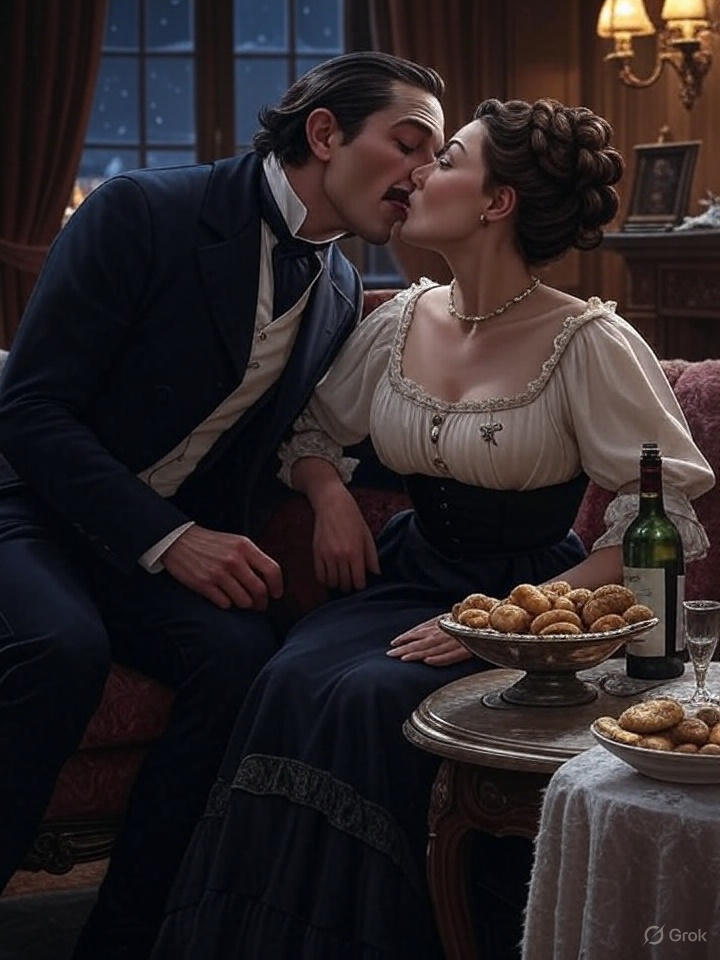
A small table stood there with a bowl of pastries and a bottle of Hungarian wine and two glasses. Max Heiland moved it close to the sofa, poured himself some in a picturesque manner, and pulled Ottane down beside him. He bent her body back, seized her mouth, and kissed her so long that she felt she was suffocating, and her vision darkened. She forgot everything; everything had sunk and vanished; she was only a part of the life force coursing through the universe, blissfully stolen from herself and swept into another.
Max Heiland had found this hideaway for their love hours since his atelier wasn’t safe enough. Strange women came there, and Therese made surprise, mistrustful visits. She had asked: “Are you meeting with Ottane? Where are you meeting with Ottane? I know you’re deceiving me, but watch out—I’m not one of those women who let themselves be cheated.” Max Heiland also had to be cautious; no one suspected this nest. The kind, deaf old woman who had rented him two rooms in her apartment made herself invisible; she didn’t want to risk losing the good pay.
“Take!” he said after releasing Ottane. He broke a piece of dry pastry in two and pushed half into Ottane’s mouth; he was an exuberant, reckless, boundless-in-love big boy. “Your father is still in a bad mood? Have you told Hermine anything yet?”
“I don’t know if it might not be better not to tell her. She keeps asking why Schuh doesn’t come. What should I say? I tell her he’ll come back eventually. Maybe Schuh was wrong, and Hermine cares for him more than he thinks. But she has a way of not showing it.”
“Thank God you can show it,” laughed the painter and kissed her.
“She’s closed off and completely unapproachable. But I think she’s tormented, suffering, unable to explain it. And Schuh doesn’t come. The father wrote him a letter. He wrote that Schuh isn’t suited for marriage, that he lacks the flexibility and suppleness needed for it, and that Hermine has a similar character—stubborn and unyielding—and that she has therefore turned down other proposals. He should not disturb Hermine’s peace and should be content with her respect and friendship. And he wrote that this is by no means a reason to avoid our house, and he should come and must come. But Schuh doesn’t come.”
Ottane raises her head; it feels to her as if a distant noise is pressing in—murmuring of many people, a clamor that a marching crowd pushes ahead of itself.
“If I imagine,” says Max Heiland, “that I should always be with you and not reveal with a single word that I love you… I couldn’t do that; I’m convinced it would be impossible for me. How can your father impose such a thing on Schuh? I find Schuh is right not to come. I, of course, might have done it differently.”
“Yes, you…” says Ottane, looking at the painter quite strangely. Then she adds: “Father is conducting experiments with the Hofrätin, and he probably needs Schuh to discuss the matter with him.”
“Egoist!” Heiland declares with great certainty.
Ottane wants to reply, perhaps that all people are more or less selfish, but her attention is drawn to the noise on the street. What is that? Step and tread, step and tread on the street—a vast crowd must be passing below.
Max Heiland and Ottane stand behind thick curtains, shielded from the view of people across who lean out of windows, looking at the street, waving handkerchiefs, and calling down. Below, a dense throng of young people, row upon row, linked arm in arm, marches—feather hats, caps, waves, and shouts back and forth between the street and the windows.
“They are the students,” explains Heiland, “heading to the country house in Herrengasse.”
Ottane lets out a cry: “Reinhold is among them!”
“Why shouldn’t he be there? The youth is making its voice heard; it wants to be listened to.”
“But the father? And if there’s a tumult, a rebellion? And how will I get home if the streets are so full? I must leave.”
Max Heiland has a cure-all for doubts and anxiety attacks. He takes Ottane wordlessly into his arms and kisses her. And Ottane instantly loses her senses. She knows nothing more of herself, floats between being and non-being in a rapture where all form dissolves into luminous ether.
Reinhold, on this March morning that anticipates a piece of May, went to the Polytechnic as usual. But there were no lectures today; the students stood in the hallways and around the building. It’s said those from the university mean to get serious today and force a decision. Yesterday, the lecture hall was locked, but the university students forced it open, drafted an address, signed it, and two professors had to deliver it to the Emperor. And it’s said that Count Kolowrat, who is usually very accommodating and seeks to balance opposites, even Count Kolowrat has said: “That’s just what’s missing—that the students should make splinters for us!”
But the Emperor gave an evasive and delaying response, and now those from the university want to make it happen. In the suburbs, there have been already been said yesterday: “It’s starting!” And the workers didn’t go to work today, and some masters even released their journeymen themselves so they could be part of it. In Reinhold, enthusiasm surges—yes, now freedom will finally come; he feels the breath of great events, what happiness to be able to throw himself into it. Bent, twisted, crushed all these years, but now he straightens up; somehow, the surge also crashes against the rigid bonds of his own life. All tyranny shall be shattered; it’s also against the tyranny of fathers—Reinhold has a very comprehensive concept of the freedom that is now coming.
A young student hurries up: “They’re already heading to the country house.”
“Comrades!” shouts a broad-shouldered, bearded man next to Reinhold, “are you servant souls? Do you want to remain slaves forever? Always just put off? Forward, we march with them!”
And the broad-shouldered, bearded man grabs Reinhold under the arm and pulls him along. This broad-shouldered, bearded figure was once a small, pitiful tutor and house steward, a poor wretch and hanger-on named Futterknecht; long ago, he also taught Reinhold and, through detours via other households and families, found his way back to being a student. With every house, every table, every bite of educator’s bread, every reprimand, and even every praise, a drop of hatred was added to his soul. The years since have thoroughly cleared away his humility and obsession; they have let him grow into a broad and bearded man, and freedom has stamped a daring hat with a feather on his head. Through his age, his enmity toward tyrants, and his relentlessness, he has gained respect and weight among his comrades; they follow him, and now he marches at the head of the procession with Reinhold under his arm. Reinhold is very proud to be so far forward, the confidant of the leader. Yes, now freedom comes; they are leading freedom.
The people join in, workers walking alongside, encouraging with shouts, shaking their fists. Reinhold stands next to a ragamuffin with a coat like a map of Germany, stitched a hundred times over, and a dirty cap. His pockets bulge wide, stuffed with something heavy. Beside him hobbles an old, greasy, stocky man, striving to keep pace; he wears a broad-brimmed hat and a coat much too large, with sleeves turned up, and something heavy must be in the long tails’ pockets, for they slap against his thin calves with each step. And now the ragged giant laughs, reaches into his pockets, and pulls out a fist-sized stone, showing it to the other; the greasy old man reaches into his coat tails and also pulls out a fist-sized stone, showing it to the ragged giant.


 Anarchistbanjo's World
Leave a comment