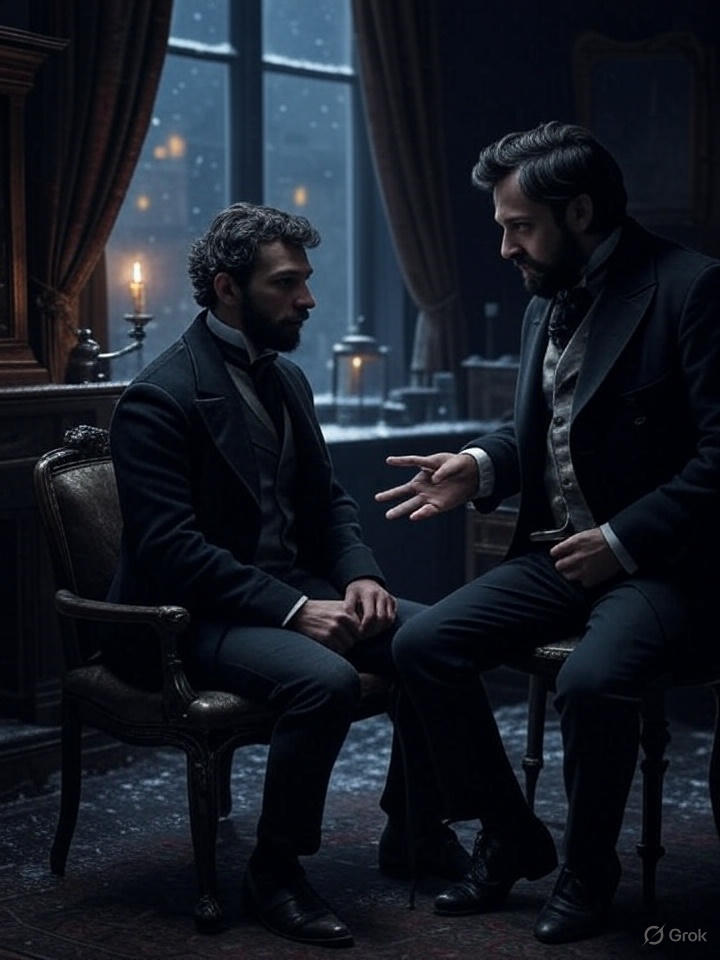
OD by Karl Hans Strobl and translated by Joe E Bandel
Chapter10
Freiherr von Reichenbach had made every effort to bring his thoughts into order. But before he could manage that, something had happened that renewed the confusion and only increased it further.
About two days after the visit to Frau Hofrätin Reißnagel, a sense of unease had come to his awareness. A dull feeling of fatigue at first, then dragging pains in the limbs, hammering in the temples, ringing in the ears, flickering before the eyes, scratching in the throat. And then the cold was there, with all that goes with it—sniffles, headache, and cough—the Freiherr had to take to his bed despite his resistance. Tea-drinking, sweating, and gargling.
There he lay over the Christmas holidays and had time to think further. So he had indeed become sick; he had caught the cold on the way to the Hofrätin, and she had foreseen that he would become ill. She had sensed it beforehand, at a time when he still believed himself completely healthy. How was that possible, what secret powers did this woman possess? And if she had correctly foreseen this, then all the other phenomena that Reichenbach had observed were likely neither conscious nor unconscious deceptions. One had to assume it was so, but where was the explanation for all this? Amid the swaying of considerations, the fleeting glimmer from back then held up the best. Were they on the trail of an unknown natural force, a kind of invisible rays?
Caught up in this mental work, Reichenbach was so gripped that he could hardly wait to test his thoughts. He had Eisenstein summoned; Eisenstein sat by his bed, but chatting with him didn’t help—Eisenstein had few ideas; he was too eager to agree with the Freiherr, making him only impatient. Reichenbach needed substantive objections to clarify his thoughts.
As soon as he was allowed to get up, he took Ottane aside. He didn’t say what it was about. He had Ottane stand, walked slowly toward her, circled her. He had her sit and stretched his hand toward her—the left, then the right; he touched her shoulder, her hips; he had her lie on a sofa and stood alternately at her head and her feet, asking in between: “Do you feel anything? Do you feel anything?” But Ottane felt nothing at all.
He locked himself and Ottane in a room, hung blankets over the windows and doors, extinguished the light. And after they had sat in the darkness for half an hour, he asked: “Do you see anything? Do you see anything?”
But Ottane laughed, saying she saw absolutely nothing—how could she see anything in this pitch darkness? Then he took Hermine aside and performed the same solemn, mysterious actions with her as with Ottane, asking in between: “Do you feel anything? Do you see anything?”
“No,” Hermine replied each time shyly and anxiously; she felt nothing and saw nothing.
“Naturally,” said the Freiherr angrily, “how could you feel or see anything other than the most ordinary?”
Afterward, the two sisters stood facing each other, and Hermine looked quite frightened, but Ottane also showed a concerned expression.
“What’s wrong with the father?” They exchanged their experiences—yes, yes, approaching and withdrawing, strokes with the hands, sitting in the darkness; the same for both—what could this be again?
Hermine began to cry.
“No, no,” Hermine comforted her, “you don’t need to be afraid that the father might—; no, that’s certainly not it. I think he has discovered something new; he looks just like someone who has made a new discovery.”
Ottane had something luminous in her nature, a radiant confidence that quickly made her victorious over all doubts. She held her head high and had a light, free step; she often smiled to herself without anyone knowing the reason; she tilted her head as if listening to an inner voice. Often she startled Hermine by suddenly pouncing on her and kissing her. Hermine found that her sister was somehow mysteriously elevated; Ottane said nothing, nor did she reveal where she sometimes went when she claimed she had errands to run. Oh yes, Ottane, she took everything lightly; when one is happy, one can take many things lightly that become a cause of worry and gloom for others.
When the Freiherr received the delayed permission to leave the house due to bad weather, his first visit was to Frau Hofrätin Reißnagel. He found her in relatively good health, a bit bloodless and weakened, but mentally alert and, though with some sighing, willing to undergo the experiments he had in mind.
Reichenbach had brought a system with him, a framework of thought built on provisional, bold, yet very astute assumptions. He saw much confirmed, had to discard some things, some hit the mark exactly, others remained unruly and enigmatic; overall, however, the basic outlines of a new understanding began to emerge more clearly from the mist. Only after hours of work did he relent from his subject when the Hofrätin, groaning, declared she could no longer continue, and finally a violent vomiting brought everything to an end. The Freiherr was dripping with sweat, his brain convolutions glowed; he assured the Hofrätin that her nausea was trivial and held no significance compared to the healing that had befallen her today: that she had, namely, entered the annals of science with this day.
“A new science, dear lady!” he said, beaming with joy, waving the black notebook in which he had meticulously recorded the course of his experiments. “Your name has become immortal today.”
For the time being, however, the Hofrätin felt so miserable that she had no real understanding of scientific fame and immortality, and her only wish was to see the Freiherr out the door from the outside.
Reichenbach staggered through the streets like a drunk, bumping into people, nearly getting under the horses of the princely Esterházy carriage; in one of the courtyards he passed through, he threw a handful of coins into a blind violinist’s hat; he felt the urge to grab some unknown person and say: “Do you know what has happened? I’ve made a discovery, an extraordinary discovery.”
When he returned home somewhat calmer, he heard four-hand piano playing from the music room. Schuh was there, thank God—a man with an understanding of the significance of the event. He opened the door and shouted into the middle of the Adagio of the Beethoven sonata: “Please, dear Schuh, come over to my room at once.”
After a while, Schuh came, more serious than usual but Reichenbach was incapable of making observations that didn’t connect with what consumed him.
“You shall be the first to hear it,” he said, “wait. Please, stretch out your hand and raise your spread fingers. Like this!” Reichenbach took a blank sheet of paper from the desk and placed it over the tips of Schuh’s outstretched fingers. “Now?” he asked, looking at Schuh with eager anticipation: “How do you perceive it? Pleasant or unpleasant?”
Aha, thought Schuh, now comes that thing Hermine and Ottane told me about. He couldn’t help but smile; a sheet of paper lay on his fingers—what of it? How could that be pleasant or unpleasant?
“Nothing?” asked Reichenbach, slightly disappointed. “Well, it doesn’t matter. You just don’t belong to the people sensitive enough to feel it.”
“How was I supposed to perceive it?”
“Unpleasant!”
Now Schuh couldn’t refrain from laughing outright: “Yes, why?”
Reichenbach was too elated to get angry; he took the paper and placed it back on the desk. “Yes, that’s it, that’s what it all revolves around. Frau Hofrätin Reißnagel perceives it as unpleasant.”
“So, Frau Hofrätin Reißnagel?” Schuh chuckled.
“Exactly, I’ve conducted a series of experiments with this lady that have shed some light on the matter. Pay attention! What happens when you rub your hands?”
“If I’m cold, I rub my hands, and they get warm.”
“Exactly, with you! With the Hofrätin, only the left hand gets warm, not the right. When the Hofrätin folds her hands as if in prayer, it soon becomes so unpleasant that she must separate them again. The same happens when she points her fingertips toward each other. She cannot place her hands on her hips; she cannot rest her head on her arm without feeling unease. What do you make of that?”
“Strange!” said Schuh, quite seriously.
“Wait. When the Hofrätin covers her right eye with her hand and looks into my left eye with her left, she is completely blind for a while afterward. If I take two glasses of water, one in my left hand and one in my right, and slowly turn them between my fingers, the Hofrätin finds the water from the left lukewarm and repulsive, and that from the right cool and pleasantly tingling. If I place two glasses of water on the table, one in the sunlight and one beside it in the shade, what happens?”
“Certainly something odd,” answered Schuh, without changing his expression.
“Quite right. The Hofrätin drinks the water from the sun with pleasure and says it’s cool, while the water from the shade is lukewarm and unpleasant. What do you say to that?”
“What I say? I personally esteem the Hofrätin highly, but there are coarse people who think she’s a crazy box.”
“Schuh, I beg you,” growled Reichenbach, annoyed, “I took you for a more serious thinker.” He suddenly stepped toward the disobedient disciple, grabbed his left hand with his own left hand, and pulled it sharply toward himself. “Stay like that—for a moment!” And he stretched out the index finger of his right hand and moved it close over Schuh’s wrist and across the palm in the direction toward the middle finger. “Now?” He almost pleaded, the tufts of hair, like gray, wild underbrush beside his bald forehead, seemed to crackle.
Schuh shook his head: “I’m supposed to feel something?”
“Isn’t it like a fine, cool wind drifting over your hand, as if… blown from a straw?”
“And even if you cut me up for goulash, I wouldn’t feel any wind or straw!”


 Anarchistbanjo's World
Leave a comment