OD by Karl Hans Strobl and translated by Joe E Bandel
Chapter 5
Silkworms are a tricky bunch. They need warmth, but not too much, fresh air but no drafts. They’re more delicate than you’d imagine, and above all, stubborn—they’ll only eat mulberry leaves. But mulberry trees don’t grow around Vienna like limes, birches, or chestnuts. You have to bring the leaves from afar, which raises costs, and the worms don’t seem to like leaves that aren’t freshly picked.
Even if you refresh the leaves with water, dry them, and do everything humanly possible, one day, for no clear reason, the silkworms stop eating. Something suddenly doesn’t suit them. They stop feeding and shrink into empty husks, or they swell, grow grotesquely fat, and burst, dissolving into mush. It happens alarmingly fast—in a few days, not a single worm is left alive.
Reichenbach has endured three such mass die-offs of his silkworms. But you can’t leave anything untried, so he starts a fourth time.
“You know,” Reichenbach said to his famous guest, the chemist Liebig, “you mustn’t shy away from personal sacrifices to launch an industry. Imagine if we succeed, if we can produce the silk we need—how much wealth that’d bring to the land.”
Liebig paused. “Maybe the critters don’t take to your Viennese climate. Maybe they’re just homesick. Your wine thrives better here, anyway. And frankly, you should stick to chemistry—that’s your field.”
Liebig was headed to the naturalists’ convention in Graz and had accepted Reichenbach’s invitation to be his guest, using his city apartment on Bäckergasse, his carriage, and one of his lackeys. Today, though, he’d come to Reisenberg for the feast Reichenbach was hosting. He arrived early that afternoon so his host could show him the estate. Count Kolowrat had wanted to appoint Liebig to the university, and Reichenbach hinted the idea was his, claiming he’d moved heaven and earth to secure the scholar to win for Vienna. The negotiations fell through, but the friendship forged then endured.
And because of this friendship, Liebig felt obliged to speak plainly about what struck him during the tour. “Look,” he said, “a man shouldn’t want too much at once. Or if he does, it should all stem from one center. But you’re scattering your strength—estates here and in Gutenbrunn, in Galicia, ironworks in Ternitz and Gaya, and now this silkworm business. Why not stick to your true field and build there? Why let others reap the fruits of your groundwork? Sell, who apprenticed with you, started tar distillation in Offenbach, and Hofmann found the tar base kyanol there. That’s a big deal you let slip away.”
“It’ll be no less big,” Reichenbach insisted, “if I succeed in founding a local silk industry. Once these trees grow and the worms get fresh leaves…”
They walked the road from Sievering to Reichenbach’s castle, known locally as Kobenzl, a road he’d lined with mulberry trees on both sides. But for now, the delicate fodder saplings were mere twigs, pitiful brooms, and if the worms had to get their food from elsewhere, countless generations might still perish.
Liebig saw that Reichenbach was one of those people who can’t pass a wall without wanting to bash through it, learning only from their own failures. But it was regrettable, deeply regrettable, to see him stray so far from his true calling.
Before the castle, Reichenbach excused himself, asking the baron to stroll in the garden or sit in the library until he’d changed.
But after leaving Liebig, he didn’t go straight to his dressing room. Instead, he wanted to quickly check the silkworm room. A double door sealed it from the hall to shield the delicate creatures from drafts. As he opened the first door, he heard someone weeping inside.
Indeed, there sat Friederike on the floor, sobbing bitterly.
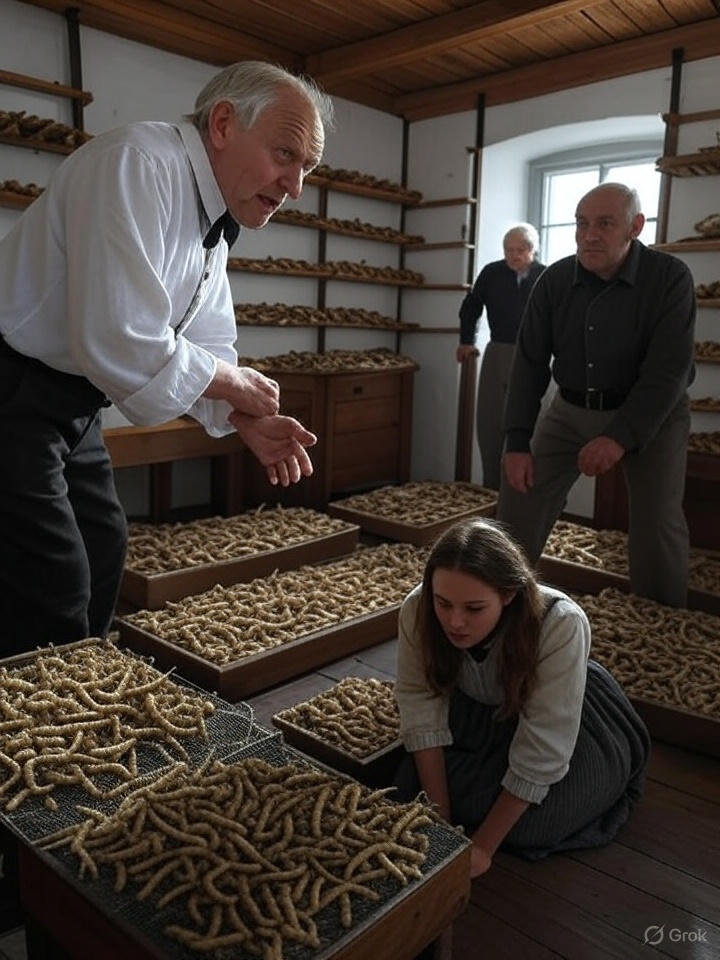
It was a large, bright room with whitewashed walls, lined with wide wooden racks stacked with wire trays for the silkworms. And amid the racks, fifteen-year-old Friederike sat on the floor, crying wretchedly.
Lost in grief, she didn’t hear Reichenbach approach, wholly surrendered to her tears, as if she’d dissolve into a stream. She started when she heard his voice: “Now, now, little one, why such crying?”
When Reichenbach spoke to the child, he always slipped back into his native Swabian dialect, which he usually suppressed with great effort. But despite the kindness in his words, Friederike pressed her hands tighter to her face, tears flowing even more freely. The little Friederike, whom Frau Friederike Luise had once christened, had grown into a lanky, angular girl. Everything about her was sharp-edged, but her brown hair, in contrast to her otherwise plain frame, hung in two heavy braids down her back.
“Come now, little one! What’s so terrible?” Reichenbach asked again.
Finally, sobbing with heaving shoulders, she stammered, “They… won’t… eat… anymore!”
What, the silkworms wouldn’t eat again? Reichenbach stepped to one of the racks and saw that, indeed, the same thing that had happened before was starting again. The wretched, spoiled, delicate little beasts had stopped feeding. They lay still, no longer crawling, motionless on the wire mesh. Some had half-raised their bodies, as if rearing up in a desperate spasm before freezing in place. A nudge with his finger toppled them. A few showed faint signs of life, but most were already free of hunger’s cares. Just last evening, even this morning, they’d nibbled at the leaves, and now, inexplicably suddenness and for unfathomable reasons, the great dying had come over them again. The entire colony was clearly on the verge of collapse.
“Yes, yes,” Reichenbach said mournfully, “they won’t eat anymore.” But as the child sobbed harder, he steadied himself, giving his voice a brighter, comforting tone: “Nothing to be done. These critters just don’t like it here. No one’s to blame… least of all you.”
Little Friederike Ruf had begged to care for the silkworms, wanting to do something, especially something she knew Reichenbach cared about. She could be trusted with the task—no one had been more diligent, more attentive, kept the racks cleaner. If disaster had struck again, Friederike bore the least blame; she’d overlooked nothing and surely rejoiced more than anyone in their thriving.
Now she lifted her hands from her face and rose to her knees. A delicate, clever child’s face emerged. Tears still streamed from her eyes, her lips trembled, but she looked up at Reichenbach with gratitude and trust.
“You can’t let your spirits sink,” Reichenbach continued confidently. “One day we’ll succeed, figure out what’s wrong. Now, you must pick out the dead worms, and we’ll see if we can save the rest.”
He stroked the child’s wavy crown, and from the touch, joy flowed into her young, yearning soul. Yes, now she could laugh again and spring to her feet. Reichenbach wasn’t even out the door before she began clearing away the worms ravaged by the plague.
At the end of the hall, where the stairs rose to the upper floor, Reichenbach paused before a door and, after a brief hesitation, entered.
The corner room had two windows. One was draped with vine leaves over a curved iron grille; in the bright light of the other stood a long table with books and plant specimens.
Hermine was still bent over the microscope.
“It’s time to get dressed,” Reichenbach urged. “Our guests will arrive soon.”
“Yes, Father.”
“Maybe you could sing something today.”
“I think,” Hermine said timidly, “my voice isn’t quite right today.”
“Not right? What nonsense is that? Are you a theater princess? Theater princesses can afford to be ‘out of voice’—it always sounds interesting. You don’t need to make yourself interesting. If you sing poorly, people will say, ‘Well, she’s a botanist, it’s not her field, but for a woman devoted to science, she sings remarkably well.’ And if you sing well, they’ll say, ‘She’s a botanist too, and the late Baron Jacquin called her his most gifted student, and she’s already made a name for herself in the scientific world with her discoveries about plant anatomy. It’s remarkable that she sings so well too. Besides, you really do sing well—why else did I spend so much on your lessons if you’re suddenly not going to sing? So you’ll sing, and that’s that. I’ve already sent Severin with the carriage for Meisenbiegl.”
“Yes, Father!”
From the door, he added, “Oh—and one more thing. Dr. Eisenstein will be here today. He’s an ambitious young man, a capable doctor, you can’t deny him that. He’s got all sorts of unusual, new ideas; he’ll make something of himself. But he’s too eager for you and has hinted he’ll soon ask me a certain question. I don’t like it, and it shouldn’t suit you either. You have other plans, other goals—you’ve already turned down professors, councillors, barons, counts, and rich factory owners. So if he gets any ideas, make it clear his suit won’t find a warm welcome, not from you, not from me. Let him spare himself the trouble. I hope you understand.”
“Yes, Father!” Hermine said softly.


 Anarchistbanjo's World
Leave a comment