OD by Karl Hans Strobl and translated by Joe E Bandel
Chapter 3, pages 33-38
“Where are the gentlemen headed?” Friederike Luise asks, brushing past the reproach.
Reichenbach mumbles something about inspecting the forest, then they shake hands and go their separate ways. The old count is silent for a moment, then says, “She has such a beautiful confidence. Maybe she’s right—how could something like that touch her? Wouldn’t it make you despair of God? But you shouldn’t let her.”
Reichenbach grumbles about allowing or not allowing and not letting anyone interfere, and how stubborn she can be, but deep down, he’s glad he saw Friederike Luise and held her warm, firm hand in his for a moment.
They stride out briskly now, and Reichenbach shifts the conversation to the damned furnace, still burning, which must be extinguished before they can build a new one. It’s the same path they took that moonlit night of the meteor fall, passing the hunting lodge and entering the Od Valley, always upstream along the Punkva, which they plan to tackle today. They reach the spot where the Punkva emerges from the rock a second time, and then it grows quiet beside them; the living water now flows within dead stone. And now they’re at the place where the little river vanishes into the cliff, and the narrow valley feels livelier again, with that voice of the water beside them. At last, they reach the spot where the Punkva first emerges from the rock, out of a wide, dark cave, its stone vault dipping low to the water’s surface.
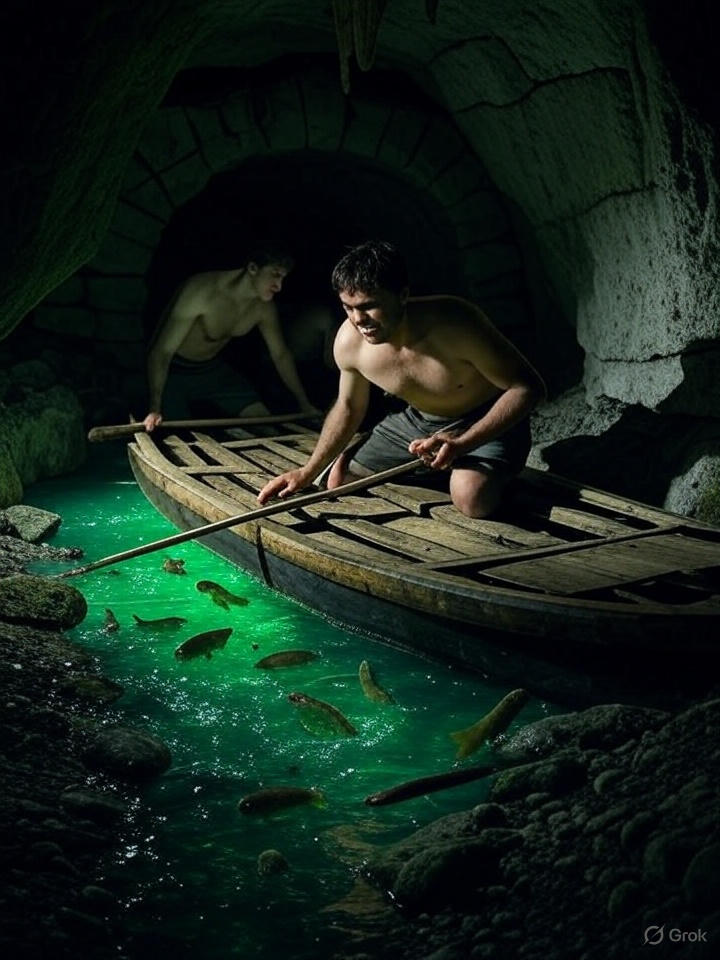
The miners Franta and Hadraba are already waiting with two rafts, ropes, lamps, and all the gear for a journey into the underworld. The rafts are simple—each made of two planks, cross-latticed, with two more planks on top, just wide and long enough for a man to lie on and use his hands as paddles.
“Has the water level dropped?” Reichenbach asks.
“About a foot and a half, please, sir!” Franta replies.
Franta and Hadraba, the two miners from Willimowit, had to clear stones and boulders from the outlet on Reichenbach’s orders. They also dug a deep channel in the streambed to speed the water’s flow. And now the water has indeed dropped—perfectly, by about a foot and a half. Last week, when Reichenbach tried alone, the water in the first cave was too high to go further.
Reichenbach and the old count exchange a glance, reading readiness in each other’s eyes. They shed their clothes, tie ropes around their waists, and, in shirts and underdrawers, carefully slide onto the wobbly planks, still held at the shore by the helpers. At the front of each raft, a small oil lamp smokes in a glass tulip on a short stem, A waterproof pouch with tinder is nailed to the planks.
Reichenbach turns his head. Beside him lies the old count, arms spread, hands dangling in the water, smiling at him.
“Go!” Reichenbach commands. Franta and Hadraba give the rafts a push, and hands paddle on either side of the planks. Man and craft become flat fish with two short fins and a murky red, smoldering, stalked light organ at the head.
Dark, eerily quiet, the waterway emerges from under the stone arch, leading into the earth’s belly. The countercurrent is barely felt; the wooden fish paddle forward. It grows dim, the anxious red light pushing against rock that sinks, dipping into the flood. The water path turns left, daylight fades behind them, rock and water nearly touch.
“At this spot,” Reichenbach says, “last week I had to push the raft under the water. Not needed today. Just keep paddling behind me.” His voice rings painfully loud, as if through a megaphone. He shouldn’t speak, the old count thinks—no, the human voice shouldn’t sound so bold here, where something might sleep that’s better left undisturbed. Here, one should only whisper.
Cautiously, the men inch forward, one behind the other, through the low entrance, the lamp’s glass tulip nearly scraping the ceiling. But then the stone canopy above their heads recedes, the light breathes freely, stretching toward the ceiling of a cave polished smooth by spring floods and thunderstorms.
Dark openings in the walls lead onward. Reichenbach paddles toward the largest, his compass before him. “We’re heading straight for the Macocha. Maybe this is the same water as at its bottom,” he says.
He’s talking again, the old count thinks, feeling they should be silent here, like fish.
They glide into a second, roomier cave. Stalactites hang from the ceiling, large and small, snowy white. At the tip of each clings a tiny water droplet. For the first time, human eyes behold this marvel of millennia. A cold droplet falls on the old count’s shirt, stinging like a needle between his shoulder blades.
The vault sinks toward the water again. “Will we make it through?” Reichenbach asks before the narrow gap. “We’ve got to try.” He pushes the raft to the wall, wedges it under the rock, arches his back, presses against the ceiling, forcing himself and the frail planks underwater, keeping only the light—the searching, forward-probing eye—above, unextinguished.
How long is this perilous passage? Will their breath hold? A gamble with little chance of turning back. For the old count, left behind, it’s a painful wait, an almost unbearable strain on his soul. Fear? Hardly, but a sudden realization of the reckless audacity of their venture grips him. Something unknown glares from the darkness and solitude. He pushes away troubling thoughts, silences his conscience to stay strong. All reproaches must fall silent now; he thinks only of Friederike Luise, her eyes, the pressure of her hand that sent a spark through his veins, like dwelling on the eyes and hands of a sacred icon.
Then a voice comes from the crevice, a strained sound: “Keep going. It’s alright!”
Without hesitation, the old count pushes his raft underwater, feels the icy flow envelop him, shoves with his back, paddles with his hands, holds his breath tight in his compressed chest. Just when he thinks he can’t bear it any longer, the raft surfaces, air rushing back.
The two rafts float in a hall, its vault soaring beyond the reach of their light, lost in darkness above their heads.
“This is as far as we go!” Reichenbach says. They paddle along the walls, encrusted and coated with limestone, sloping into the water everywhere except the entry point. A white curtain of rippling folds hangs from the darkness to the water’s surface. As Reichenbach passes, he raps his knuckle against the stalactite. It rings like a bronze bell—music of the underworld.
“We’d need a very dry year,” Reichenbach says. “Maybe then it’d work. Today, we turn back.”
They squeeze through the passage into the second cave, where stalactites hang. Take one, the old count thinks, for Friederike Luise—a trophy from the underworld.
He kneels on the raft, eyes searching for the finest, largest stalactite, reaching out, but the planks slip from under him. He stumbles, grasps for support, and plunges thrashing into the water. A spray shoots up, falls back, dousing both lamps. Reichenbach clings to his rocking raft, seeing a struggling body in glassy green, wild, frantic, aimless movements stirring air bubbles. This isn’t the steady confidence of a swimmer at ease in water—it’s a desperate fight against death. A moment’s hesitation, then he tears the rope from his waist, ties a loop, and as the sinking man’s flailing brings him briefly to the surface, throws the line over his head and arms.
“Calm! Stay calm!” Reichenbach urges, pulling the old count close and paddling with one hand to the drifting raft. “Try to climb up now!”
Obediently, the old count grabs the planks, slides them under himself, rolls his body onto them, and scrambles aboard. Then he lies still, exhausted, surrendering to the reclaimed sense of life.
“You can’t even swim, can you?” Reichenbach asks reproachfully.
“I can swim,” the old count gasps, “swim well, just as I can ride, shoot, and fence. But I don’t know what happened. A paralysis… like a stone around my body… I was pulled down…” He adds, “If it weren’t for you…”
Reichenbach doesn’t reply, his attention now wholly captured by something else. He only now realizes why, despite the lamps going out, they aren’t in darkness. Light radiates from the depths, the water glowing in emerald green, like liquid bottle glass flecked with gold, so clear you can see the rocky bottom, every stone, and the trout standing still or flashing their white bellies in swift turns—green stars, meteors of the deep.
The walls, ceiling, and stalactites shimmer in this green reflection, drawn under the rocks. Waves stirred by paddling hands cast their glimmer onto the stone, bringing it to life. When you scoop water and pour it out, a spray of sparkling gems falls back. It’s daylight’s light, the green forest light of trees, absorbed by the water and carried beneath the rocks—a fairy-tale harmony of elements: water, stone, and light.
The feeble human wit of the lamps had hidden this wonder; now, with them extinguished, it shines in unveiled splendor. They need no further light, finding their way through this green enchanted realm back through the cave’s mouth to the miners Franta and Hadraba, who are a bit worried, and to old Johann, who has arrived with the carriage as the old count ordered.
Soaking wet, the two men lie in the grass to dry off a bit before diving into the basket old Johann brought. As they clink their first glasses, the old count furrows his brow, turning serious: “Do you think thoughts can weigh like stones, stopping you from swimming?” For a moment, it seems he wants to say more, but seeing Reichenbach’s skeptical face, he suppresses the urge and forces his old smile. “And now, on top of everything, you’re my lifesaver! Cheers!”
“Oh, don’t talk about it,” Reichenbach grumbles. But deep down, it’s not unpleasant to be his master’s lifesaver, all else aside. There are still a few things he’d like to see settled his way.
After a pause, the old count adds, “You know what I thought when I suddenly couldn’t swim?”


 Anarchistbanjo's World
Leave a comment