Chapter 2
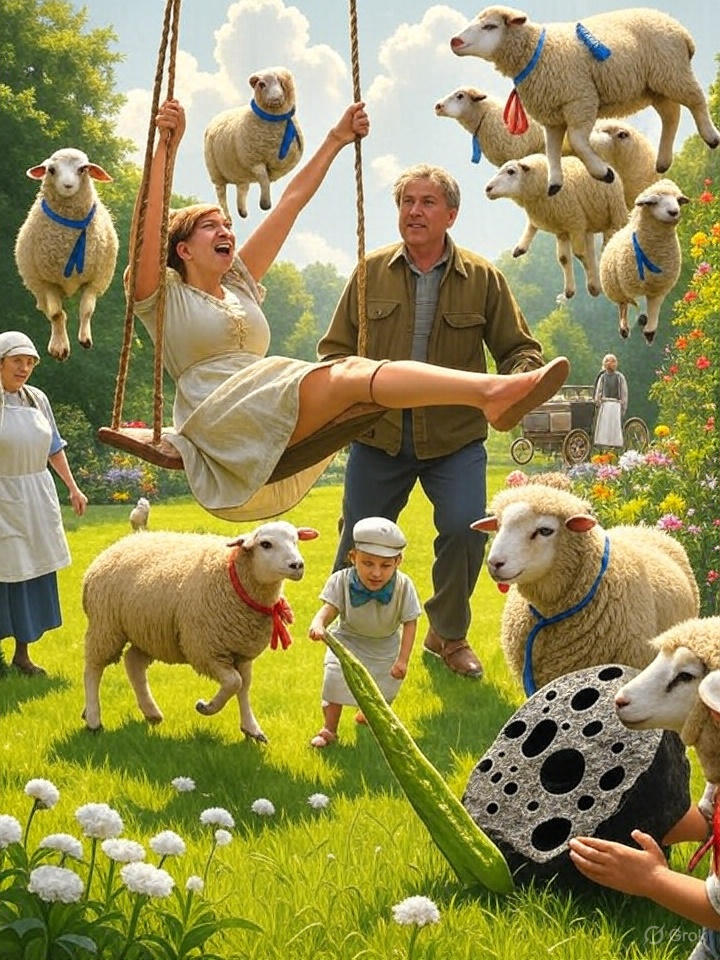
On the swing sat little Ottane, with Reinhold keeping it in motion.
“Higher!” Ottane squealed, kicking her thin legs. Her brother strained, stretching himself so that he could just barely touch the swing’s seat at its highest point with his fingertips.
“Now I’m flying!” Ottane crowed. “Now I’m flying into the sky, right through the clouds!”
“What do you see up there?” her brother asked, panting.
“I see lots of sheep on a green meadow. Nothing but—”white sheep. They have blue ribbons around their necks. No, some have red ones too. And they sing…”
“Sheep can’t sing,” Reinhold corrected.
“Oh, yes, the heavenly sheep can sing.” Ottane was indignant that Reinhold wouldn’t believe her sky-sheep could sing.
“If you talk such nonsense, you’ll have to get down,” said her brother, stopping the swing. “It’s Hermine’s turn now. Hermine!”
Hermine was kneeling in the grass by the flowerbed, holding a thick green seedpod in her hand. “Never mind,” she said, “I don’t want to.” She had other things to do; with a sharp little knife, she was already dissecting the elongated pod, carefully studying the arrangement of the snow-white, soft seeds in their tiny cradles.
Ottane obediently climbed off the now-still swing and walked slowly, a bit sadly, to her sister. “Is that why you don’t want to swing?” she asked. “There’s nothing better than flying like that.”
“Look!” Hermine held up the sliced pod to her sister. “See how beautifully the seeds lie side by side.” She pursued the life and growth of the plant world with passionate zeal, dissecting stems, flowers, and roots; her neatly kept herbarium had reached a tally of about five hundred specimens.
“No,” Ottane disagreed, “the whole thing is much nicer.” With a faint pang of regret, Ottane watched for a while as Hermine’s knife continued its work of destruction. Then she put her arm around her sister’s neck: “There’s a huge cake with a seven on it, and Friederike. And whole mountains of gingerbread, sooo high, and candied calamus and preserved nuts—”
“Father’s coming,” Reinhold said, standing by the girls, his voice carrying a note of warning. The children looked up, a ripple of tension and composure running through their bodies.
Reichenbach came through the garden, bringing with him the gravity of life, judicial sternness, responsibility, duty, and a faint unease about the incomprehensible. Only Ottane ran to her father, wrapping her arms around his knees. The other two stood stiff and alert, an unyielding will casting a shadow over them.
“Have you done your lessons?” Reichenbach asked, and the children nodded, Reinhold with a slightly guilty conscience, for two of his six math problems remained unsolved.
“Is Mother back from church yet?” he asked further. No, the christening party hadn’t returned yet; but the old countess had sent a ham and Linzer cookies, Ottane reported, and Frau Paleczek had arrived, putting on a large white apron and a white cap, looking so funny with her dark face, like a fly in buttermilk, Ottane thought.
Reichenbach stroked Ottane’s blond head, listening for a moment to the clatter of plates in the large room on the first floor, where the christening feast was being prepared, and to the booming voice of Frau Paleczek, who had taken command over the maids.
“She sent us out to the garden,” Ottane confessed,— “She doesn’t need us; we’re just in her way.”
Now Reichenbach noticed the sliced seedpod in Hermine’s hands. “Well done!” he praised. “What’s the plant called? Iris germanica. Repeat!”
“Iris germanica,” Hermine recited obediently.
“You’ll write down what you found while dissecting it. The work will be on my desk by noon tomorrow.”
“Father, what’s that?” Ottane asked, tapping the small linen sack Reichenbach held in his hand.
“Well, that’s something special.” Reichenbach lowered the heavy sack to the ground, reached in, and pulled out a black stone. It looked like a dark-brown coal with a host of strange bumps and hollows, as if it were made of a dark, molten glass fused into a lump. At the fracture, it was blue-gray, speckled with iron-gray and yellow flecks.
“What is it?” Reinhold asked eagerly.
“It’s a stone that fell from the sky,” Reichenbach said. When he spoke to the children, his Swabian dialect was scarcely noticeable. “And when it hit the Earth’s air, it shattered. That was a few days ago, at night, but you were all asleep, of course, and didn’t hear a thing. The foolish people say it’s a sign and means trouble. But it was just a stone—granted, a stone from the sky. And we’ve been searching for the pieces, hundreds of them, scattered in an elliptical— pattern, like a strewn field. The smaller pieces fall almost straight down, while the larger ones continue their slanted path. Remember that, Reinhold—you’ll work on a problem about it, and it’ll be on my desk by noon tomorrow. What you see on the outside here is a fusion crust. That comes from the tremendous speed and heat. And what’s inside the stone? I’ve already examined some of the pieces in the laboratory and found various minerals—nickel, labradorite, hornblende, chromite. Reinhold, what is chromite made of?”
Reinhold stared at the stone, a heavy unease sealing his lips. Chromite, my God, chromite—what’s it made of? He stayed silent.
“You don’t know,” said his father, his eyes hardening. “You don’t know. You’ll know it tomorrow and write it out a hundred times on my desk. It’s remarkable that these stones contain iron compounds not found in nature, but which we produce artificially in metallurgy.”
Reichenbach didn’t get a chance to expound further on these curious iron compounds, for now the sound of wheels rolling on the road was heard, and then the decorated carriages came into view, bringing the christening party back from the church.
Frau Paleczek poked her dark face, framed by the white cap, out of the open window and shouted, “Jesus, they’re already here!”
The children felt stones lift from their hearts, far larger and heavier than the ones that fell from the sky. They breathed a sigh of relief and ran to meet the guests. But Hermine still found time to give Reinhold a poke in the ribs. “Write it out a hundred times, ugh!” And Reinhold returned the poke with interest.
Ottane trailed behind slowly, lost in thought. A small tumult had erupted in her mind. Who was throwing these stones from the sky? On her green heavenly meadow with the singing sheep, there were no such black, ugly stones.
The christening feast was loud and merry. That Frau Friederike Luise Reichenbach had taken on the role of godmother for the seventh Ruf child turned the modest forester’s family event into a matter of significance, granting the father honors that dazed and delighted him long before the wine, provided by the old count from his cellar, took effect.
The pastor Mandrial was there, along with Dr. Roskoschny, the chemist Mader, and a dozen other senior officials from the Salm works, and, of course, the old count himself. He sat to the right of the hostess, and to her left, between him and the pastor, the proud father of today’s christened child swelled with a sense of boundless bliss and importance. He was clearly at a pinnacle of his existence, taking great care to match the refined manners and skill of the distinguished company around him. In doing so, he completely forgot the worries about his wife, who had been lying in high fever since the birth of the child, and the ominous head-shaking with which Dr. Roskoschny had stood at the sick woman’s bedside.
Reichenbach had taken his place between the chemist Mader and Dr. Roskoschny, who was Meineke’s successor as the doctor in Lettowitz. They were a welcome audience for his current obsession with meteors—their origins, orbits, and composition—especially since, alongside the already-convinced Mader, the doctor was a skeptic who still needed persuading.
At the lower end of the table sat the children next to their tutor, a poor, peasant-looking philosophy student named Futterknecht, whose name seemed to prophetically chart his life’s course. They were perfectly well-behaved and modest, but their eyes lingered with growing longing on the dish of the old count’s Linzer Kränzerln nearby, waiting for the moment it would be served.
But Frau Paleczek, midwife, corpse-washer, and indispensable fixture at every festive feast far and wide, kept bringing out new platters of roasted and baked poultry from the kitchen. Her quick eyes darted over the table and guests, and her face—blackened since time immemorial by some ailment—gave no hint of when she would finally allow them to move on to the long-prepared pastries.
“That’s how it is,” Reichenbach said, clapping the doctor on the shoulder. “You can believe me, and once I’ve thoroughly studied the material, I’ll write a major treatise on meteors that’ll push science forward a bit.”
The doctor shook his head, unable to accept what Reichenbach was explaining. “Couldn’t it have been an optical illusion?” he asked cautiously, with the tenacity of his old-school training, reluctant to abandon an opinion without proof.
“Optical illusion, please, Doctor,” Reichenbach snapped. “The old count saw it, and I saw it, and we were only on the second bottle of Forster Hofstück—where’s the illusion supposed to come from?”
The doctor stared gravely ahead. “For now, it looks like the common folk with their superstitions might be right.”
“Please, don’t talk like that as a man of science!”
“Haven’t you read about the epidemic in Hamburg?”
“What’s Hamburg got to do with us?”
“And last week it started in Prague. And since yesterday, I’ve had a case in Lettowitz that seems highly suspicious to me.”
Reichenbach paused. “What exactly do you mean?”
The doctor hesitated to say the word, glanced around, and then said very quietly, “Cholera! But please,” he added quickly, “keep it to yourself. The symptoms aren’t entirely clear yet. We don’t want to cause alarm among the people prematurely.”
A gray shadow fell over the table and the guests, a hollow-eyed specter in a blood-flecked shroud grinned palely through the loud, carefree merriment.
But Reichenbach wouldn’t let himself be daunted. “Oh, come off it,” he said brusquely, “with your cholera! In summer, it’s just stomachache season—people gobble cherries and currants and unripe apples, then gulp down raw milk, and there’s your cholera. Besides, if medicine was worth anything, it would’ve found a cure for it by now.”
“The best remedy for cholera is not catching it,” the doctor admitted. “Careful eating, plenty of fresh air, and staying away from the sick.”
“That’s not much wisdom to boast about,” Reichenbach scoffed. “And the best remedy for childbed fever is not having children!” Then he added, “How’s our Frau Ruf doing?”
“I hope we’ll pull her through,” Roskoschny said curtly.
A gesture from the hostess drew Reichenbach away from further attacks on medicine. It reminded him of his duties. With a sharp tap of his knife against his glass, Reichenbach called for attention and stood to toast the christened child and her proud father. After tossing in a few more jocular remarks about Ruf’s remarkable vigor and the blessings of his marriage, he urged those present to raise their glasses to the father and little Friederike.


 Anarchistbanjo's World
Leave a comment