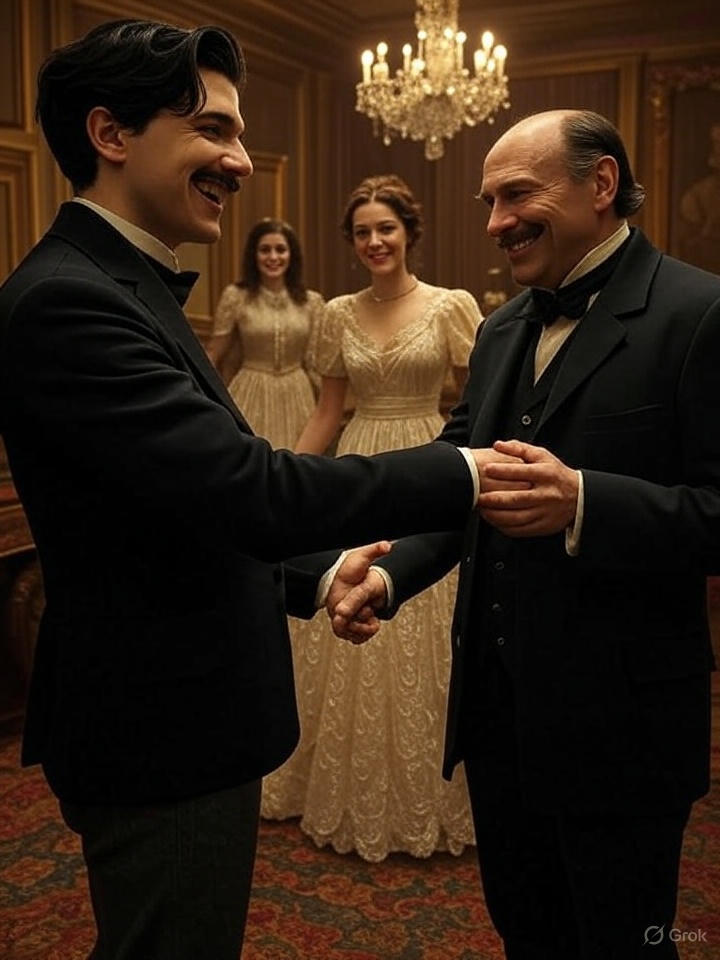
Homo Sapiens by Stanislaw Przybyszewski and translated by Joe E Bandel
Falk faltered, then spoke with growing fervor.
“Look, what we need is a mind for which nothing is obvious, a mind that has awe and fear and reverence for the most obvious things; that’s the mind in which the nexus has been freed—yes, the sacred nexus of all senses, where a line becomes a sound, a great experience becomes a gesture, and a thousand people merge into one another, where there’s an unbroken scale from sound to word to color without the boundaries that exist now…”
Falk caught himself again and smiled quietly…
“No, no! Spare me your ridiculous logic of consciousness and your atavistic mate-selection trifles…”
Isa couldn’t stop looking at him. His thick hair had fallen over his forehead, and his eyes were wide and deep… She never would have guessed he could be so beautiful—so demonically beautiful…
“Mr. Falk seems to have studied with the Theosophists.”
The Anarchist spoke slowly and meaningfully, with a sudden glance upward.
Falk smiled.
“No, dear sir, not at all. But look: you are a great poet, and certainly, as far as the German tongue reaches, an unprecedentedly significant one…”
Someone suddenly laughed out loud, surely with malicious intent.
The Anarchist glared at him furiously, his face reddening, and shouted at Falk:
“I forbid any mockery!” Falk grew deeply serious.
“Look, that was very dignifiedly said. But unfortunately misplaced. It was my politest earnestness. I didn’t mean that I see you as such, but surely others do.”
The Anarchist seethed; he saw Isa’s eyes looking at him with unmistakable mockery.
“My dear sir, you go too far!”
“No, not at all. You assume I have insulting intentions, which I don’t. Besides, you’ve created something for me too, an image of such… I’d call it antithetical grandeur… Yes, I mean the red hussars of humanity.”
The same man laughed again, this time so clearly that it embarrassed Falk.
“But let’s get to the point. When you write poetry, isn’t it a strange, mystical, and, if you will, theosophical moment—since everything strange seems to be theosophy to you? You’ve surely heard of fakirs who artificially put themselves into a somnambulistic ecstasy, in which they can lie buried alive for months. I myself saw a fakir in Marseille who, in that ecstatic state, inflicted wounds on himself without a trace of bleeding. Now look, when you write poetry, it’s the same state of somnambulistic ecstasy, though it can’t be artificially induced. In a single moment, your entire life converges on one point. You see nothing, you hear nothing, you work unconsciously, you don’t need to think—it comes in your sleep… And now tell me, isn’t that mystical? Can you explain it with logic? Can you make it clear to someone why you are the significant poet and he isn’t?…”
Everyone fell silent, taken aback. Falk had gone too far. The Anarchist stood up and left.
Iltis hadn’t understood any of it. No, no, his mind was too big for these metaphysical games. But he understood that Falk had put the other down, and he toasted him amiably…
“Give me your hand.”
The young man who earlier deigned to throw glasses on the floor stood up, theatrically stiff, and extended his hand broadly.
Falk shook it with a smile.
Isa was silent. She felt so happy. She hadn’t felt this happiness in a long, long time.
Falk was a marvelous person. Yes, he was her greatest experience. She suddenly grew restless.
“You’re so quiet?” Mikita approached her. “I’m happy.” She gently squeezed his hand. “Aren’t you tired?”
“No, not at all!”
“But we should go, shouldn’t we?”
Something held her back with all its force. She wanted to stay at all costs. But she read a silent plea in his eyes.
“Yes, we should go.” It sounded strange, almost cold. She stood up.
“You’re really leaving? Stay a bit longer.” Falk would have held her back by force.
But Mikita couldn’t possibly stay longer; he had to escort Isa home.
As they were about to leave, Iltis jumped up. “So, Mikita, don’t forget…”
“Yes, right!” Mikita had completely forgotten that he and Isa were invited to an evening party at Iltis’s.
“Yes, I’ll definitely come. Whether Isa wants to come, I don’t know…”
Isa heartily wanted to come.
“And you, Falk? You’re coming, of course?” Iltis patted Falk amiably on the shoulders.
“Certainly.”
Isa suddenly turned to Falk and extended her hand again.
“You’ll come to me soon, won’t you?”
It seemed to Falk that the veil around her eyes tore apart; a blaze welled up and curled hotly around her lids.
“Your room is my home.”
Mikita grew restless; he shook Falk’s hand especially firmly, and they left.
“They’re in a hurry!” Iltis winked lasciviously.
Falk suddenly became very irritated. He struggled to hold back a word that surely wouldn’t have flattered Iltis.
But he sat back down and looked around.
Everything became so bleak around him, and he felt so lonely…
He was also very dissatisfied with himself. He felt a bit ridiculous and boyish. He had really tried so hard to impress Isa. No doubt… And everything he’d said seemed so stupid to him… So many grand, pompous words… He surely could have said it all much more finely… But he was trembling when he spoke.
He grew genuinely angry.
That stupid Infant, how disgustingly he slurped at his glass… Repulsive! Suddenly, everything in the famous “Nightingale” became repulsive to him—everything.
No! Why should he sit there any longer? He needed fresh air. He felt an urge to walk and walk, endlessly, along every street… To clarify something. There was something inside him that needed to be resolved, something… yes, something new, strange…
He paid and left.


 Anarchistbanjo's World
Leave a comment