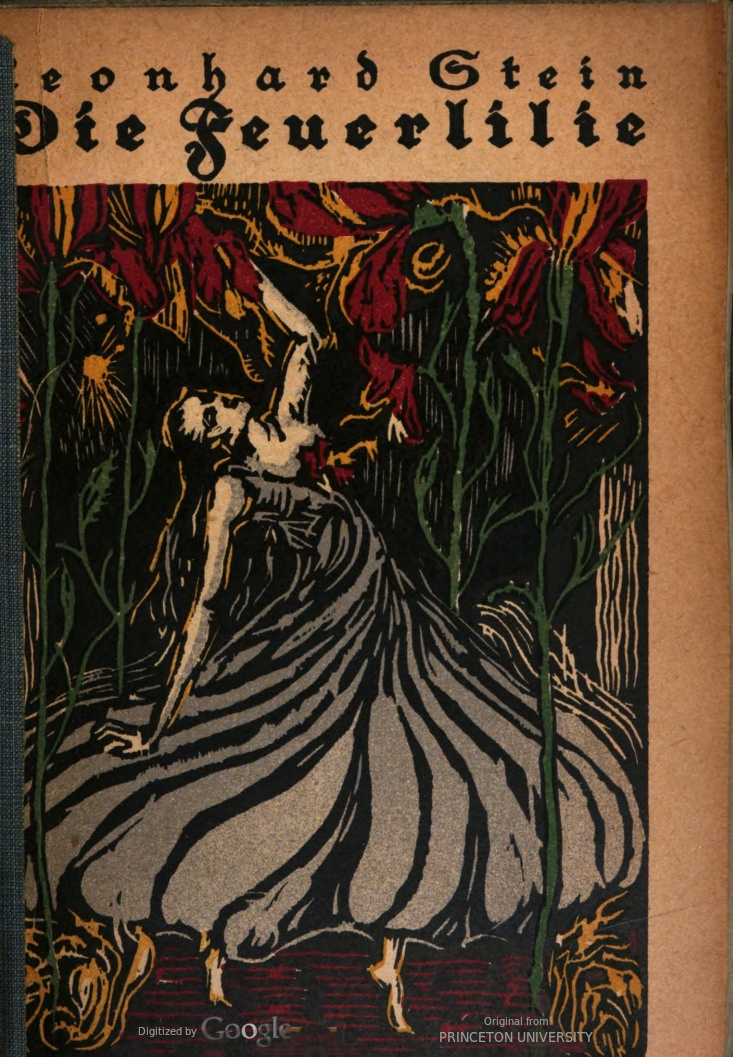
The project I am currently working on is the collected works of Leonhard Stein who is considered by some to be as good as Hanns Heinz Ewers and Karl Hans Strobl. Unfortunately it seems he published three novellas and then disappeared never to be seen again! I have access to all three small books and have translated about half of The Fire Lilly a couple years ago but never finished it. Now I’m working on The Ballet of Death which is a slim volume of short stories. The final novella is The Flutist and I have no idea what to expect from it. My last Deadly Days – Tales of Dark Fantasy podcast included Vampyre which is one of the short stories in this collection. The entire collection should only be around 300 pages.
Der Orchideengarten Vol. 1 No. 18 contains the following stories and poems: The Blinded by Anonymous; The Golden Garden by Karl Hans Strobl; The Birth Seeker by L. W. Rochowanski; Dance in Montmartre by Walter Rheiner; The Duke of Portland by Villiers de l’Isle-Adam; Song by Al Kolowr. This is the first time these stories have been translated into the English language by Joe E Bandel. Layout by John Hirschhorn-Smith.
My best friend that I’ve known since 1st grade just died two days ago and I’m still dealing with it. This issue in particular touches the heart strings because it deals with such things as loss. I really love it. This issue is free to access on my patreon page.
This issue contains the following stories and poems: Poem by Ernst Hardt; The Final End by Frank Wedekind; The Fried Flounder by Paul Scheerbart; The Confession by Wilhelm von Polenz; The New Light by Jacob Wassermann; Summer Sunday Afternoon by John Henry Mackay; Mother Songs by Mia Holm; The Collector by Arthur Holitscher; Dimples by Otto Erich Hartleben.
I have wanted to explore the Simplicissimus and Jugend magazines for over twenty years but there was never any practical way to do it and there was simply not enough interest to support the time and effort required. Both of these famous literary and art magazines began in 1896 and continued well past World War I. Now I believe I have found a way to move forward with this dream. But it will need the help and support of others who find these stories, poems and the artwork as fascinating as I do.
On my Patreon page I will have links to access each magazine as a PDF and Epub file. I intend to translate at least one of each every month. The first five issues of each will be free so people can get a good idea of if they want to support this project or not. After that every other issue of each magazine will remain free to access as a PDF or Epub file and the alternate issues will only be available to my patrons who support this work and project. I’m asking $5/mo for basic patron support. This will give access to all Jugend and Simplicissimus magazines. A special Angel tier for $10/mo will allow access to all Jugend and Simplicissimus magazines plus every month I will be offering access to one of my newly published books as a PDF or Epub file beginning with Ghosts in the Swamp by Karl Hans Strobl. This will begin after my birthday on 24 April 2024.
I want to make clear that these magazines are not professionally done since I don’t have the time and energy to do so. But they will have all the stories and poems translated into English and will have examples of the interior art cut and pasted inside. To make these magazines more professional would be a nightmare. Jugend is printed in black and white interiors with lush beautiful cover and back cover art. Most pages are printed with three columns of text. I am simply making the text available as a single column with art added in the approximate locations. Simplicissimus is an even greater challenge because it was printed in newspaper format with color interior. The oversize pages allow several variations of page layout and artwork. The pages have turned yellow because of the acid in the paper aging over the years. Also the print is in Fraktur which is the old fashioned typeset that is extremely difficult to work with and translate. I’ve opted to place the text on a colored background and simply cut and paste the art in the best places to give an idea of what the original was like. You can find my Patreon site here.
This issue contains the poems and stories: Greetings to the Youth by Richard Schmidt-Cabants; Youth! Youth!; Franz von Dofregger; Unpolished Thoughts; Theater People by Ferdinand Bonn; Epitaph for a Great Doctor by Fritz Murner; Sing Song by Otto Erich Hartleben; My Cinderella by Ludwig Soyaux, So I See Him by Fritz Evers; Two Friends, an Expert and a Connoisseur by Georg Hirth; Demi-Vierge; How is She? by Frida Schanz; Poems of Meaning by Ludwig Fulda; A Very Old Story From Modern Life by F. V. Ostini; A Likeness of Hermann Allmers; How Virtue Moved into Schwarzenau by Ki-Ki-Ki; Sayings of the Confucius; An Oracle; Nobile Trifolium; Terrible!
045 Vampyre by Leonhard Stein. Samassa was a highly successful gentleman that was on his way to the top and soon to be married to his sweetheart Klara. But the new employee at his workplace was a vampyre and had other ideas.
“Hanns Heinz Ewers Brevier” was first published in 1922 in the German language as a sampler of Ewers thoughts, ideas and beliefs. It is a collection of excerpts taken from a wide variety of his writing and organized into the categories, Music, Art and the Artist,Love, Philosophical Observations, Religion, Peoples and Lands, Politics and Love of the Fatherland and a final section entitled In Person.
This small book gives important insight into the thoughts and beliefs of this very important and forgotten author. It has been translated into English for the first time by Joe E. Bandel. The contents of this brevier were selected by people that knew Hanns Heinz Ewers very well and were quite close to him. It is a very important book in terms of how his closest friends and associates saw him.
This is available from Lulu publishing as a Hardcover and epub version.
I am trying this as an experiment. You can read this magazine for free as a docx or pdf file on my Patreon page! If there is enough interest I will continue the project. Please feel free to comment. This issue included stories and poems: Princess Russalka by Frank Wedekind; Greeted by Fear by Richard Dehmel; Siesta by Jacob Wasserman; The Lonely Pond by Arthur Holitscher; Alone by Mia Holm; Song by Theodor Wolff; Wurst and Love by Th. Th. Heine; Homage by Georg Herwegh; To Georg Herwegh by Robert Bruss; Leaving in Spring by Carl Busse
044 Edgar Allan Poe by Hanns Heinz Ewers. This beautiful essay is a tribute to Edgar Allan Poe and is one of the most beautiful things I have ever read. Edgar Allan Poe was Hanns Heinz Ewers favorite author and a very strong influence on him.
The Fenris Wolf is a light hearted book about love, romance, the dream of writing poems, books and dramas and being published. It is also a book about the soul of a city and life in general. So this is really a book about the heart. Fenris Wolf is a clique or social club of aspiring poets, authors and artists in a world where there are social clubs for just about everyone! As such it is specifically of interest to those who aspire to be writers and artists in its humility and earthy realism. We experience the struggles of being rejected, vanity publishing, the poison of success and the snobbery of the intellectual gradually learning the value of the common heart and ordinary life. In other words it is a story of becoming wiser and deeper. I can only say that it touched my heart like a warm blanket that I could wrap around me. I will also admit that it might not be of interest to others that expect action, adventure or horror. It is simply a warm and interesting story and perhaps a cautionary tale for those who aspire to be creators, artists and writers.
Requiem Aeternam is now available as a hard cover and epub from Lulu.com
Requiem Aeternam is one of the five books of the Pentateuch by Stanislaw Przybyszewski and shows some of the occult and spiritual thinking of the author. This small book gives his thoughts on the role that sex and sexuality play in both life and death. Przybyszewski was one of two major influences on Hanns Heinz Ewers and Ewers drew on the writings of Przybyszewski in giving his religion of Satan lectures. This is a new English language translation by Joe Bandel.





 Anarchistbanjo's World